

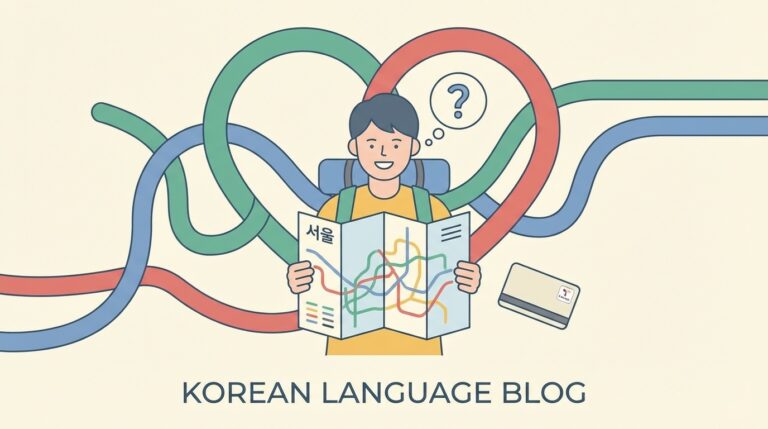
Phase 1: The ‘Spaghetti Bowl’ Challenge
Greeting:
“Annyeonghaseyo! Welcome back to Daily Hangul.” I’m your editor, the guy who still gets dizzy looking at the complex web of lines at Sindorim Station.
The K-Drama Moment:
Picture this: You’re watching a K-Drama. The main character is running desperately through a subway station to stop their love from leaving. They look up at the sign, panting. The sign says ‘갠아타는 곳 (Transfer)’. They sprint left, but the train doors close right in front of their face. 😭
The ‘Why’:
The Seoul Metropolitan Subway is one of the best in the world, but the map looks like a giant bowl of colorful spaghetti. If you don’t know how to read the signs or ask for the right “Line,” you might end up in Incheon when you wanted to go to Gangnam.
Transparency Note:
This guide is based on real struggles my students faced when they first arrived at Incheon Airport and tried to take the subway to Seoul. Let’s decode the map together!
Phase 2: Deep Dive – Decoding the Map
Here are the 3 expressions that will save you from getting lost.
1. ~호선 (Line number…)
- Pronunciation: [~ho-seon]
Think of Santa saying ‘Ho!’ + ‘Son’ (as in son and daughter).- Meaning: Line (Subway Line)
- K-Culture Moment: If you live in Seoul, your personality is practically defined by your line. Line 2 (The Green Line) is the “Circle of Hell” during rush hour but connects all the hot spots like Hongdae and Gangnam.
- Editor’s Insight: You don’t say “Line 2” in English order. In Korean, the number comes first. So, it’s 2호선 (E-ho-seon).
- Situation Spectrum:
[🚫 Formal only] ———— [✅ Everyone] ———— [🚫 Slang]
- (This is standard terminology used by everyone.)
- 🤔 Think About It: Why does Seoul use colors so heavily? Even if you forget the name, you can say “Green Line.” It’s designed for visual intuition over linguistic memory.
2. 갠아타는 곳 (Transfer / Way to Transfer)
- Pronunciation: [Gal-a-ta-neun got]
Sounds like: ‘Gala’ (party) + ‘Ta’ (ta-da!) + ‘Noon’ + ‘Goat’.- Meaning: 갠아타는 (changing/transferring) + 곳 (place).
- Real Nuance: Literal translation is “Place where you change rides.” You will see this written on signs everywhere.
- Editor’s Insight: If you are asking a person, you use the verb 갠아타야 돼요 (I have to transfer).
- Situation Spectrum:
[🚫 Rude] ———— [⚠️ Polite] ———— [✅ Standard]
- Used on signs and in standard conversation.
- 🤔 Think About It: The verb isn’t “transfer” (which sounds Latin-based and formal). It’s “change-ride.” Korean verbs often describe the specific physical action.
3. ~방면 (Toward / Direction)
- Pronunciation: [~bang-myeon]
Sounds like: ‘Bang!’ (gunshot) + ‘Myon’ (from ramyeon).- Meaning: Toward [Station Name]
- K-Travel Moment: You are on the platform. The train arrives. Is this the train to Hongdae or the train to the opposite side? Check the 방면 on the screen!
- Editor’s Insight: You usually say the final destination station + 방면. Example: 홍대 방면 (Toward Hongdae).
- Situation Spectrum:
[🚫 Formal] ———— [✅ Standard] ———— [🚫 Slang]
- Standard directional language.
Phase 3: Textbook vs. Real Life
| Situation | 📖 Textbook Korean | 🗣️ Real Korean (Street) | 💡 Why is it different? |
|---|---|---|---|
| Asking for a transfer | 어디서 환승합니까? (Where do I transfer?) | 어디서 갠아타요? (Where do I change rides?) | ‘환승’ is a formal Sino-Korean word. ‘갠아타는’ is pure Korean and spoken more often. |
| Checking the line | 이것은 2호선입니까? (Is this Line 2?) | 이거 놙색 라인 맞아요? (Is this the Green Line?) | Locals often use the color (놙색) because it’s faster to recognize than the number. |
| Asking if it goes to… | 이 기차는 강남에 갑니까? (Does this train go to Gangnam?) | 이거 강남 가요? (Does this go Gangnam?) | Koreans love efficiency. We drop particles (에, 는) in speech for speed. |
Bottom Note: As an A2 learner, stick to 갠아타요? It sounds much more natural than the stiff 환승합니까.
Phase 4: Cultural Context — The Rules of the Underground
4-1. Non-verbal: The Art of ‘Ppali-Ppali’ (Hurry Hurry)
When the subway doors open, it’s a battlefield. But there is a rule: Getting OFF comes first.
* Nunchi Tip: Don’t stand directly in front of the doors. Stand to the side. If you block the way, you might get a gentle (or not so gentle) push from an Ajumma (middle-aged lady).
4-2. K-Culture Connection: K-Pop Birthday Ads
Look at the subway station walls! You will see giant illuminated photos of K-Pop idols like BTS, Seventeen, or IVE.
* The Context: Fans pool money to buy ad space to celebrate their idol’s birthday. This is unique to Korea (and China/Japan).
* Survival Tip: If you see a crowd of girls taking photos of a wall in a busy station like Samseong or Hongdae, don’t panic. They aren’t blocking the way; they are on a “pilgrimage” to see their idol’s ad.
Phase 5: Immersive Roleplay — Lost in Gangnam
Setting:
It’s 6:30 PM on a Friday. Gangnam Station. It is packed. People are rushing everywhere. You need to meet your friend at Hongdae Station (Line 2), but you are currently standing near the Sinbundang Line (Red Line) transfer gate.
Characters:
* YOU: A confused foreign exchange student holding a phone with a map.
* Student: A university student wearing headphones, waiting for a friend.
Dialogue:
YOU: (💦 Looking confused) 저기요… 실례합니다.
(Jeogiyo… sillyehamnida.)
[Excuse me… I’m sorry to bother you.]
Student: (🎧 Takes off one headphone) 네?
(Ne?)
[Yes?]
YOU: 홍대로 가고 싶은데… 어디서 갠아타요?
(Hongdae-ro gago sipeunde… eodiseo garatayo?)
[I want to go to Hongdae… where do I transfer?]
Student: 아, 홍대요? 저기 놙색 선 보이세요?
(Ah, Hongdae-yo? Jeogi nok-saek seon boiseyo?)
[Ah, Hongdae? Do you see that green line over there?]
🔀 Decision Point! How do you confirm?
* A) “Yes, thank you.” (네, 감사합니다.)
* B) “Green Line? Towards Sadang?” (놙색 선이요? 사당 방면이요?)
* C) “You take me there.” (데려다 주세요.)✅ Best Choice: B — Checking the 방면 (direction) is crucial on Line 2 (the circle line) or you might go the long way around!
⚠️ Choice C Analysis: This is very rude unless you are a lost child!
YOU: 아, 놙색 선 따라가면 돼요? 감사합니다!
(Ah, nok-saek seon ttaragamyeon dwaeyo? Gamsahamnida!)
[Ah, I just follow the green line? Thank you!]
Phase 6: 10-Second Shadowing Drill
Let’s practice the sentence that will save your life in the station.
- Situation: Asking someone if this is the right direction.
- Emotion: 🥺 Slightly worried but polite.
저기요… / 이거 / 홍대 방면 / 맞아요?
(Jeogiyo… / igeo / Hongdae bang-myeon / majayo?)
[Excuse me… / is this / toward Hongdae / correct?]
Phase 7: K-Culture Mini Glossary
| Korean | Romanization | Meaning | Context |
|---|---|---|---|
| 티머니 | T-Money | Transport Card | The magical card for subway, bus, and even convenience stores. |
| 지옥철 | Jiok-cheol | Hell Train | 지옥 (Hell) + 전철 (Subway). Used for Rush Hour trains. |
| 스크린도어 | Screen Door | Safety Door | Glass doors on the platform. They only open when the train arrives. |
| 노약자석 | Noyakja-seok | Priority Seat | Seats for elderly/disabled. 🚫 NEVER sit here, even if empty. |
Phase 8: Traveler’s Survival Kit (Subway Edition)
🆘 Survival Phrases TOP 3
1. “신촌 가려면 몇 호선 타야 해요?”
* (Sinchon garyeomyeon myeot ho-seon taya haeyo?)
* “If I want to go to Sinchon, which line number should I take?”
2. “여기서 멀어요?”
* (Yeogiseo meoreoyo?)
* “Is it far from here?”
3. “보증금 환불해주세요.”
* (Bojeung-geum hwanbul-hae juseyo.)
* “Please refund my deposit.” (Used for single-journey card machines).📍 Editor’s Travel Note
* Apps: Forget Google Maps in Korea. Download Naver Map or KakaoMap. They show you exactly which train car (e.g., 5-3) is closest to the escalator/transfer!
* Transfer Discount: If you transfer from subway to bus within 30 minutes, it’s free! Just tap your card when you get off (Tag-out).
Phase 9: Think Deeper — “The Sound of Silence”
Topic: Public Etiquette & The ‘Quiet’ Culture
Have you noticed how quiet the Seoul subway is? Even when it’s packed with 100 people, it’s almost silent. People rarely talk loudly on the phone. If they do, they whisper or cover their mouths.
Why? In Korea, “Not bothering others” (남에게 피해 주지 않기) is a massive social value. A loud voice breaks the collective peace. This contrasts with some cultures where chatting with strangers or talking on the phone is normal.
💬 Your Turn: Is it rude to talk on the phone on public transport in your country? Or is it a social hub? Tell me in the comments!
Phase 10: FAQ & Troubleshooting
Q: Can I sit in the pink seats if I’m tired?
A: NO! 🚫 The pink seats are for pregnant women. Even if it’s empty, Koreans leave it empty. There is a sensor (sometimes) or just heavy social pressure. Don’t be the “ignorant tourist”—stand or find a regular seat!
Q: I’m lost inside the station. Who do I ask?
A: Look for people wearing a sash or vest, usually older citizens (Subway Sheriffs), or just ask a young person looking at their phone. Young Koreans are usually shy but very willing to help foreigners!
❌ Common Mistake: Asking “Where is the subway?” while inside the station.
✅ Correction: Ask “Where is the platform (타는 곳)?”
Phase 11: Wrap-up & Mission
One-Liner: Knowing “~Ho-seon” (Line) and “~Bang-myeon” (Direction) is your compass in the Seoul underground.
Action Mission:
* 🥉 Bronze: Say “2호선” (E-ho-seon) out loud 3 times.
* 🥈 Silver: Open a map of Seoul and trace a route from ‘Incheon Airport’ to ‘Seoul Station’. Say the transfer station name.
* 🥇 Gold: If you are in Korea, find a K-Pop Birthday Ad in the subway and take a selfie with it!
Phase 12: Quiz — Survival Check
- Situation: You are at a station. You want to go to Line 4. What do you look for?
- A) 4방면 (4-bang-myeon)
- B) 4호선 (4-ho-seon)
- C) 4개 (4-gae)
- Culture: You see an empty seat, but it is pink. You are very tired. Should you sit?
- A) Yes, first come first served.
- B) No, it’s for pregnant women.
- Real Life: A sign says “갠아타는 곳”. What does it mean?
- A) Exit
- B) Toilet
- C) Transfer
Answers: 1. (B), 2. (B), 3. (C)
Frequently Asked Questions (FAQ)
Q: What does "~호선 (Line number...)" mean in Korean and how do you pronounce it?
A: In Korean, "~호선 (Line number...)" is pronounced [~ho-seon] and means: Line (Subway Line)
Q: What does "갠아타는 곳 (Transfer / Way to Transfer)" mean in Korean and how do you pronounce it?
A: In Korean, "갠아타는 곳 (Transfer / Way to Transfer)" is pronounced [Gal-a-ta-neun got] and means: 갠아타는 (changing/transferring) + 곳 (place).
Q: What does "~방면 (Toward / Direction)" mean in Korean and how do you pronounce it?
A: In Korean, "~방면 (Toward / Direction)" is pronounced [~bang-myeon] and means: Toward [Station Name]







