

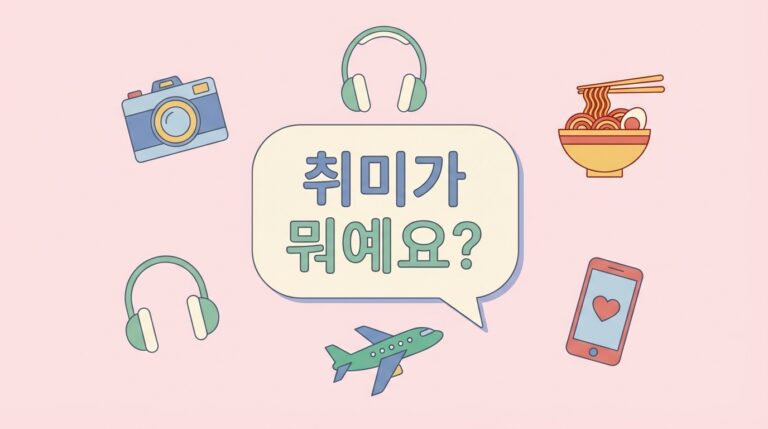
Don’t Just Say “Music”: How to Talk About Hobbies Like a Local 🎧
Phase 1: The Hook — More Than Just “My Hobby Is…”
Hello! This is your Senior Editor at Daily Hangul.
Picture this: You are at a fan meeting for your favorite K-Pop group in Seoul. It’s finally your turn. The idol looks you in the eyes and asks, “What do you like to do?”
Your brain freezes. You remember the textbook sentence: “Jeo-neun eum-ak-eul joh-a-hap-ni-da” (I like music).
The idol smiles politely, but the conversation dies. Why? Because that sentence sounds like a robot reading a manual. 🤖
In K-Dramas, when the leads are getting to know each other over Soju, they don’t speak like textbooks. They share their vibes, not just facts. Today, I’ll teach you how to talk about your hobbies (취미 – chwimi) so you sound like an interesting friend, not a walking dictionary. Let’s get you ready for that “insider” conversation!
Phase 2: Deep Dive — Core Expressions
Here are the top 3 phrases you actually need. forget the rest for now.
1. 취미가 뭐예요? (Chwimi-ga mwo-ye-yo?)
- Pronunciation: [Chwi-mi-ga] + [Mwo-ye-yo]
- Tip: ‘Chwi’ sounds like ‘Chewy’ candy. ‘Mwo’ sounds like ‘Mwah’ (a kiss) but shorter.
- Meaning: What is your hobby?
- K-Culture Moment: This is the classic “first date” or “new coworker” icebreaker. In the drama Business Proposal, characters ask this to gauge if they are compatible.
- Editor’s Insight: This is a safe, polite question. You can ask this to anyone!
- Situation Spectrum:
[🚫 Formal Boss] ———— [✅ Stranger/Coworker/Friend] ———— [✅ Casual]- 🤔 Think About It: Why do Koreans ask this so early? It’s not just small talk; it’s a quick way to find “Common Ground” ( 공통점) to build a relationship fast.
2. 저는 [] 좋아해요. (Jeo-neun [] jo-a-hae-yo)
- Pronunciation: [Jeo-neun] + [___] + [Jo-ah-hae-yo]
- Tip: ‘Jo-ah’ flows together. It sounds like “Jo-ah”!
- Meaning: I like [___].
- Real Nuance: This is way more natural than saying “My hobby is [___].” It feels softer and friendlier.
- K-Pop Connection: Watch any idol’s V-Live. They say “Jeo-neun chicken jo-a-hae-yo” (I like chicken), not “My hobby is eating chicken.”
- Situation Spectrum:
[🚫 Army General] ———— [✅ Teacher/Coworker] ———— [✅ Friend]3. 시간 있을 때 [] 해요. (Sigan isseul ttae [] haeyo)
- Pronunciation: [Si-gan] [it-seul-ttae] …
- Tip: ‘Ttae’ is a strong T sound, like the sound of spitting a seed!
- Meaning: When I have time, I do [___].
- Editor’s Insight: This is the pro-level A1 phrase. It sounds humble and casual. It implies, “I’m busy, but in my free time, I do this.”
- 🤔 Think About It: Koreans value “diligence.” Saying “When I have time” implies you are usually hardworking. Why might that be important in Korean culture?
Phase 3: Textbook vs. Real Life
Let’s see why your textbook sounds awkward in a Hongdae cafe.
| Situation | 📖 Textbook Korean | 🗣️ Real Korean | 💡 Why the difference? |
|---|---|---|---|
| Talking about Movies | 제 취미는 영화 감상입니다. (My hobby is movie appreciation.) |
넷플릭스 자주 봐요. (I watch Netflix often.) |
“Appreciation” is too serious. Koreans use brand names (Netflix, YouTube) to be specific and trendy. |
| Listening to Music | 음악 감상을 좋아합니다. (I like music appreciation.) |
케이팝 좋아해요. (I like K-Pop.) |
Specificity creates connection! “Music” is too broad; “K-Pop” invites conversation. |
| Eating/Foodie | 요리하기를 즐깁니다. (I enjoy cooking.) |
맛집 탐방 다녀요! (I go visiting tasty restaurants!) |
“Tasty place hunting” (Matjib) is a huge culture in Korea. It sounds more active and fun. |
💡 Editor’s Note: For A1 level, if you don’t know the specific word, just use “YouTube” or “Instagram”. Everyone in Korea understands these!
Phase 4: Cultural Context — K-Culture Deep Dive
4-1. The Art of “Reaction” (Reaction implies Listening)
In the West, you might nod quietly. In Korea, if someone tells you their hobby, you must make sound effects!
– The Magic Sound: “Aaah~” (Rising tone) or “Oooh!” (Impressed tone).
– Non-verbal: Nod your head quickly. This shows you are “reading the room” (Nunchi).
4-2. Hobbies in the Land of K-Pop (Fan Culture)
If your hobby is K-Pop, own it! But how do you say “fangirling”?
– Real Word: 덕질 (Deok-jil).
– Example: “Jeo-neun BTS deok-jil haeyo.” (I stan BTS / I am doing fangirl activities for BTS.)
– Warning: Use this with friends or young people. Don’t say “Deok-jil” to your boss or an elderly person!
Phase 5: Immersive Roleplay
Setting: Saturday afternoon at a hip cafe in Seongsu-dong (the Brooklyn of Seoul). You are meeting a new Korean language exchange partner, Min-ji (24, University student, energetic).
Min-ji: 안녕하세요! 반가워요. 주말에 보통 뭐 하세요? ☕
(Annyeonghaseyo! Bangawoyo. Jumal-e botong mwo haseyo?)
(Hello! Nice to meet you. What do you usually do on weekends?)
🔀 YOUR TURN! Choose your response:
- A) 제 취미는 잠자기입니다. (My hobby is sleeping.)
- B) 저는 유튜브 봐요. 먹방 좋아해요! (I watch YouTube. I like Mukbang!)
- C) 취미 없습니다. (I have no hobby.)
Decision Analysis:
– Choice A: Grammatically correct, but Min-ji might think you are tired or boring.
– Choice B (Best Choice!): ✅ specific (YouTube) + specific genre (Mukbang). This gives Min-ji a chance to ask, “Oh! What food do you like?”
– Choice C: ❌ Conversation killer. Avoid this!
If you chose B:
Min-ji: 오! 대박! 저도 먹방 좋아해요! 한국 음식 잘 먹어요?
(Oh! Daebak! Jeo-do meokbang joahaeyo! Hanguk eumsik jal meokeoyo?)
(Oh! Awesome! I like Mukbang too! Can you eat Korean food well?)
(🎭 Stage Direction: Min-ji’s eyes light up. You have successfully made a connection!)
Phase 6: 10-Second Shadowing Drill
Repeat this 3 times. Focus on the emotion!
😊 (Happy & Enthusiastic):
저는 / 여행을 / 정~~~말 좋아해요!
(Jeo-neun / yeo-haeng-eul / jeong~~~mal jo-a-hae-yo!)
Guide: Stretch the “Jeong” (really) to show your passion!
Phase 7: K-Culture Mini Glossary
| Korean | Romanization | Meaning | Context |
|---|---|---|---|
| 맛집 | Mat-jib | Tasty House | A famous or delicious restaurant. Visiting these is a common hobby. |
| 덕질 | Deok-jil | Stanning/Fangirling | Actively supporting an idol/actor (buying albums, streaming, etc.). |
| 호캉스 | Ho-cance | Hotel + Vacance | Spending a holiday in a hotel (very popular hobby in Korea). |
| 카페 투어 | Cafe Tour | Cafe Hopping | Going to pretty cafes to take photos and drink coffee. |
Phase 8: Traveler’s Survival Kit
Even if you are just traveling, knowing “Hobby” phrases helps you get recommendations!
🆘 Survival Phrase #1
– 🇰🇷 “사진 찍기 좋은 곳 있어요?” (Sajin jjik-gi jo-eun got isseoyo?)
– Meaning: Is there a good place for taking photos?
– Use here: Hotel reception, asking a taxi driver.
– 💡 Pro Tip: Koreans love taking photos. If you say you like photos, they will show you the best “Instagrammable” spots!📌 Editor’s Travel Note
– Solo Hobbies: In Korea, “eating alone” (Hon-bap) used to be weird, but now it’s a trend! Don’t be afraid to say you like doing things alone.
Phase 9: Think Deeper — “Collective Hobbies”
🧠 Think About It:
Have you noticed that when you ask a Korean “What is your hobby?”, many will say “Golf,” “Hiking,” or “Visiting Cafes”? In Western cultures, hobbies are often very personal (e.g., knitting, collecting coins). In Korea, hobbies are often social activities. Doing what is “trendy” allows people to belong to a group and have things to talk about.
💬 Your Turn: In your country, is it cooler to have a unique hobby or a popular one? Share in the comments!
Phase 10: FAQ & Troubleshooting
Q: Can I say “Drinking” (Sul-masi-gi) is my hobby?
A: Maybe! ⚠️ In Korea, social drinking is a huge part of the culture. To a close friend or at a casual party, saying “I like drinking” is funny and creates a bond. But never say this to your boss or father-in-law first! Use “Mat-jib tour” (Restaurant tour) instead—it’s safer.
Q: I don’t really have a hobby. What do I say?
A: Say “Just resting” (Geu-nyang swiyo). Or better, say “Sanchaek” (Walking). Walking along the Han River is a classic “national hobby” that everyone respects.
❌ Common Mistake: Saying “My hobby is game.” (Game is a noun).
✅ Correction: Say “I like playing games.” -> “Game ha-neun-geo jo-a-hae-yo.”
Phase 11: Wrap-up & Action Mission
One-Liner Summary: Instead of robotic nouns, use “I like doing [___]” to sound friendly and natural!
🚀 Action Missions:
– 🥉 Bronze: Stand in front of a mirror and say “Jeo-neun [your hobby] jo-a-hae-yo” 3 times with a smile.
– 🥈 Silver: Go to a Korean YouTube video about your hobby (e.g., K-Pop MV) and comment: “저는 [Group Name] 좋아해요!”
– 🥇 Gold: Next time you order coffee at a Korean cafe, if it’s not busy, ask the barista: “Coffee jo-a-hae-yo?” (Do you like coffee?) – Brave!
Phase 12: Quiz — Interactive Challenge
- Situation: You are meeting your Korean boyfriend’s mother for the first time. She asks what you do for fun.
- A) “I like drinking Soju.”
- B) “I like cooking Korean food.”
- C) “I like sleeping.”
- Fill in the blank:
- “When I have time, I watch Netflix.”
- “[_______] isseul ttae, Netflix bwayo.”
- True or False (K-Culture):
- Koreans rarely ask about hobbies because it is private information. (T/F)
Answers:
1. B (A is too risky, C sounds lazy to an elder! B is the perfect ‘safe’ answer.)
2. Sigan (Time)
3. False (Asking about hobbies is a key way to build relationships quickly!)
Frequently Asked Questions (FAQ)
Q: What does "취미가 뭐예요? (Chwimi-ga mwo-ye-yo?)" mean in Korean and how do you pronounce it?
A: In Korean, "취미가 뭐예요? (Chwimi-ga mwo-ye-yo?)" is pronounced [Chwi-mi-ga] and means: a key conversational Korean expression covered in this lesson.
Q: What does "저는 [] 좋아해요. (Jeo-neun [] jo-a-hae-yo)" mean in Korean and how do you pronounce it?
A: In Korean, "저는 [] 좋아해요. (Jeo-neun [] jo-a-hae-yo)" is pronounced [Jeo-neun] and means: a key conversational Korean expression covered in this lesson.
Q: What does "시간 있을 때 [] 해요. (Sigan isseul ttae [] haeyo)" mean in Korean and how do you pronounce it?
A: In Korean, "시간 있을 때 [] 해요. (Sigan isseul ttae [] haeyo)" is pronounced [Si-gan] and means: a key conversational Korean expression covered in this lesson.







