

Phase 1: Immersive Hook
Greeting: 안녕하세요! This is your Daily Hangul Chief Editor. 👋
The K-Culture Cold Open:
Picture this: You’re watching a K-Drama set in the Joseon Dynasty. It’s the dead of winter. The protagonist, shaking from the cold, enters a small room, immediately takes off their shoes, and practically melts onto the floor, wrapping a blanket around their shoulders. They let out a deep groan: “Eu-uh, shiwonhada!” (으어, 시원하다!).
Wait, doesn’t shiwonhada mean “cool” or “refreshing”? Why say that when lying on a hot floor? Or think about modern K-pop idols doing a “Hanok Stay” reality show—why do they fight over who gets to sleep on the floor nearest the fireplace?
The ‘Why’:
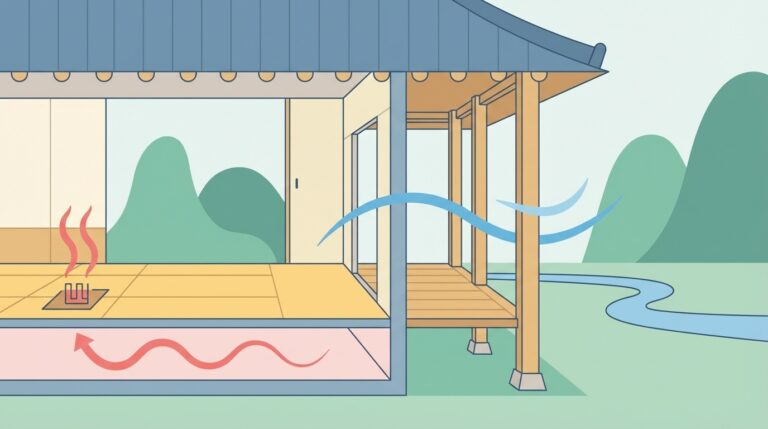
To understand the Korean soul, you must understand the floor. Korean architecture, specifically Hanok (한옥), isn’t just about pretty curved roofs; it is a masterpiece of scientific engineering that dictates how Koreans eat, sleep, and speak even today. If you don’t understand the science of the Hanok, you’ll never truly understand why modern Korean apartments still have floor heating, or why we take our shoes off at the door.
Transparency: Today, we are moving beyond “This is a house.” We are diving into C1-level cultural literacy: Ondol, Maru, and the philosophy of Baesan-imsu.
Phase 2: Deep Dive into Key Expressions
1. 온돌 (Ondol)
- Pronunciation: [On-dol] (Sounds like ‘On’ as in ‘On/Off’ + ‘Dol’ like the start of ‘Dolphin’)
- Meaning:
- Literal: Warm stone.
- Real Nuance: The traditional Korean underfloor heating system. It’s the reason Koreans have a “sedentary lifestyle” (좌식 생활 – sitting on the floor).
- K-Culture Moment: In the drama Reply 1988, notice how the family huddles under a thick blanket on the floor? That’s the Ondol culture. Even in modern apartments, we call the boiler system “Ondol.”
- Editor’s Insight: You will often hear the phrase “지 지다” (Jijida). Literally, it means to “sear” or “pan-fry,” but we use it when lying on a hot Ondol floor to relax stiff muscles. It feels like a hot stone massage for your whole body.
- Situation Spectrum:
[🚫 Formal Speech] ———— [✅ Casual/Descriptive]- “Boiler broke”: ✅
- “The Ondol is scientific”: ✅ (Suitable for academic/cultural discussions)
- 🤔 Think About It: Most Western heating systems heat the air (radiators, HVAC). Korean heating heats the floor. How does this change the way people interact within a room? (Hint: It forces physical closeness.)
2. 대청마루 (Daecheong-maru)
- Pronunciation: [Dae-cheong-ma-ru]
- Meaning:
- Literal: Big wooden floor hall.
- Real Nuance: The open wooden hall in the center of a Hanok. While Ondol is for surviving winter, Maru is designed for surviving Korea’s humid summer. It allows air to flow freely.
- K-Culture Moment: Historical dramas often show the noblemen sitting on a raised wooden platform drinking tea while the summer breeze blows. That space is the Daecheong-maru.
- Editor’s Insight: Hanok is a “hybrid” house. It combines a northern heating system (Ondol) and a southern cooling system (Maru) in one structure. It’s an architectural oxymoron that works perfectly.
- Situation Spectrum:
- Describing a Hanok cafe: ✅
- Metaphor for openness: ⚠️ (Rarely used metaphorically in daily speech)
- 🤔 Think About It: The Maru connects the inside and the outside without a wall. How does this reflect the Korean value of harmony with nature?
3. 배산임수 (Baesan-imsu)
- Pronunciation: [Bae-san-im-su]
- Meaning:
- Literal: Back to the mountain, facing the water.
- Real Nuance: The ideal location for a house according to Feng Shui (Pungsu-jiri). It’s not just superstition; scientifically, the mountain blocks the cold winter wind, and the water provides cool air in summer and distinct agricultural advantages.
- K-Culture Moment: In the movie Feng Shui (Myeongdang), characters fight over the perfect burial ground or house site. They are looking for the perfect Baesan-imsu spot.
- Editor’s Insight: If you use this 4-character idiom (Sajeo-seong-eo) when looking at a nice house or scenery, Koreans will be shocked by your fluency. “와, 여기 완전 배산임수네요!” (Wow, this place is perfectly situated!)
- Situation Spectrum:
[🚫 Slang] ———— [✅ Intellectual/Observation]- Real Estate Agent: ✅
- Describing a scenery: ✅
- 🤔 Think About It: Modern Seoul apartments along the Han River are expensive. Is this a modern version of Baesan-imsu, or just capitalism?
Phase 3: Textbook vs. Real Life
| Situation | 📖 Textbook Korean | 🗣️ Real Korean (Insider) | 💡 Why different? |
|---|---|---|---|
| Turning on heat | 난방을 켜 주세요. (Please turn on the heating.) |
보일러 좀 틀어 봐. (Turn on the boiler.) |
‘Boiler’ is the modern implementation of the Ondol concept. |
| Feeling warm | 바닥이 따뜻하네요. (The floor is warm.) |
아, 뜨끈하다~ (Ah, it’s pleasantly hot/searing.) |
‘따뜻하다’ is mild warmth. ‘뜨끈하다’ implies deep, therapeutic heat (like hot soup or Ondol). |
| Entering a house | 신발을 벗고 들어오세요. (Please take off shoes and enter.) |
신발 여기 두세요. (Leave your shoes here.) |
Context implies taking them off. The focus is on where to put them. |
Bottom Note: In C1 level, distinct vocabulary for sensations is key. Using Tteu-kkeun-haeyo (뜨끈해요) instead of just Ttateut-haeyo (따뜻해요) for floor heating shows you understand the feeling, not just the temperature.
Phase 4: Cultural Deep Dive
4-1. Non-verbal: The Floor is the Furniture
In a Hanok (and modern Korean homes), the floor is kept cleaner than a dining table in some cultures.
* The Rule: If you step on the threshold (munjibang – 문지방) of a Hanok door, you might get scolded by an elder. It damages the structure and is traditionally considered bad luck (blocking fortune).
* Nunchi Tip: When sitting on the floor (Ondol), don’t stretch your legs out towards an elder. Sit cross-legged (agul-pagul/yangban-dari). If your legs go numb, politely ask, “May I stretch my legs?”
4-2. K-Drama Connection: The “Cheoma” (Eaves) Scene
- The Trope: A romantic scene where two characters stand under the curved roof edge (Cheoma) during a sudden rainstorm.
- The Science: The angle of the Cheoma is calculated so that it blocks the high summer sun (keeping the house cool) but allows the low winter sun to shine deep into the room (heating the Ondol). It’s passive solar heating from the 14th century!
- Critical View: Dramas romanticize Hanok, but historically, maintaining the Changhoji (paper windows) was a nightmare for insulation. Real Hanok living requires constant maintenance.
Phase 5: Immersive Roleplay Scenario
Setting: A chilly November evening at a Hanok Stay in Bukchon Hanok Village. You are checking in. The owner is an elegant lady in her 60s.
Characters:
* YOU: An architecture student interested in Hanok.
* Sajangnim (Owner): Proud of her renovated Hanok.
Dialogue:
Sajangnim: (Opening the wooden door) 어서 오세요. 오늘 날씨가 꽤 쌀쌀하죠?
(Eoseo oseyo. Oneul nalssiga kkwae ssalssalhajyo?)
(Welcome. The weather is quite chilly today, isn’t it?)
YOU: 네, 바람이 좀 차네요. 그래도 한옥에 오니까 분위기가 참 좋아요.
(Ne, barami jom chaneyo. Geuraedo hanoge onikka bunwigiga cham joayo.)
(Yes, the wind is a bit cold. But the atmosphere is lovely coming to a Hanok.)
Sajangnim: 방금 아궁이에 불 때는 대신 보일러를 세게 틀어놨어요. 방이 절절 끓을 거예요.
(Banggeum agungie bul ttaeneun daesin boilleoreul sege teureonwasseoyo. Bangi jeoljeol kkeureul geoyeyo.)
(Instead of lighting a fire in the traditional stove, I turned the boiler up high. The room will be boiling hot!)
🔀 Decision Point: How do you react to “The room will be boiling hot”?
- A) “너무 뜨거우면 어떡하죠?” (What if it’s too hot?) – Practical, but kills the vibe.
- B) “와, 바닥에 등 지지고 싶었는데 딱이네요!” (Wow, I wanted to sear my back on the floor, that’s perfect!) – Highly idiomatic & Culturally fluent.
- C) “감사합니다.” (Thank you.) – Safe, but boring.
✅ Best Choice: B
* Why? Using phrases like “등 지지다” (searing one’s back) shows you understand the therapeutic purpose of Ondol. The owner will treat you like a true Korean insider.
Sajangnim: (Laughing delightedly) 어머, 한국 사람 다 되셨네! 짐 풀고 대청마루로 나오세요. 차 한 잔 드릴게요.
(Eomeo, Hanguk saram da doesyeon-ne! Jim pulgo daecheongmaruro naoseyo. Cha han jan deurilkkeyo.)
(Oh my, you’ve become a complete Korean! Unpack and come out to the Maru. I’ll give you a cup of tea.)
Phase 6: 10-Second Shadowing Drill
Let’s practice the feeling of relief when your body touches the warm floor.
- Sentence: 밖이 너무 추웠는데, 아랫목이 뜨끈해서 녹아내릴 것 같아요.
- Romanization: Bakki neomu chuwonneunde, / araemmogi tteukkeun-haeseo / noganaeril kkeot gatayo.
- Meaning: It was so cold outside, but the warmest part of the floor is so hot/searing that I feel like I’m melting.
- Emotion: ☺️ Relieved & Cozy (Imagine tension leaving your shoulders)
- Guide:
- chuwonneunde (Raise pitch slightly for contrast)
- tteukkeun-haeseo (Elongate ‘tteuk’ slightly to emphasize the heat)
- noganaeril (Softly, like melting)
Phase 7: K-Culture Mini Glossary
| Korean | Romanization | English | Context in Architecture |
|---|---|---|---|
| 처마 | Cheoma | Eaves | The curved edge of the roof. Controls sunlight scientifically. |
| 창호지 | Changhoji | Traditional Paper | Paper for doors/windows. “Breathing” paper that controls humidity. |
| 아랫목 | Araemmok | Warmest Spot | The part of the floor closest to the fire/boiler. Reserved for elders/guests. |
| 마당 | Madang | Courtyard | The empty space in the middle. Not a garden, but a multi-purpose space. |
| 한옥 스테이 | Hanok Stay | Hanok Guesthouse | A popular travel accommodation style to experience traditional living. |
Phase 8: Traveler’s Survival Kit (Hanok Stay Edition)
Staying in a traditional house requires traditional etiquette.
🆘 Survival Expression #1
* 🇰🇷 “이불은 어디에 있어요?” (Ibureun eodie isseoyo?)
* 🗣️ Sound-alike: [Ee-bull-eun uh-dee-eh is-suh-yo?]
* Usage: Hanoks don’t usually have beds. You need to find the bedding (Yo and Ibul) in the closet.🆘 Survival Expression #2
* 🇰🇷 “화장실은 방 안에 있나요?” (Hwajangsireun bang ane innayo?)
* Usage: Crucial! Old Hanoks often have bathrooms outside. Renovated ones have them inside. Always check before booking.📌 Editor’s Pro Tip:
Hanok walls are not soundproof (often made of wood and paper). Keep your voice down at night. Also, never poke a hole in the paper doors (Changhoji) with your finger, no matter how tempting it looks! It’s extremely rude and hard to repair.
Phase 9: Think Deeper — “Architecture Shapes Culture”
Topic: Communal Living & The ‘We’ Culture
Think about the Ondol system again. Because the heat comes from the floor, people sit on the floor, eat on low tables, and sleep on the floor. Unlike Western beds which are private and separated, the Ondol floor is a shared space. A whole family might sleep in one heated room during winter to save firewood.
This architectural necessity fostered Korea’s strong “Cheong” (정 – deep affection/bond) and collective identity (“Our mom” instead of “My mom”). Physical proximity created emotional proximity.
🧠 Think Deeper:
As Koreans move into high-rise apartments with beds and sofas, the “floor lifestyle” is fading. How do you think this change in architecture is affecting the traditional Korean “family bond”? Is the privacy of a bed creating more individualism?💬 Your Turn: Does your country’s traditional architecture influence how your family interacts? Share in the comments!
Phase 10: FAQ & Troubleshooting
- Q: Can I wear slippers inside a Hanok?
- A: Generally, NO. You must be barefoot or wear socks. Some guesthouses provide indoor slippers, but never wear them on the bedding. The floor is the bed; you wouldn’t walk on your bed with shoes, right?
- Q: Why is the pillow so hard?
- A: You might encounter a traditional pillow filled with buckwheat hulls or even a wooden block. It’s designed to keep the head cool (health principle: “Cool Head, Warm Feet”). If it’s too hard, ask for a softer one or use a towel.
- ❌ Common Mistake: Stepping on the door sill (threshold).
- ✅ Fix: Always step over the wooden beam at the bottom of the door frame. Stepping on it is considered disrespectful to the house and the owner.
Phase 11: Wrap-up & Action Items
One-Liner Summary: Hanok is not just a house; it’s a scientific machine for climate control that created Korea’s floor-sitting culture and warm communal bonds.
Action Missions:
* 🥉 Bronze: Say “Ah, shiwonhada!” (It’s refreshing) next time you take a hot bath or shower.
* 🥈 Silver: Search for “Bukchon Hanok Village” on YouTube and identify the Cheoma (eaves) and Maru (wooden floor).
* 🥇 Gold: Visit a Korean restaurant with floor seating (Jwaskik) and sit cross-legged for the entire meal without complaining! 😉
K-Culture Mission: Watch a clip of the drama Kingdom (Netflix). Look at how the King sits vs. how the commoners sit. Can you spot the difference in the floor they are on?
Engagement: Have you ever slept on the floor? Did you wake up with a backache or feeling refreshed? Tell me your story below! 👇
Phase 12: Interactive Quiz
1. Situation Judgment:
Your Korean friend invites you to their grandparents’ Hanok. You enter the room and feel the floor is very hot. What is the most culturally appropriate thing to say?
* A) “The heating system seems broken.”
* B) “Can we turn on the air conditioner?”
* C) “Wa, Ondol is proper! My back feels relieved.”
* D) “Why are there no chairs?”
2. True or False:
* Statement: Because Hanok is old-fashioned, the windows (Changhoji) are bad for ventilation and humidity control.
* (T/F)?
Answers:
1. C) Complimenting the Ondol heat is the ultimate praise for a host.
2. False. Changhoji is known as “living paper” that naturally regulates humidity and ventilation better than glass.
Frequently Asked Questions (FAQ)
Q: What does "온돌 (Ondol)" mean in Korean and how do you pronounce it?
A: In Korean, "온돌 (Ondol)" is pronounced [On-dol] and means: Literal: Warm stone.
Q: What does "대청마루 (Daecheong-maru)" mean in Korean and how do you pronounce it?
A: In Korean, "대청마루 (Daecheong-maru)" is pronounced [Dae-cheong-ma-ru] and means: Literal: Big wooden floor hall.
Q: What does "배산임수 (Baesan-imsu)" mean in Korean and how do you pronounce it?
A: In Korean, "배산임수 (Baesan-imsu)" is pronounced [Bae-san-im-su] and means: Literal: Back to the mountain, facing the water.







