

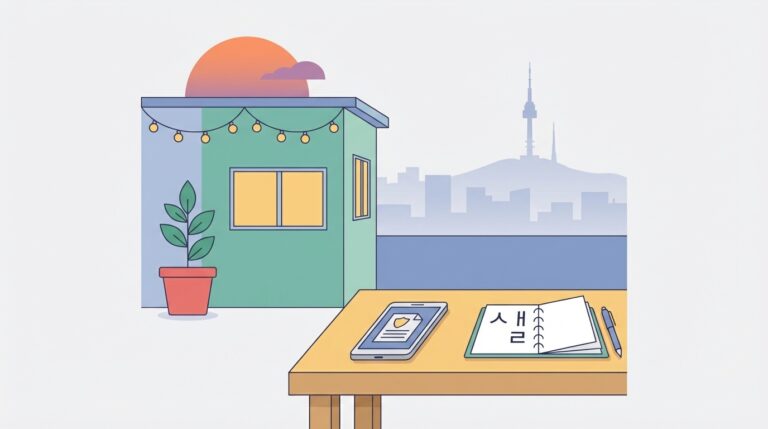
Phase 1: Immersive Hook — The “K-Drama” Tenant Crisis
Greeting: 안녕하세요! This is your Daily Hangul Senior Editor.
Imagine this scene: You’re watching a K-Drama. The protagonist finally finds peace in a small rooftop apartment (옥탑방) with a stunning view of Seoul. Suddenly, the phone rings. It’s the landlord (집주인). The music turns ominous. The landlord says, “방 빼주세요” (Please vacate the room).
In older dramas, the protagonist would cry and pack their bags while it rains. But in modern Korea? They have a Magic Shield. It’s a legal weapon called “계약 갱신 청구권” (Right to Request Contract Renewal).
If you live in Korea, knowing this phrase isn’t just about language—it’s about survival. Today, we’re going to learn how to stand your ground like a smart, modern Seoulite. Let’s secure your home! 🏠✨
Phase 2: Deep Dive — The Magic Spells of Real Estate
Here are the three most critical expressions you need when your lease is ending.
1. 계약 갱신 청구권 (Right to Request Contract Renewal)
- Pronunciation: [Gye-yak gaeng-sin cheong-gu-gwon]
Sound Analogy: “Gye-yak” (Contract) + “Gaeng-sin” (Gang-seen) + “Cheong-gu-gwon” (Chung-goo-gwon).- Meaning:
- Literal: Contract Renewal Request Right.
- Real Nuance: “I am exercising my legal right to extend this lease for another 2 years, and you cannot easily refuse.”
- K-Culture Moment: In recent news and realistic dramas, tenants mention this term to stop landlords from raising the rent too high. It’s a very “official” and powerful term.
- Editor’s Insight: You don’t say this casually over a beer. This is your trump card. Use it when the landlord hints at kicking you out or raising the rent significantly.
- Situation Spectrum:
[🚫 Casual Friends] ———— [⚠️ Semi-formal] ———— [✅ Landlord/Agent]- 🤔 Think About It: Why is this term so long? Korean legal terms are often based on Hanja (Chinese characters). Each block (계약, 갱신, 청구, 권) carries a specific legal weight.
2. 연장하다 (To extend)
- Pronunciation: [Yeon-jang-ha-da]
Sound Analogy: “Yeon” sounds like “Yawn” but shorter + “Jang” like “Django”.- Meaning: To extend (time, deadline, or contract).
- K-Culture Moment: You hear this in sports (overtime is ‘연장전’) and even at beauty salons (“eyelash extension” is ‘속눈썹 연장’).
- Editor’s Insight: This is the verb you will use most. “계약을 연장하고 싶어요” (I want to extend the contract).
- Situation Spectrum:
[✅ Friends (about time)] ———— [✅ Boss (about deadlines)] ———— [✅ Landlord]3. 보증금 / 전세 / 월세 (Deposit / Jeonse / Monthly Rent)
- Pronunciation: [Bo-jeung-geum] / [Jeon-se] / [Wol-se]
- Meaning:
- Bo-jeung-geum: Security Deposit (often huge in Korea).
- Jeon-se: Lump-sum housing lease (Unique to Korea—you pay a huge deposit, usually 50-80% of property value, and pay NO monthly rent).
- Wol-se: Monthly rent (usually with a smaller but still significant deposit).
- Editor’s Insight: Understanding the difference between Jeonse and Wolse is crucial. Jeonse is considered a stepping stone to owning a house in Korean culture.
Phase 3: Textbook vs. Real Life
| Situation | 📖 Textbook Korean | 🗣️ Real Street Korean | 💡 Why the difference? |
|---|---|---|---|
| Telling intent to stay | “임대차 계약을 갱신하고 싶습니다.” (I wish to renew the lease contract.) | “저 더 살고 싶은데요…” (I want to live here more…) OR “이번에 갱신 청구권 쓰려고요.” (I plan to use the renewal right.) | The textbook version sounds like a lawyer. “더 살고 싶다” is softer, but using the legal term (청구권) makes you sound smart and firm. |
| Negotiating Rent | “월세를 깎아 주실 수 있나요?” (Can you discount the monthly rent?) | “요즘 시세가 좀 내렸던데… 조정 안 될까요?” (I saw market prices dropped… can’t we adjust?) | Direct requests to “cut” prices work in markets, not real estate. “Adjustment” (조정) is the magic business word. |
Bottom Note: When dealing with money and contracts, being too casual (slang) can make you look pushover-ish. Stick to polite forms (Honifics) but be firm in meaning.
Phase 4: Cultural Deep Dive — The “Nunchi” of Negotiation
4-1. Non-verbal: The Art of the “Pause”
In Western cultures, directness is often valued. In Korean business/real estate, silence and hesitation are tools. If the landlord says, “I need to raise the rent by 10%,” don’t immediately say “No.”
* The Move: Pause. Sigh slightly (mildly). Say “아…” (Ah…). This signals, “That is difficult for me,” without starting a fight. It triggers the landlord’s Nunchi (social sensing) to realize they might be pushing too hard.
4-2. K-Culture Connection: The “Jeonse” Crisis in Dramas
In K-Dramas like Squid Game or Parasite, housing insecurity is a major theme. The Jeonse system is unique—it acts as an interest-free loan from tenant to landlord.
* The Reality: Landlords often invest that money (Gap Investment). When the contract ends, they must return it. If they can’t, it becomes a “Jeonse Crisis.” This is why the Renewal Right is so sensitive. You are essentially telling the landlord, “Keep my money, I’m staying, but don’t raise the price more than 5%.”
Phase 5: Immersive Roleplay — The Phone Call 📞
Setting: It’s Tuesday afternoon. You are at a quiet cafe. Your phone rings. It’s “Building Owner Auntie” (saved in your phone as ‘건물주 아주머니’). Your 2-year contract ends in 3 months.
Characters:
* YOU: An expat living in a nice one-room in Mapo-gu.
* Landlord (Mrs. Kim): 50s, sharp but generally nice. Wants to raise the rent.
Dialogue:
Mrs. Kim: (Brightly) 아이고, 00씨! 잘 지내죠? 벌써 계약 만기 때가 다 됐네.
(Aigo, 00-ssi! Jal jinaejo? Beolsseo gyeyak man-gi ttae-ga da dwaenne.)
(Oh my, [Name]! Doing well? It’s already time for the contract expiration.)
YOU: 네, 아주머니. 저도 연락 드리려고 했어요.
(Ne, ajumeoni. Jeodo yeollak deuriryeogo haesseoyo.)
(Yes, Auntie. I was planning to contact you too.)
Mrs. Kim: 그래요? 이번에 아들이 들어와서 살까 하는데… 방을 좀 비워줄 수 있어요?
(Geuraeyo? Ibeone adeuri deureowaseo salkka haneunde… bangeul jom biwojul su isseoyo?)
(Really? My son might move in… could you vacate the room?)
🛑 STOP! Critical Moment!
Under Korean law, if the landlord or their direct family wants to move in, they CAN refuse your renewal request. But is she telling the truth? Or just trying to get a new tenant at a higher price?🔀 Your Turn! How do you respond?
– A) “아, 정말요? 알겠습니다. 이사 갈게요.” (Ah, really? Okay. I’ll move.)
– B) “아드님이요? 음… 사실 저 더 살고 싶어서 ‘갱신 청구권’ 쓰려고 했거든요.” (Your son? Hmm… Actually, I wanted to stay and use my ‘renewal right’.)
– C) “거짓말 아니에요? 증명해 보세요.” (Isn’t that a lie? Prove it.)✅ Best Choice: B
Analysis: Choice A is too passive; moving is expensive! Choice C is too aggressive. Choice B politely informs her that you know your rights. If she insists on the son, she must legally prove it later (or pay you damages if she lies). Mentioning the ‘right’ usually makes landlords back down unless they are serious.
Phase 6: 10-Second Shadowing Drill
Let’s practice the “Magic Shield” sentence. Say it clearly but politely.
The Sentence:
“저는 / 이번에 / 계약 갱신 청구권을 / 행사하고 싶습니다.”
(I / this time / contract renewal request right / want to exercise.)Pronunciation Guide:
Jeo-neun / ibeon-e / gye-yak gaeng-sin cheong-gu-gwoneul / haeng-sa-ha-go sip-seum-ni-da.Emotion Tag: 😐 [Polite & Firm] (Not smiling, not angry. Just business.)
Phase 7: K-Culture Mini Dictionary
| Korean | Romanization | Meaning | Context |
|---|---|---|---|
| 복비 | Bokbi | Brokerage Fee | Paid to the real estate agent. Lit. “Fortune Fee.” |
| 임대인 | Imdaein | Lessor/Landlord | The legal term for the owner. |
| 임차인 | Imchain | Lessee/Tenant | The legal term for you. |
| 관리비 | Gwallibi | Maintenance Fee | The monthly fee for building cleaning, elevator, internet, etc. |
| 확정일자 | Hwakjeong-ilja | Fixed Date | A stamp from the community center proving when you moved in. Essential to protect your deposit! |
Phase 8: Traveler’s & Expat’s Survival Kit
Even if you aren’t signing a 2-year lease, you might book an Airbnb or a month-long stay. Here is what you need.
🆘 Survival Expression #1: Asking about extra costs
– 🇰🇷 “관리비는 포함인가요?” (Gwallibi-neun poham-in-gayo?)
– 🗣️ Meaning: “Is the maintenance fee included?”
– 💡 Pro Tip: In Korea, the rent listed online often excludes the maintenance fee, which can be another $50~$150. Always ask!📌 Editor’s Real Estate Note
– App Recommendations: ‘Zigbang’ (직방) and ‘Dabang’ (다방) are the top real estate apps. They are like the Zillow of Korea.
– The “False Listing” (Heowi-maemul): Be careful. If a house looks too good and cheap on the app, it probably doesn’t exist. It’s bait to get you to call.
Phase 9: Think Deeper — “My House” vs. “Investment”
Why is the housing market so intense in Korea?
In many Western countries, renting for life is common. In Korea, owning a home (내 집 마련) is deeply tied to social status and stability. The Jeonse system exists because, historically, banks didn’t lend money easily, so landlords used tenants’ deposits as investment capital.
This makes the tenant-landlord relationship unique: You are not just a customer; you are technically the landlord’s creditor (lender). The “Contract Renewal Right” was introduced recently (2020) to balance this power dynamic, as tenants were often forced out whenever housing prices spiked.
💬 Your Turn: In your country, does the law protect the tenant more, or the landlord? How hard is it to evict someone? Share in the comments!
Phase 10: FAQ & Troubleshooting
Q: Can I tell my landlord I want to renew via text message (KakaoTalk)?
A: YES! In fact, it is better.
In Korea, legal disputes often rely on evidence. A recorded phone call (legal in Korea if you are part of the convo) or a KakaoTalk message is perfect proof. Take a screenshot after they reply.
Q: My landlord says they will raise the rent by 10%. Is this allowed?
A: NO. If you use the “Renewal Right,” the law caps the increase at 5%. If they demand more, simply say: “법적으로 5%까지만 가능한 걸로 알고 있습니다.” (I understand that legally, only up to 5% is possible.)
❌ Common Mistake:
Thinking “silence” means renewal.
* Correction: While “implied renewal” (묵시적 갱신) exists, it’s risky. Always clearly state your intent to renew 2 to 6 months before the contract ends.
Phase 11: Wrap-up
One-Liner Summary: Use “계약 갱신 청구권” to legally extend your stay for 2 more years, and keep any rent increase under 5%!
Action Missions:
– 🥉 Bronze: Stand in front of a mirror and say “계약 갱신 청구권” 5 times until your tongue doesn’t twist.
– 🥈 Silver: Search for “Jeonse Crisis” on YouTube/Google to understand the current Korean news context.
– 🥇 Gold: Check your own housing contract (if you are in Korea) and find the word “임대차 기간” (Lease Period).
K-Culture Mission: Watch a clip of the drama “Because This Is My First Life” (이번 생은 처음이라). The entire show is about the struggle of housing, contracts, and finding a place to belong. It’s the perfect study material for this module!
See you in the next lesson! 매일한글 에디터 드림. 🖊️
Frequently Asked Questions (FAQ)
Q: What does "계약 갱신 청구권 (Right to Request Contract Renewal)" mean in Korean and how do you pronounce it?
A: In Korean, "계약 갱신 청구권 (Right to Request Contract Renewal)" is pronounced [Gye-yak gaeng-sin cheong-gu-gwon] and means: Literal: Contract Renewal Request Right.
Q: What does "연장하다 (To extend)" mean in Korean and how do you pronounce it?
A: In Korean, "연장하다 (To extend)" is pronounced [Yeon-jang-ha-da] and means: To extend (time, deadline, or contract).
Q: What does "보증금 / 전세 / 월세 (Deposit / Jeonse / Monthly Rent)" mean in Korean and how do you pronounce it?
A: In Korean, "보증금 / 전세 / 월세 (Deposit / Jeonse / Monthly Rent)" is pronounced [Bo-jeung-geum] and means: Bo-jeung-geum: Security Deposit (often huge in Korea).







