

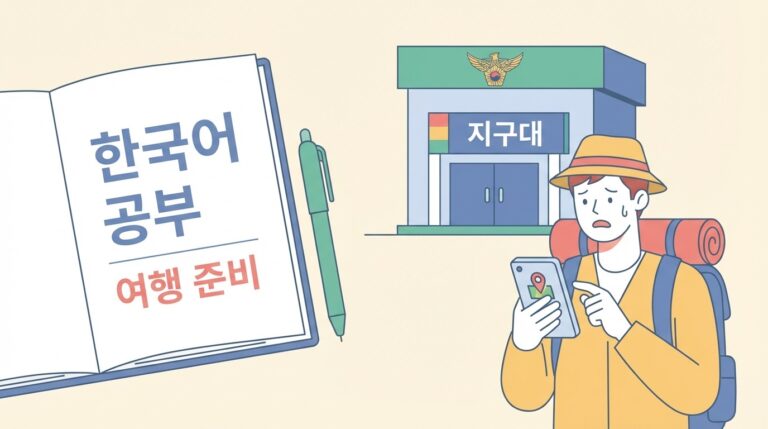
Phase 1: The “Don’t Panic” Opening
Hello, Daily Hangul family! Editor here. 👋
Imagine this scene: You are in the middle of Myeongdong, surrounded by delicious street food smells and K-Pop music blasting from cosmetic shops. It feels like a scene straight out of a variety show like Youth Over Flowers. You reach into your bag to pay for a hotteok, and… your heart stops.
Your wallet and passport are gone.
Cue the dramatic K-Drama sound effect. 😱
In movies, the hero always knows exactly where to run. But in real life, standing alone in a foreign country without your ID is terrifying. You need to contact your embassy, but your hands are shaking, and you don’t know the number.
Today, we are going to learn the ultimate survival phrase: how to ask for embassy contact information. This isn’t just about language; it’s about your safety net in Korea. Let’s make sure you never have to use this, but if you do, you’ll be ready to handle it like a pro.
Phase 2: Deep Dive into Survival Phrases
Here are the three phrases that will be your lifeline.
1. 대사관 전화번호 좀 알려 주세요.
- Pronunciation: [Dae-sa-gwan jeon-hwa-beon-ho jom al-ryeo ju-se-yo]
- Sound-alike: Day-sa-gwan (sounds like ‘Day’ + ‘Sa’ as in Salsa + ‘Gwan’ as in Taekwondo) + jeon-hwa-beon-ho (phone number) + jom (like ‘John’ with an m) + al-ryeo ju-se-yo.
- Meaning: Please tell me the embassy phone number.
- Editor’s Insight: You see that little word “좀 (jom)”? It literally means “a little,” but in requests, it’s a magic softener. Without it, you sound like a robot demanding data. With it, you sound like a polite person asking for help. Always use jom!
- Situation Spectrum:
[🚫 Friends] ———— [⚠️ Strangers] ———— [✅ Police/Help Centers]- 🤔 Think About It: Why do Koreans add “a little” (jom) when asking for big favors? It’s a way of minimizing the burden on the listener. “Just a little help, please!”
2. 여권을 잃어버렸어요.
- Pronunciation: [Yeo-gwo-neul i-reo-beo-ryeo-sseo-yo]
- Sound-alike: Yeo-gwon (sounds like ‘Yuh’ + ‘Gwon’ like Kwon in Taekwondo) + i-reo-beo-ryeo-sseo-yo.
- Meaning: I lost my passport.
- K-Culture Moment: This is the classic “crisis starter” in travel reality shows. The moment the cast realizes they lost something, the fun music stops and the captions turn red!
- Editor’s Insight: The verb
잃어버리다(to lose) contains the nuance of “lost completely/regrettably.” It’s not just misplaced; it’s gone.- Situation Spectrum:
[✅ Anyone who can help]3. 도와주세요.
- Pronunciation: [Do-wa-ju-se-yo]
- Sound-alike: Dough (like pizza dough) + wah + ju-se-yo.
- Meaning: Please help me.
- Editor’s Insight: CRITICAL TIP! 🚨 Don’t confuse this with “살려 주세요” (Sal-ryeo ju-se-yo). Sal-ryeo means “save my life” (use this if you are being chased by zombies in Kingdom or hanging off a cliff). Do-wa is for “help me with a task/problem.”
Phase 3: Textbook vs. Real Life
| Situation | 📖 Textbook Korean | 🗣️ Real Life Korean (Survival) | 💡 Why the difference? |
|---|---|---|---|
| Urgent Request | 미국 대사관 전화번호를 알고 싶습니다. (I would like to know the US embassy number.) | 미국 대사관 번호 좀요! (US Embassy number, please!) | In emergencies, we cut the fluff. “Number, please!” is faster and understood. |
| Reporting Loss | 저는 제 여권을 분실하였습니다. (I have lost my passport.) | 저 여권 잃어버렸어요. (I lost [my] passport.) | “분실하였습니다” is for written police reports. Spoken Korean uses simple past tense. |
Bottom Note: As an A2 learner, stick to the Real Life column, but keep the “yo” (요) at the end to stay polite!
Phase 4: Cultural Deep Dive — The “K-Police” Experience
4-1. Non-verbal: The “Urgent” Face
In Korea, Nunchi (reading the room) works both ways. If you approach a police officer laughing or looking too relaxed, they might think you are just asking for directions. Show your urgency with your face, but do not scream. Hysteria can be frowned upon. A worried face + polite language is the golden combination.
4-2. K-Travel Connection: The “Jigudae” (Local Police Center)
In K-Dramas like Live, you see police officers working in small neighborhood stations called 지구대 (Jigudae) or 파출소 (Pachulso).
- Good News: These are everywhere in tourist areas (Hongdae, Myeongdong, Gangnam).
- Better News: Korean police are generally very helpful to tourists. They often have translation apps ready on their phones.
- Critical Insight: Unlike some action movies where the police are scary, the local Jigudae is often a safe haven for lost items. You can even walk in just to ask for directions!
Phase 5: Immersive Roleplay 🎬
Setting: A Friday night in Hongdae. It’s chaotic. You just realized your bag is open and your passport is gone. You spot a police officer (Police/Pol-li-seu) standing near a patrol car.
Characters:
– YOU: A panicked tourist.
– Officer Kim: A helpful young police officer.
Start!
YOU: (Approaching quickly) 저기요! 경찰관님!
(Jeo-gi-yo! Gyeong-chal-gwan-nim!)
(Excuse me! Officer!)
Officer Kim: 네, 무슨 일이세요? 🤔
(Ne, museun iriseyo?)
(Yes, what’s the matter?)
YOU: [Insert Phrase 2 Here]! 여권을 잃어버렸어요!
(Yeo-gwo-neul i-reo-beo-ryeo-sseo-yo!)
Officer Kim: 저런… 어느 나라 사람이에요?
(Jeoreon… eoneu nara saram-i-e-yo?)
(Oh no… Where are you from?)
🔀 Decision Point: How do you answer?
- A) 미국이요. (America.) — Short & Direct
- B) 저는 미국 사람입니다. (I am an American person.) — Textbook
- C) Help me!! — English
✅ Best Choice: A. In emergencies, short answers are best. “[Country Name] + i-yo” is perfect.
YOU: 미국이요. [Insert Phrase 1 Here]? 대사관 전화번호 좀 알려 주세요.
(Miguk-iyo. Dae-sa-gwan jeon-hwa-beon-ho jom al-ryeo ju-se-yo.)
Officer Kim: (Takes out phone) 잠시만요. 여기 있습니다. 📱
(Jamsimanyo. Yeogi isseumnida.)
(One moment. Here it is.)
Phase 6: 10-Second Shadowing Drill 🗣️
Repeat this 3 times. Focus on the intonation!
Context: You are asking a passerby for help urgently.
😢 (Worried tone) 저기요, / 대사관 전화번호 / 알아요?
(Jeo-gi-yo, / Dae-sa-gwan jeon-hwa-beon-ho / a-ra-yo?)
Translation: Excuse me, do you know the embassy phone number?
Phase 7: K-Culture Mini Glossary
| Korean | Romanization | English | Context |
|---|---|---|---|
| 대사관 | Daesagwan | Embassy | The place you go when you lose your passport. |
| 분실물 | Bunsilmul | Lost Property | You might see signs for “Bunsilmul Center” in subways. |
| 파출소 | Pachulso | Police Box | Smaller than a station, perfect for asking help. |
| 112 | Il-il-i | 112 | The emergency number for Police in Korea (Not 911!). |
Phase 8: Traveler’s Survival Kit 🆘
If you are traveling in Korea, take a screenshot of this RIGHT NOW.
🆘 Survival Expression #1: The Magic Hotline
– 🇰🇷 “1330에 전화해 보세요.” (Il-sam-sam-gong-e jeon-hwa-hae bo-se-yo)
– Meaning: Call 1330.
– 💡 Pro Tip: 1330 is the Korea Travel Hotline. They speak English, Japanese, Chinese, and Russian 24/7. They can connect you to the police or your embassy. Memorize this number: 1330.📌 Editor’s Travel Note
– Map Apps: Google Maps is okay, but Naver Map or Kakao Map is much better for finding the nearest police station.
– Safety: Korea is one of the safest countries in the world (CCTV is everywhere), so if you lose something, there is a high chance it is at a “Lost and Found” center!
Phase 9: Think Deeper — Language & Politeness in Crisis
Topic: Why be polite when you are panicking?
In many Western cultures, if you are in an emergency, you just shout “Help!” or “Embassy!” and grammar goes out the window. In Korean culture, keeping your composure and using polite endings like “-yo” (요) or “-juseyo” (주세요) even during a crisis signals that you are a rational person worth listening to. It establishes a quick bond of mutual respect. By speaking politely to the police officer, you are acknowledging their authority and asking for their benevolence.
💬 Your Turn: In your country, if you talk to a police officer, do you have to use special formal language? Tell us in the comments!
Phase 10: FAQ & Troubleshooting
Q: Can I just speak English to the police?
A: Maybe. Young officers often speak basic English, but older ones might not. However, almost all patrol cars have access to a translation service. Don’t be afraid to say “English, please?”
Q: Should I call 911?
A: NO. In Korea, 112 is for Police, and 119 is for Fire/Ambulance. 911 might not work depending on your phone carrier.
❌ Common Mistake: shouting “살려 주세요!” (Save me!) when you just lost a bag.
✅ Correction: Use “도와주세요” (Help me). Save the dramatic “Sal-ryeo ju-se-yo” for life-or-death situations!
Phase 11: Wrap-up & Mission
Summary: Today we learned how to ask for the embassy number using the magic word “jom”, and the difference between life-saving help and practical help.
🚀 Action Mission:
– 🥉 Bronze: Say “Yeo-gwo-neul i-reo-beo-ryeo-sseo-yo” 3 times while looking in the mirror.
– 🥈 Silver: Save the number 1330 in your phone contacts as “Korea Help”.
– 🥇 Gold: Find the nearest Embassy of your country on Naver Map/Kakao Map and screenshot the address.
K-Culture Mission: Watch a clip of the movie Midnight Runners (청년경찰). Look at how they interact with the police station (Pachulso). It’s funny but educational!
Phase 12: Interactive Quiz
Situation: You lost your wallet. You run into a police station. What is the WORST thing to say?
- 지갑(wallet) 잃어버렸어요. 도와주세요.
- 1330 전화번호 좀 알려 주세요.
- 살려 주세요! (Sal-ryeo ju-se-yo!)
⬇️ Click to see the answer
Answer: 3. Unless your wallet contained the antidote to a poison you just drank, do not scream “Save my life!” It will confuse the police. Use option 1 or 2!
Frequently Asked Questions (FAQ)
Q: What does "대사관 전화번호 좀 알려 주세요." mean in Korean and how do you pronounce it?
A: In Korean, "대사관 전화번호 좀 알려 주세요." is pronounced [Dae-sa-gwan jeon-hwa-beon-ho jom al-ryeo ju-se-yo] and means: Please tell me the embassy phone number.
Q: What does "여권을 잃어버렸어요." mean in Korean and how do you pronounce it?
A: In Korean, "여권을 잃어버렸어요." is pronounced [Yeo-gwo-neul i-reo-beo-ryeo-sseo-yo] and means: I lost my passport.
Q: What does "도와주세요." mean in Korean and how do you pronounce it?
A: In Korean, "도와주세요." is pronounced [Do-wa-ju-se-yo] and means: Please help me.







