

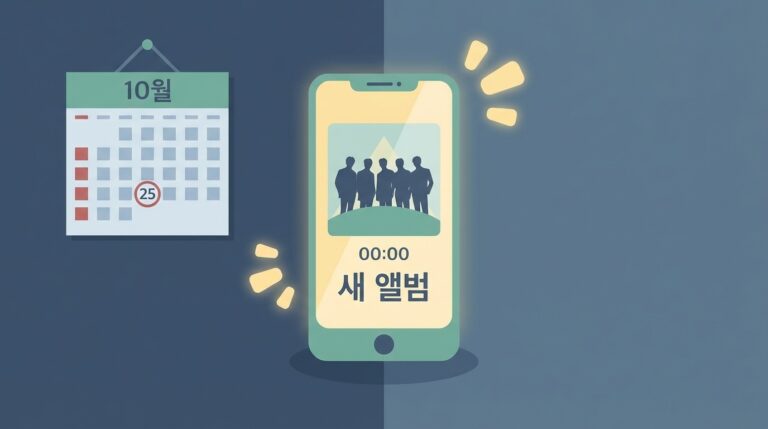
Phase 1: The 11:59 PM KST Anxiety 🕛
Hello! This is your Daily Hangul Editor.
If you are a K-Pop fan, you know exactly what I’m talking about. It’s 11:59 PM in Korea (KST). You are refreshing your phone screen like crazy. Your heart is pounding. Why? Because the agency promised a Teaser Image or a Tracklist at midnight.
Suddenly, the screen changes. A new logo appears. You want to scream, text your friend, and post on social media all at once. But wait—how do you express this exploding heart in Korean?
Today, we are learning the essential survival phrases for the most stressful yet exciting time in a fan’s life: Waiting for a Comeback.
Don’t just rely on subtitles. Let’s learn the real Korean that will make your mutuals ask, “Wait, are you actually Korean?”
Phase 2: Deep Dive into Key Expressions 🧐
1. 컴백 언제 해요? (Keombaek eonje haeyo?)
- Pronunciation: [Keom-baek eon-je hae-yo?]
- Tip: ‘Keombaek’ sounds just like ‘Comeback’. ‘Eonje’ sounds like ‘On-jay’.
- Meaning: “When are you making a comeback?” (Literal: Comeback when do?)
- K-Culture Moment: You are watching your favorite idol’s live stream (Instagram Live or Weverse Live). They are just eating fried chicken, but you are dying to know the schedule. This is the comment you type.
- Editor’s Insight: This is a very direct question. Fans use it constantly, but remember to add polite endings like ‘yo’ (요) if you are talking to the artist directly.
- Situation Spectrum:
[🚫 Formal Biz] ———— [✅ Fan-to-Idol] ———— [✅ Friend] - 🤔 Think About It: Why do K-Pop groups have “Comebacks” even if they were only gone for 3 months? In Western music, it’s just a “New Release.” In Korea, every return is an event!
2. 떴다! (Tteotda!)
- Pronunciation: [Tteot-da!]
- Tip: The ‘Tt’ (ㄸ) is a strong, tense sound. Imagine spitting out a seed. It sounds sharp.
- Meaning: “It’s out!” or “It showed up!”
- Original Meaning: To float or rise (like the sun rising).
- K-Culture Moment: It’s 12:00 AM. The music video teaser finally appears on YouTube. You scream “Tteotda!” to your roommate or in the group chat.
- Editor’s Insight: This is the most thrilling word in fandom culture. It means the wait is over. It’s usually shouted or typed with many exclamation marks.
- Situation Spectrum:
[🚫 Boss] ———— [⚠️ Stranger] ———— [✅ Friends/Internet]
3. 현기증 나요 (Hyeon-gi-jeung nayo)
- Pronunciation: [Hyeon-gi-jeung na-yo]
- Tip: ‘Hyeon’ is one syllable. Say it quickly.
- Meaning: “I’m getting dizzy.” (Real nuance: “I can’t wait anymore, give it to me!”)
- K-Culture Moment: A famous internet meme in Korea involves a man saying, “Please give me ramen quickly, I’m getting dizzy.” K-Pop fans use this when the agency delays the content. “Where is the MV? Hyeon-gi-jeung nayo.“
- Editor’s Insight: Use this to show you are a funny, culturally fluent fan. It’s a cute way to complain.
- Situation Spectrum:
[🚫 Funeral] ———— [⚠️ Formal] ———— [✅ Social Media/Friends]
Phase 3: Textbook vs. Real Life 🥊
| Situation | 📖 Textbook Korean | 🗣️ Real Fan Korean | 💡 Why different? |
|---|---|---|---|
| Asking for release date | 언제 출시됩니까? (When is it released?) | 언제 나와요? (When is it coming out?) | ‘출시’ is too business-like. ‘나와요’ is conversational. |
| Seeing the Teaser | 티저가 공개되었습니다. (The teaser has been revealed.) | 미쳤다… / 떴다! (Crazy… / It’s out!) | Real reactions are emotional, not descriptive. |
| Waiting desperately | 정말 많이 기다리고 있어요. (I am waiting a lot.) | 숨 참는다 😶 (Holding my breath) | Internet slang loves exaggeration (hyperbole). |
💡 Bottom Note: Words like “숨 참는다” (I’m holding my breath until the album drops) show you understand the desperation of fandom culture.
Phase 4: Cultural Deep Dive — The “12 AM KST” Rule 🌙
4-1. The Magic Hour (Non-verbal)
In K-Pop, 00:00 KST (Midnight Korean Standard Time) is sacred. If you have a Korean friend who is a K-Pop fan, do not text them at 11:58 PM KST. They are mentally preparing.
Nunchi (눈치) Tip: If an idol posts a photo of a recording studio with no caption, that is a “Spoiler.” Do not ask “What is this?” Instead, comment “???” or “Prepare our wallets.” We all know what it means.
4-2. Concept Photos & Teasers
K-Dramas usually release one or two trailers. K-Pop? It’s a 2-week festival.
1. Schedule Poster: Just a calendar.
2. Concept Photos: Idols looking handsome/pretty in new outfits.
3. MV Teaser 1 & 2: 10-second clips.
4. Highlight Medley: A preview of the songs.
🧠 Critical View: Why is it so structured? It keeps the fans engaged every single day, building hype (and algorithm scores) before the actual sale begins.
Phase 5: Immersive Roleplay 🎬
Setting: A KakaoTalk chat room with your Korean friend, Jisoo (24, hardcore fan).
Situation: It is rumored that your favorite group is coming back in June.
Jisoo: 야, 기사 봤어? 6월에 컴백한대!!!! 🔥
(Ya, gisa bwasseo? 6wol-e keombaek-handae!!!!)
(Translation: Hey, did you see the article? They say it’s a comeback in June!!!!)
🔀 Your Turn! How do you react?
- A) “진짜요? 현기증 나요…” (Really? I’m getting dizzy…) -> Funny & Relatable
- B) “언제 나와요?” (When is it coming out?) -> Direct & Simple
- C) “네, 알겠습니다.” (Yes, I understand.) -> Too formal/Robot
If you choose A:
YOU: 진짜요? 아… 현기증 나요 빨리 보고 싶다.
(Jinjja-yo? Ah… hyeon-gi-jeung na-yo ppalli bogo sipda.)
(Translation: Really? Ah… I’m getting dizzy, I want to see it fast.)
Jisoo: 내 말이 ㅠㅠ 통장 준비해라.
(Nae mari… tong-jang junbi-haera.)
(Translation: Exactly… Prepare your bank account.)
Phase 6: 10-Second Shadowing Drill 🗣️
Practice these to sound like a native fan! Watch the emotion tags.
- 🥺 (Desperate/Whining):
제발 / 컴백 / 언제 / 해요? 😭
(Jebal / keombaek / eonje / haeyo?)
Please / comeback / when / are you doing? -
😲 (Shocked/Excited):
대박 / 티저 / 떴다!!! 📱
(Daebak / tijeo / tteotda!!!)
Awesome / the teaser / is out!!! -
😤 (Determined):
오늘부터 / 숨 / 참는다. 😶
(Oneul-buteo / sum / chamneunda.)
Starting today / breath / I am holding.
Phase 7: K-Culture Glossary 📚
| Korean | Romanization | Meaning | Context |
|---|---|---|---|
| 스포 | Seupo | Spoiler | Short for Spoiler. Idols often give “Seupo” during live streams. |
| 떡밥 | Tteok-bap | Bait/Content | Literally “rice bait” for fishing. Refers to new content fans can enjoy. |
| 총공 | Chong-gong | All-out Attack | Organized mass streaming or voting by fans. |
| 스밍 | Seu-ming | Streaming | Listening to songs on repeat on Melon, Genie, or Spotify. |
Phase 8: Traveler’s Survival Kit (K-Pop Edition) 🧳
You are in Seoul during a Comeback season. You want to buy the new album.
🆘 Survival Expression: Music Store (Hottracks, WithMuu)
* 🇰🇷 “이거 포스터도 줘요?” (Igeo poseuteo-do jwoyo?)
* 🗣️ Meaning: “Do you give a poster with this too?”
* 📍 Where: Cashier desk at record stores.
* 💡 Pro Tip: Often, posters are “First Press Only” (limited). Ask this to make sure you get the rolled poster tube!📌 Editor’s Travel Note:
If you are buying albums in Myeongdong, check if the store counts towards Hanteo Chart. If you want your idol to win #1 on music shows, buying from Hanteo-certified stores is crucial!
Phase 9: Think Deeper — “Parasocial Joy” 🧠
Topic: Media vs. Reality
In Korea, a “Comeback” is not just releasing a song; it’s a restart of the relationship between the idol and the fan. The language reflects this intimacy. We don’t say “The product is released.” We say “They came back to us.”
However, have you noticed how demanding the language can be? “현기증 나요” (I’m dizzy) implies that the fan needs the idol to survive.
💬 Your Turn: In your country, do fans have a specific word for when an artist releases an album? Or is it just “New Album”? Let me know in the comments!
Phase 10: FAQ & Troubleshooting 🛠️
Q: Can I ask an idol “Keombaek eonje haeyo?” (When is the comeback?) at a fansign?
A: Yes! But be prepared. They might smile and say “Secret!” (비밀!). It’s a common playful question. Just don’t ask it aggressively.
Q: Is “Ya” (Hey) okay to use on Twitter?
A: Only if you are talking to friends or shouting into the void (monologue). Never start a sentence with “Ya” when replying to an idol or a stranger. It’s rude.
❌ Common Mistake:
Don’t confuse “Comeback” (컴백) with “Debut” (데뷔).
* Debut = First time ever.
* Comeback = Every release after the first one (even if it’s just a single).
Phase 11: Wrap-up & Action Mission 🚀
One-Liner: Waiting for K-Pop is painful, but knowing how to say “I’m dizzy” makes it fun.
🎯 Missions:
* 🥉 Bronze: Look in the mirror and practice your “shocked face” while saying “Tteotda!”
* 🥈 Silver: Go to a K-Pop music video on YouTube and comment: “노래 너무 좋아요! 현기증 나요!” (The song is so good! I’m dizzy!)
* 🥇 Gold: If your favorite group drops a teaser soon, post “숨 참는다” on your social media story with the photo.
Phase 12: K-Culture Quiz 📝
- Situation: It is 12:00 AM KST. The teaser video is released. What do you shout?
- A) 안녕히 주무세요 (Good night)
- B) 떴다! (It’s out!)
- C) 얼마예요? (How much is it?)
- True or False: “Comeback” in Korea is only used when an artist returns after retiring for 10 years.
- (True / False)
- Culture Check: If you see a photo of an idol’s foot in a practice room, this is likely a…?
- A) Mistake
- B) Seupo (Spoiler)
- C) Scandal
(Answers: 1-B, 2-False [Used for every new release], 3-B)
Frequently Asked Questions (FAQ)
Q: What does "컴백 언제 해요? (Keombaek eonje haeyo?)" mean in Korean and how do you pronounce it?
A: In Korean, "컴백 언제 해요? (Keombaek eonje haeyo?)" is pronounced [Keom-baek eon-je hae-yo?] and means: a key conversational Korean expression covered in this lesson.
Q: What does "떴다! (Tteotda!)" mean in Korean and how do you pronounce it?
A: In Korean, "떴다! (Tteotda!)" is pronounced [Tteot-da!] and means: a key conversational Korean expression covered in this lesson.
Q: What does "현기증 나요 (Hyeon-gi-jeung nayo)" mean in Korean and how do you pronounce it?
A: In Korean, "현기증 나요 (Hyeon-gi-jeung nayo)" is pronounced [Hyeon-gi-jeung na-yo] and means: a key conversational Korean expression covered in this lesson.







