

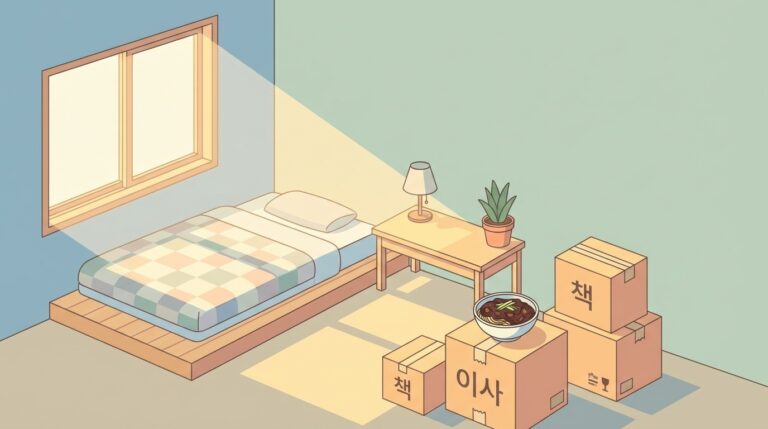
Help! Where Should I Put My Bed? 🛏️
🏠 Designing Your Korean Space Like a K-Drama Star
Phase 1: The Immersive Hook
Annyeonghaseyo! It’s your Daily Hangul Editor. 👋
Picture this: You’ve just watched a K-Drama where the main character moves into a cozy Oktapbang (rooftop room). The view is amazing, but the room is… tiny. They are standing there with a heavy box, sweating, trying to tell the mover where to put the bed.
“Put it there… no, here… wait, maybe near the window?”
If you move to Korea, you will likely live in a “One-room” (studio) or an “Officetel.” Space is precious! Knowing how to describe where things go isn’t just about furniture; it’s about claiming your space. Today, we’re not just learning words; we’re designing your sanctuary. Let’s get that Feng Shui right! ✨
Phase 2: Deep Dive — Key Expressions
Here are the 3 essential tools you need to organize your room (and your life).
1. [가구] + 옆에 (Next to the [furniture])
- Pronunciation: [~ yeop-e] (Sounds like ‘yup’ + ‘eh’)
- Meaning: Next to / Beside
- K-Culture Moment: In K-Pop dorm tours, you often hear idols say, “Jungkook’s bed is next to mine.” It defines closeness!
- Editor’s Insight: In English, we use “next to,” “beside,” “by.” In Korean, 옆에 (yeop-e) covers 90% of these situations. It’s the magic word for location.
- Situation Spectrum:
[✅ Casual] — [✅ Polite] — [✅ Formal](Safe to use everywhere!)- 🤔 Think About It: Why is relative location (“next to X”) used more often than absolute location (“North wall”) in daily conversation? Is it because we navigate space based on relationships between objects?
2. 여기에 놔주세요 (Please put it here)
- Pronunciation: [Yeogi-e nwa-ju-se-yo]
- Sound Analogy: Yeo-gi (Yogi bear) + Nwa (like ‘Noir’ but short) + Ju-se-yo.
- Meaning: Please place/put it here.
- K-Drama Scene: The mover is holding a heavy fridge. He looks tired. You point to a spot and say, “Yeogi-e nwa-ju-se-yo.” He smiles because you were clear and polite.
- Editor’s Insight: The verb
놓다(to put) combined with주세요(please give/do for me) creates a soft, polite command. It shows you respect their labor.- Situation Spectrum:
[🚫 Friends] — [✅ Service Workers/Strangers] — [✅ Elders]- 🤔 Think About It: Korean adds “-juseyo” (please do for me) to almost any request. How does this change the tone compared to just saying “Put it here”?
3. 창문 쪽 (Towards the window)
- Pronunciation: [Chang-mun jjok]
- Meaning: Window side / Direction of the window
- K-Culture Context: Koreans love natural light (South-facing houses are premium!). Placing a desk “Chang-mun jjok” is a classic study vibe.
- Editor’s Insight:
쪽 (jjok)means “direction” or “side.” It’s less specific than “at” but more natural for general arrangement.
Phase 3: Textbook vs. Real Life
| Situation | 📖 Textbook Korean | 🗣️ Real Korean (Survival Mode) | 💡 Why? |
|---|---|---|---|
| Where is the desk? | 책상이 방 안에 있습니다. (The desk is inside the room.) |
책상은 그냥 저기 두세요. (Just put the desk over there.) |
“Inside the room” is obvious. “Over there” is practical direction. |
| Moving heavy boxes | 상자를 바닥에 내려놓으십시오. (Please put the box down on the floor.) |
여기요! / 거기요! (Here! / There!) |
In the chaos of moving, speed and pointing are key! |
💡 Bottom Note: In A2 level, using full sentences is good practice, but adding pointing gestures (hand open, not finger!) makes you fluent.
Phase 4: Cultural Deep Dive — The “Full Option” Life
4-1. Non-verbal: The “Hand” Guide
When you tell someone to put furniture somewhere, never point with a single index finger. It can be seen as rude or accusatory. Instead, use your whole hand (palm facing up or side) to gesture towards the spot. It looks elegant and respectful.
4-2. K-Culture Connection: The “Officetel” (Office + Hotel)
Most foreigners and young Koreans live in an Officetel (오피스텔).
– Full Option (풀옵션): This is a magic word. It means the washing machine, fridge, and sometimes a desk are already built-in. You usually only need to arrange your bed and small items.
– K-Drama Trope: Have you noticed characters always eat Jajangmyeon (Black Bean Noodles) on moving day? It’s a tradition! It’s cheap, delivered fast, and easy to eat when you don’t have dishes unpacked yet.
Phase 5: Immersive Roleplay — Moving Day! 📦
Setting: It’s Saturday morning. You are moving into a new studio in Hongdae. Mr. Park (the mover) is holding your heavy mattress.
Characters:
– YOU: Excited but tired new tenant.
– Mr. Park: Friendly but busy mover (Age: 50s).
(Dialogue)
Mr. Park: 침대는 어디에 둘까요? (Chimdae-neun eodi-e dulkkayo?)
(Where shall I put the bed?)
YOU: 음… 창문 옆이요. (Eum… changmun yeop-iyo.)
(Umm… Next to the window, please.)
Mr. Park: (Looking at the space) 여기는 너무 좁아요. (Yeogi-neun neomu jobayo.)
(It’s too narrow here.)
YOU: 아, 정말요? 그럼… (Ah, jeongmal-yo? Geureom…)
(Ah, really? Then…)
🔀 Decision Point: Where should the bed go?
A) “그냥 문 앞에 놔주세요.” (Just put it in front of the door.)
B) “벽 쪽에 붙여주세요.” (Please push it against the wall side.)
C) “아몰라요!” (I don’t know!)
✅ Best Choice: B) “Byeok jjok-e buchyeo-juseyo.”
– Reason: In small Korean rooms, pushing furniture against the wall (벽) is the standard way to save space.
– Why not A? In Feng Shui (and safety), blocking the door is a big No-No!
(Roleplay Continues)
Mr. Park: 네, 알겠습니다! (Moves the bed) 끝났습니다!
(Okay, got it! All done!)
YOU: 감사합니다! 수고하셨습니다!
(Thank you! You worked hard!)
Phase 6: 10-Second Shadowing Drill 🗣️
Read these aloud with the emotion tag!
- 🤔 Thinking: 침대는 / 어디에 / 놓을까요?
(Chimdae-neun / eodi-e / no-eul-kkayo?)
-> Where should I put the bed? -
👉 Directing: 책상은 / 침대 옆에 / 놔주세요.
(Chaeksang-eun / chimdae yeop-e / nwa-ju-se-yo.)
-> Please put the desk next to the bed. -
😊 Satisfied: 와! / 방이 / 정말 / 예뻐요!
(Wa! / Bang-i / jeongmal / yeppeoyo!)
-> Wow! The room is really pretty!
Phase 7: K-Culture Mini Glossary
| Korean | Romanization | English | Context |
|---|---|---|---|
| 원룸 | Won-room | Studio Apt | A one-room apartment. The most common housing for singles. |
| 풀옵션 | Pul-op-shyeon | Full Option | Fully furnished (appliances included). |
| 이사 | I-sa | Moving | The act of moving houses. |
| 짜장면 | Jajangmyeon | Black Bean Noodles | The OFFICIAL food of moving day in Korea. |
Phase 8: Traveler’s & Mover’s Survival Kit
Even if you are just staying in an Airbnb, you might need to move things around.
🆘 Survival Phrases
– 🇰🇷 “이거 무거워요?” (Igeo mugeowo-yo?)
– “Is this heavy?” (Ask before lifting!)
– 🇰🇷 “조심하세요!” (Jo-sim-ha-se-yo!)
– “Please be careful!” (Useful when movers handle fragile items.)
– 🇰🇷 “신발 벗어야 해요?” (Sinbal beoseo-ya haeyo?)
– “Do I have to take off my shoes?” (The answer is almost always YES.)📌 Editor’s Tip:
If you order furniture online (Coupang, IKEA), Korean delivery is fast. But if you live in a building without an elevator (common in older areas), you might need to pay a small extra fee called ‘sadari-cha’ (ladder truck) fee for moving.
Phase 9: Think Deeper — “Floor Culture”
Why do we need to keep the floor empty?
🧠 Think Deeper:
In many Western cultures, the floor is for walking with shoes on. In Korea, the floor is a living space. We sit, eat, and sleep on the floor because of Ondol (floor heating).This impacts furniture arrangement! We usually push furniture against the walls to maximize the open floor space in the center. This isn’t just for looks; it’s to create a warm, shared space for sitting together.
💬 Your Turn: Does your culture wear shoes inside? How does that change how you arrange your sofa?
Phase 10: FAQ & Troubleshooting
- Q: Can I ask the delivery person to assemble the furniture?
- A: Not usually. Unless you paid for “assembly service” (조립 서비스), they just drop the box off. Offering them a cold drink (Vitamin drink or water) is a nice gesture, though!
- Q: Is it rude to tell an older mover what to do?
- A: Not if you use polite language! Use
~에 놔주세요(Please put it ~) instead of pointing silently. Being vague is actually more frustrating for them.
- A: Not if you use polite language! Use
- ❌ Common Mistake: Saying “Put it on the room.”
- Don’t say: 방 위에 (On top of the room? No!)
- Say: 방 안에 (Inside the room) or just 방에 (In the room).
Phase 11: Wrap-up & Action Mission
One-Liner: To organize your room in Korea, master “Yeop-e” (Next to) and “Nwa-ju-se-yo” (Please put)!
🚀 Action Mission:
– 🥉 Bronze: Look around your room now. Say aloud in Korean: “The [Item A] is next to [Item B].”
– 🥈 Silver: Draw a simple floor plan of your dream “Korean One-room” and label the furniture positions in Korean.
– 🥇 Gold: Next time you order delivery or move something, politely tell the person: “Yeogi-e nwa-ju-se-yo!”
📺 K-Culture Mission:
Search for “K-Pop Idol Dorm Tour” on YouTube. Listen for when they explain their room. Can you hear “Yeop-e” or “Jjok”?
Phase 12: Interactive Quiz
- Situation: You want the sofa placed near the window. What do you say?
- A) 창문 없어요. (There is no window.)
- B) 창문 쪽에 놔주세요. (Please put it towards the window.)
- C) 창문이 비싸요. (The window is expensive.)
- True or False?
- On moving day, Koreans traditionally eat Pizza. (T/F)
- Fill in the blank:
- Please put the bag here.
- 가방을 ______ 놔주세요.
- (Hint: The word for “Here” + location particle)
Answers:
1. B
2. False (It’s Jajangmyeon!)
3. 여기에 (Yeogi-e)
Frequently Asked Questions (FAQ)
Q: What does "[가구] + 옆에 (Next to the [furniture])" mean in Korean and how do you pronounce it?
A: In Korean, "[가구] + 옆에 (Next to the [furniture])" is pronounced [~ yeop-e] and means: Next to / Beside
Q: What does "여기에 놔주세요 (Please put it here)" mean in Korean and how do you pronounce it?
A: In Korean, "여기에 놔주세요 (Please put it here)" is pronounced [Yeogi-e nwa-ju-se-yo] and means: Please place/put it here.
Q: What does "창문 쪽 (Towards the window)" mean in Korean and how do you pronounce it?
A: In Korean, "창문 쪽 (Towards the window)" is pronounced [Chang-mun jjok] and means: Window side / Direction of the window







