

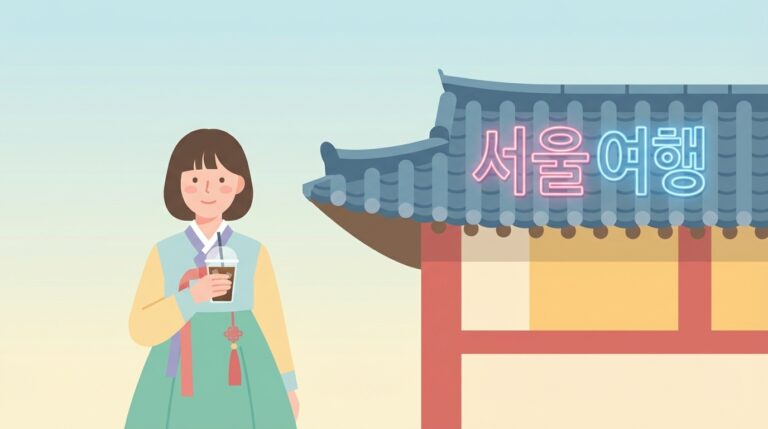
Phase 1: Immersive Hook
Greeting: 안녕하세요! This is your Daily Hangul Chief Editor.
Imagine this scene: You are walking down a narrow alleyway where 1,000-year-old royal tombs loom in the background, but right in front of you is a sleek, glass-walled cafe serving basil pesto pasta. K-Pop beats drift from a traditional Hanok roof. This is Gyeongju Hwangnidan-gil (황리단길), the absolute epicenter of Korea’s “Newtro” (New + Retro) craze.
Perhaps you’ve seen it in dramas like Mr. Sunshine—that specific late 19th-century “Enlightenment Era” aesthetic. You want to rent a Hanbok, sip an Einspänner at a hotplace, and blend in. But here’s the catch: Standard textbook Korean like “이 한복 예뻐요 (This Hanbok is pretty)” won’t capture the vibe. To truly navigate this trendy intersection of history and hipster culture, you need the language of the modern Korean aesthete.
Today, we aren’t just learning words; we are decoding the sophisticated social currency of Gyeongju’s cafe and fashion scene. Let’s dive in.
Phase 2: Deep Dive Expressions
1. 인생샷을 건지다 (Insaeng-shot-eul geonjida)
- Pronunciation: [In-saeng-syat-eul geon-ji-da] (Think: In-sang + shot + gun-jee-da like ‘gee’ in geese)
- Meaning:
- Literal: To fish out/salvage a life shot.
- Real Nuance: To successfully take the best photo of your life; a photo worthy of being your profile picture for the next year.
- K-Culture Moment: You’ll hear this constantly in Hwangnidan-gil. A couple takes 50 photos in front of a Hanok wall. Suddenly, the girlfriend checks her phone and exclaims, “대박, 하나 건졌다!” (Jackpot, I salvaged one!).
- Editor’s Insight: The verb 건지다 is key here. It implies effort. You didn’t just take a photo; you sifted through the chaos of reality to rescue that one perfect moment. It elevates photography to a treasure hunt.
- Situation Spectrum:
[🚫 Formal Reports] ———— [⚠️ Semi-formal] ———— [✅ Casual/Social Media]- 🤔 Think About It: Why does Korean culture use a verb related to ‘fishing/salvaging’ for photography? Does this reflect the high standards of visual perfection required in Korea’s digital society?
2. 개화기 감성 (Gaehwagi gamseong)
- Pronunciation: [Gae-hwa-gi gam-seong]
- Meaning:
- Literal: Enlightenment Period Sensibility/Emotion.
- Real Nuance: The specific vintage aesthetic of Korea in the late 19th/early 20th century (modernity meeting tradition). Think lace gloves, velvet dresses, and fedoras mixed with Hanbok.
- K-Culture Moment: Walking into a cafe with antique mahogany furniture and stained glass lamps. This is the distinct vibe of dramas set in the 1900s, heavily heavily influenced by the show Mr. Sunshine.
- Editor’s Insight: 감성 (Gamseong) is a C2-level powerhouse word. It’s not just ‘emotion’; it’s ‘vibe,’ ‘aesthetic,’ and ‘mood’ rolled into one. Attaching a noun before ‘gamseong’ (e.g., camping gamseong, cafe gamseong) is how locals describe atmosphere.
- Situation Spectrum:
[🚫 Business Meeting] ———— [✅ Reviews/Conversation] ———— [✅ Social Media]- 🤔 Think About It: Why is this specific historical period (roughly 1876-1910) romanticized in modern Korean pop culture despite the turbulent history associated with it?
3. 웨이팅이 장난 아니다 (Waiting-i jangnan anida)
- Pronunciation: [Wei-ting-i jang-nan a-ni-da]
- Meaning:
- Literal: The waiting is not a joke/prank.
- Real Nuance: The line is insanely long; the wait time is brutal.
- K-Culture Moment: You arrive at the famous Sibwon-ppang (10-won bread) stand. The line wraps around the block. You turn to your friend and sigh, “와, 여기 웨이팅 장난 아니다.”
- Editor’s Insight: Koreans often use the English loanword “Waiting” (웨이팅) specifically for restaurant queues. 장난 아니다 is the ultimate intensifier for anything extreme—good or bad.
- Situation Spectrum:
[🚫 High Formal] ———— [⚠️ Polite with 'yo'] ———— [✅ Casual]
Phase 3: Textbook vs. Real Life
| Situation | 📖 Textbook Korean | 🗣️ Real Korean (Insa) | 💡 Why different? |
|---|---|---|---|
| Asking for a photo | 사진 좀 찍어주시겠어요? (Could you take a picture?) | 혹시 저희 인생샷 좀 부탁드려도 될까요? (Could we ask for a ‘life shot’?) | The latter jokingly puts pressure on the photographer to do a good job, building instant rapport. |
| Describing the cafe | 분위기가 좋아요. (The atmosphere is good.) | 여기 완전 사진 맛집이네. (This place is a ‘photo restaurant’.) | ‘맛집’ (delicious restaurant) is now used for anything excellent (scenery, photos, lighting). |
| Waiting line is long | 줄이 너무 길어요. (The line is too long.) | 웨이팅 지옥이다… (It’s ‘waiting hell’…) | Hyperbole is essential in Korean internet/slang culture to express frustration humorously. |
Bottom Note: Use “사진 맛집” when posting on Instagram. It allows you to search for hotspots that are visually guaranteed.
Phase 4: Cultural Deep Dive
4-1. Non-verbal: The “Madam Photographer” Stance
When you ask a Korean to take your photo in Hwangnidan-gil, or when you take one for them, simply standing and clicking is insufficient. The cultural norm is dedication. You must squat, tilt the phone, and take at least 10 rapid-fire shots from different angles. Showing this effort is a sign of Jeong (affection/connection).
4-2. K-Culture Connection: The “Newtro” Phenomenon
Hwangnidan-gil is the physical embodiment of the K-Drama trope where the past meets the present.
– K-Drama: Think of The King: Eternal Monarch or Mr. Sunshine. The visual appeal comes from the clash of eras.
– Hanbok Rentals: You will see two main styles: Traditional (전통) vs. Theme/Fusion (테마/퓨전). The “Theme” Hanbok often features lace, gold foil, and pastel tones—historically inaccurate but aesthetically aligned with K-Pop stage costumes. Purists may critique it, but in the realm of Instagram tourism, aesthetic reigns supreme.
Phase 5: Immersive Roleplay
Scenario: It is 2:00 PM on a sunny Saturday. You are at a high-end Hanbok rental shop in Hwangnidan-gil. You’ve picked a skirt, but you need help with styling.
Characters:
– YOU: A fashion-conscious traveler who wants the “Premium” look.
– Owner (이모님): A fast-talking, energetic middle-aged woman who knows exactly what looks good.
Dialogue:
이모님: 자기야, 이 치마엔 저고리가 너무 밋밋해. 이걸로 입어봐.
(Jagi-ya, i chima-en jeogori-ga neomu mimmit-hae. Igeollo ibeobwa.)
[Translation] Honey, the top is too plain for this skirt. Try this one on.
YOU: 아, 그래요? 저는 좀 개화기 감성으로 입고 싶은데요.
(Ah, geuraeyo? Jeoneun jom gaehwagi gamseong-euro ipgo sipeundeyo.)
[Translation] Oh, really? I actually want to dress with that “Enlightenment era” vibe.
이모님: 아~ 뭔지 알지! 그럼 머리에 장식도 좀 화려한 걸로 해야 사진이 잘 나와.
(Ah~ mwonji alji! Geureom meori-e jangsik-do jom hwaryeohan geollo haeya sajini jal nawa.)
[Translation] Ah~ I know what you mean! Then you need flashy hair accessories so the photos turn out well.
🔀 Decision Point! How do you respond?
- A) “네, 그냥 기본으로 해주세요.” (No, just the basic please.)
- B) “맞아요! 인생샷 건져야 하니까 풀세팅으로 해주세요!” (Right! I need to snag a life shot, so give me the full setting!)
- C) “너무 비싸요. 깎아주세요.” (Too expensive. Discount please.)
✅ Best Choice: B — This shows you understand the goal (photos) and the culture. The owner will likely put extra effort into your hair braiding.
⚠️ Choice C Analysis: While bargaining is possible in markets, fixed-price rental shops usually have set rates for accessories. Asking for a discount immediately might sour the mood.
Phase 6: 10-Second Shadowing Drill
Emotion: Excited & slightly in awe (😍)
Sentence:
“솔직히 / 여기 조명이 좋아서 / 막 찍어도 / 인생샷이에요!”
(Soljiki / yeogi jomyeong-i joaseo / mak jjigeodo / insaeng-syasi-eyo!)
Meaning: “Honestly / because the lighting here is good / even if you snap randomly / it’s a life shot!”
Phase 7: K-Culture Glossary
| Korean | Romanization | Meaning | Context |
|---|---|---|---|
| 핫플 | Hot-ple | Hot Place | A trendy location that is popular on social media. |
| 한옥 | Hanok | Traditional House | In Gyeongju, many cafes/hotels are renovated Hanoks. |
| 대여 | Daeyeo | Rental | Used for Hanbok, bikes, or scooters. |
| 보증금 | Bojeung-geum | Deposit | Usually required for Hanbok rentals (often an ID card). |
| 물품 보관함 | Mulpum bogwan-ham | Locker | Where you store your regular clothes while wearing Hanbok. |
Phase 8: Traveler’s Survival Kit (Gyeongju Edition)
🆘 Survival Expression #1
– 🇰🇷 “머리 손질도 포함된 가격인가요?” (Meori sonjil-do poham-doen gagyeong-ingayo?)
– Meaning: Is hair styling included in the price?
– Why: Some shops charge extra (3,000~5,000 KRW) for complex braiding with pearls.🆘 Survival Expression #2
– 🇰🇷 “반납 시간은 몇 시까지예요?” (Bannap sigan-eun myeot si-kkaji-yeyo?)
– Meaning: Until what time is the return time?
– Pro Tip: Late fees are strictly calculated by the hour. Be punctual!📌 Editor’s Travel Note
– Hanbok Perks: Wearing a Hanbok gets you free entry into major palaces and royal tombs (Cheonmachong, etc.) in Gyeongju!
– Shoes: Most rentals don’t include shoes. Wear comfortable sneakers (you can hide them under the skirt) or bring your own neutral-colored flats. Walking in Hwangnidan-gil involves gravel and pavement.
Phase 9: Think Deeper — “Newtro” and Identity
Topic: The Nostalgia for a Past We Never Lived
Why are Koreans in their 20s obsessed with Gaehwagi (Enlightenment Era) styles? It represents a time of rapid modernization and influx of new cultures, much like today. But critically, it sanitizes history. By focusing on the gamseong (vibe) of lace dresses and coffee, the younger generation reclaims a period of historical trauma as a playground for aesthetic expression. It is a selective memory—filtering out the pain to enjoy the style.
💬 Your Turn: Does your country have a fashion era that is controversial yet popular? How do you balance history with aesthetics?
Phase 10: FAQ & Troubleshooting
Q: Can I wear the Hanbok into a cafe?
A: YES! That is the whole point of Hwangnidan-gil. Cafes expect it. Just be careful not to drag the skirt on wet bathroom floors.
Q: Is it rude to take photos in a quiet cafe?
A: Generally, no, if you are quick. However, commercial photography (changing outfits, using massive reflectors) is banned. Using your phone for a quick insaeng-shot is standard behavior.
❌ Common Mistake: Calling an older female owner “아줌마 (Ajumma).”
✅ Do this instead: Call her “사장님 (Sajang-nim – Boss)” or “이모님 (Imo-nim – Auntie)” if she is friendly. “Ajumma” can sound rude or dismissive in a service setting.
Phase 11: Wrap-up
One-Liner: In Gyeongju, you don’t just ‘visit’; you ‘capture’ the moment with Insaeng-shots and Gaehwagi vibes.
Action Missions:
– 🥉 Bronze: Look in the mirror and practice the phrase: “와, 이거 완전 개화기 감성이다.”
– 🥈 Silver: Search #황리단길 on Instagram and comment “사진 맛집이네요!” on a post.
– 🥇 Gold: When you visit a cafe (even in your home country), take a photo of your friend and say, “움직이지 마, 인생샷 건졌어!”
K-Culture Mission: Watch a clip of the drama Mr. Sunshine on YouTube. Observe the clothing and the interiors. That is the Gaehwagi Gamseong you will find in Gyeongju.
Phase 12: Quiz — Interactive Challenge
- Situational Judgment: You see a cafe with a long line. You want to express surprise at the crowd to your Korean friend. What is the most natural C2-level reaction?
- A) 사람이 많아요. (There are many people.)
- B) 웨이팅이 장난 아니네. (The waiting is no joke.)
- C) 줄이 깁니다. (The line is long.)
- K-Culture True or False:
- “In Korea, if you rent a Hanbok, you must take it off before entering a restaurant or cafe.” (True/False)
- Fill in the Blank:
- “Did you see the photo I took? Complete _______ (jackpot/awesome), right?”
- “대박이죠? 완전 ______ 건졌어요!”
Answers:
1. B (A and C are correct but sound like a textbook. B captures the slang/cultural nuance.)
2. False (It is fully encouraged to wear it everywhere in Gyeongju.)
3. 인생샷 (Insaeng-shot)
Frequently Asked Questions (FAQ)
Q: What does "인생샷을 건지다 (Insaeng-shot-eul geonjida)" mean in Korean and how do you pronounce it?
A: In Korean, "인생샷을 건지다 (Insaeng-shot-eul geonjida)" is pronounced [In-saeng-syat-eul geon-ji-da] and means: Literal: To fish out/salvage a life shot.
Q: What does "개화기 감성 (Gaehwagi gamseong)" mean in Korean and how do you pronounce it?
A: In Korean, "개화기 감성 (Gaehwagi gamseong)" is pronounced [Gae-hwa-gi gam-seong] and means: Literal: Enlightenment Period Sensibility/Emotion.
Q: What does "웨이팅이 장난 아니다 (Waiting-i jangnan anida)" mean in Korean and how do you pronounce it?
A: In Korean, "웨이팅이 장난 아니다 (Waiting-i jangnan anida)" is pronounced [Wei-ting-i jang-nan a-ni-da] and means: Literal: The waiting is not a joke/prank.






