

Phase 1: Immersive Hook
Hello! This is your Daily Hangul Editor.
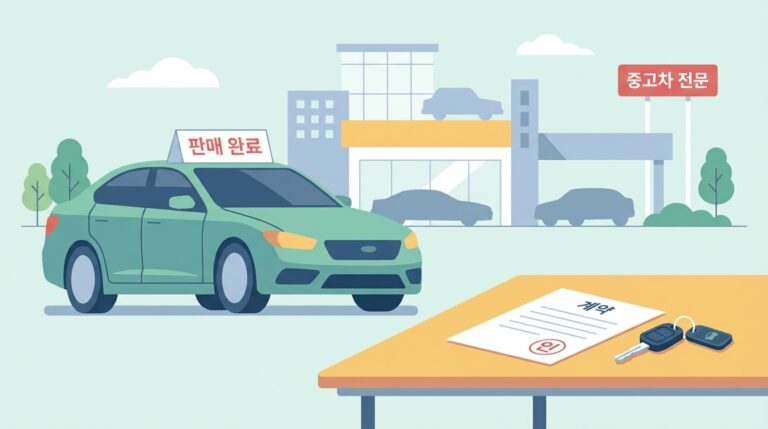
Picture this: You are the protagonist in a gritty Korean crime thriller (think The Roundup or a scene from Vincenzo). You need a getaway car, or maybe just a reliable ride to commute to your new job in Pangyo. You walk into a massive used car complex that looks more like a futuristic fortress than a parking lot.
The dealer approaches you with a smile that’s a little too bright. He points to a shiny sedan. “Sajangnim, this is a total steal. A unicorn!”
In K-Dramas, this is usually the moment the naive character gets ripped off, buying a car that breaks down two blocks away. But not you. You’re equipped with the linguistic armor to distinguish a ‘kkul-mae-mul’ (honey deal) from a ‘chim-su-cha’ (flooded car).
Buying a used car in Korea requires high-level psychological warfare, specific vocabulary that doesn’t exist in textbooks, and a heavy dose of nunchi. Today, we are going to upgrade your Korean from “survival mode” to “negotiator mode.”
Phase 2: Deep Dive into Key Expressions
1. [무사고 vs. 완전 무사고]
- Pronunciation: [Mu-sa-go] vs. [Wan-jeon mu-sa-go]
- Meaning: Accident-free vs. Completely accident-free
- Nuance: This is a critical distinction in the Korean market. ‘무사고’ (Accident-free) often includes cars that have had “simple repairs” like bolted parts (doors, fenders, trunk) replaced. The logic is that the frame wasn’t damaged. ‘완전 무사고’ (Completely accident-free) means the car has never had a single screw turned for repair.
- K-Culture Moment: In investigative news programs or consumer protection shows, you often see blurred faces of angry buyers yelling, “You said it was musago!” only to find out the door was replaced.
- Editor’s Insight: If a dealer emphasizes “It is musago,” you must ask, “Is it wanjeon musago?” Watch their eyes twitch.
- Situation Spectrum:
[🚫 Casual] ———— [✅ Business/Market] ———— [✅ Formal]
🤔 Think About It: Why does the Korean market make this semantic distinction? It reflects a culture that highly values “original condition” and purity, drastically affecting resale value (gam-ga-sang-gak) even for cosmetic changes.
2. [쿨거래 / 네고]
- Pronunciation: [Kul-geo-rae] / [Ne-go]
- Meaning: Cool deal (Hassle-free transaction) / Negotiation
- Nuance: ‘쿨거래’ is a slang term born from online marketplaces (Karrot Market, Joonggonara). It implies, “I won’t ask annoying questions, I have cash ready, let’s make this quick.” In exchange for a cool deal, buyers often expect ‘네고’ (a discount).
- K-Culture Moment: Imagine a confident character in a drama throwing an envelope of cash on the table. “Here is the full amount. Kul-geo-rae, okay?”
- Editor’s Insight: Don’t ask “Can you give me a discount?” instead say, “If I do kul-geo-rae right now, how much nego is possible?”
- Situation Spectrum:
[✅ Online/Market] ———— [⚠️ Dealership] ———— [🚫 Department Store]
3. [성능기록부]
- Pronunciation: [Seong-neung gi-rok-bu]
- Meaning: Performance Check Record
- Nuance: This is the bible of the used car transaction. It is a legal document stating the car’s health. Demanding this shows you are not a tourist; you are a serious buyer who knows the system.
- Editor’s Insight: If a dealer hesitates to show this or says, “I’ll show you later,” run away. Immediately.
Phase 3: Textbook vs. Real Life
| Situation | 📖 Textbook Korean | 🗣️ Real Korean | 💡 Why the difference? |
|---|---|---|---|
| Asking for a discount | 가격을 깎아 주실 수 있나요? (Can you discount the price?) | 차비 좀 빼 주세요. (Please take off some ‘car fare’.) | “Cha-bi” (transport money) is a culturally polite way to ask for a discount, implying you traveled far to get here. |
| Asking about options | 어떤 옵션이 있나요? (What options does it have?) | 풀옵인가요? (Is it ‘full-op’?/Full option?) | Koreans value “Full Option” cars highly for status and convenience. “Full-op” is the standard buzzword. |
| Expressing doubt | 이 차는 문제가 없어 보여요. (This car looks like it has no problems.) | 이거 침수차 아니죠? (This isn’t a flooded car, right?) | Since Korea has monsoon seasons, the fear of ‘flooded cars’ (chim-su-cha) is the #1 suspicion buyers have. |
💡 Bottom Note: In the C1 level context, using words like “감가” (depreciation) or “이력” (history) instead of simple words makes you sound like an expert.
Phase 4: Cultural Deep Dive — The Psychology of “Options”
The “Full Option” Obsession
In the West, you might buy a car with manual windows if the engine is good. In Korea, a car without a “sunroof,” “ventilation seats (tong-pung sheet),” and “navigation” is often considered unsellable or “kkantong-cha” (tin can car).
Why?
1. Resale Value: A car without options depreciates (gam-ga) horribly fast.
2. Shared Driving: Korea has a strong designated driver (daeri unjeon) culture. You want your car to look good and feel comfortable when someone else drives you home after a hoesik (company dinner).
Non-verbal Tip: When checking a car, sit in the driver’s seat and immediately press the buttons for the heated/ventilated seats. It signals, “I know what matters in this market.”
Phase 5: Immersive Roleplay Scenario
Setting: Saturday, 2 PM. A sprawling Used Car Complex in Suwon. The air smells of tires and coffee. You are standing in front of a Genesis G80 that looks pristine.
Characters:
* YOU: An expat looking for a reliable sedan. You’ve done your research on Encar (a popular car app).
* Mr. Park (Dealer): Mid 40s, wearing a gold watch, fast talker, very eager.
Dialogue:
Mr. Park: (Slapping the hood of the car) 아이고, 사장님! 이런 매물 진짜 없어요. 완전 무사고에 1인 신조 차량입니다!
(Aigo, Sajangnim! Ireon maemul jinjja eopseoyo. Wanjeon musago-e irin sinjo charyang-imnida!)
(Oh boss! A listing like this rarely exists. Completely accident-free and owned by one person since new!)
YOU: 겉은 깨끗해 보이네요. 그런데 성능기록부에는 ‘단순 교환’도 없다고 나와 있나요?
(Geoteun kkaekkeuthae boineyo. Geureonde seongneung-girokbu-eneun ‘dansun gyohwan’do eopdago nawa innayo?)
(The outside looks clean. But does the Performance Record say there are no ‘simple replacements’ either?)
Mr. Park: (Hesitating slightly) 아, 범퍼는 소모품이라… 살짝 긁혀서 도색만 한 번 했어요. 그건 사고로 안 쳐요.
(Ah, beompeo-neun somopumira… saljjak geulkyeoseo dosaekman han beon haesseoyo. Geugeon sagoro an chyeoyo.)
(Ah, bumpers are consumables… it was slightly scratched so we just painted it. We don’t count that as an accident.)
🔀 Decision Point: Mr. Park is downplaying the repair. How do you respond?
- A) “아, 그렇군요. 알겠습니다.” (Accepting his logic – Passive)
- B) “범퍼 교환도 이력에 남잖아요. 감가 요인이니까 가격 좀 시원하게 빼 주세요.” (Using logic to leverage a discount)
- C) “사고차네! 안 사요!” (Overreacting – might lose a decent car)
✅ Best Choice: B
Reason: You acknowledge the reality (bumpers are minor), but you use the technical fact (it’s on the record) to demand a ‘nego’. Using terms like “감가 요인” (depreciation factor) and “시원하게” (coolly) shows you are a pro negotiator.
Phase 6: 10-Second Shadowing Drill
Practice saying this with a confident, slightly skeptical tone.
“Since I’m paying in cash / can you give me a ‘cool deal’ / covering the transport fee?”
🇰🇷 현금으로 할 건데 / 차비 명목으로 / 쿨거래 네고 / 가능할까요?
([Pronunciation]: Hyeongu-meuro hal geonde / cha-bi myeong-mo-geuro / kul-geo-rae ne-go / ga-neung-hal-kkayo?)
Emotion: 😎 Confident & Business-savvy (Not begging, but proposing)
Phase 7: K-Culture Glossary (Car Edition)
| Korean | Romanization | English | Context |
|---|---|---|---|
| 블랙박스 (블박) | Black Box | Dashcam | Essential in Korea. Used for insurance claims and reporting traffic violations. Buying a used car without one is rare. |
| 1인 신조 | Irin sinjo | One-owner car | A highly coveted status. It implies the previous owner took great care of it (unlike a rental or company car). |
| 침수차 | Chim-su-cha | Flooded car | The ultimate nightmare of Korean used car buyers, especially after the summer monsoon season. |
| 매물 | Mae-mul | Item for sale | The standard term for a car listed on the market. |
| 문콕 | Mun-kok | Door ding | The act of banging your door into the next car in tight Korean parking lots. Highly sensitive issue. |
Phase 8: Traveler’s & Driver’s Survival Kit
Even if you aren’t buying, you might rent or drive. Here is your survival kit.
🆘 Driving Survival Expressions
– 🇰🇷 “여기에 주차해도 되나요?” (Yeogie jucha-haedo doenayo?)
– “Can I park here?” (Crucial, as parking enforcement is strict.)
– 🇰🇷 “기름 만땅으로 채워주세요.” (Gireum manttang-euro chaewo-juseyo.)
– “Fill it up full, please.” (‘Manttang’ is a very common slang derived from Japanese ‘Mantan’, widely used at gas stations.)
– 🇰🇷 “대리 불러주세요.” (Daeri bulleo-juseyo.)
– “Please call a designated driver.” (Essential after drinking.)📌 Editor’s Pro Tip: The Hazard Lights (Bissang-deung)
In Korea, hazard lights are the universal language for “Thank you” or “I’m sorry.” If someone lets you merge, blink them 3 times. It’s polite driving etiquette!
Phase 9: Think Deeper — “Trust in a High-Context Society”
Language & Trust
Why does the Korean used car market rely so heavily on terms like “Cool Transaction” or “Trust”? Historically, the used car market (often called ‘Jang-an-pyeong’ in the old days) had a reputation for scams. The evolution of language reflects a desperate attempt to build transparency.
The rise of corporate platforms (like K Car) has changed the vocabulary from “haggling” to “warranty.” Yet, the old habit of asking for “cha-bi” (gas money discount) remains as a vestige of Jeong (affection/connection) — a small gesture that says, “We are humans trading, not just robots.”
💬 Your Turn: In your country, is haggling for a used car expected, or is the price fixed? Do you have a specific word for a “lemon” (bad car)?
Phase 10: FAQ & Troubleshooting
Q: Can I really ask for “Cha-bi” (Gas money) even if I live nearby?
A: Yes! It’s a figure of speech. It’s a polite, culturally accepted way to ask for the final small discount (maybe 50,000 ~ 100,000 KRW) to close the deal. It softens the hard edge of negotiation.
Q: What if the dealer speaks informal Korean (Banmal) to me because I’m a foreigner?
A: Maintain your frame. Continue speaking polite formal Korean (Yo-form or Nida-form). If it bothers you, you can say jokingly, “사장님, 저 한국말 잘해요. 존댓말 해주세요.” (Boss, I speak Korean well. Please use honorifics.) This usually embarrasses them into politeness.
❌ Common Mistake:
Signing the contract without checking the Insurance History (Bo-heom I-ryeok). Never trust verbal promises like “It was just a scratch.”
Phase 11: Wrap-up & Action Items
One-Liner Summary:
Buying a car in Korea is about balancing technical scrutiny with the social art of “Cool Dealing” (Kul-geo-rae).
🏆 Action Missions:
– 🥉 Bronze: Practice the pronunciation of “Wanjeon Musago” and “Kul-geo-rae” in front of a mirror.
– 🥈 Silver: Go to a Korean used car website (like Encar.com) and try to read a Seong-neung gi-rok-bu (Performance Record). Look for ‘X’ marks on the car skeleton diagram.
– 🥇 Gold: Visit a dealership (or pretend to be a buyer) and ask, “Is negotiation possible for a cool deal?” (Kul-geo-rae nego ganeunghayo?)
Phase 12: Interactive Quiz
- Situation Judgment: The dealer says the car is “Musago” (Accident-free), but you see the hood has been replaced in the records. What is the most accurate understanding?
- A) He is lying completely.
- B) In Korea, simple external replacements are often legally categorized as “Musago,” but it’s not “Wanjeon Musago.”
- C) The car was definitely flooded.
- True or False: blinking your hazard lights after cutting in front of someone is considered rude in Korea.
- ( True / False )
- Fill in the Blank: You want to ask for a final small discount politely. “Sajangnim, please take off some _________.”
- ( Cha-bi / Rice money / Coffee money )
Answers:
1. B (It’s a technicality in the Korean market. Always check if it’s Wanjeon.)
2. False (It is a polite gesture of thanks or apology.)
3. Cha-bi (Car fare/Gas money).
Frequently Asked Questions (FAQ)
Q: What does "[무사고 vs. 완전 무사고]" mean in Korean and how do you pronounce it?
A: In Korean, "[무사고 vs. 완전 무사고]" is pronounced [Mu-sa-go] and means: Accident-free vs. Completely accident-free
Q: What does "[쿨거래 / 네고]" mean in Korean and how do you pronounce it?
A: In Korean, "[쿨거래 / 네고]" is pronounced [Kul-geo-rae] and means: Cool deal (Hassle-free transaction) / Negotiation
Q: What does "[성능기록부]" mean in Korean and how do you pronounce it?
A: In Korean, "[성능기록부]" is pronounced [Seong-neung gi-rok-bu] and means: Performance Check Record







