

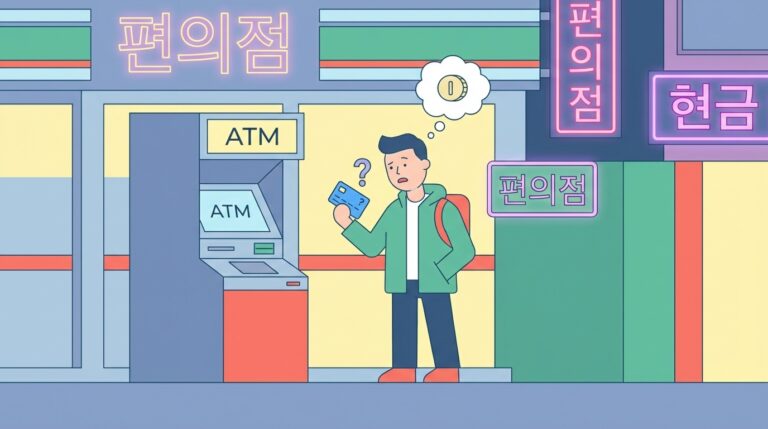
Phase 1: The Panic at the Bungeoppang Stall 🐟
Hello! This is your Daily Hangul Editor.
Picture this: You are walking down a street in Seoul in winter. You smell something sweet and nutty. It’s a Bungeoppang (fish-shaped pastry) stall! You excitedly reach for your wallet, but then you see the sign: “CASH ONLY” (현금 결제만 가능).
Or maybe you just landed, and you need to recharge your T-money card to take the subway, but the machine only accepts cash.
In K-Dramas, whenever the protagonist runs away from home or goes on a secret trip, they always stop at a convenience store (pyeoneui-jeom) first. Why? Because it’s the lifeline for everything—including cash.
Today, we are going to learn how to save your life (and your stomach) by finding an ATM in a Korean convenience store. Don’t worry, it’s easier than you think!
Phase 2: Deep Dive into Key Expressions 🧐
Here are the 3 golden phrases you need to get your hands on some Won.
1. 여기 ATM 있어요?
(Yeogi ATM isseoyo?)
- Pronunciation: [Yeo-gi A-T-M i-sseo-yo?]
- Tip: “Yeogi” sounds like “Yogi” (the bear). “Isseoyo” sounds like saying “Is-so-yo” quickly.
- Meaning: Is there an ATM here?
- K-Culture Moment: In the drama Squid Game, cash is king. In real life, while Korea is very digital, specific moments (like street food or old markets) still demand hard currency.
- Editor’s Insight: You can use the English word “ATM.” Everyone understands it. The official word is complicated, so stick to “ATM.”
- Situation Spectrum:
[🚫 Formal Meeting] ———— [⚠️ Elders] ———— [✅ Convenience Store Staff]
- Note: Perfectly safe to use with store clerks!
- 🤔 Think About It: Why do Koreans use the English acronym “ATM” instead of the Korean word? (Hint: It’s all about efficiency!)
2. 현금 인출기 어디예요?
(Hyeongeum inchulgi eodiyeyo?)
- Pronunciation: [Hyeon-geum in-chul-gi eo-di-ye-yo?]
- Tip: “Hyeongeum” (Cash) sounds like a hum. “Eodi” means where.
- Meaning: Where is the cash dispenser?
- Editor’s Insight: Use this if you are in a large store and can’t see the machine. It’s slightly more specific than just asking for an ATM.
- Situation Spectrum:
[🚫 King Sejong] ———— [✅ Strangers/Clerks] ———— [✅ Friends]3. 수수료 얼마예요?
(Susuryo eolmayeyo?)
- Pronunciation: [Su-su-ryo eol-ma-ye-yo?]
- Tip: “Su-su-ryo” is tricky. Think of it as “Sue-Sue-Rio”. It means “fee.”
- Meaning: How much is the fee?
- K-Travel Reality: Foreign cards often incur a fee (usually 3,600 KRW ~ 4,000 KRW) at convenience store ATMs. It’s painful, but sometimes necessary!
- Situation Spectrum:
[✅ Universal]
Phase 3: Textbook vs. Real Life 🥊
| Situation | 📖 Textbook Korean | 🗣️ Real Korean (Street Smart) | 💡 Why the difference? |
|---|---|---|---|
| Asking for an ATM | 현금 자동 입출금기가 있습니까? (Hyeongeum jadong ipchulgeumgiga isseumnikka?) | ATM 있어요? (ATM isseoyo?) | The textbook version is too long! Koreans love speed (Pbali-Pbali culture). |
| Finding the location | 그것은 어디에 위치해 있습니까? (Geugeoseun eodie wichihae isseumnikka?) | 어디 있어요? (Eodi isseoyo?) | “Wi-chi” (located) is for maps, not for asking a part-timer. |
| Checking the fee | 수수료는 얼마입니까? (Susuryoneun eolmainnikka?) | 수수료 얼마예요? (Susuryo eolmayeyo?) | Drop particles like ‘neun’ in speech for a more natural flow. |
💡 Bottom Note: Unless you are writing a formal report to a bank CEO, stick to the Real Korean column!
Phase 4: Cultural Deep Dive — The “Global ATM” Hunt 🌏
4-1. Non-verbal Communication (Nunchi)
When you walk into a convenience store (CU, GS25, 7-Eleven), don’t just shout. Use your Nunchi (eye-measure/sense).
1. Scan the room. ATMs are usually in the back corner or near the door.
2. If you can’t find it, make eye contact with the clerk, bow slightly (head nod), and then ask.
4-2. K-Travel Connection: The “Global” Sign
Not all ATMs accept foreign cards! This is a classic traveler’s panic moment.
– Look for the sign: You MUST find a machine with the “Global Services” or “Foreign Cards” logo.
– K-Drama Trope: Remember the scene where the rich CEO’s card gets declined? That could be you if you try to use a domestic-only machine with your Visa/Mastercard.
– Pro Tip: Most major convenience stores in tourist areas (Myeongdong, Hongdae, Gangnam) have Global ATMs. In rural areas? It’s a gamble.
Phase 5: Immersive Roleplay 🎬
Setting: A bustling GS25 in Hongdae on a Friday night (10 PM). You need cash for street food. The store is playing loud K-Pop music (NewJeans).
Characters:
– YOU: A hungry traveler craving spicy rice cakes (Tteokbokki).
– Min-su (Clerk): A tired but kind university student working part-time.
(Scene Start)
YOU: (Walking to the counter) 저기요… ATM 있어요?
(Jeogiyo… ATM isseoyo?)
(Excuse me… Is there an ATM?)
Min-su: (Points to the corner) 네, 저쪽에 있어요.
(Ne, jeojjoge isseoyo.)
(Yes, it’s over there.)
YOU: (Looking at the machine) 아, 혹시… 글로벌 카드 돼요?
(Ah, hoksi… global card dwaeyo?)
(Ah, by any chance… does it accept global cards?)
Min-su: 네, 됩니다.
(Ne, doemnida.)
(Yes, it works.)
YOU: 감사합니다!
(Gamsahamnida!)
(Thank you!)
(Wait! The machine shows a fee of 4,000 KRW!)
🔀 Decision Point: What do you say to yourself?
- A) “아, 너무 비싸요! 안 뽑을래요.” (Ah, too expensive! I won’t withdraw.)
- B) “배고파요. 그냥 뽑아요.” (I’m hungry. Just withdraw it.)
- C) (To the clerk) “수수료 깎아주세요?” (Discount on the fee, please?)
✅ Best Choice: B — Convenience comes at a price! The fee is standard for foreign cards.
⚠️ Why not C? — The clerk has zero control over bank fees. Asking for a discount here would be very awkward!
Phase 6: 10-Second Shadowing Drill 🗣️
Repeat after me! Focus on the intonation.
- Is there an ATM? (Checking existence)
- 🇰🇷 여기 / ATM / 있어요? ↗
- 🔊 [Yeogi / ATM / isseoyo?] (😊 Polite & Curious)
- Does my card work? (Checking function)
- 🇰🇷 제 카드 / 돼요? ↗
- 🔊 [Je kadeu / dwaeyo?] (🥺 Slightly worried)
- Thank you! (Success)
- 🇰🇷 감사합니다! ↘
- 🔊 [Gamsahamnida!] (😊 Happy)
Phase 7: K-Culture Glossary 📚
| Korean | Romanization | Meaning | Context |
|---|---|---|---|
| 현금 | Hyeongeum | Cash | Still essential for street food, recharging transport cards, and some traditional markets. |
| 수수료 | Susuryo | Fee | The extra money you pay to the bank. Usually 1,000~4,000 KRW for ATMs. |
| 편의점 | Pyeoneui-jeom | CVS | The holy grail of Korean life. Open 24/7. |
| 공인인증서 | Gong-in-injeung-seo | Digital Certificate | You don’t need this for ATMs, but it’s the “final boss” of Korean online banking hell. Be glad you are just using cash! |
Phase 8: Traveler’s Survival Kit 🧳
Finding Cash in Korea: The cheat sheet.
🆘 Survival Phrases TOP 3
1. 🇰🇷 “글로벌 ATM이에요?” (Is this a Global ATM?)
2. 🇰🇷 “오만 원권 돼요?” (Does it accept 50,000 won bills? – usually for deposit)
3. 🇰🇷 “잔돈 좀 바꿔주세요.” (Please change this into small change. – Note: Clerks might refuse if they are low on change.)📌 Editor’s Travel Note
– App Tip: Use Naver Map or Kakao Map. Search for “ATM” nearby. Google Maps is often outdated in Korea.
– Cash Culture: While 90% of places take cards, street food (Bungeoppang, Hotteok) and T-money recharging machines are strictly CASH ONLY. Always carry 30,000 KRW in cash just in case.
Phase 9: Think Deeper — “Cash in a Digital Nation” 🧠
Topic: Why does high-tech Korea still use cash?
Korea is one of the most cashless societies in the world. You can pay for a taxi with your phone and buy a soda with your watch. Yet, the “Street Food Culture” (Gilgeori eumsik) keeps cash alive. Why?
It’s partly about tradition and the informal economy. The Ahjumma (middle-aged lady) selling Tteokbokki isn’t a corporation; she’s a micro-business. Paying cash is often seen as a small gesture of support (and yes, sometimes tax reasons). Also, for foreigners, cash is the ultimate safety net when technology fails.
💬 Your Turn: Does your country have “Cash Only” places? Or is everything digital now?
Phase 10: FAQ & Troubleshooting 🛠️
Q: The machine “ate” my card! What do I do?
A: Don’t panic! There is usually a phone attached to the ATM. Lift it. If you can’t speak Korean, shout “Help! English please!” or ask the store clerk: “카드가 안 나와요” (My card won’t come out).
Q: Can I use this expression with a bank teller?
A: You can, but banks are more formal. At a bank, you’d usually take a number ticket and sit down. The phrases “ATM 있어요?” is best for convenience stores or asking security guards.
❌ Common Mistake:
– Thinking all ATMs are open 24/7. Store ATMs are usually 24/7, but Bank ATMs inside branches often lock their doors after 11 PM or midnight!
Phase 11: Wrap-up & Action Items 🎁
One-Liner Summary: To survive in Korea, find the “Global ATM” logo and don’t be afraid to pay the fee for that sweet street food cash.
🚀 Action Mission:
– 🥉 Bronze: Say “ATM 있어요?” aloud 3 times right now.
– 🥈 Silver: Open Naver Maps and search for “ATM” in Seoul (even if you are at home!). See where they are located.
– 🥇 Gold: Go to a Korean convenience store (or an Asian market near you) and identify where the cash machine is. Imagine asking the clerk the question.
🎬 K-Culture Mission:
– Watch an episode of a Korean travel vlog (like Korean Englishman or a random travel tuber). Spot when they use cash vs. card!
Phase 12: Interactive Quiz 📝
- Situation: You are at a 7-Eleven. You see a machine but don’t see the “Global” sign. What should you ask the clerk?
- A) 수수료 얼마예요? (How much is the fee?)
- B) 글로벌 카드 돼요? (Do global cards work?)
- C) 떡볶이 있어요? (Do you have spicy rice cakes?)
- True or False: You should speak very formally (using -simnida) to a convenience store part-timer asking for an ATM.
- (True / False)
- Culture Check: Why do you need cash in Korea?
- A) To buy a Tesla.
- B) To buy Street Food & recharge T-money.
- C) To pay for Wi-Fi.
Answers:
1. B (Check compatibility first!)
2. False (Polite “-yo” ending is perfect. Too formal can be awkward.)
3. B (The essentials of travel!)







