

Phase 1: Immersive Hook
Hello! This is your Daily Hangul Editor.
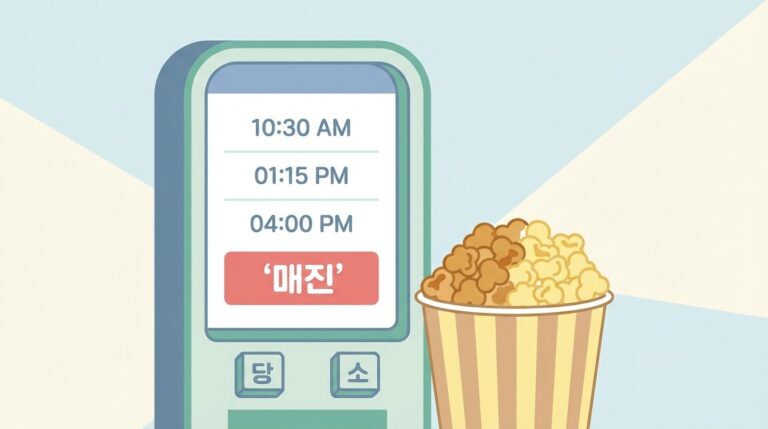
Imagine this: You are in Seoul, and the latest blockbuster movie starring your favorite K-Drama actor just came out. You rush to the cinema, heart pounding. You look up at the digital screen filled with numbers and Hangul.
Suddenly, you see the red text “매진” (Maejin) blinking next to the time you wanted.
Panic sets in. The staff member asks you something rapidly. You just wanted to see the movie, but now you’re holding up the line. In K-Dramas, the main character always gets the last ticket by destiny. In reality? You need the right words to survive the Korean box office.
Don’t worry. Today, we aren’t just learning how to read a schedule; we are learning how to claim your seat in the fast-paced world of Korean cinema culture.
Phase 2: Deep Dive into Key Expressions
Here are the top 3 expressions you need to survive the ticket counter.
1. 몇 시 (Myeot si)
- Pronunciation: [Myeot si] + Sounds like “Myot-she”
- Meaning: What time? (Literal: How many hours?)
- K-Culture Moment: You’ll hear this in variety shows when members are waking up confused: “지금 몇 시예요?” (What time is it now?). At the cinema, it’s your sword.
- Editor’s Insight: Koreans usually use the 12-hour clock in conversation but cinemas use the 24-hour clock (13:00, 14:00) on screens to avoid confusion.
- Situation Spectrum:
[🚫 Formal Speech] ———— [⚠️ Polite/Standard] ———— [✅ Casual]
Use “Myeot si-eyo?” (Polite) with staff.- 🤔 Think About It: Why does Korean have a specific counter word just for “time” (si)? In English, “time” is general. In Korean, precision matters.
2. 매진 (Maejin)
- Pronunciation: [Maejin] + Sounds like “Me-gin” with a soft j
- Meaning: Sold Out
- K-Culture Moment: Every K-Pop fan’s nightmare. Whether it’s a concert ticket or a limited edition movie tumbler, seeing this word means you were too slow.
- Editor’s Insight: If you see red text on the kiosk, it’s likely this word. Don’t try to click it!
- Situation Spectrum:
[N/A - This is a noun used on signs/screens]- 🤔 Think About It: Korea is a high-density society. “Maejin” happens incredibly fast here compared to other countries. What does this say about the “Pbali-pbali” (Hurry, hurry) culture?
3. 예매 (Yemae)
- Pronunciation: [Yemae] + Sounds like “Yeah-meh”
- Meaning: Advance Booking / Reservation
- K-Culture Moment: In dramas, the rich CEO rents out the whole theater. He doesn’t just buy a ticket; he does Yemae for the whole room.
- Editor’s Insight: In Korea, we rarely say “buy a ticket” (pyo-reul sada) at the theater. We say “Yemae” because most people book via apps before arriving.
- Situation Spectrum:
[🚫 Slang] ———— [⚠️ Standard] ———— [✅ Official]
Used in apps and signs mainly.
Phase 3: Textbook vs. Real Life
| Situation | 📖 Textbook Korean | 🗣️ Real Korean | 💡 Why is it different? |
|---|---|---|---|
| Asking for a ticket | “영화표를 한 장 사고 싶습니다.” (I would like to buy one movie ticket.) | “세 시 영화, 한 분이요.” (3 o’clock movie, one person.) | Context is key! We value speed. No need to say “buy” or “ticket.” |
| Choosing a seat | “어느 좌석에 앉으면 좋을까요?” (Which seat would be good to sit in?) | “중간 자리 주세요.” (Middle seat, please.) | Efficiency. The staff knows the best seats; just tell them your preference (Middle/Back). |
Bottom Note: In Korean cinemas, simplicity is polite because it saves everyone’s time.
Phase 4: Cultural Deep Dive
4-1. Non-verbal Communication: The Screen Point
In a noisy theater lobby, words can get lost. When ordering at the counter (if not using a kiosk), it is perfectly polite to point at the screen behind the staff member or the small screen on the counter while saying “Igeo” (This one). It’s not rude; it’s helpful!
4-2. K-Culture Connection: The “Sweetbox” (Couples)
Have you seen K-Dramas where the couple sits in a special seat with no armrest between them? That’s often called a “Sweetbox” or “Couple Seat.”
- Critical Perspective: While romantic in dramas, in reality, these seats are often more expensive. Also, notice how Korean cinemas act as a primary dating course? It’s a safe, public, yet private space for young couples who might live with their parents until marriage.
Phase 5: Immersive Roleplay
Scenario A: The Friday Night Rush
Setting: It’s Friday, 7 PM at a CGV in Gangnam. It’s packed. The smell of caramel popcorn is everywhere. You are with your Korean friend, Min-su.
Characters:
* YOU: A student who really wants to see the new Marvel movie.
* Min-su: Your Korean friend who loves mobile booking.
Dialogue:
Min-su: 사람 진짜 많다! 우리 예매 안 했잖아.
(Saram jinjja manta! Uri yemae an haetjana.)
(Wow, so many people! We didn’t book in advance.)
YOU: (Looking at the screen) 저기… 7시 영화 있어?
(Jeogi… 7-si yeonghwa isseo?)
(Over there… is there a 7 o’clock movie?)
Min-su: 잠깐만. (Checking app) 아, 7시는 매진이야.
(Jamkkanman. Ah, 7-sineun maejiniya.)
(Wait a sec. Ah, 7 o’clock is sold out.)
🔀 Decision Point: What do you say?
* A) “아… 집에 가자.” (Ah… let’s go home.)
* B) “그럼 다음 영화는 몇 시야?” (Then, what time is the next movie?)
* C) “왜 매진이야!” (Why is it sold out!)
✅ Best Choice: B – Even if the prime time is gone, Korean theaters often have late-night screenings (Shim-ya). It shows you know the system!
Min-su: 9시 영화는 자리 있어! 이거 볼래?
(9-si yeonghwaneun jari isseo! Igeo bollae?)
(The 9 o’clock movie has seats! Wanna watch this?)
Scenario B: Bonus K-Culture Moment
Setting: The Popcorn Counter.
Staff: 맛은 무엇으로 하시겠어요? (What flavor would you like?)
YOU: 반반 주세요! (Half-half, please!)
* Context: Just like Fried Chicken, Koreans love “Banban” (Half/Half) popcorn. Usually Caramel + Onion is the god-tier combo.
Phase 6: 10-Second Shadowing Drill
Let’s practice asking for the time. Listen to the intonation!
😢 Sad/Disappointed:
7시 영화는 / 매진이에요.
(Il-gop-si yeonghwaneun / maejinieyo.)
The 7 o’clock movie / is sold out.
😊 Bright/Hopeful:
다음 영화는 / 몇 시예요?
(Daeum yeonghwaneun / myeot siyeyo?)
The next movie / what time is it?
Phase 7: K-Culture Mini Glossary
| Korean | Romanization | Meaning | Context |
|---|---|---|---|
| 조조 | Jo-jo | Morning Discount | The first movie of the day (usually before 10 AM). Very cheap! |
| 심야 | Shim-ya | Late Night | Movies showing after midnight. Popular for night owls. |
| 포토티켓 | Poto-tiket | Photo Ticket | A collectible credit-card-sized ticket with a photo you upload. Huge among fans! |
| 상영시간표 | Sangyeong-siganpyo | Showing Schedule | The scary table of numbers you see on the wall. |
Phase 8: Traveler’s Survival Kit
Most ticketing in Korea is done via Kiosks. Here is your survival guide.
🆘 Survival Phrases
1. “자리 있어요?” (Jari isseo-yo?) – Are there seats?
2. “성인 두 명이요.” (Seong-in du-myeong-iyo) – Two adults, please.
3. “주차권 주세요.” (Jucha-gwon juseyo) – Please give me a parking pass.📌 Editor’s Travel Note
* Apps: Utilize the CGV or Lotte Cinema apps. They have English settings often, but the seat maps are visual.
* Popcorn: Did you know you can bring outside food into many Korean cinemas? However, strongly smelling food (like tteokbokki) is considered bad manners (bad nunchi).
Phase 9: Think Deeper — Efficiency Culture
Topic: Why is “Yemae” (Pre-booking) so critical?
In Korea, walking into a theater and buying a ticket on the spot is becoming rare. This reflects the “Pbali-pbali” (Hurry-hurry) culture and the high value placed on efficiency. Koreans hate wasting time standing in lines. By booking on an app, they can arrive 5 minutes before the movie, grab a mobile ticket, and walk in.
💬 Your Turn: In your country, is it common to book seats in advance, or is it “first come, first served”? How does this shape your movie-going experience?
Phase 10: FAQ & Troubleshooting
- Q: Can I use the ‘Sold Out’ expression for food?
- A: Yes! If you go to a bakery and the bread is gone, it is “maejin.”
- Q: I see 13:00 on the screen. Do I say “13 si”?
- A: You can, but usually in speech, we convert it to “afternoon 1 o’clock” (Ohu han-si). But for a beginner, pointing at “13:00” and saying “Igeo” (This one) is safer!
- ❌ Common Mistake: Trying to pay with cash at a “Card Only” Kiosk.
- ✅ Fix: Look for the kiosk that has a slot for bills, or go to the “Ticket Box” counter where staff are sitting.
Phase 11: Wrap-up & Mission
Summary: Today we learned how to ask for movie times (Myeot si), identify sold-out shows (Maejin), and the culture of booking (Yemae).
🎬 Action Missions:
* 🥉 Bronze: Say “Maejin-ieyo” (It’s sold out) 3 times while making a sad face.
* 🥈 Silver: Open a Korean cinema site (like CGV.co.kr) and try to find the “Schedule” button.
* 🥇 Gold: Go to a theater in Korea (or a Korean town), find the kiosk, and try to navigate to the seat selection screen (you don’t have to pay!).
K-Culture Mission: Watch a scene from a K-Drama where they go to the movies (e.g., Goblin). Can you spot if they bought tickets or booked them?
Phase 12: Interactive Quiz
1. You want to see the first movie of the morning to save money. What is this time called?
* A) Shim-ya
* B) Jo-jo
* C) Maejin
2. True or False?
* “In Korean cinemas, you must sit exactly in your assigned seat number, even if the theater is empty.”
* (Think about Korean rule-following culture!)
3. Fill in the blank:
* Staff: “The 2 PM movie is ______.”
* You: “Oh no! I really wanted to see it.”
* (Answer: Maejin / Sold out)
Answers:
1. B (Jo-jo)
2. True (Generally, Koreans stick to their assigned reserved seats strictly as a form of etiquette.)
3. Maejin
Frequently Asked Questions (FAQ)
Q: What does "몇 시 (Myeot si)" mean in Korean and how do you pronounce it?
A: In Korean, "몇 시 (Myeot si)" is pronounced [Myeot si] and means: What time? (Literal: How many hours?)
Q: What does "매진 (Maejin)" mean in Korean and how do you pronounce it?
A: In Korean, "매진 (Maejin)" is pronounced [Maejin] and means: Sold Out
Q: What does "예매 (Yemae)" mean in Korean and how do you pronounce it?
A: In Korean, "예매 (Yemae)" is pronounced [Yemae] and means: Advance Booking / Reservation







