

Phase 1: The “Ding-Dong” Panic (Immersive Hook)
Greeting: Hello! This is your Senior Editor at Daily Hangul.
Picture this: You are watching your favorite K-Drama. The main character has just suffered a heartbreak, so naturally, they are sitting on the floor in their sweatpants, mixing rice into a big bowl or holding a chicken drumstick. Ding-dong! The delivery has arrived.
In K-Dramas, they just open the door, take the food, and close it. But in real life? The payment moment is the final boss.
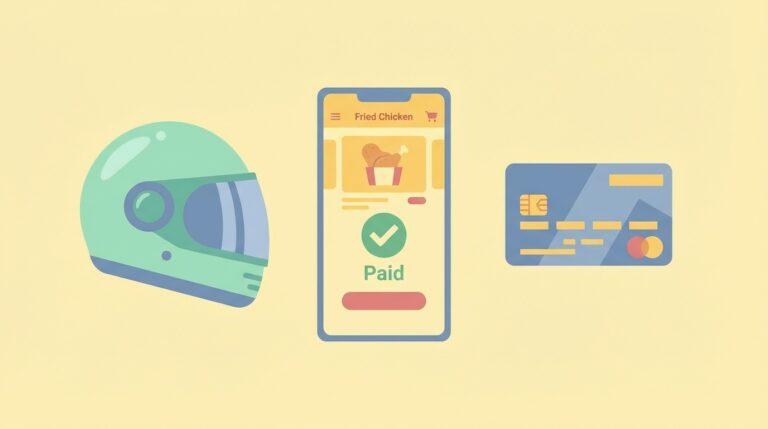
Is the rider staring at you? Did you pay in the app? Do you need to hand over your card? If you freeze here, the awkward silence is louder than a K-Pop concert. Today, we are going to master the Payment (결제하기) stage of Korean food delivery so you can get your chicken while it’s still hot and crispy.
This guide is based on real panic moments from my students living in Seoul. Let’s make sure you never go hungry because of a language barrier!
Phase 2: Deep Dive into Key Expressions
Here are the top 3 phrases you need when the delivery arrives (or when ordering).
1. 선결제했어요. (Seon-gyeol-je-haess-eo-yo)
- Pronunciation: [Sun-gyul-jeh-hess-uh-yo]
Tip: ‘Sun’ sounds like the Sun in the sky. ‘Gyeol’ rhymes with ‘Hull’ but with a G.- Meaning:
- Literal: I did pre-payment.
- Real Nuance: “I already paid in the app, so you can go.”
- K-Culture Moment: In modern Korea, 90% of people pay inside the app (Baedal Minjok, Yogiyo) before the food arrives. If the rider looks confused or waits, say this to clear the air.
- Editor’s Insight: This is the magic spell to dismiss the rider politely. Use it with a slight bow.
- Situation Spectrum:
[🚫 Formal Boss] ———— [✅ Semi-formal/Casual] ———— [✅ Friends]
Safe to use with delivery riders (strangers).- 🤔 Think About It: Why is “pre-payment” (선결제) so dominant in Korea? It links to the “Pali-pali” (Hurry, hurry) culture. Speed is everything!
2. 문 앞에 놔주세요. (Mun a-pe nwa-ju-se-yo)
- Pronunciation: [Moon ah-peh nwah-ju-seh-yo]
Tip: ‘Moon’ is the door. ‘Nwa’ sounds like ‘Noir’ film.- Meaning:
- Literal: Please put it in front of the door.
- Real Nuance: “Just leave it at the door (contactless delivery).”
- K-Culture Moment: Since the pandemic, this has become the standard. You’ll often see photos sent by riders proving they left the food. It’s also great for introverts!
- Editor’s Insight: You can write this in the “Request to Rider” box in the app, or say it through the intercom.
- Situation Spectrum:
[🚫 Rude] ———— [⚠️ Direct] ———— [✅ Standard]
This is perfectly polite standard Korean.3. 카드로 할게요. (Ka-deu-ro hal-ge-yo)
- Pronunciation: [Kah-deu-ro hal-geh-yo]
- Meaning:
- Literal: I will do it by card.
- Real Nuance: “I’ll pay with my credit card (right now).”
- K-Culture Moment: Sometimes the app payment fails, or you chose “Pay on Site” (만나서 결제). When the rider arrives, you declare your weapon of choice: The Card.
- Editor’s Insight: Cash is becoming very rare for delivery. Always have a card ready.
- Situation Spectrum:
[🚫 Formal] ———— [✅ Daily Life] ———— [✅ Casual]
Phase 3: Textbook vs. Real Life
| Situation | 📖 Textbook Korean | 🗣️ Real Korean (Streets of Seoul) | 💡 Why the difference? |
|---|---|---|---|
| Saying you paid | 이미 요금을 지불했습니다. (I have already paid the fee.) | 선결제요 / 앱에서 냈어요. (Pre-paid / Paid in app.) | “Pre-payment” (선결제) is the specific industry term everyone uses. |
| Paying with card | 신용카드로 계산하겠습니다. (I will calculate with a credit card.) | 카드요. (Card, please.) | In high-speed delivery situations, shorter is better. |
| Asking for receipt | 영수증을 주실 수 있나요? (Could you give me a receipt?) | 영수증 주세요. (Receipt, please.) | Riders are busy; drop the extra polite endings, just keep the ‘Yo’. |
Bottom Note: A2 learners, sticking to “카드요” (Card-yo) is perfectly fine. It’s polite enough without being a tongue twister.
Phase 4: Cultural Context — The “Delivery Nation”
4-1. Non-verbal Communication: The Helmet Nod
When you open the door to pay or receive food, the rider is likely wearing a helmet and looking at their phone for the next order. They are busy.
– Do: Give a quick, slight bow (head nod). Have your card out before you open the door.
– Don’t: Try to have a long conversation. They are timed on their deliveries!
4-2. K-Culture Connection: The “Service” (서비스)
In K-Dramas, you might see a rider giving extra dumplings. This is called “Service” (freebie).
– Food Context: In the past, if you paid cash, you might get a free soda. Now, with app payments, “Service” is usually promised in exchange for a 5-star review (리뷰 이벤트). If you see a sticker on your box saying “뇌물” (Bribe), that’s a cute way of asking for a good review!
– Critical View: Why is Korean delivery so fast? It’s the competitive market. But remember, safe driving is better than fast driving. If it’s raining, don’t complain about a 10-minute delay!
Phase 5: Immersive Roleplay
Scenario A: The “Doorbell Rings” Moment
Setting: Friday night, 8 PM. You are at your Airbnb in Hongdae. You ordered Fried Chicken (Chimaek time!). The intercom rings.
Characters:
– YOU: Hungry A2 Learner.
– Rider: A middle-aged man in a raincoat, very quick.
(Intercom buzzes)
Rider: (Through speaker) 배달이요! (Delivery!)
YOU: 네, 잠시만요! (Yes, just a moment!)
(You open the door)
Rider: 18,000원입니다. 어떻게 하시겠어요? (It’s 18,000 won. How will you do it [pay]?)
🔀 YOUR TURN! How do you answer?
- A) “돈… Money… give?” (Too broken, might confuse him)
- B) “카드로 할게요.” (I’ll pay by card.)
- C) “맛있게 드세요?” (Bon appetit? – Wrong context!)
✅ Best Choice: B
YOU: 카드로 할게요. (Here is my card.)
(You hand over the card. Beep.)
Rider: 네, 결제됐습니다. (Okay, payment done.)
YOU: 감사합니다! 수고하세요! (Thank you! Keep up the good work!)
Scenario B: Bonus — The “Contactless” Confusion
Situation: You paid in the app, but the rider rings the bell instead of leaving it.
Rider: 배달 왔습니다~ (Delivery is here~)
YOU: (Through the closed door) 저 선결제했는데요! (I already paid!)
Rider: 아, 문 앞에 두고 갈까요? (Ah, shall I leave it by the door?)
YOU: 네, 문 앞에 놔주세요. 감사합니다! (Yes, please leave it there. Thanks!)
Phase 6: 10-Second Shadowing Drill
Practice this sentence to handle the contactless delivery request smoothly.
🗣️ Sentence:
“감사합니다 / 문 앞에 / 놔주세요!”
(Gamsa-hamnida / mun a-pe / nwa-ju-se-yo!)
- Tone: 😊 Bright and polite (even through a closed door).
- Breakdown:
- 감사합니다 (Thank you)
/ - 문 앞에 (In front of the door)
/ - 놔주세요 (Please put/leave it)
!
- 감사합니다 (Thank you)
Phase 7: K-Culture Mini Glossary
| Korean | Romanization | Meaning | Context |
|---|---|---|---|
| 배달비 | Baedal-bi | Delivery Fee | The extra charge for delivery. “Why is the delivery fee more than the coffee?!” |
| 리뷰 이벤트 | Review Event | Review Promo | Getting free food (Service) in exchange for promising to write a review. |
| 더치페이 | Deochi-pei | Dutch Pay | Splitting the bill. Usually, one person pays the rider, and friends transfer money via KakaoPay later. |
| 최소 주문 금액 | Chin-so jumun geumaek | Min Order Amount | You must order at least this much (e.g., 15,000 won) to get delivery. |
Phase 8: Traveler’s Survival Kit
Even if you don’t speak fluent Korean, you will likely use apps like Baedal Minjok (Baemin) or Shuttle (English friendly).
🆘 Survival Phrases #1
– 🇰🇷 “여기요!” (Yeogiyo!)
– 🗣️ Pronunciation: [Yuh-gi-yo]
– 📍 Use: When you need to call the waiter or rider back.
– 💡 Pro Tip: Don’t shout. Just raise your hand and say it clearly.📌 Editor’s App Note
– Payment Method (결제 수단): Look for ‘신용카드’ (Credit Card) or ‘만나서 결제’ (Pay upon meeting).
– Warning: Many Korean apps require a Korean phone number/ID to pay in the app. If you are a traveler without an ARC (Alien Registration Card), select “만나서 결제” (Pay upon meeting) -> “만나서 카드 결제” (Pay by card upon meeting).
Phase 9: Think Deeper — “The Doorstep Trust”
Why do Koreans leave food at the door?
In many countries, leaving a $30 box of fried chicken unattended in a hallway is risky. In Korea, “Drop-off” delivery exploded during COVID-19, but it stayed because of High-Trust Culture (and CCTV). You will often see piles of packages in apartment lobbies or food sitting in front of doors for hours.
🧠 Think Deeper:
This convenience relies on the social contract that “nobody touches what isn’t theirs.” Does this reflect a society that values community trust over individual suspicion? Or is it simply because there are cameras everywhere?💬 Your Turn: Would you feel safe leaving your dinner on your doorstep in your hometown? Why or why not?
Phase 10: FAQ & Troubleshooting
Q: Should I tip the delivery rider?
A: NO. Tipping is not a custom in Korea. The delivery fee (배달비) is included in your total. If you give cash, they might think you made a mistake and try to give it back. Just a warm “Sugohaseyo” (Thank you for your effort) is the best tip.
Q: The rider is wearing a helmet and I can’t hear him!
A: If he mumbles something and holds out a device, he’s asking for your card. If he hands you the food and lingers, he might need a signature (rare) or he’s waiting for you to take it so he can mark it ‘complete’. Just say “Gamsahamnida” and bow.
❌ Common Mistake #1: Trying to pay with foreign cash (USD/EUR).
✅ Fix: Only KRW (Won) or Visa/Mastercard. Riders are not currency exchanges!
Phase 11: Wrap-up & Action Mission
One-Liner Summary: When the bell rings, stay calm, tell them you paid in the app (선결제했어요), or have your card ready (카드로 할게요).
🎯 Action Mission:
– 🥉 Bronze: Say “문 앞에 놔주세요” out loud 3 times while looking at your front door.
– 🥈 Silver: Open a Korean delivery app (like Baemin) and try to find the button for “Pay upon meeting” (don’t actually order yet!).
– 🥇 Gold: Actually order food! If you are in Korea, select “Pay upon meeting” and use the phrase “카드로 할게요.”
🎥 K-Culture Mission: Watch a scene in the drama Crash Landing on You or Hospital Playlist where they order food. Do they pay the rider, or was it product placement (PPL)? Spot the difference!
Phase 12: Quiz — Interactive Challenge
1. Situation Judgment
The app says you already paid via credit card. The rider arrives. What do you say?
– A) 얼마예요? (How much is it?)
– B) 선결제했어요. (I pre-paid.)
– C) 카드로 할게요. (I will pay by card.)
2. True or False (Culture)
In Korea, it is polite to give the delivery rider a 10% tip in cash.
– (True / False)
3. Fill in the Blank
You want the rider to leave the food at the door.
“________ 놔주세요.”
Answers:
1. B (You don’t need to pay again!)
2. False (No tipping culture!)
3. 문 앞에 (Mun a-pe / In front of the door)
Frequently Asked Questions (FAQ)
Q: What does "선결제했어요. (Seon-gyeol-je-haess-eo-yo)" mean in Korean and how do you pronounce it?
A: In Korean, "선결제했어요. (Seon-gyeol-je-haess-eo-yo)" is pronounced [Sun-gyul-jeh-hess-uh-yo] and means: Literal: I did pre-payment.
Q: What does "문 앞에 놔주세요. (Mun a-pe nwa-ju-se-yo)" mean in Korean and how do you pronounce it?
A: In Korean, "문 앞에 놔주세요. (Mun a-pe nwa-ju-se-yo)" is pronounced [Moon ah-peh nwah-ju-seh-yo] and means: Literal: Please put it in front of the door.
Q: What does "카드로 할게요. (Ka-deu-ro hal-ge-yo)" mean in Korean and how do you pronounce it?
A: In Korean, "카드로 할게요. (Ka-deu-ro hal-ge-yo)" is pronounced [Kah-deu-ro hal-geh-yo] and means: Literal: I will do it by card.






