

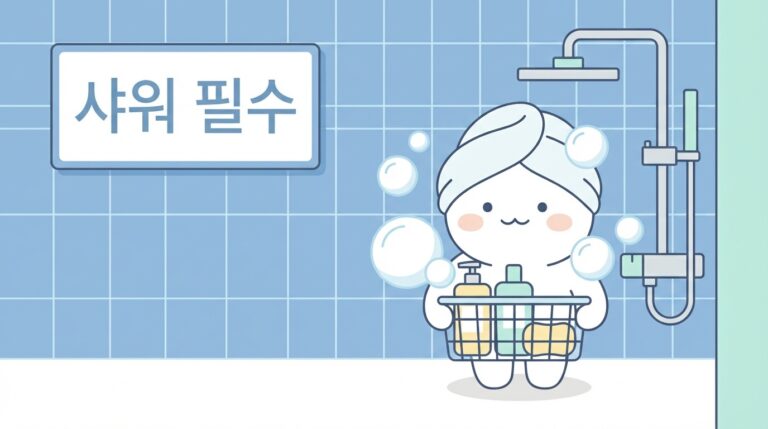
Phase 1: The Naked Truth — An Immersive Opening
Hello! This is your Senior Editor at Daily Hangul. 👋
Picture this: You’ve just watched a K-Drama scene where the protagonist dramatically dives into a pristine pool to cool off their anger. Inspired, you head to a public swimming pool in Seoul. You put on your stylish swimsuit in the locker room, grab your toiletries, and head to the showers to rinse off before jumping in.
Suddenly, you feel eyes on you. An ahjumma (middle-aged lady) or ajeossi (middle-aged man) stops scrubbing their back, looks at you with wide eyes, and points aggressively at your swimsuit. “벗어! (Take it off!)”
Panic sets in. Why are they yelling?
Here is the K-Culture shock: In Korea, “showering” before swimming means a full, naked scrub with soap and shampoo. Wearing a swimsuit in the shower room is seen as unhygienic because you aren’t washing the parts covered by the fabric. If you just rinse with water (known as a “Gringo Shower” in some cultures, but here called ‘고양이 세수’ – cat’s face wash), you might actually get kicked out by the regulars.
Today, we are diving deep into the high-context culture of Korean hygiene, ‘Nunchi’ in the locker room, and the vocabulary you need to avoid becoming a ‘민폐’ (public nuisance).
Phase 2: Deep Dive into Key Expressions
1. [비누칠을 꼼꼼히 하다]
- Pronunciation: [binuchireul kkomkkomhi hada] + Think of ‘kkomkkom’ as the sound of a comb going through hair perfectly straight—detailed and thorough.
- Meaning: To lather/soap up thoroughly (Literal); To wash with obsessive detail to show respect for the facility (Nuance).
- K-Culture Moment: Think of Korean sauna (Jimjilbang) scenes in variety shows like Running Man. The cast doesn’t just splash water; they scrub until they are covered in white foam. This is the standard.
- Editor’s Insight: This is a C1 level collocation. Beginners say “씻다” (wash). Advanced learners specify the action and the attitude. ‘꼼꼼히’ (meticulously) is the key adverb here. It implies you are a responsible member of the community.
- Situation Spectrum:
[🚫 Casual Chat] ———— [⚠️ Explaining Rules] ———— [✅ Strict Etiquette]- This is formal phrasing often found on signs or used when correcting someone’s behavior politely.
- 🤔 Think About It: Why does Korean society equate ‘cleanliness’ with ‘morality’ in public spaces? How does this reflect the collective mindset versus individual convenience?
2. [수질 관리를 위해]
- Pronunciation: [sujil gwallireul wihae] + ‘Su’ implies water, ‘jil’ implies quality.
- Meaning: For the sake of water quality management.
- K-Culture Moment: You will see this on signs everywhere. “수질 관리를 위해 오일 사용을 금지합니다” (To manage water quality, oil use is prohibited). It is the “golden justification” for all strict rules.
- Editor’s Insight: Use this phrase when you want to complain politely or explain a rule. Instead of saying “The water is dirty,” you say “I am worried about the sujil gwalli.”
- Situation Spectrum:
[🚫 Friends] ———— [⚠️ Staff/Complaints] ———— [✅ Official Context] - 🤔 Think About It: Notice the passive, objective tone. It’s not “for my health,” it’s for the abstract concept of “water quality.” It removes the personal ego from the complaint.
3. [눈살을 찌푸리게 하다]
- Pronunciation: [nunsareul jjipurige hada]
- Meaning: To make someone frown; to cause disapproval through bad etiquette.
- K-Culture Moment: In news reports about unruly tourists or bad subway etiquette, this idiom is the headline. “수영장 비매너, 이용객들의 눈살을 찌푸리게 해…” (Bad manners at the pool cause users to frown…)
- Editor’s Insight: This is a fantastic C1 idiom. Instead of saying “People were angry,” you describe the physical reaction of the collective group. It emphasizes the social pressure of the environment.
- Situation Spectrum:
[🚫 To the offender] ———— [⚠️ Gossip/Reporting] ———— [✅ Describing Atmosphere]
Phase 3: Textbook vs. Real Life
| Situation | 📖 Textbook Korean | 🗣️ Real Korean (Survival) | 💡 Why the difference? |
|---|---|---|---|
| Entering the shower | 수영복을 벗고 씻으세요. (Please take off your swimsuit and wash.) | 아예 다 벗고 들어가셔야 해요! (You have to go in totally naked!) | The textbook is polite; the real version emphasizes “totally” (아예) because foreigners often hesitate. |
| Did you wash? | 샤워 하셨습니까? (Did you take a shower?) | 비누칠 했어요? 머리 감았어요? (Did you soap up? Did you wash your hair?) | Locals know that “showering” is ambiguous. They ask for specific evidence of hygiene. |
| Wait your turn | 줄을 서 주세요. (Please stand in line.) | 여기 자리 있어요? / 바구니 좀 치워주세요. (Is this spot taken? / Move your basket please.) | In locker rooms, people mark territory with plastic baskets. You must address the object, not just the line. |
Bottom Note: At C1 level, you must understand that “passive aggression” is often conveyed through polite questions like “Did you soap up?” (implying you smell or look dry).
Phase 4: Cultural Deep Dive — The “Public Body”
4-1. Non-verbal Communication: The “Scan”
In a Korean locker room, there is no shame in nudity among the same sex. In fact, hiding or being overly shy can draw more attention.
– The Scan: Older regulars might scan you up and down. It’s usually not sexual; it’s a mix of curiosity and checking if you know the rules (like wearing shower shoes inside the pool area—a big no-no).
– The Basket Culture: If you see a plastic basket with toiletries on a shower faucet, that spot is taken. Do not move it. That is tantamount to a declaration of war.
4-2. K-Drama Connection: The “Sauna” Trope
Remember the scenes in dramas where characters sit in a sauna with sheep-head towels (Yangmeori)? The swimming pool locker room is an extension of that. It’s a communal hub. The gossip happens while naked.
– Critical View: In dramas, actors usually wear towels or strategically placed items. Reality Check: In real life, no one wears a towel in the wet area. Bringing a towel into the shower area will get it wet and useless, marking you as a rookie.
Phase 5: Immersive Roleplay Scenario
Setting: A busy morning at a district sports center (Gu-min Center) in Seoul. You are rushing to the pool.
Characters:
– YOU: A foreign resident who is running late for swimming class.
– Kyung-sook (50s): A pool regular (the “master” of the locker room).
(Scene: You quickly rinse your body with water while wearing your swimsuit and head toward the pool entrance.)
Kyung-sook: (Loudly, over the sound of water) 저기요! 학생! 잠깐만요.
(Jeogiyo! Haksaeng! Jamkkanmanyo.)
(English) Excuse me! Student! Hold on a second.
YOU: (Startled) 네? 저요?
(Ne? Jeoyo?)
(English) Huh? Me?
Kyung-sook: 지금 수영복 입고 씻은 거예요? 거품 안 냈죠?
(Jigeum suyeongbok ipgo ssiseun geoyeyo? Geopum an naetjjo?)
(English) Did you just wash while wearing your swimsuit? You didn’t lather up, right?
🔀 Decision Point: How do you respond?
- A) “집에서 씻고 왔어요.” (I washed at home.)
- B) “아, 몰랐습니다. 다시 씻고 오겠습니다.” (Ah, I didn’t know. I will wash again.)
- C) “바빠서요. 그냥 들어갈게요.” (I’m busy. I’ll just go in.)
✅ Best Choice: B
– Analysis: Even if you showered at home, the rule is to wash immediately before entering to remove sweat and oils. Admitting ignorance and complying restores harmony.
⚠️ Choice A Analysis:
– This is the most common excuse, and it never works. The regulars will block the door. “Home is home, here is here” is the logic.
(Continuation with Choice B)
Kyung-sook: (Voice softening) 수질 나빠지니까 그래요. 머리카락도 꼭 샴푸 하시고.
(Sujil nappajinikka geuraeyo. Meorikarakdo kkok syampu hasigo.)
(English) It’s because the water quality gets bad. Make sure to shampoo your hair, too.
YOU: 네, 신경 쓰겠습니다. 알려주셔서 감사합니다.
(Ne, singyeong sseugetseumnida. Allyeojusyeoseo gamsahamnida.)
(English) Yes, I’ll pay attention to that. Thank you for letting me know.
Phase 6: 10-Second Shadowing Drill
Let’s practice a polite way to ask about etiquette or respond to corrections.
😊 Apologetic & Polite:
제가 / 처음이라서 / 잘 몰랐습니다. // 바로 / 씻고 올게요!
(Je-ga / cheo-eum-i-ra-seo / jal mol-lat-sseum-ni-da. // Ba-ro / ssit-kko ol-kke-yo!)
“I didn’t know well because it’s my first time. I’ll go wash right away!”
Phase 7: K-Culture Mini Glossary
| Korean | Romanization | English | Context |
|---|---|---|---|
| 텃세 | teot-se | Territorial behavior | When regulars bully or act bossy towards newcomers. Common in local pools. |
| 원정 수영 | won-jeong su-yeong | Expedition swimming | Visiting different pools across the city/country as a hobby (like a ‘pool tour’). |
| 샤워 바구니 | sya-wo ba-gu-ni | Shower basket | The essential plastic basket Koreans carry toiletries in. Leaving this in a spot claims the spot. |
| 래시가드 | rae-si-ga-deu | Rash guard | Very popular in Korea for modesty and sun protection, but sometimes banned in indoor lap pools (check rules!). |
Phase 8: Traveler’s Survival Kit (Pool & Spa Edition)
Heading to a hotel pool, Jimjilbang, or a water park? Here is your cheat sheet.
🆘 Survival Phrases
– 🇰🇷 “수영모자 꼭 써야 하나요?” (Suyeong-moja kkok sseoya hanayo?)
– “Do I absolutely have to wear a swim cap?” (Note: In 99% of Korean pools, Yes.)
– 🇰🇷 “수건은 따로 챙겨야 해요?” (Su-geoneun ttaro chaeng-gyeoya haeyo?)
– “Do I need to bring my own towel?” (Gyms usually provide them; public pools often do not.)
– 🇰🇷 “탈수기 어디 있어요?” (Talsugi eodi isseoyo?)
– “Where is the swimsuit spinner/dryer?” (A magical machine found in every Korean locker room.)📌 Editor’s Pro Tip:
In Korea, you put your swim cap on in the shower room or locker room before walking out to the pool deck. Struggling to put on a silicone cap with dry hair on the pool deck marks you as a beginner!
Phase 9: Think Deeper — “My Body, Our Water”
Topic: Collectivism in Hygiene
In many Western cultures, the shower is a private sanctuary. Polishing one’s body in front of strangers feels intrusive. However, in Korea, the ‘Shared Water’ (공동 사용 물) concept overrides individual privacy. If you don’t scrub naked, you are viewed as a ‘pollutant’ to the community.
This extends to the language. Notice how complaints are framed: “You make us frown” or “For the water quality.” It is rarely “I don’t like you.” It is “You are harming the group.”
🧠 Think Deeper:
Does your culture prioritize individual privacy over communal hygiene standards, or vice versa? Is nudity in a locker room seen as natural or taboo?💬 Your Turn: Have you ever experienced ‘Nunchi’ in a public space in Korea? Tell us in the comments!
Phase 10: FAQ & Troubleshooting
Q: Can I wear my bikini to an indoor lap pool?
A: You can, but you will stand out. Most Koreans wear one-piece suits (indoor) or rash guards (outdoor/water parks). A bikini in a serious lap-swimming lane might attract the ‘stare’.
Q: I have tattoos. Can I enter the pool?
A: This is changing. Old-school saunas might ban large tattoos (associating them with gangs), but public pools generally allow them. However, if you have very large tattoos, wearing a rash guard prevents awkward stares.
❌ Common Mistake #1: Bringing your street shoes into the locker room.
✅ Fix: You must remove shoes at the distinct ‘entrance’ step (hyeon-gwan) before stepping onto the locker room floor. Walking on the locker floor with shoes is a catastrophic etiquette failure.
Phase 11: Wrap-up & Action Items
One-Liner Summary: In Korea, stripping down completely and scrubbing with soap is not just hygiene; it’s a ticket to community acceptance in the pool.
Action Missions:
– 🥉 Bronze: Practice the phrase “수질 관리를 위해” and try to spot it on signs in K-Dramas.
– 🥈 Silver: Search for “Korean Swimming Pool Vlog” on YouTube and observe the locker room entrance process.
– 🥇 Gold: Visit a local Jimjilbang or pool and successfully navigate the ‘naked shower’ without hesitation!
– K-Culture Mission: Watch the K-Drama Weightlifting Fairy Kim Bok-joo. Pay attention to the pool scenes—not the romance, but the background dynamics of the swimmers!
Phase 12: Quiz — The “Nunchi” Challenge
Q1. You are in the shower room. There is a plastic basket on the floor in front of a showerhead, but no person. What should you do?
– A) Move the basket and use the shower.
– B) Find another spot. That shower is claimed.
– C) Use the shower but stand very close to the wall.
Q2. Which phrase best completes the sentence?
“Don’t just rinse with water! You need to _____!”
– A) 고양이 세수를 하다
– B) 비누칠을 꼼꼼히 하다
– C) 눈살을 찌푸리게 하다
Answer Key:
Q1: B. (Touching someone’s basket is a major breach of etiquette!)
Q2: B. (A implies barely washing; C is the result of not washing. B is the correct action.)
Frequently Asked Questions (FAQ)
Q: What does "[비누칠을 꼼꼼히 하다]" mean in Korean and how do you pronounce it?
A: In Korean, "[비누칠을 꼼꼼히 하다]" is pronounced [binuchireul kkomkkomhi hada] and means: To lather/soap up thoroughly (Literal); To wash with obsessive detail to show respect for the facility (Nuance).
Q: What does "[수질 관리를 위해]" mean in Korean and how do you pronounce it?
A: In Korean, "[수질 관리를 위해]" is pronounced [sujil gwallireul wihae] and means: For the sake of water quality management.
Q: What does "[눈살을 찌푸리게 하다]" mean in Korean and how do you pronounce it?
A: In Korean, "[눈살을 찌푸리게 하다]" is pronounced [nunsareul jjipurige hada] and means: To make someone frown; to cause disapproval through bad etiquette.







