

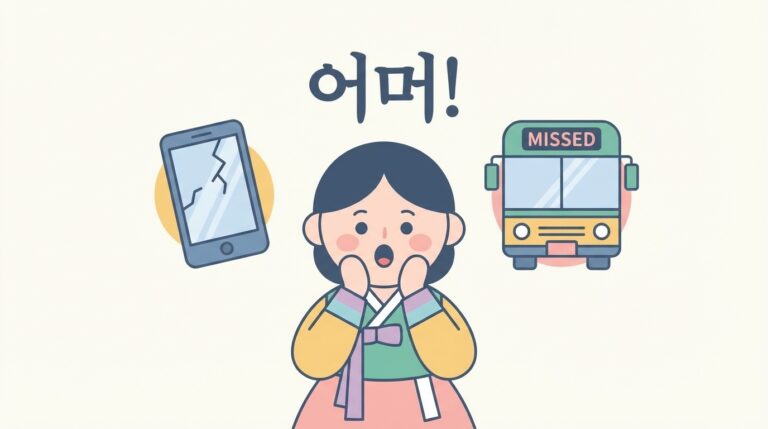
Phase 1: The Immersive Hook
Hello! This is your Daily Hangul Editor. 👋
Picture this: You are watching your favorite K-Drama. The main character is running to the airport to stop their true love from leaving. They arrive at the gate, breathless, only to see the plane already taking off. 🛫
The camera zooms in on their teary face. They drop to their knees and say one word.
It’s not “I’m sorry.” It’s not “Goodbye.”
It’s “어떡해 (Eotteokhae)…”
Or maybe you’re watching a K-Pop idol drop their ice cream on a live stream. They cover their mouth and squeal, “Ah! Ottoke!” 🍦
If you don’t know this phrase, you’re missing out on 50% of the emotion in Korean content. It’s the ultimate “Panic Button” of the Korean language. Today, we aren’t just learning a word; we are learning the soul of Korean reaction. Let’s dive in!
Phase 2: Deep Dive into “The Panic Button”
Here are the must-know variations. Don’t just read them; feel them!
1. 어떡해 (Eotteokhae)
- Pronunciation: [Eo-tteok-hae] → Sounds like “Uh-Duk-Hae”
- Meaning: “What should I do?” / “Oh no!” / “I’m in trouble.”
- K-Culture Moment: Used when you make a mistake, hear bad news, or feel shy. (e.g., You accidentally liked your ex’s photo on Instagram 😱).
- Editor’s Insight: It’s often rhetorical. You aren’t really asking for a solution; you are expressing your frustration or worry.
- Situation Spectrum:
[🚫 Boss] ———— [⚠️ Co-worker] ———— [✅ Friends]- 🤔 Think About It: Why do Koreans say this out loud even when they are alone? Is it a way to release stress instantly?
2. 어떡하지? (Eotteokhaji?)
- Pronunciation: [Eo-tteok-ha-ji] → Sounds like “Uh-Duk-Ha-Gee”
- Meaning: “What shall I do?” (Self-talk)
- K-Culture Moment: The protagonist is pacing around the room, biting their nails, deciding whether to confess their love.
- Editor’s Insight: This is softer than “어떡해.” It sounds like you are thinking, not just panicking.
- Situation Spectrum:
[🚫 Boss] ———— [⚠️ Co-worker] ———— [✅ Friends/Self]
Phase 3: Textbook vs. Real Life
Let’s be real. Textbooks are polite; life is chaotic.
| Situation | 📖 Textbook Korean | 🗣️ Real Korean | 💡 Why is it different? |
|---|---|---|---|
| Lost your wallet | 지갑을 잃어버렸어요. 무엇을 해야 합니까? (I lost my wallet. What must I do?) | 헐… 나 지갑 없어. 어떡해… (Heol… no wallet. Ottoke…) | Real panic is short and emotional. “Heol” (Hul) adds the shock factor. |
| Late for a date | 늦어서 죄송합니다. (I am sorry for being late.) | 아, 어떡해! 진짜 미안! (Ah, ottoke! So sorry!) | Shows you are worried about being late, not just stating a fact. |
Bottom Note: For A1 beginners, just saying “Ah! Eotteokhae!” with a worried face conveys everything you need.
Phase 4: Cultural Context — The Art of “Nunchi”
4-1. Non-verbal Communication 🤭
When you say “어떡해,” your body must match the words.
– The Hands: Cover your mouth with one hand (shock) or both hands on cheeks (cute panic).
– The Feet: Stomp your feet lightly like a child (frustration). This is very common in K-Dramas!
– The Eyes: Widen them! 👀
4-2. K-Pop Connection (Aegyo Alert)
In K-Pop culture, “어떡해” is often used as Aegyo (acting cute).
– Scenario: An idol pretends to be scared of a bug.
– Tone: High pitched, dragged out. “Eotteokhaeee~~ing!”
– Warning: Do NOT use this tone with a taxi driver or a police officer! They will be very confused.
Phase 5: Immersive Roleplay
Scene: It is Friday night in Hongdae. You missed the last subway train home. Your phone battery is at 2%.
Characters:
– YOU: A foreign student in Korea.
– Minji: Your Korean friend (20s, energetic).
Dialogue:
YOU: (Looking at phone) Oh no… It’s 12:30 AM.
Minji: 진짜? 지하철 끝났어? 😲
(Jinjja? Jihacheol kkeut-nass-eo?)
(English) Really? Is the subway finished?
YOU: (Showing screen) Yeah… Battery is low too.
Minji: 헐… 대박. 집에 어떻게 가?
(Heol… Daebak. Jibe eotteoke ga?)
(English) Oh my god… crazy. How do you go home?
🔀 YOUR TURN! How do you react?
- A) “Taxi gaja.” (Let’s take a taxi.) — Logical & calm.
- B) “Ah! Eotteokhae…” (Cover mouth) — Emotional & relatable.
- C) “Good night.” — Too cool for school.
✅ Best Choice: B
Why? Reacting with emotion first shows Minji that you understand the gravity of the situation. It invites her to help you. After saying B, you can suggest A!
Phase 6: 10-Second Shadowing Drill
Listen to the rhythm and repeat. Practice the emotion!
- 😟 Worried: 아… / 어떡해… / 늦었어. (Ah… / ottoke… / neujeosseo.) -> Ah… what to do… I’m late.
- 🥺 Cute/Begging: 제발~ / 어떡해~ / 한 번만! (Jebal~ / ottoke~ / han beon man!) -> Please~ / what to do~ / just this once!
- 😱 Shocked: 헐! / 어떡해! / 망했다! (Heol! / ottoke! / mang-haet-da!) -> OMG! / What to do! / I’m screwed!
Phase 7: K-Culture Glossary
| Korean | Romanization | Meaning | Context |
|---|---|---|---|
| 헐 | Heol | OMG / No way | Used when shocked or speechless. Often pairs with Ottoke. |
| 대박 | Daebak | Awesome / Crazy | Can be positive or negative depending on tone. |
| 망했다 | Mang-haet-da | I’m screwed | Slang. Used when you fail a test or miss a bus. |
| 애교 | Aegyo | Cuteness | Acting cute to get what you want or show affection. |
Phase 8: Traveler’s Survival Kit 🆘
So, you are actually in trouble in Korea? “Ottoke” expresses worry, but it doesn’t solve the problem. Here is what to say next.
🆘 Survival Phrase #1
– 🇰🇷 “도와주세요!” (Dowa-juseyo!)
– 🗣️ Pronunciation: [Doh-wah-ju-seh-yo]
– 📍 Meaning: Please help me!
– 💡 Pro Tip: If you lost something, say “Bun-sil-mul” (Lost & Found). Every subway station has a center.
Phase 9: Think Deeper — “Language of Empathy”
Why do Koreans say “What should I do?” instead of just fixing it?
In Western cultures, problem-solving is often individual and immediate. In Korea, expressing worry (Hann) is a communal activity. When you say “Eotteokhae,” you aren’t just talking to yourself. You are signaling to the group, “I am vulnerable right now. Share this worry with me.” It builds a bond. By worrying together, the burden feels lighter.
💬 Your Turn: In your culture, when you make a big mistake, do you swear, stay silent, or ask for help? Tell us in the comments!
Phase 10: FAQ & Troubleshooting
Q: Can I say “Eotteokhae” to my teacher or boss?
A: ⚠️ Be careful. It can sound childish or unprofessional if used alone. Instead, use complete sentences like “어떻게 하면 좋을까요?” (What would be good to do?).
Q: Is it “어떡해” or “어떻게”? They sound the same!
A: This is the #1 mistake foreigners make!
– 어떻게 (Eotteoke): Means “How” (e.g., How do you go?)
– 어떡해 (Eotteokhae): Means “What do I do?” (Panic)
Trick: If it’s at the end of a sentence, it’s usually 어떡해.
Phase 11: Wrap-up & Mission
One-Liner: “Eotteokhae” is your emotional connection tool—use it to show you care, worry, or just to be cute!
🎯 Action Missions:
– 🥉 Bronze: Look in the mirror, put your hands on your cheeks, and say “Eotteokhae!” 3 times.
– 🥈 Silver: Watch a K-Drama episode today. Count how many times they say it! (Bonus if you find the “feet stomp”).
– 🥇 Gold: Next time you drop something in front of a Korean friend, whisper “Ah, ottoke…” and watch them smile.
Phase 12: Interactive Quiz
1. Situation: You just realized you left your passport at the hotel while at the airport. What is the most natural reaction?
– A) 안녕 (An-nyeong)
– B) 헐… 어떡해… (Heol… Eotteokhae…)
– C) 감사합니다 (Gamsahamnida)
2. True or False:
– You should shout “Eotteokhae!” loudly during a business meeting if you forgot your pen.
– (True / False)
⬇️ Scroll down for answers!
.
.
.
Answers:
1. B) This is a major panic moment! A is “Hello/Bye” and C is “Thank you.”
2. False. In a formal meeting, keep your cool! Saying it loudly would be seen as immature.
Frequently Asked Questions (FAQ)
Q: What does "어떡해 (Eotteokhae)" mean in Korean and how do you pronounce it?
A: In Korean, "어떡해 (Eotteokhae)" is pronounced [Eo-tteok-hae] and means: "What should I do?" / "Oh no!" / "I'm in trouble."
Q: What does "어떡하지? (Eotteokhaji?)" mean in Korean and how do you pronounce it?
A: In Korean, "어떡하지? (Eotteokhaji?)" is pronounced [Eo-tteok-ha-ji] and means: "What shall I do?" (Self-talk)







