

Phase 1: The Immersive Hook
Hello! This is your Daily Hangul Editor. 👋
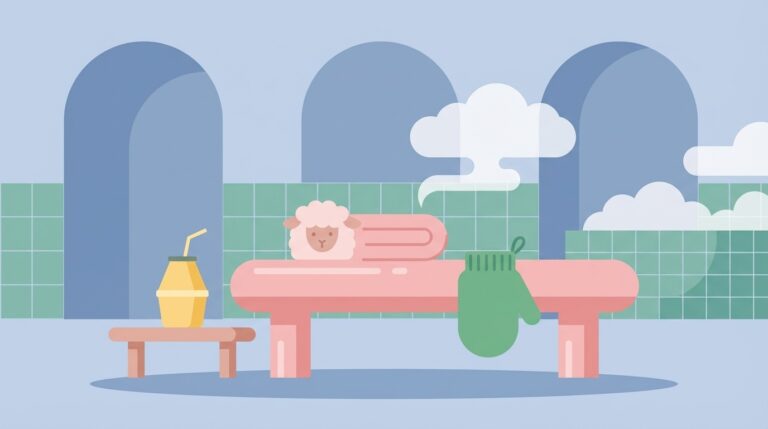
Imagine this: You are lying on a pink plastic bed in a steamy, mist-filled room. You are completely naked. Standing over you is a Korean ajumma (middle-aged woman) or ajossi (middle-aged man) wearing black lace underwear, holding a rough green mitten. 🧤
It sounds like the beginning of a thriller movie, doesn’t it? But for Koreans, this is the ultimate form of relaxation and self-care. It’s the Seshin (세신) experience, or the famous “Korean Body Scrub.”
In K-Dramas, you often see characters with glowing, baby-soft skin drinking banana milk after a bath. That glow comes from here. But let’s be real—if the Seshinsa (scrub master) scrubs too hard and you don’t know how to speak, you might feel like a potato being peeled! 🥔
Don’t worry. Today, I’ll teach you the magic words to survive the scrub and come out shining like a K-Pop idol.
Phase 2: Deep Dive into Key Expressions
Here are the 3 lifesavers you need when you are on the scrubbing table.
1. 아파요 (Apayo)
- Pronunciation: [A-pa-yo]
- Sound Analogy: Sounds like “Appa” (Dad) + “Yo”-yo.
- Meaning: It hurts. (Literal & Real)
- K-Culture Moment: Think of a medical K-Drama scene where a patient winces. This is the universal word for pain.
- Editor’s Insight: You don’t need a full sentence here. Just saying this one word will make the master stop instantly. It’s a reflex word!
- Situation Spectrum:
[🚫 Formal Speech] ———— [⚠️ Polite (Here)] ———— [✅ Casual]
- Use this with the -yo ending to be polite even when you are in pain.
- 🤔 Think About It: Why is “It hurts” (아파요) and “I’m sick” (아파요) the same word in Korean? In Korea, physical pain and illness are often treated with the same word. Context is everything!
2. 살살 해주세요 (Salsal haejuseyo)
- Pronunciation: [Sal-sal hae-ju-se-yo]
- Sound Analogy: “Sal-sal” sounds soft, like whispering or salt sprinkling gently.
- Meaning: Please do it gently / softly.
- K-Culture Moment: When an idol asks a fan to “go easy” on them during a game, or when asking a hairdresser to be careful with tangled hair.
- Editor’s Insight: “Salsal” is a magic adverb. It sounds soft, right? Use this before the scrubbing starts if you have sensitive skin.
- Situation Spectrum:
[🚫 Rude] ———— [✅ Perfect for Service] ———— [✅ Casual]
- This is a polite request used in taxis (drive gently), massages, and salons.
- 🤔 Think About It: Korean has many “mimetic” words (words that mimic movement). Salsal mimics a gentle, light touch. Can you feel the difference between Salsal (gently) and Pak-pak (hard/rough)?
3. 시원해요 (Siwonhaeyo)
- Pronunciation: [Si-won-hae-yo]
- Sound Analogy: “She-won” (She won the game) + “Hey-yo”.
- Meaning: It’s cool (Literal) / It feels refreshing & relieving (Real nuance).
- K-Culture Moment: You will see old men in K-Dramas sitting in boiling hot water shouting “Ah, siwonhada!” It confuses every foreigner!
- Editor’s Insight: If the scrubbing pressure is perfect, say this. The Seshinsa will love it. It means “You are unblocking my stress/pain.”
- Situation Spectrum:
[🚫 Formal] ———— [⚠️ Polite] ———— [✅ Emotional Exclamation]- 🤔 Think About It: Why do Koreans say “It’s cool/refreshing” when eating hot soup or sitting in a hot bath? It refers to the relief inside your body, not the temperature outside.
Phase 3: Textbook vs. Real Life
| Situation | 📖 Textbook Korean | 🗣️ Real Korean | 💡 Why is it different? |
|---|---|---|---|
| Asking for a scrub | 때를 밀고 싶어요. (I want to scrub my dirt.) |
세신 할게요. (I’ll do “Seshin”.) |
“Ddae” (dirt) sounds a bit crude. “Seshin” (washing body) is the professional term used at the counter. |
| During the scrub | 조금 더 세게 해주세요. (Please do it a little harder.) |
세게요! / 팍팍! (Harder! / Roughly!) |
When you are naked and wet, short words are better. Pak-pak is the sound of energetic scrubbing. |
| Turning over | 뒤로 돌아누우세요. (Please lie on your back.) |
뒤요. / 반대요. (Back. / Opposite.) |
Efficiency. The Seshinsa works fast and uses short commands. |
💡 Bottom Note: In the sauna, short and clear is best. The noise of water makes long sentences hard to hear.
Phase 4: Cultural Deep Dive — The Art of “Nunchi”
4-1. Non-verbal Communication (Body Language)
- The “Tap” Command: Sometimes the Seshinsa won’t speak. They will just tap your shoulder or hip. That is the signal to turn over. Do not wait for a verbal request! Use your Nunchi (quick situational awareness).
- The Limp Noodle Technique: Do not try to help them lift your arm or leg. Just relax your body like a wet noodle. If you stiffen your muscles to “help,” they will tap you to say “Relax!”
4-2. K-Culture Connection (K-Drama & Food)
- The “Sheep Head” (Yang-meori): Before or after the scrub, you might see people in the dry sauna wearing towels folded like sheep heads. This was popularized by the drama My Name is Kim Sam-soon (2005) and is still a cute “must-do.”
- Banana Milk & Sikhye: After the scrub, your skin is tingling. The tradition is to drink cold Banana Milk (sweet) or Sikhye (sweet rice punch). In dramas, this is the reward for enduring the heat.
Phase 5: Immersive Roleplay Scenario
Setting: Inside the wet area of a Mog-yok-tang (Public Bathhouse). It is humid, noisy with splashing water. You are lying on the vinyl bed. A tough-looking Seshinsa (Master) approaches.
Characters:
– YOU: A tired traveler wanting soft skin.
– Master Park: A veteran Seshinsa with 20 years of experience. Very strong hands.
Dialogue:
Master Park: (Splash! Throws warm water on you) 자, 시작합니다. 긴장 풀어요.
(Ja, sijak-hamnida. Ginjang pur-eo-yo.)
[Okay, starting now. Relax your tension.]
(🎭 Stage Direction: Master Park starts scrubbing your arm. It feels… extremely rough!)
🔀 YOUR TURN! It hurts a little too much. What do you say?
A) “아! 하지 마세요!” (Ah! Don’t do it!)
B) “저기요… 조금만 살살 해주세요.” (Excuse me… just a little gently, please.)
C) “아이고! 죽겠다!” (Oh my god! I’m dying!)✅ Best Choice: B
– Why? Option A stops the service completely. Option C is dramatic (good for friends, but maybe too much here). Option B is the polite, perfect way to adjust the pressure without offending the Master’s skill.
Master Park: 아, 아파요? 알겠어요. 살살 할게요.
(Ah, apayo? Algesseoyo. Salsal hal-geyo.)
[Ah, does it hurt? Understood. I’ll do it gently.]
(🎭 Stage Direction: The pressure becomes perfect. It feels like a massage now.)
YOU: 와… 진짜 시원해요!
(Wa… jinjja siwonhaeyo!)
[Wow… it’s really refreshing!]
Master Park: (Smiling) 외국 분이 때가 잘 나오네.
(Oeguk buni ddaega jal naone.)
[For a foreigner, the dead skin is coming off well.]
(Note: This is a compliment in the Sauna world!)
Phase 6: 10-Second Shadowing Drill
Practice this emotional rollercoaster!
- 🥺 Worried/Polite: 선생님, / 조금만 / 살살 / 해주세요.
(Seonsaeng-nim, / jogeum-man / salsal / haejuseyo.)
[Teacher (Master), please do it just a little gently.] -
😌 Relieved/Happy: 우와… / 진짜 / 시원해요!
(U-wa… / jinjja / siwonhaeyo!)
[Wow… it is really refreshing!]
Phase 7: K-Culture Mini Glossary
| Korean | Romanization | Meaning | Context |
|---|---|---|---|
| 세신사 | Seshinsa | Scrub Master | The polite title for the person scrubbing you. Don’t call them “Ajumma/Ajossi” while they work. |
| 때 | Ddae | Dead skin cells | Literally “dirt/grime,” but in this context, it’s the gray rolls of skin coming off. Satisfaction visual! |
| 목욕탕 | Mog-yok-tang | Public Bath | The local neighborhood bathhouse, smaller than a big theme-park style “Jjimjilbang.” |
| 이태리 타월 | Italy Towel | Viscose Towel | The rough green/yellow mitten. Invented in Korea, but called “Italy” because the fabric came from Italy originally! |
Phase 8: Traveler’s Survival Kit
Going to a Sauna? Here is your survival cheat sheet.
🆘 Survival Phrases
– 🇰🇷 “세신 예약 되나요?” (Seshin yeyak doenayo?)
– Meaning: Can I book a scrub?
– Usage: Ask this at the counter BEFORE you get naked. Sometimes you have to book inside the locker room.
– 🇰🇷 “샴푸 포함이에요?” (Syampu poham-ieyo?)
– Meaning: Is shampoo included?
– Usage: Some scrubs include a hair wash, some don’t.📌 Editor’s Travel Note
– Nudity: You must be 100% naked in the wet area. No swimsuits. No towels wrapped around you in the water. It’s awkward for 1 minute, then liberating!
– Payment: In big Jjimjilbangs, you pay with your electronic key bracelet. In small local baths, you might need cash inside to pay the Master directly. Check beforehand!
Phase 9: Think Deeper — “Naked Friendship”
🧠 Think Deeper:
In Korea, there is a concept called “Mog-yok-jeong” (Bathhouse Bonding). Close friends or family members often scrub each other’s backs. Why? Because being naked together removes social masks and hierarchies. When we are all naked, there is no CEO, no employee, no rich, no poor—just humans trying to get clean. The scrub is an act of care (Jeong/정). By trusting someone to scrub your back (a vulnerable spot), you are showing deep trust.
💬 Your Turn: Does your culture have a communal bathing tradition? Or is bathing strictly private? How would you feel scrubbing a friend’s back?
Phase 10: FAQ & Troubleshooting
Q: Should I tip the Seshinsa?
A: Generally, no. The price is fixed (usually 20,000 ~ 30,000 KRW). However, around holidays or if they did an amazing job, offering a small drink (like a cold coffee or Sikhye) is a very classy “Korean Local” move.
Q: Can I talk to the Master?
A: Yes, but keep it light. They are working hard physically. A simple compliment like “You are strong!” (Him-i se-siyo!) is enough.
❌ Common Mistake:
Wearing underwear into the bath water.
✅ Fix: Leave everything in the locker. But if you have long hair, tie it up. Letting hair float in the communal tub is a big “No-No.”
Phase 11: Wrap-up & Mission
One-Liner Summary: Use “Apayo” if it hurts, “Salsal” for gentle mode, and “Siwonhaeyo” when it feels like heaven!
🚀 Action Mission:
– 🥉 Bronze: Practice saying “Salsal haejuseyo” while washing your face gently tonight.
– 🥈 Silver: Buy an “Italy Towel” (you can find them online or in Asian markets) and try exfoliating your arm.
– 🥇 Gold: Visit a Korean Spa (Jjimjilbang) in your country or Korea and get a real Seshin! Remember to drink Banana Milk afterwards!
Phase 12: Interactive Quiz
- Situation: The water in the tub is 42°C (very hot). An old man enters and says “Ah, Siwonhada!” What does he mean?
- A) The heater is broken, the water is cold.
- B) He is crazy.
- C) He feels physically relieved and refreshed by the heat.
- True or False: You should wear a swimsuit in the “Wet Area” (tubs) of a Korean sauna.
- ( ) True
- ( ) False
- Fill in the blank: The Master is scrubbing too hard! You should say: “_________ haejuseyo.”
🔑 Answers:
1. C (The paradox of hot = refreshing!)
2. False (Naked is the rule! Swimsuits are only for the unisex sleeping/play areas outside.)
3. Sal-sal (살살)
Frequently Asked Questions (FAQ)
Q: What does "아파요 (Apayo)" mean in Korean and how do you pronounce it?
A: In Korean, "아파요 (Apayo)" is pronounced [A-pa-yo] and means: It hurts. (Literal & Real)
Q: What does "살살 해주세요 (Salsal haejuseyo)" mean in Korean and how do you pronounce it?
A: In Korean, "살살 해주세요 (Salsal haejuseyo)" is pronounced [Sal-sal hae-ju-se-yo] and means: Please do it gently / softly.
Q: What does "시원해요 (Siwonhaeyo)" mean in Korean and how do you pronounce it?
A: In Korean, "시원해요 (Siwonhaeyo)" is pronounced [Si-won-hae-yo] and means: It’s cool (Literal) / It feels refreshing & relieving (Real nuance).







