

Phase 1: Immersive Hook — Is Seoul the “Main Character” of Korea?
Greeting: 안녕하세요! This is your Daily Hangul Editor, back with a topic that digs deep into the structural backbone of Korean society.
The K-Drama Scene: Picture this. The protagonist of a K-Drama grabs a green bottle of soju, sighs deeply, and says, “Should I just go back down to my hometown and farm?” (아, 그냥 고향 내려가서 농사나 지을까?)
You’ve seen this, right? Or the scene where a student from Busan takes the KTX to Seoul, looking at the Han River with stars in their eyes, while their parents worry about them surviving in the “cold city.”
The ‘Why’: Why is there such a dramatic divide between Seoul and everywhere else (often lumped together as Ji-bang meaning ‘the provinces’)? Today, we are not just learning political terms; we are decoding the tension between Centralization and Local Autonomy (지방 자치).
Understanding this unit explains why property in Gangnam is so expensive, why young people flock to the capital, and why regional dialects (Satoori) carry such a strong identity marker. This is C1-level content: we are moving beyond “Where is the bathroom?” to “How should this country develope?”
Transparency: This guide mixes high-level political vocabulary with the real-world sentiments of Koreans discussing the future of their hometowns.
Phase 2: Deep Dive Expressions
1. [지방 자치] (Ji-bang Ja-chi)
- Pronunciation: [Ji-bang Ja-chi] + (Sounds like ‘Gee-bang’ + ‘Jah-chee’)
- Meaning:
- Literal: Local Self-Governing
- Real Nuance: Local Autonomy / Grassroots Democracy. It refers to the system where local residents and governments handle their own affairs rather than the central government deciding everything.
- K-Culture Moment: Think of the drama City Hall or Designated Survivor: 60 Days. When a mayor fights for their specific city’s budget or opposes a central policy to protect their citizens, they are exercising 지방 자치.
- Editor’s Insight: You will hear this constantly during election seasons (지방 선거 – Local Elections). It’s not just a legal term; it represents a region’s pride and independence.
- Situation Spectrum:
[🚫 Casual Slang] ———— [✅ News/Debate] ———— [✅ Academic] - 🤔 Think About It: Korea has a long history of a strong central kingdom. Why do you think the shift to local autonomy (which fully restarted in the 1990s) was such a big deal for Korean democracy?
2. [수도권 집중 현상] (Su-do-gwon Jip-jung Hyeon-sang)
- Pronunciation: [Su-do-gwon Jip-jung Hyeon-sang]
- Meaning:
- Literal: Capital Area Concentration Phenomenon
- Real Nuance: The “Seoul Republic” issue. The overcrowding of resources, jobs, and people in Seoul, Incheon, and Gyeonggi-do.
- K-Culture Moment: Every drama where the hero struggles to find an apartment in Seoul, or when K-Pop idols from the countryside talk about their “hard times” adjusting to Seoul life. This phrase explains the background of those struggles.
- Editor’s Insight: This is a negative or critical term. You use this when discussing problems like traffic, housing prices, or the decline of rural areas.
- Situation Spectrum:
[🚫 Joke] ———— [⚠️ Serious Talk] ———— [✅ Formal] - 🤔 Think About It: Over 50% of South Koreans live in the Seoul Capital Area. How does this compare to the capital city of your country?
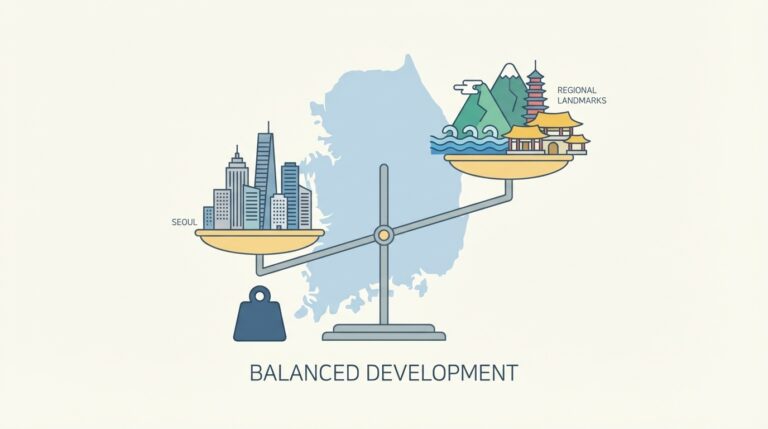
3. [균형 발전] (Gyun-hyeong Bal-jeon)
- Pronunciation: [Gyun-hyeong Bal-jeon]
- Meaning:
- Literal: Balanced Development
- Real Nuance: The political goal of spreading wealth and infrastructure evenly across the country, not just in Seoul.
- K-Culture Moment: Have you noticed government offices moving to Sejong City or K-Pop concerts finally happening in Busan or Daegu? That is 균형 발전 in action.
- Editor’s Insight: This is the “solution” word paired with the “problem” word (수도권 집중). Use this when advocating for regional tourism or investment.
- Situation Spectrum:
[🚫 Friends Chilling] ———— [⚠️ Work Meeting] ———— [✅ Policy Discussion]
Phase 3: Textbook vs. Real Life
| Situation | 📖 Textbook Korean | 🗣️ Real Korean (Identity & Pride) | 💡 Why different? |
|---|---|---|---|
| Describing Rural Areas | 지방 도시 (Regional city) | 시골 / 깡촌 (Countryside / Boonies) | Si-gol feels nostalgic; Kkang-chon is self-deprecating humor about isolation. |
| Moving to Seoul | 상경하다 (To go up to the capital) | 서울 라이프 시작 (Starting Seoul Life) | Sang-gyeong is archaic/literary; Seoul Life implies the modern dream/struggle. |
| Local Pride | 지역 감정 (Regional sentiment) | 우리 동네 부심 (Neighborhood Pride/Swag) | Jiyeok Gamjeong has negative political baggage; Busim is modern slang for pride. |
Bottom Note: In C1 discussions, use the Textbook terms for debates, but understand the Real Korean terms to catch the emotional undertone.
Phase 4: Cultural Context — K-Culture Deep Dive
4-1. Non-verbal: The “Satoori” (Dialect) Switch
In professional settings (news, politics), Standard Seoul Korean is mandatory. However, politicians often switch to a thick Satoori (dialect) when visiting their hometowns to win votes. It signals, “I am one of you; I haven’t forgotten my roots.”
Lesson: If you are traveling in Busan or Jeolla-do, and a local speaks to you in dialect, they are showing friendliness. Don’t be scared! Just smile and use the standard Korean you know. They will understand you.
4-2. K-Drama Connection: The “Reply” Series (응답하라)
The Reply series (1997, 1994) is the ultimate textbook for Local Autonomy of Culture. It showed that stories didn’t have to be set in Gangnam to be hits.
- The Trope: The character who desperately hides their dialect to fit in Seoul.
- The Reality: Nowadays, regional identity is “hip.” The development of local autonomy has led to Local Branding (e.g., Yangyang for surfing, Jeonju for Hanok). It’s no longer just about “catching up to Seoul,” but finding a unique local color.
Phase 5: Immersive Roleplay Scenario
Setting: A quiet Izakaya in Seoul, Friday night. You are having a deep conversation with Min-ji (30), a close friend originally from Daegu who is tired of the intense Seoul corporate life.
Min-ji: (Sighs) 월세 또 올랐어. 진짜 서울 살기 힘들다. 그냥 대구 내려갈까 봐.
(Wolse tto ollasseo. Jinjja Seoul salgi himdeulda. Geunyang Daegu naeryeogalkka bwa.)
[Translation: My rent went up again. Living in Seoul is seriously hard. I’m thinking of just going back down to Daegu.]
YOU: [Choose your response below]
Min-ji: 글쎄… 옛날엔 그랬는데, 요새는 지방도 많이 좋아졌잖아. 혁신도시도 생기고.
(Geulsse… yennalen geuraenneunde, yosaeneun jibangdo mani joajyeotjana. Hyeoksin-dosido saenggigo.)
[Translation: Well… that was the past, but lately the regions have improved a lot. There are ‘Innovation Cities’ now too.]
🔀 Your Turn! How do you respond?
- A) “그래도 일자리는 서울에 집중되어 있잖아.” (But jobs are concentrated in Seoul.)
- B) “맞아, 요즘은 지방 자치도 잘 되어 있어서 살기 좋을 거야.” (Right, local autonomy is well-established now so it should be good to live there.)
- C) “대구 가면 막창 맨날 먹을 수 있어서 부럽다!” (I’m jealous you can eat Makchang every day if you go to Daegu!)
✅ Best Choice for C1 Level: B
* Why: It acknowledges her struggle and validates the development of her hometown using the key concept (Local Autonomy/Development).
* ⚠️ Choice A Analysis: Factually true, but might sound discouraging when she needs support.
* ⚠️ Choice C Analysis: Good for a joke, but a bit too light for a conversation about life choices.
Phase 6: 10-Second Shadowing Drill
Let’s practice a sentence you might hear on the news or use in a debate about regional development.
Sentence: “True democracy begins with our interest in our local neighborhood.”
😊 진정한 민주주의는 / 우리 동네에 대한 / 관심에서 시작됩니다.
(Jinjeonghan minju-juui-neun / uri dongne-e daehan / gwansim-eseo sijak-doemnida.)
- Intonation: Rise slightly on ‘민주주의는’ and ‘대한’, fall firmly on ‘시작됩니다’ to sound convincing.
Phase 7: K-Culture Mini Glossary
| Korean | Romanization | Meaning | Context |
|---|---|---|---|
| 지자체 | Ji-ja-che | Local Gov. | Short for Ji-bang Ja-chi Dan-che (Local Autonomous Entity). Used frequently in news. |
| 풀뿌리 | Pul-ppu-ri | Grassroots | Literally “grass roots.” Refers to democracy starting from ordinary citizens. |
| 민심 | Min-sim | Public Sentiment | Literally “people’s heart.” Politicians are always trying to “read the Min-sim.” |
| 혁신도시 | Hyeok-sin Do-si | Innovation City | Planned cities outside Seoul created to promote balanced development. |
| 특산물 | Teuk-san-mul | Local Specialty | Famous products from a region (e.g., Jeju tangerines). A huge part of local economy. |
Phase 8: Traveler’s Survival Kit (Regional Festival Edition)
Local Autonomy in Korea has led to a boom in Regional Festivals (지역 축제) to attract tourists. If you leave Seoul, you will need these.
🆘 Survival Phrases for Local Travel
- “이 지역 특산물이 뭐예요?” (What is the local specialty here?)
- Use this to find the best food or souvenir. Locals love this question.
- “서울 가는 막차 언제예요?” (When is the last bus/train to Seoul?)
- Crucial. Public transport in the provinces stops earlier than in Seoul.
- “여기 사투리 너무 매력적이에요!” (The dialect here is so charming!)
- The ultimate compliment to break the ice with locals.
📌 Editor’s Travel Note:
When traveling to smaller cities, the “Bus Terminal” (버스터미널) is often the center of town, not the train station. Taxis may be harder to catch via apps like Kakao T; you might need to call or wave one down.
Phase 9: Think Deeper — “Seoul Republic”
Topic: Efficiency vs. Equity
Korea faces a dilemma. Focusing resources on Seoul makes the nation efficient and globally competitive (the “Han River Miracle”). However, Local Autonomy argues that this leaves the rest of the country behind, creating “extinction risk” villages.
🧠 Think Deeper:
Does your country have a “mega-city” like Seoul that drains resources from other regions? Or is your country more decentralized? How does language reflect this (e.g., standard accent vs. regional dialects)?💬 Your Turn: In Korean, we say “말은 제주도로 보내고, 사람은 서울로 보내라” (Send horses to Jeju, send people to Seoul). Does your culture have a similar saying about the capital city?
Phase 10: FAQ & Troubleshooting
- Q: Can I use the word ‘시골’ (Sigol – countryside) to describe someone’s hometown?
- Maybe. If they are from a very small village, it’s fine. But if they are from a big city like Busan, Daegu, or Gwangju, calling it ‘Sigol’ can be offensive! They are “Jibang” (Provinces) or “Metropolitan Cities” (Gwangyeok-si), not the countryside.
- Q: Is it rude to ask about someone’s political views on regional development?
- Yes, be careful. Regionalism (Jiyeok Gamjeong) has deep historical roots in politics. It’s safe to talk about economic development (jobs, tourism), but avoid criticizing specific regions’ political voting patterns.
- ❌ Common Mistake: Assuming everyone wants to live in Seoul.
- Correction: Many Koreans prioritize ‘Work-Life Balance’ (Warabel) and are moving to places like Jeju or Gangwon-do. Don’t assume moving to the province is a “failure.”
Phase 11: Wrap-up & Action Items
One-Liner Summary: Understanding Local Autonomy (지방 자치) helps you see Korea not just as Seoul, but as a diverse tapestry of regions striving for Balanced Development (균형 발전).
Action Mission:
* 🥉 Bronze: Say “지방 자치” and “균형 발전” out loud 3 times to get used to the Hanja sounds.
* 🥈 Silver: Go to Google Maps and find a Korean city other than Seoul, Busan, or Jeju. Find out its “Local Specialty” (Teuk-san-mul).
* 🥇 Gold: Ask a Korean friend: “고향이 어디세요? 그곳의 자랑거리는 뭐예요?” (Where is your hometown? What is the pride of that place?)
K-Culture Mission: Watch an episode of a travel variety show like 1 Night 2 Days (1박 2일) or Hometown Flex (서울촌놈). Observe how they highlight the unique food and dialect of the region they visit.
Phase 12: Interactive Quiz
- Situational Judgment: You are discussing the overcrowding of Seoul with a professor. Which term is most appropriate?
- A) 서울 짱 (Seoul Jjang)
- B) 수도권 집중 현상 (Concentration in Capital Area)
- C) 시골 냄새 (Countryside smell)
- True or False:
- “Calling Busan ‘Sigol’ (countryside) is a compliment.” (T/F)
- Fill in the Blank:
- “To solve the traffic and housing issues in Seoul, we need [ ] development.”
- (Hint: 균형 __ __)
(Answers: 1-B, 2-False [It’s a major metropolis!], 3-균형 발전)
Frequently Asked Questions (FAQ)
Q: What does "[지방 자치] (Ji-bang Ja-chi)" mean in Korean and how do you pronounce it?
A: In Korean, "[지방 자치] (Ji-bang Ja-chi)" is pronounced [Ji-bang Ja-chi] and means: Literal: Local Self-Governing
Q: What does "[수도권 집중 현상] (Su-do-gwon Jip-jung Hyeon-sang)" mean in Korean and how do you pronounce it?
A: In Korean, "[수도권 집중 현상] (Su-do-gwon Jip-jung Hyeon-sang)" is pronounced [Su-do-gwon Jip-jung Hyeon-sang] and means: Literal: Capital Area Concentration Phenomenon
Q: What does "[균형 발전] (Gyun-hyeong Bal-jeon)" mean in Korean and how do you pronounce it?
A: In Korean, "[균형 발전] (Gyun-hyeong Bal-jeon)" is pronounced [Gyun-hyeong Bal-jeon] and means: Literal: Balanced Development







