

The K-Drama Curse: Why Everyone Eats Ramyeon at 11 PM (and How to Say No)
Phase 1: The Late-Night Struggle is Real 🍜
Hello! This is your Senior Editor at Daily Hangul.
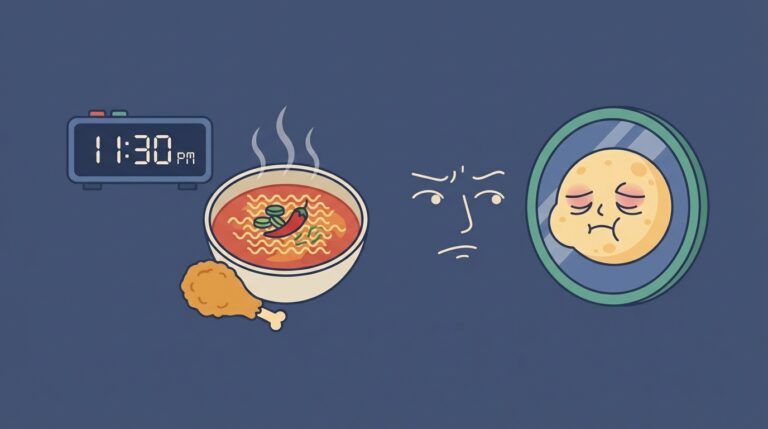
Picture this: It’s 11:30 PM on a Tuesday. You are watching your favorite K-Drama. The lead characters are sitting at a convenience table outside a CU or GS25. Steam rises from a paper cup of spicy Ramyeon. They take a bite, slurping loudly, and exclaim, “Waa, machitta!” (Wow, delicious!).
Suddenly, your stomach growls. You open a delivery app (Baedal Minjok), and your finger hovers over the “Order” button for fried chicken. But then, a terrifying thought stops you: “If I eat this, my face will look like a full moon tomorrow.”
Welcome to the world of Yasik (Late-night Snack) culture. In Korea, the night is young, the delivery is fast, but the regret—specifically the “swollen face” the next morning—is eternal. Today, we’ll learn how to navigate this delicious but dangerous minefield.
Phase 2: Deep Dive into Core Expressions
Here are the three expressions you need when battling late-night hunger.
1. 야식 (Yasik)
- Pronunciation: [ya-sik] Sounds like ‘Ya’ (Hey) + ‘Sick’.
- Meaning: Literal: Night Food / Real Nuance: A heavy late-night meal (not just a light snack).
- K-Culture Moment: In K-Pop dorm reality shows, you often see idols whispering, “Shall we order Yasik?” while hiding from their managers. It’s usually Chicken, Pig’s Feet (Jokbal), or Ramyeon.
- Editor’s Insight: Yasik isn’t an apple or a yogurt. In Korea, Yasik implies something greasy, spicy, and caloric. It’s a guilty pleasure shared with others.
- Situation Spectrum:
[🚫 Formal Meeting] ———— [⚠️ Colleagues] ———— [✅ Friends/Family]2. 붓다 (Butda)
- Pronunciation: [boot-da] Rhymes with ‘Put’ + ‘Da’.
- Meaning: Literal: To pour (homonym) / Contextual: To swell / To get puffy.
- K-Culture Moment: Actors often say in interviews, “I drink pumpkin tea because my face swells (bueoyo) easily.” This is the number one enemy of K-Beauty.
- Editor’s Insight: You don’t say “I got fat” overnight. You say “My face is swollen” (얼굴이 부었어요). It implies a temporary state caused by salt and sleep, not permanent weight gain.
- 🤔 Think About It: Why is a “small face” (V-line) considered so important in Korea that people worry about temporary swelling more than calories? How does this compare to beauty standards in your country?
3. 참다 (Chamda)
- Pronunciation: [cham-da] ‘Cham’ sounds like ‘Chum’ (friend).
- Meaning: Literal: To endure / Real Nuance: To suppress an urge or pain.
- K-Culture Moment: A character in a diet scene staring at a piece of cake: “I have to endure it (참아야 돼).”
- Editor’s Insight: This is a very strong cultural verb. Koreans “endure” heat, cold, anger, and hunger. It reflects a culture that values patience and self-control.
Phase 3: Textbook vs. Real Life
| Situation | 📖 Textbook Korean | 🗣️ Real Korean | 💡 Why the difference? |
|---|---|---|---|
| Wanting food | 저는 야식을 먹고 싶어요. (I want to eat a late-night snack.) |
아, 야식 땡겨. (Ah, Yasik pulls me / I’m craving Yasik.) |
Ttaenggida (to pull) is the slang for “craving.” It feels more physical and urgent. |
| Worrying about face | 내일 얼굴이 부을 거예요. (My face will swell tomorrow.) |
나 내일 찐빵 되면 어떡해? (What if I become a steamed bun tomorrow?) |
Koreans use cute metaphors like “Steamed Bun” (Jjinppang) to describe a puffy face. |
| Refusing food | 저는 먹지 않겠습니다. (I will not eat.) |
나 다이어트 중이야. 참아야 돼. (I’m dieting. I gotta hold back.) |
Explaining why (diet) softens the rejection and makes it socially acceptable. |
Phase 4: Cultural Deep Dive — The Paradox of Delivery & Beauty
4-1. The “Baedal” (Delivery) Temptation
Korea has one of the world’s most advanced delivery infrastructures. You can order fried chicken to a park bench by the Han River at 1 AM. This accessibility makes Yasik Syndrome a national struggle. The question isn’t “Can we get food?” but “Should we?”
4-2. The “Butgi” (Swelling) Phobia
In K-Beauty, Butgi (swelling) is treated almost like a medical condition. Before important days (interviews, dates, weddings), Koreans avoid salty foods like Ramyeon to prevent water retention. If you see someone drinking “Pumpkin Juice” or massaging their face with a frozen spoon in the morning, they are fighting the Yasik aftermath.
K-Culture Connection (Drama):
Have you seen the trope where a character puts cold spoons on their eyes in the morning? That is the classic “I ate Ramyeon last night and cried” recovery method!
Phase 5: Immersive Roleplay Scenario
Setting: It’s 11 PM on a Friday night at a Han River Park. You and your Korean friend, Minji, are sitting on a picnic mat. The air is cool, and you smell fried chicken from a nearby group.
Characters:
* YOU: A hungry exchange student who loves Korean chicken.
* Minji: Your trendy Korean friend who has a date tomorrow.
Dialogue:
Minji: 아, 냄새 미쳤다… 우리 치킨 시킬까? 🍗
(Ah, naemsae michyeotda… uri chikin sikilkka?)
(Ah, the smell is crazy… Shall we order chicken?)
YOU:
(You are hungry, but you know Minji worries about her face.)
🔀 Your Turn! What do you say?
A) “좋아! 바로 시키자!” (Good! Let’s order right away!)
B) “너 내일 데이트 있다며? 괜찮겠어?” (Didn’t you say you have a date tomorrow? Will you be okay?)
C) “나는 배 안 고파.” (I am not hungry.)
Analysis:
* Choice A: Fun, but risky. Minji might regret it and blame you tomorrow! 😅
* Choice B (✅ Best Choice): This shows typical Korean Nunchi (sensing the atmosphere). You are reminding her of the consequences (swelling) out of care. She will appreciate your consideration.
* Choice C: A bit cold. In Korea, eating is a communal activity.
Let’s continue with Choice B:
YOU: 너 내일 데이트 있다며? 얼굴 부으면 어떡해? 😯
(Neo naeil deiteu itdamyeo? Eolgul bueumyeon eotteokhae?)
(You said you have a date tomorrow, right? What if your face swells?)
Minji: (Sighs deeply) 맞다… 참아야지. 그냥 편의점 가서 우유나 마실까? 🥛
(Matda… chamayaji. Geunyang pyeonuijeom gaseo uyuna masilkka?)
(Right… I have to endure it. Shall we just go to the convenience store and drink milk?)
(Editor’s Note: There is a myth in Korea that drinking milk helps reduce facial swelling!)
Phase 6: 10-Second Shadowing Drill
Practice this sentence to use when you need to stop yourself (or a friend) from overeating at night!
Context: Refusing a snack because you are worried about tomorrow.
😤 Emotion: Firm & Determined
지금 먹으면 / 내일 아침에 / 얼굴 엄청 부어요!
(Jigeum meogeumyeon / naeil achime / eolgul eomcheong bueoyo!)
If I eat now / tomorrow morning / my face will swell hugely!
Phase 7: K-Culture Glossary (Yasik Edition)
| Korean | Romanization | Meaning | Context |
|---|---|---|---|
| 치맥 | Chimaek | Chicken + Beer | The king of Korean late-night snacks. |
| 족발 | Jokbal | Braised Pig’s Feet | A popular Yasik rich in collagen (good for skin, bad for diet!). |
| 야식 증후군 | Yasik Jeunghugun | Night Eating Syndrome | The habit of consuming +50% of daily calories at night. |
| 붓기 | Butgi | Swelling/Puffiness | The morning aftermath of eating salty food. |
Phase 8: Traveler’s Survival Kit
Even if you aren’t living in Korea, you will likely order food at night as a traveler.
🆘 Survival Expression: Asking for Delivery
– 🇰🇷 “여기 배달 돼요?” (Yeogi baedal dwaeyo?)
– Meaning: “Do you deliver here?”
– Situation: Asking at a hotel front desk or a restaurant.
– 💡 Pro Tip: Most Korean fried chicken places stay open until 1 AM or later. If you don’t have a Korean phone number for apps, ask your hotel concierge to order “Chimaek” for you. They are used to it!
Phase 9: Think Deeper — “Why do Koreans eat so late?”
🧠 The Sociology of Late Night Eating
You might wonder, “Why is Yasik culture so developed in Korea?” It is closely tied to the overwork culture and high stress. For many Korean students and office workers, the day ends late (9 PM or 10 PM). Yasik is often the first meal they can truly enjoy without rushing. It’s not just food; it’s a reward for a hard day’s work and a way to bond with colleagues or friends.💬 Your Turn: In your country, is eating late considered a fun social activity or a bad health habit? Tell me in the comments!
Phase 10: FAQ & Troubleshooting
Q: Is it rude to refuse Yasik when a senior (Sunbae) offers?
A: It can be tricky. If a boss says, “Let’s go for Chimaek,” saying “No, I’m on a diet” might kill the vibe (B1 level).
* Better Strategy: Go with them, eat very little (pretend to eat), and focus on drinking water or serving others. Or use a “white lie” like, “I have a stomach ache today” (health excuses are always accepted).
❌ Common Mistake:
Don’t say “살 쪄요” (It makes you fat) to someone else who is eating. That is considered rude judgment. Instead, talk about your own condition: “I get bloated easily” (저는 잘 부어서요).
Phase 11: Wrap-up & Action Mission
Summary: Today we learned that Yasik is delicious but leads to Butgi (swelling), so sometimes we must Chamda (endure)—or just eat and regret it later!
🚀 Action Missions:
– 🥉 Bronze: Look in the mirror and practice saying, “Ah, Yasik ttaenggyeo!” (I’m craving late-night snacks).
– 🥈 Silver: Next time you watch a K-Drama, count how many times they eat Ramyeon or Chicken at night.
– 🥇 Gold: Go to a Korean restaurant (or Asian market), buy a spicy noodle cup, and ask yourself the ultimate question: “To eat, or to endure?”
See you in the next lesson! Don’t let the Ramyeon tempt you too much! 👋
Frequently Asked Questions (FAQ)
Q: What does "야식 (Yasik)" mean in Korean and how do you pronounce it?
A: In Korean, "야식 (Yasik)" is pronounced [ya-sik] and means: Literal: Night Food / Real Nuance: A heavy late-night meal (not just a light snack).
Q: What does "붓다 (Butda)" mean in Korean and how do you pronounce it?
A: In Korean, "붓다 (Butda)" is pronounced [boot-da] and means: Literal: To pour (homonym) / Contextual: To swell / To get puffy.
Q: What does "참다 (Chamda)" mean in Korean and how do you pronounce it?
A: In Korean, "참다 (Chamda)" is pronounced [cham-da] and means: Literal: To endure / Real Nuance: To suppress an urge or pain.







