

Don’t Panic on the Road! Essential Korean Phrases for Safe Driving 🚗💨
Phase 1: Immersive Hook
Greeting: 안녕하세요! (Hello!) It’s your Daily Hangul editor here.
The Scene: You know that intense scene in every action K-Drama? The protagonist grips the steering wheel, knuckles white, weaving through Seoul traffic to catch the villain (or their true love). The GPS is shouting, cars are honking, and the tension is high. 😰
But let’s be real. In real life, you just want to get your rental car from point A to point B without scratching it, right? Driving in Korea can feel fast-paced—we call it the “Palli-palli” (Hurry-hurry) culture on wheels.
The ‘Why’: If you don’t know how to say “Please go slowly” or “Watch out,” you might find yourself sweating more than a trainee at a K-Pop dance practice. But don’t worry! Knowing just a few magic phrases will turn you from a nervous driver into a “Best Driver” (베스트 드라이버).
Transparency: This guide combines real survival tips from expats driving in Jeju Island and Seoul’s chaotic Gangnam district.
Phase 2: Deep Dive (Core Expressions)
Here are the top 3 phrases to keep you and your passengers safe.
1. 조심해서 가세요 (Josimhaeseo gaseyo)
- Pronunciation: [Jo-sim-hae-seo ga-se-yo]
- “Jo” sounds like ‘Joe’ + “Sim” like a ‘SIM’ card + “Hae-seo” sounds like ‘Hesso’ + “Ga-se-yo”
- Meaning:
- Literal: Go carefully.
- Real Nuance: Drive safely / Get home safe / Bye!
- K-Culture Moment: In slice-of-life dramas, when a character drops their crush off at home, they lean out the window and say this softly. It’s a sign of caring.
- Editor’s Insight: You can use this even if you aren’t driving. If you say goodbye to someone leaving your house, say this! It’s warmer than just “Bye.”
- Situation Spectrum:
[🚫 Formal Only] ———— [⚠️ Caution] ———— [✅ Casual to Formal]
- Used widely for anyone leaving (polite level). ✅
- 🤔 Think About It: Why does a farewell greeting include an instruction to be “careful”? What does this say about how Koreans value safety and concern for others?
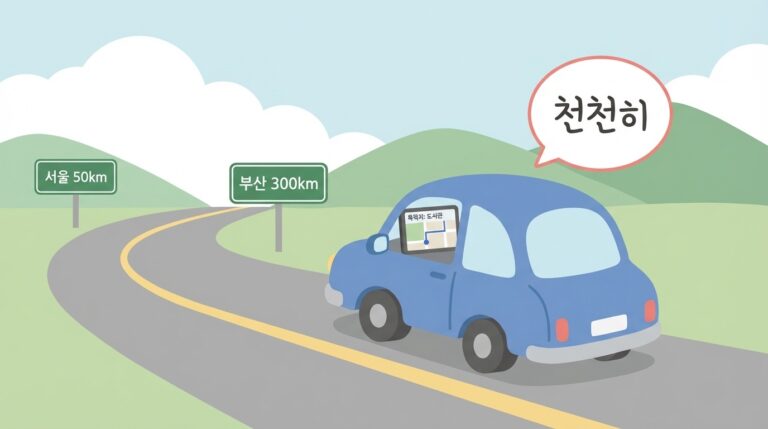
2. 천천히 가세요 (Cheoncheonhi gaseyo)
- Pronunciation: [Cheon-cheon-hi ga-se-yo]
- “Cheon” sounds like ‘Chun’ in ‘Chunk’ (repeat twice) + “Hi” + “Ga-se-yo”
- Meaning:
- Literal: Go slowly.
- Real Nuance: Please slow down (I’m scared/airsick) OR Take your time.
- K-Culture Moment: A taxi scene! The main character is late and yells “Palli gaseyo!” (Go fast!). You, however, should do the opposite. Safety first!
- Editor’s Insight: If you take a taxi and the driver thinks he is in Fast & Furious, use this phrase immediately.
- Situation Spectrum:
[🚫 Friends] ———— [⚠️ Strangers] ———— [✅ Drivers/Elders]
- Use this polite form with taxi drivers or older drivers. ✅
- 🤔 Think About It: Korea is famous for fast internet and fast delivery. Why is asking someone to go “slowly” sometimes considered a luxury?
3. 잠깐만요! (Jamkkanmanyo!)
- Pronunciation: [Jam-kkan-man-yo]
- “Jam” like ‘Jam’ on toast + “Kkan” + “Man” + “Yo”
- Meaning:
- Literal: Just a moment.
- Real Nuance: Hold on! / Wait! / Watch out!
- K-Culture Moment: You hear this in variety shows (like Running Man) when everyone is talking at once or trying to stop a game penalty.
- Editor’s Insight: In a car, use this if the driver is about to miss a turn or hit something. It’s an urgent “Pause button.”
- Situation Spectrum:
[🚫 Rude if yelled] ———— [⚠️ Urgent] ———— [✅ Standard]
- Perfectly fine to use in urgent situations. ✅
Phase 3: Textbook vs. Real Life
| Situation | 📖 Textbook Korean | 🗣️ Real Korean | 💡 Why different? |
|---|---|---|---|
| Telling a driver to stop | 세워 주세요 (Sewo juseyo) | 여기요! (Yeogiyo!) | “Here!” is faster and gets attention instantly. |
| Asking to go straight | 똑바로 가세요 (Ttokbaro gaseyo) | 쭉 가세요 (Jjuk gaseyo) | “Jjuk” mimics the sound/feeling of a straight line (onomatopoeia). |
| Apologizing for bad driving | 죄송합니다 (Joesonghamnida) | (Turn on Hazard Lights) 🚨 | Drivers communicate with lights, not just words. |
Bottom Note: “Jjuk” (Straight) is very common. Think of it like “Zoooom” straight ahead.
Phase 4: Cultural Deep Dive — K-Culture Connection
4-1. The Secret Language of Hazard Lights (Bisang-deung)
In Korea, the hazard lights (emergency blinkers) are not just for emergencies. They are the ultimate polite gesture.
* Scenario: You accidentally cut someone off or made a sudden stop.
* Action: Blink your hazard lights 3 times.
* Meaning: “I am so sorry, thank you for letting me in.”
* Why? You can’t bow to the other car, so the car bows for you! 🙇♂️🚗
4-2. Nunchi (Eye-measure) Driving
Koreans rely heavily on Nunchi (sensing the atmosphere) while driving. If you see a car edging forward, use your Nunchi. Are they aggressive? Let them pass. Are they hesitating? Use your hand to wave them in. Driving isn’t just following rules; it’s reading the flow.
Phase 5: Immersive Roleplay
Scenario A: The Taxi Ride / Rental Copilot
Setting: Seoul, Friday night. Heavy traffic. You are in a taxi (or shotgun in a friend’s rental car). The driver is speeding up.
Characters:
* YOU: A tourist who wants to arrive alive.
* Driver (Gisa-nim): A veteran driver who loves speed.
Dialogue:
Driver: 아, 차가 너무 막히네요. 다른 길로 빨리 갈게요! 🏎️
(Ah, chaga neomu makhineyo. Dareun gillo palli galkkeyo!)
(Ah, traffic is so bad. I’ll take a different road and go fast!)
YOU: (Feeling nervous about the speed)
__________________________.
🔀 Your Turn! How do you respond?
- A) “운전 조심하세요!” (Unjeon josimhaseyo! – Drive carefully!)
- B) “천천히 가주세요.” (Cheoncheonhi gajuseyo. – Please go slowly.)
- C) “빨리 빨리!” (Palli palli! – Hurry hurry!)
✅ Best Choice: B — This is a direct request to adjust the speed. It’s polite but clear.
⚠️ Choice A Analysis: Good, but it sounds more like a farewell greeting than a request to slow down now.
🚫 Choice C Analysis: Unless you are in an action movie chase, don’t say this!
Phase 6: 10-Second Shadowing Drill
Let’s practice! Listen to the rhythm. Repeat after me.
- Requesting Safety (Polite but firm 😐)
- 기사님, / 천천히 / 가주세요.
- (Gisa-nim, / cheon-cheon-hi / ga-ju-se-yo.)
- Driver, please go slowly.
- Giving Directions (Brightly 👉)
- 저기서 / 오른쪽으로 / 가세요.
- (Jeogiseo / oreunjjogeuro / gaseyo.)
- Go right over there.
Phase 7: K-Culture Mini Glossary
| Korean | Romanization | English | Context |
|---|---|---|---|
| 내비 | Naebi | Navigation (GPS) | Koreans shorten “Navigation” to “Naebi.” |
| 비상등 | Bisang-deung | Hazard Lights | The “Thank you/Sorry” button on the dashboard. |
| 초보 운전 | Chobo unjeon | Beginner Driving | You’ll see this sticker on the back of cars. Give them space! |
| 대리 운전 | Daeri unjeon | Substitute Driver | Drank Soju? Call a “Daeri” to drive your car home for you. |
Phase 8: Traveler’s Survival Kit
If you are renting a car or taking a taxi in Korea, this is essential.
🆘 Survival Expression #1
* 🇰🇷 “여기서 세워 주세요.” (Yeogiseo sewo juseyo.)
* 🗣️ Sound: [Yeo-gi-seo seh-woh ju-seh-yo]
* 📍 Where: Anywhere you want to get off.
* 💡 Pro Tip: Start packing your bags before the car stops. Palli-palli culture means getting out quickly!📌 Editor’s Travel Note: The Map Trap
* Google Maps doesn’t work well in Korea for navigation due to security laws. 😱
* Download: Naver Map or KakaoMap. They have English settings and are super accurate for driving, walking, and transit.
Phase 9: Think Deeper — “Palli-Palli” vs. Safety
Media vs. Reality:
In K-Dramas, CEOS are always making illegal U-turns and speeding to stop a wedding. In reality, Korea has many speed cameras (almost everywhere!). The “Palli-palli” (hurry hurry) culture is real—people walk fast, eat fast, and drive fast to be efficient. However, recent campaigns focus heavily on safety zones (School Zones).
🧠 Think Deeper:
How does the speed of life in Korea compare to your country? Does driving “fast” mean being “rude” in your culture, or just “efficient”?
Phase 10: FAQ & Troubleshooting
Q: Can I use “Stop!” (멈춰! – Meom-chwo!) to a taxi driver?
A: No! That sounds like a police officer arresting a criminal. Stick to “Se-wo ju-se-yo” (Please pull over/stop the car). usage of “Meom-chwo” is rare in polite conversation.
❌ Common Mistake #1: trusting Google Maps for driving directions.
✅ Fix: Always use Naver Map or the car’s built-in “Naebi.”
❌ Common Mistake #2: Getting angry when a car honks lightly.
✅ Fix: In Korea, a short “Beep” often just means “I’m here,” not “I hate you.”
Phase 11: Wrap-up & Action Items
One-Liner: To drive safely in Korea, master the art of “Cheoncheonhi” (Slowly) and use your hazard lights to say thanks!
🎬 Action Mission:
* 🥉 Bronze: Look at a map of Seoul on Naver Map (App/Web) and find “Gangnam Station.”
* 🥈 Silver: Practice saying “Gisa-nim, cheoncheonhi gajuseyo” three times while pretending to hold a handle.
* 🥇 Gold: Watch a K-Drama chase scene. Can you spot any road signs or hear them honking? (Bonus if you see the hazard lights blinking!).
💬 Your Turn: Do you have “Substitute Drivers” (Daeri) in your country who drive your own car home for you? Let me know in the comments!
Phase 12: Quiz — Interactive Challenge
- Situation: You accidentally cut in front of another car. What is the most “Korean” way to apologize?
- A) Wave your hand out the window.
- B) Turn on your hazard lights (blinkers) for 3 seconds.
- C) Stop the car and bow.
- Situation: The taxi is going too fast. You say:
- A) Palli palli!
- B) Cheoncheonhi gaseyo.
- C) Annyeonghaseyo.
(⬇️ Check the comments for answers!)
Frequently Asked Questions (FAQ)
Q: What does "조심해서 가세요 (Josimhaeseo gaseyo)" mean in Korean and how do you pronounce it?
A: In Korean, "조심해서 가세요 (Josimhaeseo gaseyo)" is pronounced [Jo-sim-hae-seo ga-se-yo] and means: a key conversational Korean expression covered in this lesson.
Q: What does "천천히 가세요 (Cheoncheonhi gaseyo)" mean in Korean and how do you pronounce it?
A: In Korean, "천천히 가세요 (Cheoncheonhi gaseyo)" is pronounced [Cheon-cheon-hi ga-se-yo] and means: a key conversational Korean expression covered in this lesson.
Q: What does "잠깐만요! (Jamkkanmanyo!)" mean in Korean and how do you pronounce it?
A: In Korean, "잠깐만요! (Jamkkanmanyo!)" is pronounced [Jam-kkan-man-yo] and means: a key conversational Korean expression covered in this lesson.







