

Phase 1: The Immersive Hook
Hello! This is your Daily Hangul Editor.
Picture this: You are watching a K-Drama scene set in a Jjimjilbang (Korean Sauna). The main characters are wearing those cute sheep-head towels (yang-meori) and cracking hard-boiled eggs on each other’s heads. It looks fun, right?
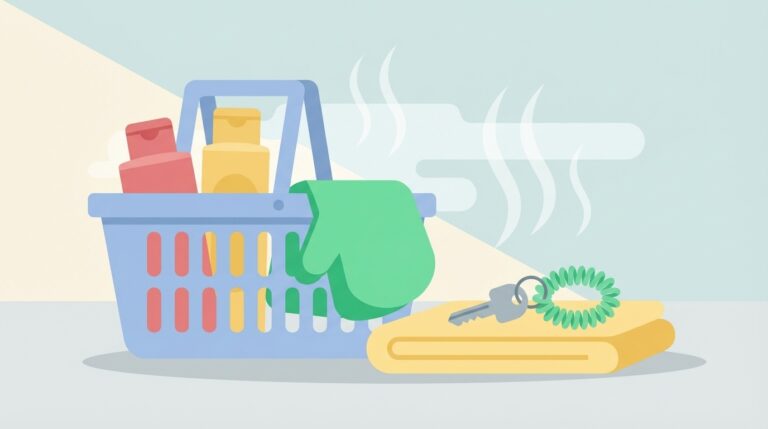
But rewind a bit. Before they got to the main hall, there was the locker room. If you look closely at the background actors—especially the “professional” aunties (Ahjummas)—you will notice they are all carrying a colorful, perforated plastic basket.
This isn’t just a container; it is the ultimate symbol of a Korean bath expert.
If you walk into a local bathhouse empty-handed, you might feel a bit lost (and definitely underprepared). Why do Koreans carry their own shampoo, soap, and rough towels to a place that should have water? Today, we are unpacking the Mokyok Baguni (Bath Basket) culture so you can scrub like a local, not just a tourist.
Phase 2: Deep Dive into Core Expressions
Here are the three must-know terms to survive the locker room.
1. 목욕 바구니 (Mokyok Baguni)
- Pronunciation: [Mokyok Baguni] + Sounds like ‘Mock-yolk Ba-goo-nee’
- Meaning: Bath Basket (Literal) vs. My Survival Kit (Real nuance)
- K-Culture Moment: In the drama Reply 1988, the mothers confirm their bond by going to the bathhouse together, swinging these baskets.
- Editor’s Insight: This basket says, “I am a regular here.” Inside, you have your personal shampoo, body wash, toothbrush, and towels. Most local baths (Mokyuktang) do not provide free toiletries (unlike fancy hotels).
- Situation Spectrum:
[🚫 Business Meeting] ———— [✅ Gym/Sauna] ———— [✅ Home]- 🤔 Think About It: Why do Koreans prefer using their own specific products rather than generic soap provided by the facility? Is it about hygiene, or perhaps a specific beauty routine?
2. 이태리 타월 (Itaeri Ta-wol)
- Pronunciation: [Itaeri Ta-wol] + Sounds like ‘Italy Towel’
- Meaning: Exfoliating Towel / Viscose Mitt
- K-Culture Moment: You’ve definitely seen a scene where someone screams in pain/pleasure while getting scrubbed. That green or yellow rough mitt? That’s the Italy Towel.
- Editor’s Insight: Why “Italy”? Because the viscose fabric used to make these rough towels was originally imported from Italy in the 1960s. It’s essential for Seshin (body scrubbing) to remove dead skin cells.
- Situation Spectrum:
[🚫 Face (Too harsh!)] ———— [✅ Body] ———— [✅ Elbows/Knees]3. 자리 맡기 (Jari Matgi)
- Pronunciation: [Jari Matgi] + Sounds like ‘Jah-ree Mat-key’
- Meaning: Saving a seat
- K-Culture Moment: In a crowded bathhouse, you’ll see a basket placed on a small stool in front of a shower tap, even if no one is there. That spot is taken!
- Editor’s Insight: This is an unwritten rule. Putting your basket down claims that shower faucet as your territory. Moving someone else’s basket? Big mistake.
- 🤔 Think About It: This concept of “saving a spot” with personal items exists in Korean cafes too (leaving a laptop). What does this say about social trust in Korea?
Phase 3: Textbook vs. Real Life
Let’s look at how to talk about bath supplies.
| Situation | 📖 Textbook Korean | 🗣️ Real Korean | 💡 Why the difference? |
|---|---|---|---|
| Buying supplies | 세면도구를 샀어요. (I bought toiletries.) |
목욕 바구니 챙겼어? (Did you pack the bath basket?) |
“Toiletries” is too formal. Locals focus on the container (the basket) which implies everything inside. |
| Asking for soap | 비누가 있습니까? (Is there soap?) |
여기 비누 있어요? (Is there soap here?) |
dropping formal endings (-sibnikka) makes you sound less like a soldier and more like a neighbor. |
| Scrubbing | 각질을 제거해요. (I am removing dead skin.) |
때 밀러 가자! (Let’s go push/scrub the dirt!) |
“Ddae” (dirt/dead skin) is the raw, real word used since childhood. “Exfoliate” is for cosmetics marketing. |
💡 Bottom Note: At B1 level, try using “때 밀다” (to scrub/push dirt). It sounds funny to foreigners, but it’s the most authentic way to say you are going to the sauna to scrub.
Phase 4: Cultural Context — K-Culture Deep Dive
4-1. Non-verbal Communication: The Basket Etiquette
In the shower area, placement is power.
– The Signal: If a plastic basket is sitting on a small plastic stool in front of a showerhead, do not sit there. It means the owner is just dipping in the hot tub or using the sauna and will return.
– The Nunchi: If you move it, an Ahjumma (middle-aged woman) or Ahjussi (middle-aged man) might come back and give you a very stern look. Use your Nunchi (eye-measure/sense)!
4-2. K-Beauty Connection: The “Seshin” Glow
Have you wondered why K-Pop idols or actors have such glowing body skin? It’s not just lotion. It’s the Seshin (Scrub) culture.
– The Ritual: Soak in hot water for 15-20 minutes $\rightarrow$ Skin softens $\rightarrow$ Use the “Italy Towel” to scrub.
– The Professional: Every large sauna has a “Seshinsa” (Professional Scrubber) in the corner wearing black underwear. You can pay them to scrub you down. It’s a transformative experience!
Phase 5: Immersive Roleplay Scenario
Setting: It is a Sunday morning at a local neighborhood sauna. Steam fills the air. You are at the counter buying a ticket. You realize you forgot your shampoo.
Characters:
– YOU: A foreign resident who loves saunas but is forgetful.
– Staff (Owner): A friendly but busy Korean lady (Auntie style).
Start Dialogue:
Staff: 어서 오세요~ 목욕만 하세요? 찜질도 하세요?
(Eoseo oseyo~ Mokyok-man haseyo? Jjimjil-do haseyo?)
(Welcome~ Just bath? Or sauna too?)
YOU: 목욕만 할게요. 아! 혹시 샴푸 있어요?
(Mokyok-man hal-geyo. Ah! Hoksi shampoo isseoyo?)
(Just bath, please. Ah! Do you happen to have shampoo?)
Staff: 안에 비누만 있어요. 일회용품 드릴까요?
(Ane binu-man isseoyo. Il-hoe-yong-pum deurilkkayo?)
(Inside there is only soap. Shall I give you single-use items?)
🔀 Your Turn! How do you respond?
- Option A: “네, 하나 주세요.” (Yes, please give me one.)
- Option B: “아니요, 친구 거 쓸게요.” (No, I’ll use my friend’s.)
- Option C: “그냥 물로 씻을게요.” (I’ll just wash with water.)
✅ Best Choice: Option A.
It costs about 500-1,000 KRW. It’s polite and convenient. Relying on strangers inside is awkward, and washing with just water is seen as unhygienic in a communal bath.
Staff: 여기요. 500원입니다. 수건은 두 장 챙겨가세요.
(Yeogiyo. Obaek-won imnida. Sugeoneun du jang chaeng-gyeo-gaseyo.)
(Here. It’s 500 won. Please take two towels.)
YOU: 감사합니다. 수고하세요!
(Gamsahamnida. Sugohaseyo!)
(Thank you. Keep up the good work!)
(🎭 Stage Direction: You take the small shampoo packet and the towels, heading toward the locker room feeling prepared.)
Phase 6: 10-Second Shadowing Drill
Let’s practice the sentence you will say to your friend before leaving the house.
😊 Bright & Checking tone
목욕 바구니 / 챙겼어요?
(Mokyok baguni / chaeng-gyeoss-eoyo?)
Did you pack / the bath basket?
Practice Tips:
– Raise the intonation at the end heavily.
– Pause slightly after ‘baguni’.
Phase 7: K-Culture Mini Glossary
| Korean | Romanization | Meaning | Context |
|---|---|---|---|
| 탕 | Tang | Tub / Bath | The hot/cold pools inside the bathhouse. |
| 세신 | Seshin | Body Scrub | Professional scrubbing service. |
| 일회용 | Il-hoe-yong | Disposable | Single-use shampoo/conditioner packets sold at the counter. |
| 탈의실 | Tal-ui-sil | Locker Room | Where you undress and store your basket. |
| 양머리 | Yang-meori | Sheep Head | The towel folded into a sheep shape (mostly for the dry sauna/hall, not the wet bath area). |
Phase 8: Traveler’s Survival Kit
Going to a sauna is a must-do in Korea. Here is how to survive the “naked truth.”
🆘 Survival Phrases
– 🇰🇷 “일회용 샴푸 주세요.” (Il-hoe-yong shampoo juseyo.)
– “Please give me a single-use shampoo.” (Use at the counter)
– 🇰🇷 “때수건 있어요?” (Ddae-sugeon isseoyo?)
– “Do you have a scrubbing towel?” (To buy the ‘Italy towel’)
– 🇰🇷 “이거 제 자리예요.” (Igeo je jariyeyo.)
– “This is my spot.” (If someone tries to take your shower booth)📌 Editor’s Travel Note
– Tattoos: Large tattoos can still be frowned upon in neighborhood baths, though less so in touristy Jjimjilbangs. If you have many, try to be discreet or check the policy.
– Nudity: Yes, you must be fully naked in the wet area. No swimsuits allowed! It’s awkward for 5 seconds, then liberating.
Phase 9: Think Deeper — “Food & Identity”
Let’s talk about “Naked Friendship” (Al-mom Chin-mok).
In Korea, there is a saying: “We became close after scrubbing each other’s backs.” Visiting a bathhouse together is a significant milestone in a friendship. It signifies removing all barriers—literally and metaphorically. The Bath Basket is the toolkit for this ritual. Sharing your expensive shampoo or scrubbing a friend’s back (a very vulnerable spot) builds deep trust (Jeong).
🧠 Think Deeper: In your culture, what is the activity that signifies “we are now truly close friends”? Is it getting drunk together? Traveling? Or something else?
Phase 10: FAQ & Troubleshooting
Q: Can I bring my phone into the bath area?
A: NO! 🚫 Absolutely forbidden in the locker room and wet bath area due to privacy/cameras. You can only take it to the common dry sauna area (Jjimjilbang hall) where people are clothed.
Q: I saw a “Bar of Soap” on a stick. What is that?
A: That is communal soap. It is usually fixed to a metal rod so no one steals it. You can use it, but most locals prefer their own fancy body wash from their basket.
❌ Common Mistake #1: Wearing underwear or a swimsuit into the tub.
✅ Fix: You must be 100% naked. It is hygienic etiquette. If you have long hair, tie it up so it doesn’t touch the bathwater.
Phase 11: Wrap-up & Action Mission
One-Liner: The “Bath Basket” is your passport to being treated like a local in a Korean sauna.
🚀 Action Mission:
– 🥉 Bronze: Go to a Korean convenience store (or Asian market) and find the “Italy Towel” (green/yellow mitt).
– 🥈 Silver: Search “Korean Sauna Vlog” on YouTube and spot the baskets in the background.
– 🥇 Gold: Visit a Jjimjilbang, buy a single-use shampoo (Il-hoe-yong), and successfully wash up like a local!
💬 Your Turn: Would you be brave enough to ask a stranger to scrub your back? Tell me in the comments!
Phase 12: Interactive Quiz
- Situational Judgment: You see a basket on a stool in front of a shower, but no human is there. What do you do?
- A) Move the basket and sit down.
- B) Find another empty spot.
- C) Use the items in the basket.
- Culture Quiz: True or False?
- “You should wear a swimsuit in the wet bath area (Tang) if you are shy.”
(Scroll down for answers)
.
.
.
Answers:
1. B) Never move the basket! It signifies the spot is taken.
2. False. Swimsuits are strictly forbidden in the wet area for hygiene reasons.
Frequently Asked Questions (FAQ)
Q: What does "목욕 바구니 (Mokyok Baguni)" mean in Korean and how do you pronounce it?
A: In Korean, "목욕 바구니 (Mokyok Baguni)" is pronounced [Mokyok Baguni] and means: Bath Basket (Literal) vs. My Survival Kit (Real nuance)
Q: What does "이태리 타월 (Itaeri Ta-wol)" mean in Korean and how do you pronounce it?
A: In Korean, "이태리 타월 (Itaeri Ta-wol)" is pronounced [Itaeri Ta-wol] and means: Exfoliating Towel / Viscose Mitt
Q: What does "자리 맡기 (Jari Matgi)" mean in Korean and how do you pronounce it?
A: In Korean, "자리 맡기 (Jari Matgi)" is pronounced [Jari Matgi] and means: Saving a seat







