

Did He Just Walk In First? Decoding Korean “Lady First” & Dating Etiquette
Phase 1: The “Wait, What?” Moment 😳
Hello! This is your Daily Hangul Senior Editor.
Picture this: You are on a date (or a friendly hangout) with a Korean guy you met in Seoul. He’s polite, dresses like a K-Drama lead, and has great nunchi. You arrive at a trendy restaurant in Hongdae. As you approach the door, you instinctively pause, expecting him to open it and gesture for you to enter.
Instead, he opens the door and walks in first.
Cue the record scratch sound effect. 🎵⛔
Did he just ignore you? Is he rude? Before you delete his number, wait! In many Western cultures, “Lady First” is the golden rule. But in Korea, the logic of etiquette is wired a bit differently. He might be walking in first to secure a table for you, to check the safety of the path, or simply because in the Confucian hierarchy, the “leader” (or host) often leads the way.
Today, we are going to decode the confusing, fascinating world of Korean gender etiquette. We’ll move beyond the textbook to understand what “care” really looks like in Korea—from carrying handbags to the art of grilling meat.
Phase 2: Deep Dive into Key Expressions 🧐
Here are three expressions that will help you navigate these subtle social moments.
1. 먼저 가세요 (Meonjeo gaseyo)
- Pronunciation: [Meon-jeo ga-se-yo] Sounds like: “Mon-jo” + “Ga-say-yo”
- Meaning: “Please go first.” / “After you.”
- K-Drama Moment: In a crowded elevator scene, the polite male lead holds the door button and says this to the female lead. It’s the classic “manners” moment.
- Editor’s Insight: While “Lady First” isn’t a strict law, saying this shows you have class. If a Korean man hesitates at a door, you can say this to break the ice. It’s also used when yielding your seat on the subway.
- Situation Spectrum:
[🚫 Casual Friends (Too stiff)] ———— [✅ Strangers/Colleagues] ———— [✅ Elders]
2. 제가 들게요 (Jega deulgeyo)
- Pronunciation: [Je-ga deul-ge-yo] Sounds like: “Jay-ga” + “Duhl-geh-yo”
- Meaning: “I will carry it.” / “Let me hold that.”
- K-Drama Moment: You’ve seen this a hundred times. The girl is carrying a shopping bag (even a small one), and the guy silently takes it from her hand.
- Editor’s Insight: This is the Korean version of holding the door. In Korea, physical labor (carrying things) is seen as something the “stronger” person should handle to show care. It is very common to see men carrying their girlfriend’s luxury handbags on the streets of Gangnam.
- Situation Spectrum:
[✅ Dating/Flirting] ———— [⚠️ Male Colleague to Female Colleague (Can be misunderstood as interest)] ———— [✅ Junior to Senior]
3. 무거워요? (Mugeowoyo?)
- Pronunciation: [Mu-geo-wo-yo?] Sounds like: “Moo-gaw-wuh-yo?”
- Meaning: “Is it heavy?”
- Editor’s Insight: This is often the precursor to “Jega deulgeyo.” It’s a soft way to check on someone’s comfort. If you want to show consideration to a Korean friend carrying a lot of luggage, ask this.
- 🤔 Think About It: Why is act of service (carrying bags, cutting meat) valued more in Korea than chivalry of position (holding doors)? It relates to the concept of Jeong (정)—an emotional bond built through shared suffering or effort.
Phase 3: Textbook vs. Real Life 🗣️
| Situation | 📖 Textbook Korean | 🗣️ Real Korean (Street Vibe) | 💡 Why the difference? |
|---|---|---|---|
| Offering to help | 제가 도와드리겠습니다. (Jega dowadeurigetseumnida) | 제가 할게요. (Jega halgeyo) | The textbook version sounds like customer service robots. “Jega halgeyo” is proactive and friendly. |
| Declining help | 아니요, 괜찮습니다. (Aniyo, gwaenchanseumnida) | 아, 아녜요! (Ah, anyeyo!) | “Anyeyo” with a hand wave is the universal “humble refusal” gesture. |
| entering a room | 먼저 들어가세요. (Meonjeo deureogaseyo) | 먼저 가요. (Meonjeo gayo) | Efficiency! In a busy city like Seoul, shorter phrases keep the ppalli-ppalli (hurry-hurry) flow. |
Phase 4: Cultural Deep Dive — The “Bag & The Grill” 🎒🥩
4-1. The “Bag Carrying” Phenomenon
If you walk around Hongdae or Garosu-gil, you will notice something that baffles many Westerners: men carrying women’s purses. Not just grocery bags, but small, pink, designer handbags.
* The Signal: It’s a public display of affection and care. It screams, “I don’t want my girlfriend to be burdened even by 1kg.”
* Non-verbal Tip: If a Korean guy reaches for your bag, he’s not trying to steal it! He’s flirting or showing manners. You can politely refuse once (“Gwaenchannayo”), but if he insists, letting him carry it makes him feel useful.
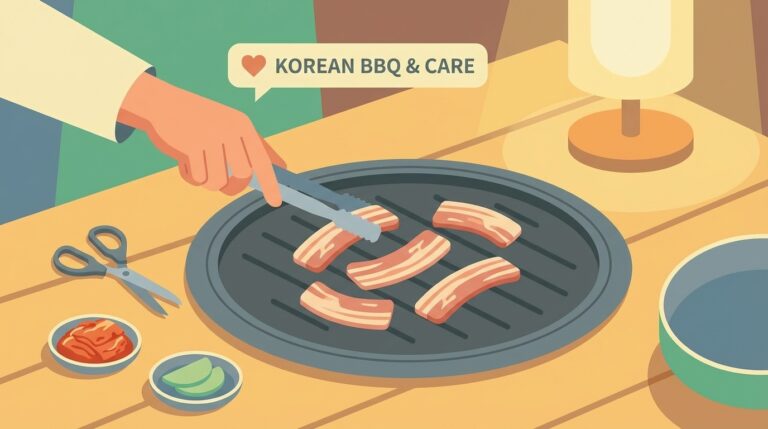
4-2. The Real Chivalry: The Grill Master
In the West, chivalry might be opening the car door. In Korea, chivalry happens at the BBQ table.
* The Action: The person who picks up the tongs and scissors controls the hierarchy. Usually, the youngest or the male in a dating scenario will cut the meat, flip it, and place a perfectly cooked piece on your plate.
* K-Drama Trope: Watch closely—the male lead often puts a piece of beef on the female lead’s spoon. This acts as a silent “I love you” or “Eat well.”
Phase 5: Immersive Roleplay 🎬
Setting: A Friday night at a busy Samgyeopsal (pork belly) restaurant in Jongno. It’s loud, smoky, and energetic.
Characters:
* YOU: An expat living in Seoul, familiar with basic Korean.
* MIN-SU: Your Korean language exchange partner (and maybe a potential crush?). He is kind but very “Korean” in his manners.
(The meat arrives. Min-su immediately grabs the tongs.)
Min-su: 집게는 제가 잡을게요. 위험하니까요. 🔥
(Jipge-neun jega jabeulgeyo. Wiheomhanikkayo.)
“I’ll handle the tongs. It’s dangerous.”
YOU:
(🎭 Stage Direction: You feel bad just watching him work.)
Op 1. “Ah, thank you! You are good at this.”
Op 2. “No, give it to me! I want to try!”
Op 3. “Gwaenchannayo? Can I help?”
🔀 YOUR TURN! Which one fits the vibe?
- Option A: “아, 감사합니다! 고기 굽는 장인이시네요!” (Ah, gamsahamnida! Gogi gumneun jang-inisineyo!) -> Safe & Flattering. Calling him a “master” (jang-in) is a great compliment.
- Option B: “아니에요, 제가 할게요!” (Anieyo, jega halgeyo!) -> Risky. In Korea, if a guest or a lady tries to grill, the host feels uncomfortable, like they aren’t taking good care of you.
- Option C: “힘들지 않아요? 제가 좀 도울까요?” (Himdeulji anayo? Jega jom doulkkayo?) -> ✅ BEST CHOICE. It acknowledges his effort (Jeong) without taking away his role as the protector/provider of food.
(Min-su smiles and puts a piece of meat on your plate.)
Min-su: 다 익었어요. 먼저 드세요. 🥢
(Da igeosseoyo. Meonjeo deuseyo.)
“It’s all cooked. Please eat first.”
Phase 6: 10-Second Shadowing Drill 🗣️
Let’s practice the “Polite Refusal/Acceptance” dance. Practice this with a soft, slightly shy tone.
😊 Situation: He insists on carrying your bag.
“Ah, really / it’s okay / but thank you!”🇰🇷 아, 진짜 / 괜찮은데… / 그래도 고마워요!
[Ah, jinjja / gwaenchaneunde… / geuraedo gomawoyo!]
- Intonation Tip: Stretch the “de…” (데…) slightly to sound softer and less rejecting. don’t say “Gwaenchanayo!” abruptly like a robot.
Phase 7: K-Culture Mini Dictionary 📖
| Korean | Romanization | English | Context |
|---|---|---|---|
| 매너손 | Manner-son | Manner Hands | When a male celebrity hovers his hand near a woman’s shoulder/waist without touching, to show respect. |
| 썸 | Ssom | “Some” | The ambiguity stage before dating. “There is something between us.” Manners are crucial here! |
| 쩍벌남 | Jjeok-beol-nam | Manspreader | A man who spreads his legs wide on public transport. The opposite of good etiquette! |
| 레이디 퍼스트 | Lady First | Lady First | A loanword used in Korea, but often practiced differently than in the West. |
Phase 8: Traveler’s Survival Kit 🧳
Topic: Subway & Door Etiquette for Travelers
🆘 Survival Expression #1
* 🇰🇷 “여기 앉으세요.” (Yeogi anjeuseyo.)
* 🗣️ Pronunciation: [Yeo-gi an-jeu-se-yo]
* 📍 Where: Subway or Bus
* 💡 Context: In Korea, “Lady First” is often trumped by “Elder First.” If you are a young woman sitting down and an elderly man walks up, you are expected to give up your seat. It’s not about gender; it’s about age.📌 Editor’s Travel Note
* The Door Hold: Don’t be offended if someone lets a heavy door slam behind them. It’s not personal; people are just rushing. Conversely, if you hold the door for others, you might get surprised looks (but they will appreciate it!).
* Elevators: The person nearest the buttons acts as the operator. Push the “Open” button until everyone gets in. It’s a universal manner that is highly valued in Seoul.
Phase 9: Think Deeper — “Age vs. Gender” 🧠
Why does age often trump gender in Korea?
In Western etiquette, “Ladies First” is a form of benevolent chivalry rooted in medieval traditions. In Korea, Confucianism dictates the social order, and the primary axis is Age and Hierarchy, not Gender. Therefore, a young woman might open the door for an older male boss, or a young man might wait for his grandmother to eat before he picks up his spoon.
💬 Your Turn: Does your culture prioritize gender (chivalry) or age (hierarchy)? Or is it strictly “first come, first served”? Tell us in the comments!
Phase 10: FAQ & Troubleshooting 🛠️
Q: My Korean boyfriend never compliments my outfit but always asks “Have you eaten?” Is he not interested?
A: He is very interested! In Korea, asking “Bap meogeosseoyo?” (Did you eat?) is the ultimate love language. It means “I care about your well-being.” It’s more practical than poetic.
Q: Is it rude if I (a woman) pour drinks for everyone?
A: No, but in a traditional business setting, usually the youngest person pours. However, there is an old superstition that if a woman pours her own drink, she won’t get married! So, usually, someone else will rush to pour it for you.
❌ Common Mistake: Expecting “Ladies First” in the rush hour subway.
✅ Reality: The Seoul Metro during rush hour is a battlefield. Gender disappears; only survival remains. Don’t take the shoving personally!
Phase 11: Wrap-up & Mission 🚀
One-Liner: Korean chivalry isn’t about holding doors; it’s about grilling meat, carrying bags, and checking if you’ve eaten.
Action Missions:
* 🥉 Bronze: Say “Meonjeo gaseyo” (Please go first) to yourself in the mirror while gesturing with your hand.
* 🥈 Silver: Watch a K-Drama scene where they are eating BBQ. Who is grilling? Who is eating? Analyze the power dynamic.
* 🥇 Gold: Next time you are with a Korean friend (or at a Korean restaurant), offer to grill the meat or pour the water saying, “Jega halgeyo!”
K-Culture Mission: Go to a crowded café. Watch a couple entering. Who opens the door? Who orders? Who carries the vibration bell? You’ll see the unique rhythm of Korean dating manners.
Phase 12: Interactive Quiz ✍️
1. You are on a date. The food arrives. Your date grabs the scissors to cut the noodles. What should you do?
* A) Snatch the scissors away and shout “Lady First!”
* B) Watch silently and start eating immediately.
* C) Wait until he finishes cutting, then say “Gamsahamnida” (Thank you).
2. True or False?
* “In Korea, if a man enters a restaurant first, he is definitely rude.”
* (False! He might be checking for seats or leading the way as the host.)
(Answer Key: 1-C, 2-False)
Frequently Asked Questions (FAQ)
Q: What does "먼저 가세요 (Meonjeo gaseyo)" mean in Korean and how do you pronounce it?
A: In Korean, "먼저 가세요 (Meonjeo gaseyo)" is pronounced [Meon-jeo ga-se-yo] and means: "Please go first." / "After you."
Q: What does "제가 들게요 (Jega deulgeyo)" mean in Korean and how do you pronounce it?
A: In Korean, "제가 들게요 (Jega deulgeyo)" is pronounced [Je-ga deul-ge-yo] and means: "I will carry it." / "Let me hold that."
Q: What does "무거워요? (Mugeowoyo?)" mean in Korean and how do you pronounce it?
A: In Korean, "무거워요? (Mugeowoyo?)" is pronounced [Mu-geo-wo-yo?] and means: "Is it heavy?"







