

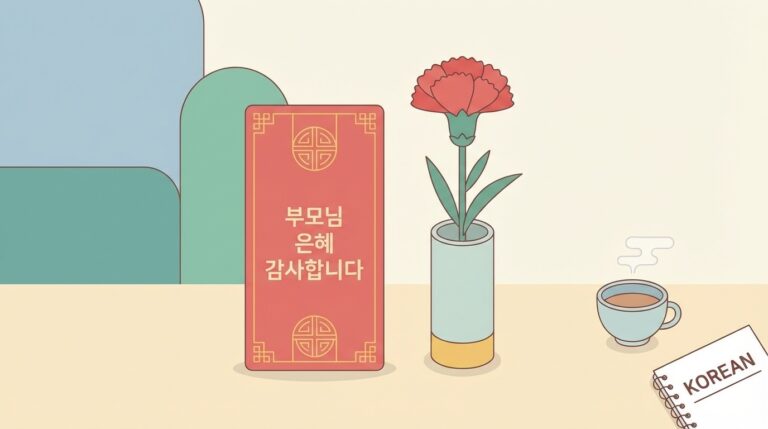
The Ultimate Guide to Korean Parents’ Day Gifts: Survive the K-Drama ‘Hyodo’ Moment
Phase 1: Empathy — Immersive Hook
Hello! I’m the Lead Editor of Daily Hangul.
Picture this: You’re watching your favorite K-Drama. The main character is sitting across from their parents at a sizzling K-BBQ restaurant. Suddenly, they slide a crisp, beautifully decorated envelope across the table, or perhaps hand over a shiny gold box of Red Ginseng sticks. The parents smile with pride, and the music swells.
What did we just witness? It is the ultimate display of 효도 (Hyodo – Filial Piety).
In Korea, Parents’ Day (어버이날 – Eobeoinal) is celebrated on May 8th. Whether you are buying a gift for your own parents, your Korean partner’s family, or simply buying a carnation at a local flower shop, knowing how to navigate this gift-giving culture will make you look like a true insider. Let’s learn the A1-level survival phrases so you can hand over your gifts with confidence and perfect Korean manners!
Phase 2: Deep Dive into Core Phrases
Let’s master the top 3 phrases you need when giving a gift to elders.
1. 선물이에요 (It is a gift)
- Pronunciation: seonmurieyo [sun-moo-ree-eh-yo]
- Meaning: Literal: It is a gift. / Real nuance: Here is a little something for you.
- K-Culture Moment: Handing over a gift bag with a warm smile. To sound even more polite and humble (a very Korean trait!), you can add ‘작은’ (jageun – small) in front: 작은 선물이에요 (It’s a small gift). Even if you bought them a luxury bag, you still call it a ‘small’ gift!
- Editor’s Insight: This phrase is magical. It removes any awkwardness when handing over an item.
- Situation Spectrum:
[🚫 Never] ———— [⚠️ Be Careful] ———— [✅ Go Ahead]
- Friends (Casual): ⚠️ (Friends usually say ‘선물이야’ seonmuriya)
- Coworkers (Semi-formal): ✅
- Parents/Elders (Formal): ✅ (Perfect and safe!)
- 🤔 Think About It: Why do Koreans downplay their gifts by calling them ‘small’ even when they are expensive? How do people present gifts in your culture?
2. 건강하세요 (Please stay healthy)
- Pronunciation: geonganghaseyo [gun-gang-ha-seh-yo] (The ‘gun’ sounds like the English word ‘gun’, ‘gang’ like ‘gang’)
- Meaning: Literal: Be healthy. / Real nuance: I wish you a long, healthy life.
- K-Culture Moment: On Parents’ Day, New Year’s, or birthdays, this is the #1 wish. In Korea, wishing someone health is often seen as a deeper expression of love and respect than just saying ‘I love you.’
- Editor’s Insight: Say this while bowing slightly for maximum effect.
- Situation Spectrum:
[🚫 Never] ———— [⚠️ Be Careful] ———— [✅ Go Ahead]
- Friends (Casual): 🚫 (Too formal and serious for young friends)
- Coworkers (Semi-formal): ⚠️
- Parents/Elders (Formal): ✅ (The absolute best phrase)
- 🤔 Think About It: Does your language have a specific greeting dedicated solely to wishing someone health?
3. 감사합니다 (Thank you)
- Pronunciation: gamsahamnida [gam-sa-ham-nee-da]
- Meaning: Literal/Real nuance: Thank you.
- K-Culture Moment: Wait, why are YOU saying thank you when giving a gift? In Korea, children thank their parents for raising them safely.
- Editor’s Insight: It is perfectly natural to hand over a gift and say ‘키워주셔서 감사합니다’ (Thank you for raising me), but for A1 beginners, just a heartfelt ‘감사합니다’ works wonders!
- Situation Spectrum:
[🚫 Never] ———— [⚠️ Be Careful] ———— [✅ Go Ahead]
- Friends (Casual): ⚠️ (Too formal, use ‘고마워’ gomawo instead)
- Coworkers (Semi-formal): ✅
- Parents/Elders (Formal): ✅
Phase 3: Textbook vs Real Life Korean
| Situation | 📖 Textbook Korean | 🗣️ Real Life Korean | 💡 Why the difference? |
|---|---|---|---|
| Giving a gift | 이것을 부모님께 드립니다. (I give this to my parents) | 엄마, 아빠! 작은 선물이에요. (Mom, Dad! It’s a small gift) | Textbooks use dry, robotic grammar. Real life uses emotional, humble phrases. |
| Expressing love | 어머니 아버지, 사랑합니다. (Mother, Father, I love you) | 건강하세요! (Please stay healthy!) | Health is the ultimate priority and expression of care for Korean elders. |
| Explaining the gift | 이것은 카네이션입니다. (This is a carnation) | (Just hands over the Red Ginseng and an envelope of cash) | Actions and practical gifts (cash) often speak louder than words! |
Phase 4: Cultural Deep Dive
4-1. Non-verbal Communication: The Power of Two Hands
Language is only half the battle. If you hand a gift to a Korean elder with one hand, especially with your other hand in your pocket, the air will freeze! Always use two hands when giving or receiving something from someone older. If the item is small, give it with your right hand while your left hand lightly supports your right elbow or wrist.
4-2. K-Culture Connection: K-Drama & K-Food
Have you noticed the gifts in K-Dramas?
1. 용돈 (Yongdon – Pocket Money): The most desired Parents’ Day gift is cold, hard cash. But never just hand over raw bills! It MUST be placed in a beautifully decorated envelope (봉투).
2. 홍삼 (Hongsam – Red Ginseng): The ultimate K-Drama product placement (PPL)! You will always see characters sucking on little red sticks. Red ginseng is believed to boost immunity, making it the premier health gift for parents.
Phase 5: Immersive Roleplay Scenarios
Scenario A: The Family Dinner
- Setting: Friday evening at a bustling Galbi (Korean BBQ) restaurant. The smell of roasted meat fills the air. You are having dinner with your Korean partner’s parents for Parents’ Day.
- Characters:
- YOU: A nervous but prepared foreigner trying to impress the in-laws.
- 어머니 (Eomeoni – Mother): Warm and constantly putting meat on your plate.
Dialogue:
어머니: (Grilling meat) 많이 먹어요!
(Mani meogeoyo!)
(English: Eat a lot!)
YOU: 네, 감사합니다! 저… 어머니.
(Ne, gamsahamnida! Jeo… eomeoni.)
(English: Yes, thank you! Um… Mother.)
어머니: 응? 왜요?
(Eung? Waeyo?)
(English: Hm? Why?)
YOU: (Takes out a neat envelope and a small box) 이거…
(Igeo…)
(English: This is…)
🔀 Your Turn! How should you complete the sentence?
– A) 내 돈이에요! (Nae donieyo! – It is my money!)
– B) 작은 선물이에요. 건강하세요! (Jageun seonmurieyo. Geonganghaseyo! – It’s a small gift. Please stay healthy!)
– C) 대박 선물입니다! (Daebak seonmurimnida! – It’s an awesome gift!)✅ Best Choice: B — It is humble, uses the correct polite ending, and includes the magic word ‘health’.
⚠️ Choice A & C Analysis: ‘My money’ sounds incredibly rude and bizarre. ‘Daebak’ is slang and too casual for your partner’s parents!
(If you chose B…)
어머니: 아이고, 뭘 이런 걸 준비했어요~ 고마워요.
(Aigo, mwol ireon geol junbihaesseoyo~ Gomawoyo.)
(English: Oh my, why did you prepare such a thing~ Thank you.)
(🎭 Stage Direction: She says ‘why did you prepare this’ but she is smiling widely and immediately putting the envelope safely in her purse!)
Scenario B: Bonus K-Travel Situation
You need to buy a red carnation (the symbol of Parents’ Day) from a street vendor in Myeongdong.
YOU: 사장님, 카네이션 얼마예요?
(Sajangnim, kaneisyeon eolmayeyo? – Boss, how much is the carnation?)
Vendor: 만 원이에요.
(Man wonieyo. – It’s 10,000 won.)
YOU: 네, 여기요. 감사합니다!
(Ne, yeogiyo. Gamsahamnida! – Yes, here you go. Thank you!)
Phase 6: 10-Second Shadowing Drill
Read this out loud. Pay attention to the pauses (/) and emotions!
😊 어머니 / 작은 선물이에요! (eomeoni / jageun seonmurieyo!)
🥺 항~상 / 건강하세요! (hang~sang / geonganghaseyo!)
Tip: Stretch the ‘hang~’ slightly to sound more affectionate and sincere!
Phase 7: K-Culture Glossary
| Korean | Romanization | English | Context |
|---|---|---|---|
| 효도 | hyodo | Filial Piety | The deep-rooted duty and respect children owe their parents. |
| 용돈 | yongdon | Pocket Money | Cash given as a gift. The undisputed #1 gift choice for parents. |
| 홍삼 | hongsam | Red Ginseng | A premium health supplement, hugely popular as a gift for elders. |
| 봉투 | bongtu | Envelope | You must use a nice paper envelope when giving cash. Never hand over bare bills! |
| 카네이션 | kaneisyeon | Carnation | The official flower given on Parents’ Day in Korea. |
Phase 8: Traveler’s Survival Kit
Even if you are just traveling in Korea in May, you will see carnations everywhere. Here are essential phrases for buying gifts!
🆘 Survival Phrases for Shopping
– 🇰🇷 ‘이거 얼마예요?’ (igeo eolmayeyo? – How much is this?)
– 🇰🇷 ‘포장해 주세요’ (pojanghae juseyo – Please wrap it for me.)
– 🇰🇷 ‘카드 돼요?’ (kadeu dwaeyo? – Do you take credit cards?)📌 Editor’s Travel Note
– Card vs Cash: Korea is a cashless society! However, if you are buying a flower from a tiny street cart, having some 1,000 and 10,000 won bills is helpful.
– No Tipping: Never leave a tip at the gift shop or restaurant. It will just confuse the staff!
Phase 9: Think Deeper — Language & Power
Language and Respect (Jondaetmal):
In Korean, the language you use entirely depends on who you are talking to. When speaking to parents or elders, Koreans use formal honorific language (존댓말 – Jondaetmal). It is not just about being polite; the language itself builds a visible hierarchy of respect that reflects traditional Confucian values. Even adult children in their 50s will use respectful speech to their 80-year-old parents.
💬 Your Turn: Does your native language change its grammar depending on the age of the person you are talking to? Share your thoughts in the comments!
Phase 10: FAQ & Troubleshooting
- Q: Do I HAVE to give cash for Parents’ Day?
- A: Not at all! While cash is the most popular, anything thoughtful works. Health supplements, nice fruits, or treating them to a nice meal is perfectly fine.
- Q: Can I call my friend’s parents by their first names?
- A: Absolutely NOT. In Korea, you never call an elder by their first name. Call them 어머니 (Eomeoni – Mother) and 아버지 (Abeoji – Father).
- Q: Should I bow when giving the gift?
- A: Yes! A slight bow (about 30 degrees) of the head and shoulders while handing over the gift with two hands is the gold standard of Korean manners.
❌ Common Mistake: Handing a gift to an elder with one hand while looking away.
✅ Do This Instead: Make soft eye contact, smile, use two hands, and say ‘작은 선물이에요’ (It’s a small gift).
Phase 11: Wrap-up & Action Items
Summary: To survive a Korean gift-giving moment with elders, use two hands, say it’s a ‘small gift’ (작은 선물이에요), and wish them health (건강하세요)!
Action Missions:
– 🥉 Bronze (Solo): Stand in front of a mirror, hold an imaginary box with two hands, and say ‘건강하세요!’ 3 times.
– 🥈 Silver (Online): Drop a comment below using ‘선물이에요’ in a sentence!
– 🥇 Gold (Real Life): Next time you meet a Korean friend or elder, give them a small snack and say ‘작은 선물이에요.’
K-Culture Mission: Watch any modern K-Drama today. I guarantee you will spot someone drinking a Red Ginseng stick or handing over a white envelope of cash. When you see it, shout ‘Yongdon!’
Phase 12: Interactive Quiz
Test your knowledge!
1. You are giving a fancy box of chocolates to your Korean mother-in-law. What is the BEST thing to say?
– A) 내 돈이에요! (It’s my money!)
– B) 작은 선물이에요. (It’s a small gift.)
– C) 대박! (Awesome!)
2. True or False: It is completely fine to hand cash directly to a Korean elder without an envelope.
– True / False
3. Fill in the blank: To wish a Korean elder a long life, you should say ‘_____ 하세요’ (_____ haseyo).
– A) 사랑 (Sarang – Love)
– B) 건강 (Geongang – Health)
(Answers: 1. B, 2. False – Always use an envelope!, 3. B)
Frequently Asked Questions (FAQ)
Q: What does "선물이에요 (It is a gift)" mean in Korean and how do you pronounce it?
A: In Korean, "선물이에요 (It is a gift)" is pronounced [seonmurieyo [sun-moo-ree-eh-yo] and means: Literal: It is a gift. / Real nuance: Here is a little something for you.
Q: What does "건강하세요 (Please stay healthy)" mean in Korean and how do you pronounce it?
A: In Korean, "건강하세요 (Please stay healthy)" is pronounced [geonganghaseyo [gun-gang-ha-seh-yo] and means: Literal: Be healthy. / Real nuance: I wish you a long, healthy life.
Q: What does "감사합니다 (Thank you)" mean in Korean and how do you pronounce it?
A: In Korean, "감사합니다 (Thank you)" is pronounced [gamsahamnida [gam-sa-ham-nee-da] and means: Literal/Real nuance: Thank you.







