

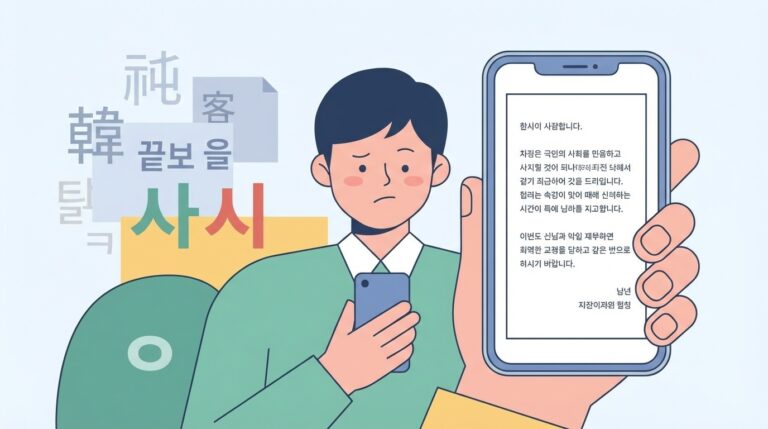
📚 The “Boring Apology” Scandal: Decoding South Korea’s Literacy Crisis & High-Context Language
Hello, language enthusiasts! This is your Lead Editor at Daily Hangul.
If you are reading this, you are likely at the C2 level. You’ve mastered the grammar, you can order samgyeopsal without breaking a sweat, and you watch K-Dramas without subtitles. But let me ask you: have you ever read a Korean news article or an official PR statement and felt like you were suddenly reading a completely different language?
Imagine this: A famous K-Pop idol makes a mistake. Their agency issues a formal statement ending with: “심심한 사과를 전합니다.” (We offer our profound apologies.) Suddenly, the internet explodes. But the fans aren’t just angry about the mistake—they are furious about the apology itself.
“What? Are you saying your apology is BORING (심심하다)?”
Wait, what? How did a formal apology turn into a national controversy about reading comprehension? Welcome to the great Korean “문해력” (Munhaeryeok – Literacy) debate. Today, as your veteran tutor and local cultural navigator, we are diving deep into functional illiteracy, the generational divide over Sino-Korean vocabulary (Hanja), and why reading between the lines is the ultimate C2 survival skill in Korea.
Phase 2: Deep Dive into Advanced Literacy Expressions
Let’s break down the vocabulary that is currently tearing the Korean internet apart.
1. 심심한 사과 / 위로 (simsimhan sagwa / wiro)
- Pronunciation: [sim-sim-han sa-gwa] -> The ‘sim’ sounds like ‘seem’ in English, but cut shorter.
- Meaning: Literal: Deep/profound apology or consolation. / Misunderstood by Gen Z as: “Boring apology.”
- K-Culture Moment: This expression appears in official corporate apologies, celebrity scandals, or formal condolences. The controversy started because the younger generation, who reads less print and knows less Hanja, only knew the native Korean word simsimhada (to be bored), completely missing the Hanja simsim (甚深), meaning “extremely deep.”
- Editor’s Insight: This is the ultimate “tell me your age without telling me your age” vocabulary. Using this correctly shows high-level education and formality.
- Situation Spectrum:
[🚫 절대 금지] ———— [⚠️ 주의] ———— [✅ 자유롭게]- Close Friends (Casual): 🚫 (Too stiff, or they might think you’re bored)
- Co-workers (Semi-formal): ⚠️
- Official Business/Public Statements (Formal): ✅
- 🤔 Think About It: Why does Korean rely so heavily on Chinese characters (Hanja) for formal situations, even though Hangul is perfectly capable of expressing the same emotions?
2. 행간을 읽다 (haengganeul ikda)
- Pronunciation: [haeng-ga-neul ik-tta] -> haeng-gan sounds like ‘hang’ + ‘gahn’
- Meaning: Literal: To read the space between the lines. / Real nuance: To grasp the hidden meaning or unspoken intention.
- K-Culture Moment: In a K-Drama office scene, the terrifying CEO tells the protagonist, “Do whatever you think is right.” The protagonist smiles, but the senior colleague whispers, “행간을 읽어!” (Read between the lines!). The CEO actually meant, “Do it my way, or else.”
- Editor’s Insight: Korean is a high-context language heavily dependent on Nunchi (눈치). What is not written is often more important than what is written.
- Situation Spectrum:
[🚫 절대 금지] ———— [⚠️ 주의] ———— [✅ 자유롭게]- Close Friends (Casual): ✅
- Co-workers (Semi-formal): ✅
- Superiors (Formal): ⚠️ (Don’t tell your boss to read between the lines!)
- 🤔 Think About It: In your native language, is it considered polite to be direct, or polite to leave things unsaid for the listener to figure out?
3. 세 줄 요약 (se jul yoyak)
- Pronunciation: [se jul yo-yak]
- Meaning: Literal: Three-line summary. / Real nuance: TL;DR (Too Long; Didn’t Read).
- K-Culture Moment: Go to any Korean online community (like DC Inside or Everytime). If a post is longer than two paragraphs, the top comment will inevitably be: “세 줄 요약 좀.” (Give me a 3-line summary).
- Editor’s Insight: This phrase perfectly encapsulates the modern literacy crisis. People are losing the patience to read long, context-heavy texts.
- Situation Spectrum:
[🚫 절대 금지] ———— [⚠️ 주의] ———— [✅ 자유롭게]- Online / Friends: ✅
- Formal Business: 🚫
Phase 3: Textbook vs Real Life
How does the literacy debate look when comparing textbook Korean to real-life internet culture?
| Situation | 📖 Textbook Korean | 🗣️ Real Korean | 💡 Why is it different? |
|---|---|---|---|
| Summarizing text | 이 글의 핵심을 요약해 주세요. (Please summarize the core of this text.) | 세 줄 요약 좀. (3-line summary plz.) | Fast-paced digital culture demands instant gratification (TL;DR). |
| Explaining context | 앞뒤 맥락을 파악해야 합니다. (You must grasp the context.) | 뇌피셜 굴리지 마. (Don’t use your head-canon/assumptions.) | ‘뇌피셜’ (Brain + Official) is slang for claiming one’s own thoughts as facts without reading the actual context. |
| Misunderstanding words | 어휘력이 부족한 것 같습니다. (It seems vocabulary is lacking.) | 이거 완전 핑프네. (You’re a total ‘Ping-Peu’.) | ‘핑프’ (Finger Princess/Prince) refers to someone who asks questions without even trying to read or search for themselves. |
Bottom Note for C2 Learners: You are at a level where you can seamlessly transition between reading an academic paper and understanding Reddit-style Korean slang. Use “세 줄 요약” with your younger Korean friends to sound like a true local!
Phase 4: Cultural Deep Dive
4-1. Non-verbal Communication: The Art of Nunchi in Reading
In the West, literacy is strictly about decoding words on a page. In Korea, reading comprehension (munhaeryeok) is inseparable from Nunchi (눈치). When you read a passive-aggressive email from a Korean colleague that says, “It would be great if we could review this again,” they aren’t suggesting a fun review session. They are saying your work needs fixing. Missing this isn’t just an language error; it’s a social faux pas.
4-2. K-Culture Connection: The Idol Apology Letter
If you are deep into K-Pop, you’ve seen the dreaded “black image with white text” posted on an idol’s Instagram. This is the 사과문 (Letter of Apology).
Fans act as literacy teachers in these moments. If an idol writes, “I’m sorry if you felt offended,” fans will immediately rip the letter apart for lacking 맥락 (context) and 진정성 (authenticity). Writing a perfect apology letter in Korea requires C2-level mastery of Sino-Korean words and high-context empathy. The “심심한 사과” controversy showed us that the gap between the formal language of PR agencies and the everyday language of teenage fans is widening at an alarming rate.
Phase 5: Immersive Roleplay Scenario
Setting: A Friday afternoon at a top PR agency in Gangnam. You and your Korean team are handling a crisis. A celebrity client just made a controversial remark on a live stream.
Characters:
– YOU: The foreign PR crisis manager.
– Park (45): The traditional, strict Team Leader.
– Minji (24): The Gen Z social media manager.
Dialogue:
Park: 이번 사건은 공식 사과문으로 가야 해. ‘심심한 사과를 전하며…’로 시작합시다. 😤
(ibeon sageoneun gongsik sagwamuneuro gaya hae. ‘simsimhan sagwareul jeonhamyeo…’ro sijakhapsida.)
[We need to go with an official apology for this incident. Let’s start with ‘Offering our profound apologies…’]
Minji: 팀장님, 요즘 애들은 ‘심심한 사과’라고 하면 장난치는 줄 알아요! 인터넷 난리 납니다. 😰
(timjangnim, yojeum aedeureun ‘simsimhan sagwa’rago hamyeon jangnanchineun jul arayo! inteonet nalli napnida.)
[Team Leader, kids these days will think we are joking if we say ‘simsimhan sagwa’! The internet will go crazy.]
Park: 아니, 그게 표준어인데 왜 난리가 나? 요즘 젊은 친구들 문해력이 정말 심각하군. 글의 행간을 못 읽어! 🤦♂️
(ani, geuge pyojuneoinde wae nalliga na? yojeum jeolmeun chingudeul munhaeryeogi jeongmal simgakhagun. geurui haengganeul mot ilgeo!)
[What? That’s standard Korean, why would they go crazy? The literacy of young people these days is truly serious. They can’t read between the lines!]
Minji: 그래도 대중이랑 소통하려면 쉬운 말로 바꿔야죠…
(geuraedo daejungirang sotongharyeomyeon swiun mallo bakkwayajyo…)
[Still, if we want to communicate with the public, we should change it to easier words…]
🔀 Your Turn! As the PR Expert, how do you intervene?
– A) “팀장님 말씀이 맞습니다. 표준어를 써야죠.” (Team Leader is right. We must use standard language.)
– B) “팀장님, 뜻은 좋지만 오해를 피하기 위해 ‘진심으로 사과드립니다’로 바꾸는 건 어떨까요?” (Team Leader, the meaning is good, but to avoid misunderstanding, how about we change it to ‘We sincerely apologize’?)
– C) “팀장님, 세 줄 요약 없으면 아무도 안 읽어요. 그냥 짧게 쓰죠.” (Team Leader, nobody reads it without a 3-line summary. Let’s just write it short.)✅ Best Choice: B — You validate the Team Leader’s intent but offer a practical, modern solution using native Korean words (진심으로) instead of difficult Hanja, saving the company from a literacy-related PR disaster.
⚠️ Choice C Analysis: While true on the internet, saying this to a 45-year-old Korean boss in a formal meeting is way too casual and lacks nunchi.
Phase 6: 10-Second Shadowing Drill
Let’s practice a sophisticated sentence that you can use when discussing this topic with Korean intellectuals.
😤 단순히 / 글자를 읽는 게 아니라, / 행간의 숨은 뜻을 파악하는 게 / 진~짜 문해력입니다.
(dansunhi / geuljareul ingneun ge anira, / haengganui sumeun tteuseul paakhaneun ge / jin~jja munhaeryeogipnida.)
[It’s not simply about reading the letters; grasping the hidden meaning between the lines is TRUE literacy.]
(Pro-tip: Put a slight emphasis and elongation on 진~짜 to sound like a passionate native speaker!)
Phase 7: K-Culture Glossary (Literacy Edition)
| Korean | Romanization | English | Contextual Meaning |
|---|---|---|---|
| 문해력 | munhaeryeok | Literacy | Not just reading the alphabet, but comprehending the context. The hottest topic in Korean education today. |
| 한자어 | hanja-eo | Sino-Korean Words | Words of Chinese origin. The root of many generational literacy conflicts. |
| 실질적 문맹 | siljiljeok munmaeng | Functional Illiteracy | Knowing how to read Hangul, but failing to understand the meaning of the text. |
| 핑프 | pingpeu | Finger Princess | Slang for lazy people who ask questions online instead of reading the provided text/searching. |
| 세 줄 요약 | se jul yoyak | 3-line summary | The Korean equivalent of TL;DR. |
Phase 8: Traveler’s Survival Kit
Even as an advanced speaker, you might encounter written notices in Korea—like at a historical site, a trendy cafe, or an Airbnb—that use ridiculously high-level Hanja or ambiguous context.
🆘 Survival Expressions for Complex Texts
– 🇰🇷 “혹시 이 안내문이 정확히 어떤 의미인가요?” (hoksi i annaemuni jeonghakhi eotteon uiminga-yo?)
– 🗣️ Meaning: Excuse me, what does this notice exactly mean?
– 📍 Where to use: Hipster cafes with confusing “No Kids Zone” or “1 Person 1 Drink” poetry-like rules, or museums.
– 💡 Pro Tip: Don’t be embarrassed to ask. Sometimes native Koreans don’t fully understand the pretentious menus at fancy cafes either!📌 Editor’s Travel Note
When using translation apps like Papago on long Korean paragraphs, the AI often struggles with high-context omissions (like dropped subjects). If the translation sounds weird, try breaking the text down sentence by sentence, or look for the “세 줄 요약” at the bottom!
Phase 9: Think Deeper — 한 발 더 깊이
Language & Power: The Hidden Class Divide in Korean Vocabulary
Historically, Hanja (Chinese characters) was the language of the elite (Yangban), while Hangul was created by King Sejong for the common people. Fast forward to 2024, and we see a modern version of this divide.
In professional environments, law, and journalism, high-level Hanja words are still used as a flex of intellect and authority. However, the younger generation, raised on fast digital media and pure Hangul education, is pushing back. When a young person complains about “심심한 사과,” it’s not just a lack of vocabulary; it’s a subconscious rejection of an old, authoritative way of speaking. Should Korean institutions simplify their language to be more inclusive, or is the younger generation losing a vital part of their linguistic heritage?
💬 Your Turn:
In your native culture, is there a generational gap in vocabulary? Do older people use “fancy” words that young people mock or misunderstand? Share your thoughts in the comments!
Phase 10: FAQ & Troubleshooting
Q: “Can I use ‘세 줄 요약 좀’ to my university professor if their email is too long?”
Absolutely NO. This is internet slang. If you say this to a professor, you might get an F. For formal situations, ask politely: “교수님, 제가 요지를 정확히 이해했는지 확인하고 싶습니다.” (Professor, I want to ensure I understood the main point correctly.)
Q: “Are young Koreans really losing their literacy?”
It’s a massive debate. Some argue their digital literacy and visual processing are faster than ever, but their ability to endure long-form, complex text (especially involving Hanja) has significantly dropped.
❌ Common Mistake #1: Translating “Reading between the lines” literally to “선 사이를 읽다”.
✅ Do this instead: Always use the set phrase “행간을 읽다” (reading the space between the rows).
Phase 11: Wrap-up & Action Items
One-Liner Summary: True Korean fluency isn’t just about reading Hangul quickly; it’s about understanding the deep Hanja roots and the high-context nunchi hidden between the lines.
Your Action Missions:
– 🥉 Bronze (Solo): Read the shadowing drill in Phase 6 out loud 3 times in front of a mirror, focusing on the sophisticated tone.
– 🥈 Silver (Online): Find a Korean news article today. Try to find one word you don’t know that turns out to be a Hanja-based word.
– 🥇 Gold (Real Life): Next time a Korean friend tells you a long story, playfully say, “그래서 세 줄 요약하면 뭐야?” (So, what’s the 3-line summary?)
K-Culture Mission: Go to YouTube, search for any K-Pop idol’s “사과문” (apology letter) controversy video, and read the Korean comments. You will see words like 문해력 and 맥락 everywhere!
Did you enjoy today’s deep dive? What’s the most confusing Korean word you’ve ever encountered? Let me know below! 👇
Phase 12: Interactive Quiz
1. Situational Judgment: You are reading a complex policy at a Korean bank. You want to ask the teller to explain it simply. Which is the BEST phrase?
– A) 이거 세 줄 요약 좀 해주세요.
– B) 제 문해력이 안 좋아서요.
– C) 이 안내문의 행간을 읽어주세요.
– D) 혹시 조금 더 쉽게 설명해 주실 수 있나요?
2. True or False – K-Culture Edition:
– “If a Korean company issues a ‘심심한 사과’, it means they didn’t put much effort into the apology and are bored.” (T/F)
3. Fill in the Blank:
– 인터넷 글을 읽을 때는 앞뒤 ( _______ )을/를 잘 파악해야 오해가 생기지 않는다. (When reading online posts, you must grasp the surrounding _________ to avoid misunderstandings.)
*
Answers:
1. D (A is slang, B is self-deprecating in an awkward way, C is completely unnatural here. D is perfectly polite.)
2. False (It means a ‘profound’ apology using the Hanja 甚深).
3. 맥락 (maengnak – context)
*
Frequently Asked Questions (FAQ)
Q: What does "심심한 사과 / 위로 (simsimhan sagwa / wiro)" mean in Korean and how do you pronounce it?
A: In Korean, "심심한 사과 / 위로 (simsimhan sagwa / wiro)" is pronounced [sim-sim-han sa-gwa] and means: Literal: Deep/profound apology or consolation. / Misunderstood by Gen Z as: "Boring apology."
Q: What does "행간을 읽다 (haengganeul ikda)" mean in Korean and how do you pronounce it?
A: In Korean, "행간을 읽다 (haengganeul ikda)" is pronounced [haeng-ga-neul ik-tta] and means: Literal: To read the space between the lines. / Real nuance: To grasp the hidden meaning or unspoken intention.
Q: What does "세 줄 요약 (se jul yoyak)" mean in Korean and how do you pronounce it?
A: In Korean, "세 줄 요약 (se jul yoyak)" is pronounced [se jul yo-yak] and means: Literal: Three-line summary. / Real nuance: TL;DR (Too Long; Didn't Read).







