

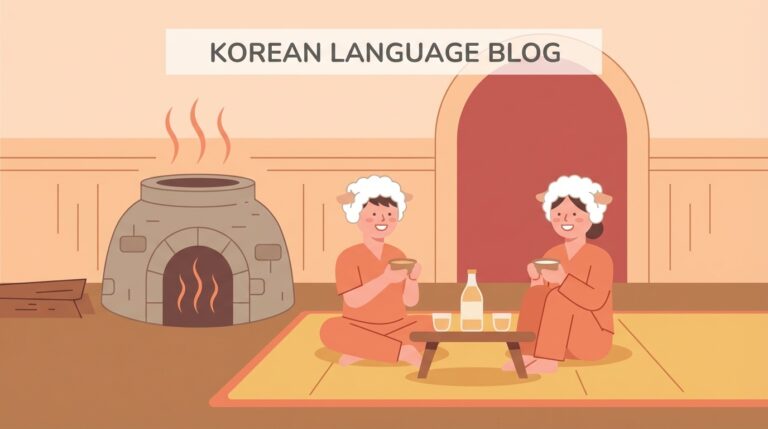
Welcome to the Jjimjilbang!
Hello! It’s your Daily Hangul Editor, your local culture navigator.
Picture this: You are watching your favorite K-Drama. The main character just lost their job, ran away from home, or simply needs a place to crash. Where do they go? Not a bar, but a place where everyone wears matching oversized T-shirts, sports a towel folded like sheep horns on their head, and sleeps on the heated floor. Yes, the Jjimjilbang (찜질방)!
And the ultimate boss level of this bathhouse? The Bulgama (불가마)—a dome-shaped kiln heated up to 90°C (194°F)!
If you don’t know the right expressions when stepping into this pizza oven with local Koreans, you’ll miss out on the ultimate bonding experience. Don’t worry, this guide is based on real struggles from my students who thought they were being baked alive! Let’s dive into the authentic phrases you need.
Phase 2: Core Expression Deep Dive
1. 아, 시원하다! (Ah, siwonhada!)
- Pronunciation: [Ah, shee-won-ha-da!] (‘시원’ sounds like ‘she won’)
- Meaning: Literal = Ah, it’s cool/cold. Real = Ah, this is refreshing/relieving!
- K-Culture Moment: You step into a 90°C Bulgama. Sweat is dripping down your face. An older Korean man next to you sighs deeply and says, “Ah… siwonhada!” Wait, cool?!
- Editor’s Insight: This is the most confusing Korean paradox! Koreans use this phrase not just for cold temperatures, but for the feeling of tension leaving the body. A hot soup, a good massage, or intense sweating in a Bulgama—they all make your muscles relax, hence, “refreshing!”
- Situation Spectrum:
[🚫 절대 금지] ———— [⚠️ 주의] ———— [✅ 자유롭게]- 친구 사이(Casual): ✅
- 직장 동료(Semi-formal): ✅ (Great for bonding!)
- 직장 상사·어른(Formal): ⚠️ (Use the polite form: 시원하네요!)
- 🤔 Think About It: Why do Koreans find extreme heat “refreshing”? Does your native culture have a concept where enduring heat or spice equals detox or relief?
2. 땀 좀 빼고 올게요. (Ttam jom ppaego olgeyo.)
- Pronunciation: [Ttam jom ppae-go ol-ge-yo] (‘Ttam’ has a sharp, tense ‘T’ sound)
- Meaning: I’m going to go sweat a bit.
- K-Culture Moment: You are chilling in the cool main hall, cracking roasted eggs. Your friend suddenly stands up, points to the fiery dome, and says this.
- Editor’s Insight: “땀을 빼다” literally means “to subtract/extract sweat.” It’s the standard, natural way to say you are going to use the sauna room.
- Situation Spectrum:
[🚫 절대 금지] ———— [⚠️ 주의] ———— [✅ 자유롭게]- 친구 사이(Casual): ✅ (Drop the ‘yo’: 땀 좀 빼고 올게)
- 직장 동료(Semi-formal): ✅
- 직장 상사·어른(Formal): ⚠️
3. 저 먼저 나갈게요. 살려주세요! (Jeo meonjeo nagalgeyo. Sallyeojuseyo!)
- Pronunciation: [Jeo meon-jeo na-gal-ge-yo. Sal-lyeo-ju-se-yo!]
- Meaning: Literal = I’ll go out first. Save me! Real = I can’t take the heat anymore, I’m out of here!
- K-Culture Moment: You tried to survive, but 3 minutes in, you’re melting. You need to gracefully exit without looking weak to your Korean friends. Adding “save me” adds a perfect touch of humor.
- Editor’s Insight: Instead of just screaming and running out, announcing your departure with a slight joke makes you sound like a total pro who knows their limits but has a great sense of humor.
Phase 3: Textbook vs Real Life
| Situation | 📖 Textbook Korean | 🗣️ Real Korean | 💡 Why different? |
|---|---|---|---|
| Expressing heat | 온도가 매우 높습니다. (The temperature is very high.) | 와, 여기 대박 뜨겁다! (Wow, it’s crazy hot in here!) | “대박” (Daebak) is the ultimate everyday slang for anything extreme. |
| Asking for space | 여기에 앉아도 되겠습니까? (May I sit here?) | 저기… 자리 있어요? (Excuse me… is this spot taken?) | Jjimjilbangs are communal, casual spaces. Textbook formal speech feels way too stiff here. |
| Proposing a break | 우리 이제 그만 밖으로 나갈까요? (Shall we go outside now?) | 이제 나갈까? (Should we head out?) | The intense heat makes people drop long sentences to save energy! |
Phase 4: Cultural Deep Dive
4-1. Non-verbal Communication: The “Nunchi” in the Sauna
In the Bulgama, space is tight. You don’t need to loudly ask everyone to move. Use your Nunchi (눈치)—read the room. Make brief eye contact, do a slight bow or nod, and people will naturally shift to make a tiny gap for your mat. No loud talking is needed!
4-2. K-Culture Connection: The Jjimjilbang Diet
If you’ve watched any slice-of-life K-Drama, you know the post-Bulgama ritual. Sweating is only 50% of the experience. The other 50% is K-Food! After surviving the heat, you MUST drink ice-cold Sikhye (식혜, sweet rice punch) and eat Guun Gyeran (구운 계란, roasted eggs). The eggs are actually cooked slowly inside the hot kilns! Smashing the egg on your friend’s head to crack the shell is a classic K-Drama trope—just make sure you warn them first!
Phase 5: Immersive Roleplay
Scenario A: Surviving the Heat
Setting: Saturday afternoon, a famous mega-Jjimjilbang in Seoul. You are inside the “Traditional Pine Wood Fire Kiln” (85°C). You are sitting on a straw mat next to your Korean language exchange partner, Min-su.
Characters:
– YOU: A brave foreigner experiencing the Bulgama for the first time.
– Min-su (28): Friendly, a bit of a show-off, sweating profusely but pretending it’s totally fine.
Dialogue:
Min-su: 와, 여기 진짜 땀 잘 난다. 안 더워요? 💦
(Wa, yeogi jinjja ttam jal nanda. An deowoyo?)
[Wow, you really sweat well in here. Aren’t you hot?]
(🎭 Stage Direction: Min-su wipes his forehead with his sheep-head towel)
YOU: 와, 진짜 오븐 안에 있는 것 같아요!
(Wa, jinjja obeun ane inneun geot gatayo!)
[Wow, it really feels like being inside an oven!]
Min-su: 하하! 원래 이렇게 땀을 빼야 건강해지는 거예요.
(Haha! Wollae ireoke ttameul ppaeya geonganghaejineun geoyeyo.)
[Haha! Sweating like this is how you get healthy.]
YOU: 그런데 한국 사람들은 왜 뜨거운 곳에서 시원하다고 해요?
(Geureonde hanguk saramdeureun wae tteugeoun goseseo siwonhadago haeyo?)
[But why do Koreans say it’s ‘refreshing’ in a hot place?]
Min-su: 음… 근육이 풀리니까요! 자, 5분만 더 버텨봅시다. 어때요?
(Eum… geunyugi pullinikkayo! Ja, obunman deo beotyeobopsida. Eottaeyo?)
[Hmm… because your muscles relax! Now, let’s endure for just 5 more minutes. How about it?]
🔀 Your Turn! How do you reply?
– A) “네, 좋습니다! 5분 더 버텨요!” (Polite and determined)
– B) “아유, 시원하다~ 10분도 가능해요!” (Using local expressions, showing off)
– C) “아니요, 저 먼저 나갈게요. 살려주세요!” (Honest and dramatic)✅ Best Choice: C — Reason: In Korea, showing a bit of dramatic suffering (“살려주세요” – Save me!) in the Jjimjilbang makes for great humor and bonding. Plus, safety first!
⚠️ Choice B Analysis: If you say you can do 10 more minutes, Min-su WILL hold you to it. Never bluff in a Bulgama!
Scenario B: The Post-Sweat Reward (Bonus Scenario)
(You escaped the Bulgama and approach the snack bar)
Snack Bar Auntie: 어서 오세요. 뭐 드릴까요?
(Eoseo oseyo. Mwo deurilkkayo?)
[Welcome. What can I get for you?]
YOU: 이모님, 식혜 두 잔이랑 구운 계란 세 개 주세요.
(Imonim, sikhye du janirang guun gyeran se gae juseyo.)
[Auntie, two glasses of Sikhye and three roasted eggs, please.]
Snack Bar Auntie: 네~ 계란 머리에 깨지 마요, 아파요!
(Ne~ gyeran meorie kkaeji mayo, apayo!)
[Sure~ Don’t crack the eggs on your head, it hurts!]
Phase 6: 10-Second Shadowing Drill
😊 아휴 / 진짜 / 시원~~~하다! (Ahyu / jinjja / siwon~~~hada!)
(Sigh with relief / Really / It’s soooo refreshing!)
Tip: Stretch out the “원~~~” (won) to sound like an authentic Korean grandpa who just found inner peace in an 80°C room.
Phase 7: K-Culture Glossary
| Korean | Romanization | English | Context |
|---|---|---|---|
| 찜질방 | jjimjilbang | Korean Bathhouse | 24/7 dry saunas with communal sleeping areas. |
| 불가마 | bulgama | Fire Kiln | The hottest, dome-shaped sauna rooms. |
| 양머리 | yangmeori | Sheep Head | Folding a towel to look like sheep horns to protect your head from the heat. |
| 식혜 | sikhye | Sweet Rice Punch | The ultimate icy drink to cool down after sweating. |
| 때밀이 | ttaemiri | Body Scrub | The intensely rough (but amazing) Korean exfoliating scrub. |
Phase 8: Traveler’s Survival Kit
🆘 Survival Expression #1: Snack Bar Essentials
– 🇰🇷 “식혜 하나 주세요.” (Sikhye hana juseyo.)
– 🗣️ Pronunciation: [Sheek-hye ha-na ju-se-yo]
– 📍 Where to use: The Jjimjilbang snack bar (매점).
– 💡 Pro Tip: Buy items by scanning your electronic locker key bracelet! You pay for everything at the front desk when you leave. Don’t bring your wallet inside!📌 Editor’s Travel Note
– Tattoos: Historically, bathhouses frowned upon tattoos, but modern Jjimjilbangs are mostly okay with them. However, if you have very large tattoos, you might get a few stares from older folks. It’s just curiosity!
– Gender Separation: The wet bath areas are strictly separated by sex (and you must be completely nude). The Bulgama and sleeping areas are unisex, where everyone wears the provided uniform!
Phase 9: Think Deeper
🧠 Think Deeper: Wellness & Identity
Why do Koreans willingly sit in a scorching room together? The Jjimjilbang is a microcosm of Korean collective culture. In modern society, status, fashion, and job titles constantly divide people. But in the Jjimjilbang, everyone wears the exact same orange or pink uniform. The shared “suffering” of the Bulgama heat strips away social hierarchy, creating a rare space where a CEO and a college student can sit side-by-side, sweating out their stress. It’s an ultimate social equalizer disguised as a wellness retreat.💬 Your Turn: Does your culture have a public bathing or sauna culture? Does it bring people together in a similar way? Share in the comments!
Phase 10: FAQ & Troubleshooting
- Q: Can I take my phone into the Bulgama?
A: 🚫 No! Extreme heat can melt your phone’s battery or cause it to shut down completely. Leave it in your locker or hide it under your mat in the cool hall. - Q: How long should I stay inside?
A: Beginners should try 3-5 minutes. Don’t force yourself. Listen to your body! - Q: Can I wear my glasses inside?
A: 🚫 The heat can warp plastic frames and heat up metal frames to the point of burning your skin. Leave them in the cubbies right outside the kiln doors.
❌ Common Mistake #1: Going into the Bulgama immediately after eating a huge Korean BBQ dinner.
✅ Do this instead: Digestion needs energy. Sweat first, and eat the roasted eggs and Sikhye later!
Phase 11: Wrap-up
- One-Liner Summary: Surviving the Bulgama is all about saying “Ah, siwonhada!” while sweating buckets, and rewarding yourself with an icy Sikhye!
-
Action Missions:
- 🥉 Bronze (Solo): Fold a towel into a “Yangmeori” (Sheep Head) at home and say “땀 좀 빼고 올게요” to your mirror.
- 🥈 Silver (Online): Comment below with how many minutes you think you could survive in a 90°C room!
- 🥇 Gold (Real Life): Visit a Korean Jjimjilbang, enter a hot room, and confidently sigh, “아~ 시원하다!”
- K-Culture Mission: Search YouTube for “K-Drama Jjimjilbang scenes” and try to spot the sheep-head towels and roasted eggs!
Phase 12: Interactive Quiz
1. Situational Judgment: What is the most natural thing to say when your muscles feel perfectly relaxed in a boiling hot sauna?
A) 너무 차가워요! (It’s too cold!)
B) 아, 시원하다! (Ah, refreshing!)
C) 배고파요. (I’m hungry.)
2. True or False — K-Culture Edition:
“You must pay with physical cash at the snack bar inside the Jjimjilbang.”
3. Fill in the blank:
“I’m going to go sweat a bit.” -> “___ 좀 빼고 올게요.”
(Answers: 1: B, 2: False – you tap your electronic bracelet, 3: 땀/Ttam)
Frequently Asked Questions (FAQ)
Q: What does "아, 시원하다! (Ah, siwonhada!)" mean in Korean and how do you pronounce it?
A: In Korean, "아, 시원하다! (Ah, siwonhada!)" is pronounced [Ah, shee-won-ha-da!] and means: Literal = Ah, it's cool/cold. Real = Ah, this is refreshing/relieving!
Q: What does "땀 좀 빼고 올게요. (Ttam jom ppaego olgeyo.)" mean in Korean and how do you pronounce it?
A: In Korean, "땀 좀 빼고 올게요. (Ttam jom ppaego olgeyo.)" is pronounced [Ttam jom ppae-go ol-ge-yo] and means: I'm going to go sweat a bit.
Q: What does "저 먼저 나갈게요. 살려주세요! (Jeo meonjeo nagalgeyo. Sallyeojuseyo!)" mean in Korean and how do you pronounce it?
A: In Korean, "저 먼저 나갈게요. 살려주세요! (Jeo meonjeo nagalgeyo. Sallyeojuseyo!)" is pronounced [Jeo meon-jeo na-gal-ge-yo. Sal-lyeo-ju-se-yo!] and means: Literal = I'll go out first. Save me! Real = I can't take the heat anymore, I'm out of here!







