

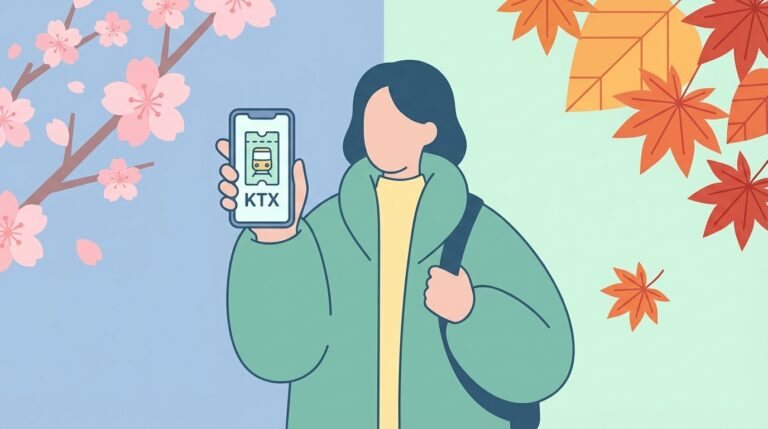
Phase 1: Immersive Hook — The K-Drama Illusion
Hello! This is your Daily Hangul Editor.
You’ve probably seen this classic K-Drama scene: The main characters, overwhelmed by city life, look at each other and say, “Let’s go to the sea!” Cut to the next scene, and they are magically sitting on an empty, beautiful beach in Gangneung, or strolling under a perfectly blooming cherry blossom tree in Jinhae.
But let me tell you a secret as someone who has lived in Seoul for over a decade. If you try to pull off a spontaneous trip during Korea’s peak seasonal times (like spring blossoms or autumn foliage)… you won’t end up on a romantic beach. You’ll end up staring at your phone screen, watching a “Sold Out” pop-up mock you.
Welcome to the fierce world of Korean Travel Planning! In Korea, traveling during the best seasons requires strategy, speed, and knowing exactly how to communicate. Today, we’re going to level up your Korean to B2 (Intermediate) so you can plan trips, negotiate bookings, and survive the “Ticketing Wars” like a true local. Let’s dive in!
Phase 2: Deep Dive into Core Expressions
As an intermediate learner, you need to move beyond simple phrases like “표 있어요?” (Do you have tickets?). When planning a trip, you often have to relay information you saw online or heard from someone else. Let’s master these crucial expressions.
1. 성수기라 방이 다 찼대요.
- Pronunciation: [seongsugira bangi da chatdaeyo] (seong-soo-gi-ra / bang-ee / da / chat-dae-yo)
- Meaning: (Literal) Because it is peak season, they say all the rooms are full. / (Real nuance) It’s peak season, so everything is fully booked!
- K-Culture Moment: You are sitting in the office with your Korean friend, desperately refreshing the Yanolja (야놀자) app to book a summer trip to Jeju Island. Your friend sighs and drops this sentence.
- Editor’s Insight: This uses the B2 grammar point
-대요(short for -다고 해요), which is used for reported speech. You aren’t just saying it’s full; you’re expressing, “The app/website/hotel says it’s full.” It shows you’ve done your research. - Situation Spectrum:
[🚫 절대 금지] ———— [⚠️ 주의] ———— [✅ 자유롭게]- Casual (Friends): ✅ (Very natural)
- Semi-formal (Co-workers): ✅ (Perfect for office small talk)
- Formal (Boss/Elders): ⚠️ (Use ‘다 찼다고 합니다’ instead)
- 🤔 Think About It: Why do Koreans use reported speech (
-대요) so often when talking about plans or news? It softens the blow of bad news by shifting the “blame” to a third party (the booking system!). Does your language have a similar softening strategy?
2. 취소표 나오면 바로 예매할게요.
- Pronunciation: [chwisopyo naomyeon baro yemaehalgeyo] (chwee-so-pyo / na-o-myeon / ba-ro / ye-mae-hal-ge-yo)
- Meaning: (Literal) If a canceled ticket comes out, I will reserve it immediately. / (Real nuance) I’ll grab a cancelation ticket as soon as it pops up.
- K-Culture Moment: It’s Chuseok (Korean Thanksgiving), and KTX train tickets sold out in 3 minutes. Your only hope is a “chwisopyo” (cancelation ticket). You tell your family not to worry—you’re on sniper duty.
- Editor’s Insight: In Korea, giving up is not an option. “취소표” (canceled tickets) are a huge part of the K-Travel and K-Pop concert culture. Knowing this word makes you sound like a true insider.
- Situation Spectrum:
[🚫 절대 금지] ———— [⚠️ 주의] ———— [✅ 자유롭게]- Casual (Friends): ✅
- Semi-formal (Co-workers): ✅
- Formal (Boss/Elders): ✅ (Polite enough, thanks to -할게요)
- 🤔 Think About It: “빨리빨리” (Hurry up) culture isn’t just about moving fast; it’s about intense digital vigilance. How does the digital booking culture differ in your home country?
3. 단풍 구경 가기 딱 좋은 날씨네요!
- Pronunciation: [danpung gugyeong gagi ttak joeun nalssineyo] (dan-poong / goo-gyeong / ga-gee / ttak / jo-eun / nal-ssi-ne-yo!)
- Meaning: (Literal) It is exactly good weather to go autumn foliage sightseeing. / (Real nuance) It’s the perfect weather to go see the fall colors!
- K-Culture Moment: You walk into a cozy cafe in November. The sky is bright blue, the air is crisp, and the barista strikes up a conversation. You drop this line, and they instantly treat you like a local.
- Editor’s Insight: The word “딱” (exactly/perfectly) is the magic seasoning here. It turns a robotic textbook sentence into a lively, native-sounding exclamation. You can swap “단풍” (autumn leaves) with “벚꽃” (cherry blossoms) in the spring.
- Situation Spectrum:
[🚫 절대 금지] ———— [⚠️ 주의] ———— [✅ 자유롭게]- Casual (Friends): ✅
- Semi-formal (Co-workers): ✅
- Formal (Boss/Elders): ✅ (A great icebreaker with anyone!)
Phase 3: Textbook vs Real Life
| Situation | 📖 Textbook Korean | 🗣️ Real Korean | 💡 Why is it different? |
|---|---|---|---|
| Booking is full | 예약이 모두 완료되었습니다. | 방이 다 찼대요. / 풀부킹이에요. | Locals use English loanwords like “풀부킹” (Full booking) or casual reported speech for everyday chats. |
| Searching for a spot | 유명한 장소를 추천해 주세요. | 사진 찍기 좋은 핫플 알아요? | The goal of modern K-Travel is often the “Hot Place” (핫플) to take photos for Instagram. |
| Planning a short trip | 우리는 하루 동안 여행을 갑니다. | 당일치기로 다녀오려고요. | “당일치기” (Day trip) is a highly efficient cultural concept for busy Koreans maximizing their weekends. |
Phase 4: Cultural Deep Dive
4-1. Non-verbal Communication: The “Nunchi” of Vacation Planning
When planning a trip with Korean co-workers or asking for vacation days (연차), Nunchi is everything. You don’t just boldly declare, “I’m going to Jeju next week!” Instead, you softly approach the topic, check the team’s schedule, and perhaps bring back a small box of local snacks (like Jeju tangerine chocolates) for the office. It’s a non-verbal way of saying, “Thanks for covering for me while I enjoyed the cherry blossoms.”
4-2. K-Travel Connection: The Ticketing War (피켓팅)
If you are a K-Pop fan, you know “Ticketing” is a blood sport (often called 피켓팅 – blood ticketing). Well, K-Travel is exactly the same. Booking a KTX train to Busan during summer vacation (여름 휴가) or a cute Hanok stay in autumn requires military precision. Everyone logs onto the Korail app at exactly 7:00 AM. If you miss it, your entire trip changes. This is why phrases like “취소표” (canceled ticket) and “새로고침” (refresh) are essential survival words in Korea.
Phase 5: Immersive Roleplay
Scenario A: The Summer Vacation Crisis
Setting: A Friday afternoon in the office breakroom. You and your Korean colleague, Min-su (32, friendly, loves surfing), are talking about the upcoming summer vacation (여름 휴가) in August.
Characters:
– YOU: An expat working in Seoul, hoping to hit the beaches of Yangyang.
– Min-su: Your veteran Korean coworker.
Min-su: 휴가 계획은 다 세웠어요? 양양 간다고 했죠? 🏄♂️
(hyuga gyehoegeun da seweosseoyo? yangyang gandago haetjyo?)
(English) Have you made all your vacation plans? You said you were going to Yangyang, right?
(🎭 Stage Direction: Min-su takes a sip of his iced americano, looking relaxed.)
YOU: 네, 근데 앱을 보니까 성수기라 방이 다 찼대요. ㅠㅠ
(ne, geunde aebeul bonikka seongsugira bangi da chatdaeyo.)
(English) Yes, but looking at the app, they say the rooms are fully booked because it’s peak season.
Min-su: 헐! 벌써요? 비행기나 KTX 표는요?
(heol! beolsseoyo? bihaenggina KTX pyoneunyo?)
(English) Omg! Already? What about airplane or KTX tickets?
🔀 Your Turn! How do you respond?
– A) “표는 있어요. 걸어갈게요.” (I have tickets. I will walk.)
– B) “KTX도 다 매진이래요. 취소표 나오면 바로 예매할게요!” (They say KTX is all sold out too. I’ll book a cancelation ticket as soon as it comes out!)
– C) “아몰랑! 그냥 집에서 쉴래요.” (Whatever! I’ll just rest at home.)✅ Best Choice: B — Reason: It uses the B2 reported speech (-이래요) and shows you understand the “chwisopyo” culture. You sound like a true local!
⚠️ Choice C Analysis: “아몰랑” is a very casual internet slang. It’s funny, but maybe a bit too immature for an office chat, even with a friendly colleague.
Min-su: 맞아요. 계속 새로고침 하다 보면 하나는 꼭 나와요. 파이팅!
(majayo. gyesok saerogochim hada bomyeon hananeun kkok nawayo. paiting!)
(English) That’s right. If you keep refreshing, one will definitely pop up. Good luck!
Bonus Scenario: The Guesthouse Greeting
Setting: You finally made it to a beautiful Hanok guesthouse in Jeonju for autumn foliage.
– Owner: 어서 오세요! 오시는 길 안 막혔어요?
(Welcome! Was the traffic bad on your way here?)
– YOU: 네, 다행히 안 막혔어요. 단풍 구경 가기 딱 좋은 날씨네요!
(Yes, thankfully it wasn’t backed up. It’s the perfect weather to go see the autumn leaves!)
– Owner: 아이고, 한국말 참 잘하시네! 방으로 안내해 드릴게요.
(Oh my, you speak Korean so well! I’ll guide you to your room.)
Phase 6: 10-Second Shadowing Drill
Read this out loud. Focus on the intonation and pauses. Imagine you are dramatically complaining to a friend!
😤 아~! / 성수기라 / 방이 / 다 찼대요! / 취소표 / 언제 나와요? ㅠㅠ
(Ah~! / seong-soo-gi-ra / bang-ee / da / chat-dae-yo! / chwee-so-pyo / eon-je / na-wa-yo?)
Tip: Stress the “다” (all) and “언제” (when) to express your frustration!
Phase 7: K-Culture Glossary (Travel Edition)
| Korean | Romanization | English | Context |
|---|---|---|---|
| 성수기 / 비수기 | seongsugi / bisugi | Peak season / Off-season | Crucial for booking pricing. |
| 핫플 | hatpeul | Hot place | Trendy cafes, restaurants, or photo zones. |
| 호캉스 | hokangseu | Hotel + Vacance (Staycation) | Going to a luxury hotel just to relax inside it. |
| 인생샷 | insaengsyat | Shot of a lifetime | The ultimate, perfect photo for your social media. |
| 당일치기 | dangilchigi | Day trip | Traveling somewhere and returning on the same day. |
Phase 8: Traveler’s Survival Kit
🆘 Top 3 Survival Phrases for Booking & Travel
1. 🇰🇷 “혹시 빈방 있나요?” (hoksi binbang innayo?) – Are there any vacant rooms by any chance?
2. 🇰🇷 “편도인가요, 왕복인가요?” (pyondo-ingayo, wangbok-ingayo?) – Is it one-way or round-trip? (You will hear this at the bus/train station!)
3. 🇰🇷 “예약자 이름은 [이름]입니다.” (yeyakja ireumeun [Name]-imnida.) – The reservation name is [Name].
📌 Editor’s Travel Note:
– Must-Have Apps: KorailTalk (for KTX), T-money GO (for intercity buses), Naver Map (Google Maps doesn’t work well for walking/driving in Korea!), Yanolja/Herea (for hotels/motels).
– Payment: Many Korean booking apps require a Korean phone number or domestic credit card. If you are a tourist, try booking KTX through the official English Korail website on a desktop, or use global platforms like Agoda/Booking.com for accommodations.
Phase 9: Think Deeper — Media vs Reality
🧠 Think Deeper: The K-Drama Illusion vs. “Ppal-li Ppal-li” Reality
In K-Dramas, whenever a character is sad or stressed, they hop on a completely empty train, arrive at a serene winter sea, and easily find a beautiful guesthouse with a warm-hearted owner. The reality? Korea is a densely populated country with a highly efficient, fast-paced (빨리빨리) culture. Escaping to nature requires digital warfare (ticketing). This contrast highlights an interesting aspect of modern Korean society: the deep yearning for slow, peaceful nature (like Hanok stays or mountain temples), paired with the highly competitive, tech-savvy methods required to actually get there.💬 Your Turn: Have you ever experienced a “Travel Expectation vs. Reality” moment? How do people in your country secure spots for popular seasonal destinations? Let us know in the comments!
Phase 10: Troubleshooting & FAQs
Q: Can I negotiate the price if I book directly at a Guesthouse (민박)?
Editor’s Answer: Maybe 20 years ago! Today, almost all accommodations use fixed pricing on apps. Trying to bargain might just cause confusion. It’s better to ask nicely, “혹시 전망 좋은 방으로 주실 수 있나요?” (Could you perhaps give us a room with a good view?).
Q: Do I tip the hotel staff or the tour guide?
Editor’s Answer: No! There is absolutely zero tipping culture in Korea. If you try to hand cash to a receptionist, they will probably chase you down the street thinking you dropped your money.
❌ Common Mistake #1: Translating “I want to book” literally as “예약하고 싶어요” when asking an app/website.
✅ Do this instead: To talk about the status of an online booking, use passive or descriptive forms like “예약이 꽉 찼대요” (It says it’s fully booked) or “예약이 가능한가요?” (Is reservation possible?).
Phase 11: Wrap-up & Action Missions
One-Liner Summary: To plan a seasonal trip in Korea, you need to master reported speech (-대요) and embrace the intense ticketing culture!
Action Missions:
– 🥉 Bronze (Solo): Read the shadowing drill out loud 3 times, pretending you just missed a KTX ticket to Busan.
– 🥈 Silver (Online): Download the “Naver Map” app, search for “Jeju Island” (제주도), and try to find a “핫플” (hot place) cafe.
– 🥇 Gold (Real Life): Message a Korean friend or language partner and ask: “혹시 단풍 명소로 유명한 곳 알아요?” (Do you happen to know a famous spot for autumn foliage?)
🌟 Special K-Culture Mission:
Go to YouTube and search “KTX 티켓팅 브이로그” (KTX Ticketing Vlog). Watch how fast Koreans click their mice during the holiday seasons. You’ll truly understand why “다 찼대요” is the most feared sentence in Korean travel!
Did you enjoy today’s guide? What season do you want to visit Korea the most? Drop a comment below!
Phase 12: Interactive Challenge (Quiz)
1. Situation Judgment: You want to tell your coworker that the trendy cafe in Gangneung you both wanted to visit is completely full according to reviews. What is the most natural B2 expression?
– A) 거기 방이 없어요.
– B) 거기 자리가 다 찼대요.
– C) 나 거기 안 가요.
2. True or False — K-Culture Edition:
– “If a Korean train is fully booked online, you can usually bribe the conductor with a tip for a secret seat.”
3. Fill in the Blank:
“I couldn’t get the ticket today, but I will keep refreshing.
____ 나오면 바로 예매할게요!” (If a canceled ticket pops up, I’ll book it right away!)
(Toggle for Answers)
Answers:
1. B (자리가 다 찼대요 – They say the seats are all full. Perfect use of reported speech!)
2. False! There is no tipping culture in Korea, and the KTX system is strictly digitized. Your only hope is a 취소표!
3. 취소표 (chwisopyo – cancelation ticket)
Frequently Asked Questions (FAQ)
Q: What does "성수기라 방이 다 찼대요." mean in Korean and how do you pronounce it?
A: In Korean, "성수기라 방이 다 찼대요." is pronounced [seongsugira bangi da chatdaeyo] and means: (Literal) Because it is peak season, they say all the rooms are full. / (Real nuance) It's peak season, so everything is fully booked!
Q: What does "취소표 나오면 바로 예매할게요." mean in Korean and how do you pronounce it?
A: In Korean, "취소표 나오면 바로 예매할게요." is pronounced [chwisopyo naomyeon baro yemaehalgeyo] and means: (Literal) If a canceled ticket comes out, I will reserve it immediately. / (Real nuance) I'll grab a cancelation ticket as soon as it pops up.
Q: What does "단풍 구경 가기 딱 좋은 날씨네요!" mean in Korean and how do you pronounce it?
A: In Korean, "단풍 구경 가기 딱 좋은 날씨네요!" is pronounced [danpung gugyeong gagi ttak joeun nalssineyo] and means: (Literal) It is exactly good weather to go autumn foliage sightseeing. / (Real nuance) It's the perfect weather to go see the fall colors!







