

Invited to a ‘Small Wedding’? The New K-Wedding Trend You Must Know
Phase 1: Immersive Hook 🎬
Hello! This is your Daily Hangul Editor.
Picture this: You are watching a K-Drama. Usually, the finale involves a grand wedding in a massive hall, right? But lately, have you noticed a change? The main characters are running away to Jeju Island or a small garden, wearing simple dresses and suits, holding a bouquet of wildflowers.
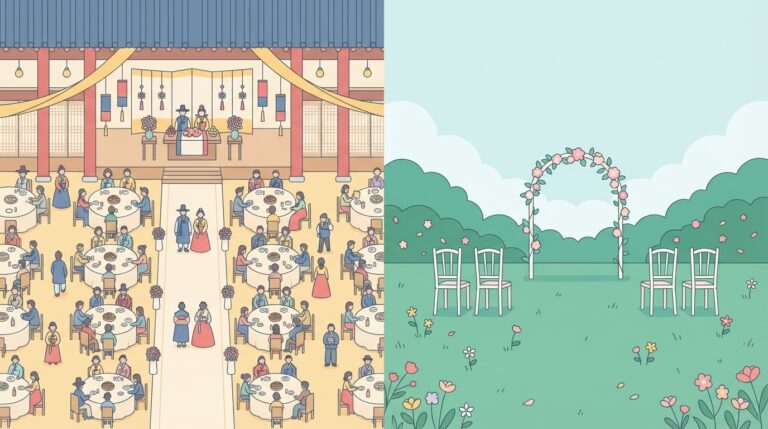
Maybe you’ve heard the term “Small Wedding” (스몰 웨딩) from your Korean friends. In a country famous for 500-guest “factory-style” weddings where you eat quickly and leave, this trend is a huge revolution.
But here is the tricky part: In Korea, a “Small Wedding” doesn’t always mean “cheap” or “casual.” If you misunderstand this context, you might show up in jeans when everyone else is in semi-formal attire, or worse, make a mistake with the money envelope (Congratulatory Money). Let’s decode the real meaning of a Korean Small Wedding together.
Phase 2: Deep Dive into Core Expressions 🧠
1. 스몰 웨딩 [Seumol Weding]
- Pronunciation: [Seu-mol We-ding] (Sounds exactly like “Small Wedding” with a Korean accent)
- Meaning: Literal: Small Wedding / Real Nuance: A wedding that breaks away from the traditional “Wedding Hall” factory system. It implies intimacy, style, and often, a rebellion against parental pressure.
- K-Culture Moment: Think of the legendary wedding of stars Won Bin and Lee Na-young. They got married in a wheat field in the countryside. That single event started the whole craze in Korea.
- Editor’s Insight: Even if you say “Small Wedding,” it can still be expensive! It emphasizes customization over size. Don’t assume it’s a potluck backyard party.
- Situation Spectrum:
[🚫 Strict Elders] ———— [⚠️ Parents] ———— [✅ Friends/Peers]
(Older generations often dislike this because they can’t invite all their business associates!) - 🤔 Think About It: Why is using the English loanword “Small Wedding” cooler than the Korean word “작은 결혼식” (Jageun gyeolhonsik)? Does English sound more modern to Koreans?
2. 가까운 지인만 초대했어요 [Gakkaun jiinman chodaehaesseoyo]
- Pronunciation: [Gah-ggah-oon Jee-in-man Cho-dae-hae-sseo-yo]
- Meaning: “We only invited close acquaintances.”
- K-Culture Moment: When a celebrity gets married secretly and issues a press release later, this is the #1 sentence they use.
- Editor’s Insight: This is the perfect polite excuse. If you are getting married and can’t invite your co-worker, you say this. If you weren’t invited to a friend’s wedding, you tell yourself this to not feel bad.
- Situation Spectrum:
[🚫 Boss] ———— [⚠️ Acquaintances] ———— [✅ Close Friends]
3. 식사 대접하고 싶어서요 [Siksa daejeophago sipeoseoyo]
- Pronunciation: [Sik-sa Dae-jeop-ha-go Si-peo-seo-yo]
- Meaning: “Because I wanted to treat (guests) to a proper meal.”
- K-Culture Moment: In traditional Korean weddings, guests often eat at a buffet without even seeing the bride and groom properly. A “Small Wedding” justification is often about the quality of the meal and conversation.
- Editor’s Insight: Use this when parents ask, “Why are you having a small wedding?” It shifts the focus from “saving money” to “honoring guests.”
Phase 3: Textbook vs. Real Life 🗣️
| Situation | 📖 Textbook Korean | 🗣️ Real Korean (Trend) | 💡 Why? |
|---|---|---|---|
| Explaining size | 결혼식을 작게 할 거예요. (I will do the wedding small.) | 스몰 웨딩으로 하려고요. (We’re planning a ‘Small Wedding’.) | The loanword implies a specific trendy style, not just size. |
| Declining gifts | 선물은 괜찮습니다. (Gifts are okay/fine.) | 축의금은 정중히 사양합니다. (We politely decline money envelopes.) | In small weddings, some couples refuse money (very rare, but happens). |
| Describing the vibe | 분위기가 좋아요. (The atmosphere is good.) | 프라이빗해서 좋아요. (It’s good because it’s ‘Private’.) | Koreans love the word “Private” to describe exclusivity. |
Bottom Note: You will hear English loanwords like “Private,” “Concept,” and “Small” used heavily in the wedding industry. It sounds more “premium” to young Koreans.
Phase 4: Cultural Deep Dive 🇰🇷
4-1. Nunchi (눈치) & The Guest List
In a traditional Korean wedding, the guest list is actually the parents’ guest list. It’s a way for parents to collect the “Congratulatory Money” (축의금 – Chugui-geum) they spent on others over the years.
Planning a “Small Wedding” requires immense Nunchi. You are essentially telling your parents, “You cannot collect your return on investment.” This is why Small Weddings are often a dramatic plot point in family K-Dramas!
4-2. K-Drama Connection: The “envelope” Scene
You’ve seen it. The guest arrives, hands over a white envelope to a person at a desk, and gets a meal ticket.
In a Small Wedding context: This desk might disappear. The couple might greet you at the door. Tip: Still bring the envelope! Even if it’s small, unless they specifically said “No Money,” giving cash is the standard rule of K-Etiquette.
Phase 5: Immersive Roleplay 🎭
Scenario: You are discussing your future wedding plans with your Korean friend, Min-ji, at a trendy cafe in Seongsu-dong.
Characters:
– YOU: Want a simple wedding.
– Min-ji: Loves K-Trends, asks realistic questions.
Min-ji: 와, 결혼 축하해! 식장은 어디로 잡았어? 호텔?
(Wa, gyeolhon chukahae! Sikjangeun eodiro jabasseo? Hotel?)
Wow, congrats on the marriage! Where did you book the venue? Hotel?
🔀 Your Turn! How do you answer?
Choice A: “아니, 돈이 없어서 그냥 작게 해.” (No, I have no money so just doing it small.)
Choice B: “응, 우리는 스몰 웨딩으로 하기로 했어.” (Yeah, we decided to do a Small Wedding.)✅ Best Choice: B
Why? Choice A sounds a bit depressing. Choice B sounds trendy and intentional. In Korea, “appearance” matters!
(Dialogue Continues with Choice B)
YOU: 응, 우리는 스몰 웨딩으로 하기로 했어.
(Eung, urineun seumol weding-euro hagiro haesseo.)
Min-ji: 진짜? 멋있다! 근데 부모님이 반대 안 하셨어?
(Jinjja? Meositta! Geunde bumonimi bandae an hasyeosseo?)
Really? That’s cool! But… did your parents not oppose it?
YOU: 조금 힘들었지만… 가까운 지인만 초대해서 파티처럼 하고 싶다고 말씀드렸어.
(Jogeum himdeureotjiman… gakkaun jiinman chodaehaeseo paticheoreom hago sipdago malsseumdeuryeosseo.)
It was a bit hard… but I told them I want to invite only close acquaintances and do it like a party.
Min-ji: 우와, 완전 드라마 같다! 나도 꼭 초대해 줄 거지?
(Uwa, wanjeon deurama gatda! Nado kkok chodaehae jul geoji?)
Wow, just like a drama! You’re inviting me, right?
Phase 6: 10-Second Shadowing Drill 🎤
Practice this sentence to sound like a modern, sensible bride/groom.
“We wanted to focus on the people, rather than the ceremony.”
😊 Soft & Sincere Tone:
형식보다는 / 사람에게 / 집중하고 싶었어요.
(Hyeongsik-bodaneun / saram-ege / jipjunghago sipeosseoyo.)
Phase 7: K-Culture Mini Glossary 📖
| Korean | Romanization | English | Context |
|---|---|---|---|
| 청첩장 | Cheong-cheop-jang | Wedding Invitation | Giving this in person involves buying dinner for the guest (Cheong-mo). |
| 하객 | Ha-gaek | Guest | The people attending the wedding. |
| 축의금 | Chugui-geum | Congratulatory Money | The cash given in white envelopes. Essential K-Culture! |
| 스드메 | Seu-Deu-Me | Studio, Dress, Makeup | The “Holy Trinity” package of Korean wedding prep. |
Phase 8: Traveler’s & Guest Survival Kit 🧳
Going to a Korean Wedding (Small or Big)? Read this!
🆘 Survival Expression
– 🇰🇷 “축하드립니다! 행복하세요!” (Chuk-ha-deu-rim-ni-da! Haeng-bok-ha-se-yo!)
– 🗣️ Meaning: Congratulations! Please be happy!
– 💡 Pro Tip: Say this when shaking hands with the bride or groom.📌 Editor’s Note: The Money Rule
– Big Wedding: 50,000 KRW (casual friend), 100,000+ KRW (close friend).
– Small Wedding: If they provide a fancy steak dinner, 100,000 KRW is polite to cover your meal cost. Korean etiquette is highly mathematical!
Phase 9: Think Deeper — “The Cost of Face” 🧠
Why are Small Weddings still controversial?
In Korea, a wedding is not just about two people; it’s a display of the family’s social status (Chaemyeon/Face). Parents often feel that a small wedding implies they don’t have enough connections or money. Also, because they paid “Congratulatory Money” to others for decades, a Small Wedding means they lose the chance to “collect” that money back.
💬 Your Turn: In your country, do parents control the guest list? Or is it strictly up to the couple?
Phase 10: FAQ & Troubleshooting 🛠️
Q: If I’m invited to a ‘Small Wedding’, can I bring a ‘Plus One’?
A: NO. 🛑 Unlike Western weddings, Korean invitations are usually strictly for the invitee unless specified. In a “Small Wedding” where every seat is counted, bringing an uninvited guest is a huge breach of Nunchi.
Q: Should I dress up more?
A: Yes. Paradoxically, small weddings often happen in boutique venues or hotels. Don’t wear a T-shirt. Business casual or semi-formal is safe.
❌ Common Mistake: Wearing White.
✅ Fix: Just like in the West, white is for the bride. But in Korea, guests usually dress quite modestly to let the couple shine.
Phase 11: Wrap-up & Mission 🚀
One-Liner: “Small Wedding” in Korea is less about size and more about modern style and intimacy (but don’t forget the money envelope!).
🌟 Action Mission:
– 🥉 Bronze: Practice saying “스몰 웨딩” with a Korean accent (Seu-mol We-ding).
– 🥈 Silver: Search #스몰웨딩 on Instagram. Look at the photos. How are they different from standard hall weddings?
– 🥇 Gold: Ask a Korean friend: “Do you prefer a Hotel Wedding or a Small Wedding?” and listen to their reasons!
See you in the next class! Happy Learning!
Frequently Asked Questions (FAQ)
Q: What does "스몰 웨딩 [Seumol Weding]" mean in Korean and how do you pronounce it?
A: In Korean, "스몰 웨딩 [Seumol Weding]" is pronounced [Seu-mol We-ding] and means: Literal: Small Wedding / Real Nuance: A wedding that breaks away from the traditional "Wedding Hall" factory system. It implies intimacy, style, and often, a rebellion against parental pressure.
Q: What does "가까운 지인만 초대했어요 [Gakkaun jiinman chodaehaesseoyo]" mean in Korean and how do you pronounce it?
A: In Korean, "가까운 지인만 초대했어요 [Gakkaun jiinman chodaehaesseoyo]" is pronounced [Gah-ggah-oon Jee-in-man Cho-dae-hae-sseo-yo] and means: "We only invited close acquaintances."
Q: What does "식사 대접하고 싶어서요 [Siksa daejeophago sipeoseoyo]" mean in Korean and how do you pronounce it?
A: In Korean, "식사 대접하고 싶어서요 [Siksa daejeophago sipeoseoyo]" is pronounced [Sik-sa Dae-jeop-ha-go Si-peo-seo-yo] and means: "Because I wanted to treat (guests) to a proper meal."







