

Phase 1: The Immersive Hook
Greeting: 안녕하세요! This is your Senior Editor from Daily Hangul.
The Scene: Picture a tense scene in a corporate K-Drama like Misaeng or Start-Up. It’s the end of the quarter. The finance team is frantically typing away, the soundtrack is a fast-paced violin string, and the team leader slams a hand on the desk shouting, “세금 계산서 아직도 안 들어왔어?!” (The tax invoice hasn’t come in yet?!).
That single piece of digital paper—the 세금 계산서 (Segeum Gyesanseo)—is the heartbeat of Korean business transactions. Without it, payments stall, taxes spiral, and the dreaded National Tax Service (국세청) might come knocking.
The ‘Why’: As a C2 learner, you aren’t just ordering bibimbap anymore. You are likely navigating professional landscapes. In Korea, issuing and receiving tax invoices correctly isn’t just accounting; it’s about trust (신뢰). A mistake here isn’t a grammar error; it’s a financial liability called ‘Gasanse’ (Penalty Tax).
Transparency: This guide digs into the high-level business Korean used by professionals, vetted by real Korean accountants and business owners.
Phase 2: Deep Dive into Core Expressions
1. 세금 계산서 발행해 주시겠습니까?
- Pronunciation: [Segeum gyesanseo balhaenghae jusigesseumnikka?] + Sounds like asking very politely for a ‘calculation paper’ of ‘tax’.
- Meaning: “Could you please issue a tax invoice?”
- K-Culture Moment: Used constantly in B2B transactions. Even if you are a freelancer (portrayed in dramas as the ‘cool creative’), you must say this to get paid properly.
- Editor’s Insight: The verb 발행하다 (to issue) is formal. In spoken business Korean, you might hear “끊어주다” (to cut/issue), originating from the old days when receipts were physically torn or ‘cut’ from a book.
- Situation Spectrum:
[🚫 Children] ———— [⚠️ Friends] ———— [✅ Business Partners] - 🤔 Think About It: Why does Korean business language distinguish so heavily between ‘writing’ (쓰다), ‘sending’ (보내다), and ‘issuing’ (발행하다)? It reflects the legal weight of the action.
2. 사업자 등록증 사본을 보내주세요.
- Pronunciation: [Saeopja deungnokjjeung saboneul bonaejuseyo.]
- Meaning: “Please send me a copy of your Business Registration Certificate.”
- Context: You cannot issue a tax invoice without the other party’s unique ID number. This is the first step in establishing a B2B relationship.
- Editor’s Insight: ‘사본’ (Copy) is the key here. In the digital age, this almost always means a JPG or PDF sent via email or KakaoTalk.
- Situation Spectrum:
[🚫 Casual] ———— [✅ Professional] - 🤔 Think About It: In many Western countries, an invoice is just a document you make yourself. In Korea, it’s strictly tied to the government’s HomeTax system. How does this centralized digital tracking reflect Korea’s “Ppalli-Ppalli” (Hurry Hurry) yet high-tech administrative culture?
3. 부가세 별도인가요, 포함인가요?
- Pronunciation: [Bugase byeoldoingayo, pohamingayo?]
- Meaning: “Is VAT excluded or included?”
- K-Culture Moment: The classic conflict point in negotiations. A price is agreed upon, but when the bill comes, there’s a 10% difference. This phrase prevents the “awkward silence” scene in a meeting.
- Editor’s Insight: 별도 (Separate/Excluded) and 포함 (Included) are critical high-level vocabulary. Confusing these can cost you 10% of your revenue.
Phase 3: Textbook vs. Real Life
| Situation | 📖 Textbook Korean | 🗣️ Real Business Korean | 💡 Why the difference? |
|---|---|---|---|
| Requesting Invoice | 세금 계산서를 발행해 주십시오. (Please issue the tax invoice.) | 계산서 끊어주세요. (Cut me the invoice.) | ‘끊다’ implies the decisive action of finalizing a transaction history. |
| Sending Info | 정보를 메일로 보냈습니다. (I sent the info by mail.) | 사업자 사본 톡으로 넣었어요. (I put the business copy in KakaoTalk.) | Speed is key. ‘KakaoTalk’ is the de facto business messenger in Korea. |
| Confirming Receipt | 확인했습니다. (I confirmed it.) | 수취 확인 눌렀습니다. (I clicked ‘confirm receipt’.) | Refers specifically to clicking the button in the HomeTax system. |
Bottom Note: While ‘끊어주세요’ is common, strictly stick to ‘발행해 주십시오’ if you are talking to a client significantly senior to you or a new client.
Phase 4: Cultural Deep Dive — K-Culture Connection
4-1. The “HomeTax” Obsession
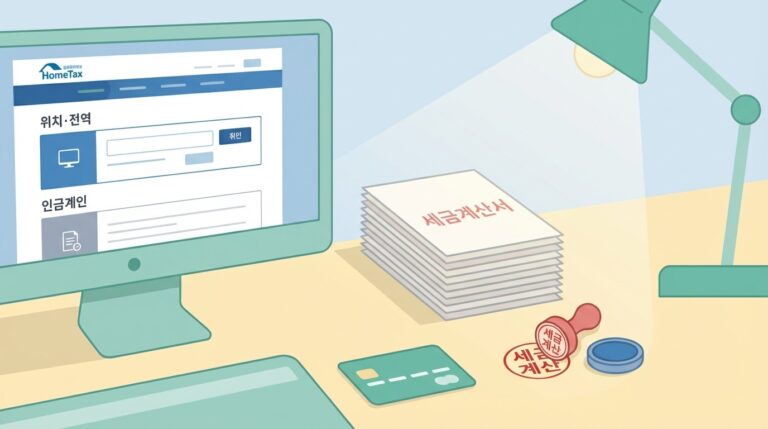
In Korea, almost all tax invoices are electronic (전자 세금 계산서). They are issued through a government portal called HomeTax. If a character in a drama is stressed about tax season, you will see them staring at a blue and white website—that’s HomeTax. It is the digital panopticon of Korean finance.
4-2. The “Corporate Card” (Beop-Ka) Narrative
You’ve seen it in K-Dramas: the protagonist treats the team to expensive beef using the 법인카드 (Beop-in Card/Corporate Card).
* The Reality: To justify that expense to the tax office, one needs a receipt or a tax invoice. If the restaurant doesn’t issue one, that beef is considered a personal expense, which constitutes embezzlement (횡령). The drama tension is real!
4-3. Nunchi (Eye-measure) in Accounting
Asking for a tax invoice too aggressively might make a vendor feel you don’t trust them. Asking too late (after the 10th of the following month) causes penalty taxes for both parties. The “Nunchi” move is to say, “마감 때문에 그러는데…” (Because of the closing deadline…) to shift the blame to the ‘system’ rather than your personal demand.
Phase 5: Immersive Roleplay Scenario
Setting: A neat meeting room in Gangnam. You (a foreign branch manager) are finalizing a contract with Mr. Kim (a local supplier).
Characters:
* YOU: C2 Level Korean learner, professional and firm.
* Mr. Kim: 50s, friendly but trying to cut corners to save money.
Dialogue:
Mr. Kim: 이번 건은 그냥 현금으로 하시죠? 부가세 10% 아깝잖아요.
(Ibeon geoneun geunyang hyeongeumeuro hasijyo? Bugase 10% akkapjanayo.)
Let’s just do this one in cash, right? That 10% VAT is a waste.
(🎭 Stage Direction: Mr. Kim leans in, whispering conspiratorially)
YOU: 사장님, 제안은 감사합니다만, 저희 회사는 모든 거래에 증빙이 필요합니다.
(Sajangnim, jeaneun gamsahamnidaman, jeohi hoesaneun modeun georaee jeungbingi piryohamnida.)
Mr. Kim, thank you for the offer, but our company requires proof (documentation) for all transactions.
Mr. Kim: 아이, 융통성이 없으시네. 그냥 우리끼리 아는 걸로 하고 5% 깎아줄게요.
(Ai, yungtongseongi eopseusine. Geunyang urikkiri aneun geollo hago 5% kkakkajulgeyo.)
Ayy, you have no flexibility. Let’s just keep it between us and I’ll cut 5% off.
🔀 Your Turn! How do you respond?
* A) “싫어요. 불법이잖아요.” (No. That’s illegal.)
* B) “아… 5%는 좀 적은데…” (Ah… 5% is a bit small…)
* C) “죄송합니다. 저희 본사 감사(Audit) 규정이 워낙 까다로워서요. 세금 계산서 발행 부탁드립니다.”✅ Best Choice: C — Blaming ‘Audit Regulations’ (감사 규정) is the ultimate business shield. It refuses the illegal offer politely without personally offending Mr. Kim.
⚠️ Choice A Analysis: Too direct. It causes ‘loss of face’ (Che-myeon) for Mr. Kim. In high-context culture, never call someone out directly if you can avoid it.
Phase 6: 10-Second Shadowing Drill
Practice the “Deadline Pressure” sentence. This is useful when you need to rush someone politely.
Sentence:
😓 다음 달 / 10일까지는 / 국세청 전송이 / 완료되어야 합니다.
(Daeum dal / sib-il-kkajineun / guksecheong jeonsongi / wallyo-doeeoya hamnida.)
Meaning: The transmission to the National Tax Service must be completed by the 10th of next month.
Phase 7: K-Culture Mini Dictionary (Tax Edition)
| Korean | Romanization | English | Context |
|---|---|---|---|
| 증빙 | Jeungbing | Proof/Evidence | Catch-all term for receipts, invoices, etc. essential for accounting. |
| 역발행 | Yeok-balhaeng | Reverse Issuance | When the buyer writes the invoice and the seller just approves it. Common for big companies paying freelancers. |
| 공급가액 | Gonggeup-ga-aek | Supply Value | The price before VAT. Don’t confuse with total price! |
| 가산세 | Gasanse | Penalty Tax | The fee you pay for messing up the deadline. The enemy of all accountants. |
Phase 8: Traveler’s & Expat’s Survival Kit
Even if you aren’t running a business, you deal with “Tax Invoices” cousins: Receipts.
🆘 Survival Expression: Tax Refund (Tax Free)
* 🇰🇷 “택스 리펀 되나요?” (Taekseu ripeon doenayo?)
* Meaning: “Is Tax Refund available?”
* 📍 Where: Department stores, Olive Young, Duty-Free shops.
* 💡 Pro Tip: You must show your Passport. Without it, the receipt is useless for refunds.📌 Editor’s Note: Cash Receipts (현금영수증)
If you live in Korea (Expat), always say “현금영수증 해 주세요” (Please do a cash receipt) at convenience stores or clinics. It lowers your year-end income tax!
Phase 9: Think Deeper — “Transparency vs. Flexibility”
The Digital Panopticon:
Korea has one of the most digitized tax systems in the world. The implementation of the Electronic Tax Invoice (전자 세금 계산서) system was a government move to eliminate the “underground economy” (cash deals without tax).
Your Turn: In your country, is cash still king for small discounts? Or is everything digitally tracked? How does language reflect your culture’s attitude towards tax compliance? (e.g., Do you have a casual word for “under-the-table” deals?)
Phase 10: FAQ & Troubleshooting
Q: Can I issue a tax invoice simply by writing it on paper?
A: Generally, No. If you are a corporate business or a certain size of individual business, you must issue an electronic invoice via HomeTax. Paper is becoming obsolete and can result in penalties.
Q: A freelancer asked for ‘3.3% deduction’. What is this?
A: This is for “Business Income Earners” (freelancers). Instead of a tax invoice, the company deducts 3.3% tax from the payment and pays it to the government. This is the K-Culture equivalent of a “1099” in the US.
❌ Common Mistake: Confusing 영수증 (Receipt) with 세금 계산서 (Tax Invoice).
✅ Correction: A simple receipt shows payment happened. A Tax Invoice is a legal declaration of VAT between businesses. They are not interchangeable for tax deduction purposes.
Phase 11: Wrap-up & Action Items
One-Liner: Issuing a tax invoice is the “Business Handshake” of Korea—do it accurately, do it electronically, and do it by the 10th.
Action Missions:
* 🥉 Bronze: Practice saying “부가가치세 별도입니다” (VAT is separate) 3 times aloud.
* 🥈 Silver: Look at a Korean receipt (from a Korean mart or online image) and find the words ‘공급가액’ and ‘부가세’.
* 🥇 Gold: If you work with Koreans, ask your finance team, “이번 달 세금 계산서 마감일이 언제인가요?” (When is the tax invoice deadline this month?)
K-Culture Mission: Watch an office K-Drama (like Chief Kim / Good Manager). Spot the scene where they panic about an audit or a missing receipt. Now you know why they are sweating!
Phase 12: Interactive Quiz
- Situational Judgment: You are a freelancer. A client asks to pay you via ‘3.3% deduction’ (Sam-jeom-sam). Do you need to issue a separate VAT Tax Invoice?
- A) Yes, always.
- B) No, the 3.3% deduction replaces the need for a VAT invoice in this specific context.
- True or False: You can issue a tax invoice for a transaction that happened last year to fix a mistake today without any penalty.
- (True / False)
- Roleplay Application: Your boss tells you to “Cut the invoice” (계산서 끊어). What does he want you to do?
- A) Shred the paper document.
- B) Issue the invoice electronically.
(Answers: 1. B, 2. False [You will pay Gasanse/Penalty], 3. B)
Frequently Asked Questions (FAQ)
Q: What does "세금 계산서 발행해 주시겠습니까?" mean in Korean and how do you pronounce it?
A: In Korean, "세금 계산서 발행해 주시겠습니까?" is pronounced [Segeum gyesanseo balhaenghae jusigesseumnikka?] and means: "Could you please issue a tax invoice?"
Q: What does "사업자 등록증 사본을 보내주세요." mean in Korean and how do you pronounce it?
A: In Korean, "사업자 등록증 사본을 보내주세요." is pronounced [Saeopja deungnokjjeung saboneul bonaejuseyo.] and means: "Please send me a copy of your Business Registration Certificate."
Q: What does "부가세 별도인가요, 포함인가요?" mean in Korean and how do you pronounce it?
A: In Korean, "부가세 별도인가요, 포함인가요?" is pronounced [Bugase byeoldoingayo, pohamingayo?] and means: "Is VAT excluded or included?"







