

Phase 1: The Invisible Strength of “The Perfect Fit”
Hello! This is your Senior Editor from Daily Hangul.
Picture this: You are watching a high-budget historical K-Drama (Sageuk), perhaps something like Mr. Sunshine or Kingdom. The camera pans across a scholar’s room. It’s elegant, minimalist, and timeless. The wooden desk, the sliding doors, the pillars—they all look seamless. Here is the secret: there isn’t a single nail holding them together.
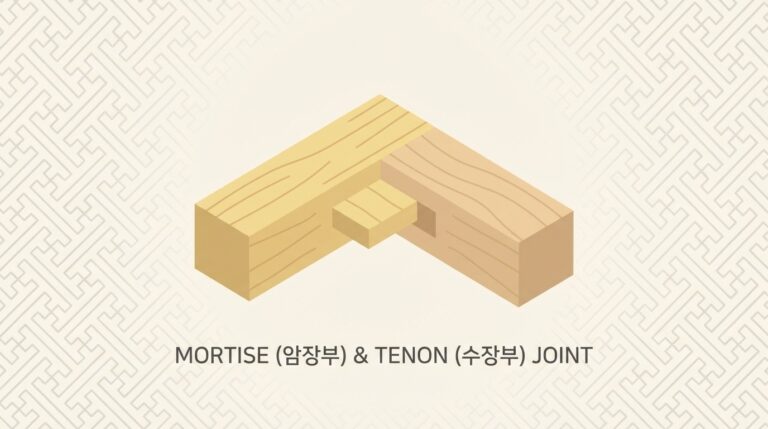
In the West, we often force things together with nails and screws. In traditional Korean woodworking, we use 짜맞춤 (Jjamatchum – Joinery). We carve the wood so it embraces another piece perfectly.
Why does this matter to you, a C1 learner? because this concept of “fitting in without external force” is the perfect metaphor for Korean society. Today, we aren’t just building a desk; we are deconstructing the language of harmony, patience, and the art of the “perfect fit.”
Phase 2: Deep Dive into Core Expressions
Here are three high-level expressions derived from woodworking that Koreans use to describe life, relationships, and plans.
1. 짜맞추다 (Jja-mat-chu-da)
- Pronunciation: [Jja-mat-chu-da] (Sounds like ‘Jazz’ but with a strong ‘Jja’)
- Meaning:
- Literal: To assemble by fitting parts together (joinery).
- Nuance: To fabricate a story, to manipulate a situation to make it make sense, or to force pieces of a puzzle (or schedule) together.
- K-Culture Moment: In crime thrillers, a detective might yell, “사건을 짜맞추지 마!” (Don’t fabricate/force the evidence to fit your theory!).
- Editor’s Insight: This is a double-edged sword. In furniture, it’s art. In interrogation rooms or arguments, it means you are making things up.
- Situation Spectrum:
[🚫 Formal/Boss (Accusatory)] ———— [⚠️ Caution] ———— [✅ Casual/Debate]- 🤔 Think About It: Why does a word for “building” also mean “fabricating a lie”? It suggests that truth should be natural, not constructed.
2. 딱 들어맞다 (Ttak deu-reo-mat-da)
- Pronunciation: [Ttak deu-reo-mat-da] (‘Ttak’ sounds like a sharp click)
- Meaning:
- Literal: To fit in perfectly (like a mortise and tenon).
- Nuance: To click perfectly (with a person), to match a prediction exactly.
- K-Culture Moment: Think of a romantic comedy where the couple’s tastes are identical. Friends would say, “너네 둘은 진짜 딱 들어맞아.” (You two act/think exactly the same/are a perfect match.)
- Editor’s Insight: The adverb ‘딱’ (ttak) is crucial here. It provides the sound image of two wooden pieces locking together with a satisfying click.
- Situation Spectrum:
[✅ Casual] ———— [✅ Workplace] ———— [✅ Formal]3. 뒤틀리다 (Dwi-teul-li-da)
- Pronunciation: [Dwi-teul-li-da]
- Meaning:
- Literal: To be warped or twisted (wood).
- Nuance: For a plan to go awry, or for someone’s personality/mood to be twisted and cynical.
- K-Culture Moment: In office dramas like Misaeng, when a project fails due to office politics, a character sighs, “계획이 완전히 뒤틀렸어.” (The plan has completely gone awry.)
- Editor’s Insight: Wood warps when it loses moisture too fast. Similarly, relationships warp when trust evaporates. It’s a very poetic yet common C1 verb.
- Situation Spectrum:
[✅ Casual] ———— [✅ Workplace (Describing situation)] ———— [🚫 To a superior (Describing them)]
Phase 3: Textbook vs. Real Life (Workshop Edition)
| Situation | 📖 Textbook Korean | 🗣️ Real Korean (Workshop/Street) | 💡 Why the difference? |
|---|---|---|---|
| Connecting parts | 이 두 부분을 결합하세요. (Combine these two parts.) | 이거랑 이거, 아귀를 딱 맞춰 봐. (Make the ‘mouths’ of these fit perfectly.) | ‘아귀(Agwi)’ refers to the matching edges. It’s vivid and tactile vocabulary used by experts. |
| It doesn’t fit | 크기가 맞지 않습니다. (The size does not fit.) | 이거 뻑뻑해서 안 들어가요. (It’s too stiff/tight, it won’t go in.) | ‘뻑뻑하다’ describes the sensation of friction, not just the size difference. |
| Fixing a mistake | 다시 하세요. (Do it again.) | 다 뜯고 다시 짜. (Rip it all apart and weave/build it again.) | ‘짜다’ (to weave/build) implies structure. ‘뜯다’ implies force. It’s more dramatic. |
Phase 4: Cultural Context — The “Nunchi” Joinery
4-1. Non-verbal: The Art of Waiting
When doing Jjamatchum (joinery), you cannot force the wood. If it’s humid, wood expands. You must wait. In Korean culture, this patience is vital. Do not rush an answer from a superior. Like the wood, give the conversation space to breathe. Pushing for a “Yes/No” immediately is like hammering a nail into fine timber—it cracks the relationship.
4-2. K-Culture Connection: The “Sageuk” Aesthetic
In historical dramas, have you noticed how scholars sit on the floor at low desks? These desks (서안, Seoan) are often masterpieces of Jjamatchum. They are designed to be easily dismantled and moved, yet sturdy.
* Critical Perspective: In modern K-Dramas, wealthy characters often live in Hanoks to show “class.” Traditional joinery has moved from a necessity of survival to a symbol of luxury and “Slow Life” in the 21st century.
Phase 5: Immersive Roleplay — The Artisan’s Workshop
Setting: A dusty but aromatic woodworking workshop in a hipster alley of Seoul. The smell of pine and oak is strong. You are learning from Master Jang (60s, grumpy but skilled).
Characters:
* YOU: An apprentice trying to fit a table leg.
* Master Jang: A veteran carpenter who hates nails.
(Dialogue Start)
Master Jang: 야, 힘으로 누르지 마! 나무 상한다.
(Ya, himeuro nureuji ma! Namu sanghanda.)
[Hey, don’t press it with force! You’ll hurt the wood.]
(🎭 He slaps your hand gently away from the mallet)
YOU: 죄송합니다. 아귀가 잘 안 맞는 것 같아서요.
(Joesonghamnida. Agwiga jal an manneun geot gataseoyo.)
[I’m sorry. The interlocking parts don’t seem to fit well.]
Master Jang: 나무가 숨을 쉬어서 그래. 오늘은 습하잖아. 억지로 끼워 맞추면 나중에 다 뒤틀린다.
(Namuga sumeul swieoseo geurae. Oneureun seuphajana. Eokjiro kkiwo matchumyeon najunge da dwiteullinda.)
[It’s because the wood is breathing. It’s humid today. If you force it to fit, it will all warp later.]
🔀 Decision Point: How do you respond?
- A) “그럼 못을 박을까요?” (Should we use a nail then?)
- B) “그럼 좀 기다릴까요? 나무가 진정될 때까지요.” (Should I wait then? Until the wood calms down.)
- C) “대패로 좀 깎아낼까요?” (Should I shave it a bit with a plane?)
✅ Best Choice: C) Showing you know the technical solution (shaving/adjusting) is best. However, B) is also great because it shows you understand the nature of the wood.
🚫 Worst Choice: A) Suggesting a nail to a traditional joinery master is an insult to his craft!
Phase 6: 10-Second Shadowing Drill
Let’s practice the rhythm of a frustrated but professional realization.
😤 Emphasis on ‘억지로’ (Forcibly)
계획을 / 억지로 / 짜맞추려니까 / 일이 / 다 뒤틀리죠!
(Gye-hoe-geul / eok-ji-ro / jja-mat-chu-ryeo-ni-kka / i-ri / da / dwi-teul-li-jyo!)Translation: Because you’re trying to force the plan together, everything is getting twisted/ruined!
Phase 7: K-Culture Mini Glossary (Woodworking Edition)
| Korean | Rom. | English | Context |
|---|---|---|---|
| 장인정신 | Jangin-jeongsin | Craftsmanship | The spirit of the artisan. Highly respected in Korea. |
| 암수 | Amsu | Male/Female parts | In joinery, the protruding part is ‘Su’ (male) and the hole is ‘Am’ (female). |
| 결 | Gyeol | Grain/Texture | Used for wood, but also for skin (피부결) and personality (마음결). |
| 공방 | Gongbang | Workshop/Studio | A very popular hobby place for young Koreans these days (Leather, Wood, Ring making). |
Phase 8: Traveler’s Survival Kit — Visiting a Hanok
Even if you aren’t building furniture, you will likely visit a Hanok Village (Bukchon or Jeonju).
🆘 Survival Expressions #1: Appreciating Architecture
* 🇰🇷 “여기 못을 하나도 안 쓴 거예요?” (Yeogi moseul hanado an sseun geoyeyo?)
* 🗣️ Translation: Did you really use zero nails here?
* 📍 Where: Hanok cafes, Palaces, Temples.
* 💡 Pro Tip: Koreans love it when foreigners recognize the “No Nail” technique. It shows deep cultural appreciation.📌 Editor’s Travel Note
* Experience: Look for “One-day Classes” (원데이 클래스) for making small wooden trays (소반). It’s a great souvenir.
* Etiquette: In Hanok accommodation, handle the sliding doors (Changhoji) gently. They are paper and wood!
Phase 9: Think Deeper — “Invisible Strength”
Topic: The Aesthetics of Invisibility
Why does Korea value Jjamatchum (Joinery)? A nail is efficient. It’s fast. But it’s visible and foreign to the wood. Joinery is slow, difficult, and hidden inside the joint.
This reflects a deeper Korean virtue called “Naeyu-Oegang” (내유외강 – Soft on the outside, strong on the inside). The furniture looks simple and soft, but the internal connection is stronger than iron. In Korean society, the loudest person is rarely the strongest. The one who fits in seamlessly and holds the group together without visible force—that is the true leader.
💬 Your Turn: In your culture, is “strength” usually visible (like a big nail) or hidden (like joinery)? Tell us in the comments!
Phase 10: FAQ & Troubleshooting
- Q: Can I use ‘짜맞추다’ for apologizing?
- No. If you say “변명을 짜맞추다” (piecing together an excuse), it sounds manipulative. Just say “변명하다.”
- Q: Can I use ‘뒤틀리다’ for my stomach?
- Yes! “배가 뒤틀리는 것 같아요” means you have severe cramps. It’s a very natural expression.
- Q: Is ‘공방’ (Workshop) only for professionals?
- No! Many couples go to a ‘Gongbang’ for dates to make matching rings or cutting boards. It’s a distinct sub-culture in Korea.
❌ Common Mistake: Using ‘맞추다’ (to match/set) and ‘짜맞추다’ (to fabricate/assemble) interchangeably in abstract contexts.
* “알람을 맞추다” (Set alarm) – OK.
* “알람을 짜맞추다” (Assemble an alarm?) – Weird.
Phase 11: Wrap-up & Mission
One-Liner: Life, like Korean furniture, lasts longer when you find the perfect fit rather than forcing it.
Action Missions:
* 🥉 Bronze: Look at your wooden furniture at home. Say out loud: “이건 짜맞춤일까?” (Is this joinery?)
* 🥈 Silver: Search for “#짜맞춤” or “#woodworking” on Instagram. Comment on a Korean carpenter’s post: “결이 정말 곱네요!” (The grain is truly fine!)
* 🥇 Gold: Visit a furniture shop or a Hanok cafe in Korea (or your local Koreatown) and ask the owner: “이거 못 없이 만든 거예요?” (Was this made without nails?)
K-Culture Mission: Watch a clip of a “Hanok building” documentary on YouTube. Observe the sound of the wooden mallet hitting the joints. That is the sound of Ttak deureomatda.
Phase 12: Interactive Quiz
1. Situational Judgment:
Your team project is failing because everyone is fighting. How do you describe this situation using today’s vocabulary?
* A) 팀워크가 딱 들어맞아요. (Teamwork fits perfectly.)
* B) 팀워크가 뒤틀렸어요. (Teamwork has warped/twisted.)
* C) 팀워크를 못 박았어요. (We nailed the teamwork.)
2. True or False – K-Culture:
Traditionally, the best Korean furniture uses many iron nails to show wealth and strength. (True / False)
Answers:
1. B) Dwiteullyeosseoyo is correct for things going wrong/relationships souring.
2. False. The highest quality furniture uses Jjamatchum (Joinery) and fish glue, preserving the wood’s integrity.
Frequently Asked Questions (FAQ)
Q: What does "짜맞추다 (Jja-mat-chu-da)" mean in Korean and how do you pronounce it?
A: In Korean, "짜맞추다 (Jja-mat-chu-da)" is pronounced [Jja-mat-chu-da] and means: Literal: To assemble by fitting parts together (joinery).
Q: What does "딱 들어맞다 (Ttak deu-reo-mat-da)" mean in Korean and how do you pronounce it?
A: In Korean, "딱 들어맞다 (Ttak deu-reo-mat-da)" is pronounced [Ttak deu-reo-mat-da] and means: Literal: To fit in perfectly (like a mortise and tenon).
Q: What does "뒤틀리다 (Dwi-teul-li-da)" mean in Korean and how do you pronounce it?
A: In Korean, "뒤틀리다 (Dwi-teul-li-da)" is pronounced [Dwi-teul-li-da] and means: Literal: To be warped or twisted (wood).







