

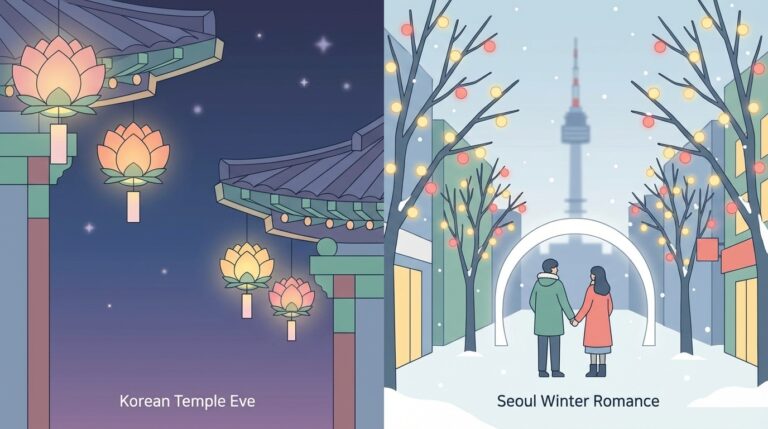
Phase 1: Immersive Hook
Hello! This is your Daily Hangul Editor. 👋
Imagine this: You are walking along the Cheonggyecheon Stream in Seoul. In May, thousands of glowing, colorful lanterns float above your head, turning the night into a mystical scene straight out of a historical K-Drama. Fast forward to December in the exact same spot: now it’s covered in LED lights, giant Christmas trees, and… couples holding hands everywhere.
Here is the unique thing about Korea: It is one of the few countries in the world where both Buddha’s Birthday and Christmas are national holidays. (Yes, we love our “Red Days” or 빨간 날!)
But here is the twist. If you wish someone “Merry Christmas” thinking it’s about family and turkey, or if you think Buddha’s Birthday is only for monks, you might feel a bit out of place.
In Korea, Christmas is actually… a second Valentine’s Day? And Buddha’s Birthday is a street festival? Let’s decode the vibe of these holidays so you don’t end up sitting alone at home on the most romantic night of the year (unless you want to!).
Phase 2: Deep Dive into Key Expressions
Here are three expressions that capture the essence of Korean holidays.
1. 분위기가 나다 (bunwigi-ga nada)
- Pronunciation: [bun-wi-gi-ga na-da] (Sounds like: boon-we-ghee-ga nah-da)
- Meaning: Literal: “The atmosphere comes out.” / Real Nuance: “It has the vibe,” “It feels festive.”
- K-Culture Moment: You walk into a cafe in November, and they are already playing Mariah Carey. You say to your friend, “벌써 크리스마스 분위기 나네!” (It already feels like Christmas!)
- Editor’s Insight: Koreans are very sensitive to bunwigi (atmosphere/vibe). Whether it’s the solemn beauty of temple lanterns or the bustling energy of Myeongdong lights, this phrase confirms you are emotionally connected to the moment.
- Situation Spectrum:
[🚫 Formal Report] ———— [✅ Casual/Polite] ———— [✅ Friends]- 🤔 Think About It: Why is “atmosphere” (mood) so important in Korean culture? It relates to Nunchi (sensing the room). Acknowledging the vibe connects you with others.
2. 챙기다 (chaeng-gi-da)
- Pronunciation: [chaeng-gi-da] (Sounds like: chang-ghee-da)
- Meaning: Literal: “To pack/take.” / Real Nuance: “To celebrate,” “To make sure to mark the occasion.”
- K-Culture Moment: In a drama, a boyfriend forgets the 100-day anniversary. The girlfriend gets upset: “기념일도 안 챙겨?” (You don’t even celebrate our anniversary?)
- Editor’s Insight: “Celebrate” (기념하다) sounds like a government ceremony. 챙기다 implies care and effort. You “take care of” the holiday by doing something special.
- Situation Spectrum:
[⚠️ Boss] ———— [✅ Co-workers] ———— [✅ Friends]- 🤔 Think About It: The word 챙기다 is also used for packing luggage or taking medicine. How does this connect “celebrating a holiday” to “taking care of one’s health/belongings”? (Hint: It’s all about effort).
3. 솔로 천국, 커플 지옥 (sollo cheon-guk, keopeul ji-ok)
- Pronunciation: [sol-lo cheon-guk, keo-peul ji-ok]
- Meaning: “Solo Heaven, Couple Hell.”
- K-Culture Moment: On Christmas Eve, single internet users spam comments sections with this phrase jokingly, pretending they are happy to be alone while couples crowd the streets.
- Editor’s Insight: This is technically a slang/meme phrase, but it’s essential for understanding the social pressure of Christmas in Korea. If you are single on December 25th, people might look at you with pity!
- Situation Spectrum:
[🚫 Formal] ———— [⚠️ Semi-formal] ———— [✅ Friends/Internet]
Phase 3: Textbook vs. Real Life
| Situation | 📖 Textbook Korean | 🗣️ Real Korean (Insa Style) | 💡 Why different? |
|---|---|---|---|
| Christmas Greeting | 즐거운 성탄절 되세요. (Have a pleasant Holy Birth Day.) |
메리 크리스마스! 오늘 뭐 해? (Merry Christmas! Wud?) |
“성탄절” is mostly used in news or churches. English loanwords are the norm for fun holidays. |
| Buddha’s Birthday | 절에 가서 기도를 드려요. (I go to the temple to pray.) |
연등 축제 보러 갈래? (Wanna go see the Lantern Festival?) |
For most young Koreans, it’s more about the festival/photos than the prayer. |
| Asking plans | 연휴에 계획이 있으십니까? (Do you have plans for the holiday?) |
빨간 날인데 어디 안 가? (It’s a Red Day, not going anywhere?) |
“Red Day” (calendar color) is the colloquial term for public holidays. |
💡 Editor’s Note: Use “빨간 날” (Red Day) instead of “공휴일” (Public Holiday) when talking to friends. It sounds much more native!
Phase 4: Cultural Deep Dive — The Context
4-1. The “Couple” Christmas Mystery 🎄💑
If you watch K-Dramas, you’ve seen it: snow falling, a couple sharing a scarf, and a romantic confession. In Korea, Christmas is for lovers, similar to Valentine’s Day in the West.
– Family? Usually, New Year’s (Seollal) or Harvest Festival (Chuseok) are for family. Christmas is for dates.
– The Cake: Koreans MUST buy a Christmas cake. Bakeries have wars over cake pre-orders. It’s not about the taste; it’s about the photo for Instagram.
4-2. Buddha’s Birthday: The Peaceful Festival 🏮
Even if you aren’t Buddhist, this is a peak K-Travel moment.
– Bibimbap: Temples often give out free Bibimbap (Sanchae Bibimbap) to everyone on this day. Sharing food is a core Buddhist (and Korean) virtue.
– Yeondeung (Lotus Lanterns): The parade in Jongno, Seoul, is massive. It’s not solemn; it’s loud, colorful, and feels like a carnival.
Phase 5: Immersive Roleplay
Scenario: It is mid-December. You are at a cafe with your Korean friend, Min-ji. The cafe is playing loud carols.
Characters:
– YOU: An expat who usually spends Christmas with family.
– Min-ji: Your trendy Korean friend (20s-30s) who loves dating gossip.
Dialogue:
Min-ji: 와, 거리마다 캐럴 나오고 난리 났다. 벌써 크리스마스 분위기 확 나는데? 🎄
(Wa, georimada kaereol naogo nanli natda. Beolsseo keuriseumaseu bunwigi hwak naneunde?)
(Wow, carols are playing on every street, it’s crazy. It totally has that Christmas vibe already, right?)
YOU: 그러게. 한국은 크리스마스 준비가 진짜 빠른 것 같아.
(Geureoge. Hangugeun keuriseumaseu junbiga jinjja ppareun geot gata.)
(I know. Korea seems to prepare for Christmas really fast.)
Min-ji: 너는 이번 크리스마스 챙겨? 누구랑 보내?
(Neoneun ibeon keuriseumaseu chaeng-gyeo? Nugurang bonae?)
(Are you celebrating this Christmas? Who are you spending it with?)
🔀 Decision Point: How do you answer?
- A) “그냥 집에서 쉴 거야. 솔로잖아.” (Just resting at home. I’m solo, you know.)
- B) “가족들한테 영상 통화 하려고.” (I’m planning to video call my family.)
- C) “명동 성당에 가보려고!” (I’m thinking of going to Myeongdong Cathedral!)
If you choose A (The Realistic Local approach):
Min-ji: 아… 역시 ‘이불 밖은 위험해’인가? 그래도 케이크는 먹어야지!
(Ah… As expected, ‘it’s dangerous outside the blanket’? Still, you have to eat cake!)
(Note: Min-ji uses a famous internet slang emphasizing that staying home is safest/best.)
Phase 6: 10-Second Shadowing Drill
Let’s practice complaining about the crowds (a very common Korean pastime during holidays)!
Sentence: “Christmas in Myeongdong? No way, it’s packed with people!”
🗣️ Drill:
크리스마스에 / 명동? // 절대 안 돼! / 사람 / 터져나가! 😱
(Keuriseumaseu-e / Myeongdong? // Jeoldae an dwae! / Saram / teojeonaga!)
- Intonation: Raise pitch on “명동?” (Disbelief). Emphasize “절대” (Absolutely) strongly.
- Emotion: 😱 Horrified. Imagine being squeezed like a sardine in a subway.
Phase 7: K-Culture Mini Glossary
| Korean | Romanization | English | Context |
|---|---|---|---|
| 빨간 날 | Ppalgan nal | Red Day | A public holiday (marked red on calendars). Everybody loves these. |
| 연휴 | Yeonhyu | Long weekend | Consecutive holidays. The best time to travel. |
| 썸 | Ssome | ‘Some’ | The ambiguous stage before dating. Christmas is the deadline to end ‘some’ and start dating. |
| 절 | Jeol | Temple | Where you go on Buddha’s Birthday. |
| 교회/성당 | Gyohoe/Seongdang | Church/Cathedral | Where Christians go, but also popular dating spots for the lights. |
Phase 8: Traveler’s Survival Kit (Holiday Edition)
If you are in Seoul during late December or May, use these tips.
🆘 Survival Phrases
1. “오늘 영업 해요?” (Oneul yeong-eop haeyo?)
– Meaning: Are you open today?
– Why: Some private shops might close on holidays, though most stay open.
2. “사람 너무 많아요.” (Saram neomu manayo.)
– Meaning: There are too many people.
– Use: When you want to express empathy with a taxi driver or friend navigating crowds.
3. “예약 되나요?” (Yeyak doenayo?)
– Meaning: Can I make a reservation?
– Critical: Restaurants on Xmas Eve are booked weeks in advance.📌 Editor’s Travel Note:
– Transportation: On Xmas Eve and New Year’s Eve, subways often run later than usual (check apps like KakaoMetro).
– Temples: Jogyesa Temple (near Insadong) is the HQ for the Lantern Festival. It’s crowded but worth it for the photos.
Phase 9: Think Deeper — Religion as Culture
Topic: Why does a non-Christian celebrate Christmas?
In many Western countries, religion is often a private identity. In Korea, religious holidays have evolved into Cultural Festivals. You will see Buddhists putting up Christmas trees and Christians visiting lantern festivals.
This reflects the Korean trait of “Heung” (흥 – Collective Joy). If there is a reason to gather, eat good food, and see beautiful lights, the origin matters less than the shared experience. Also, Korea has a unique multi-religious history where Shamanism, Buddhism, and Christianity coexist (mostly) peacefully.
🧠 Think Deeper: In your country, are religious holidays celebrated by people of other faiths? Or are they strictly religious?
Phase 10: FAQ & Troubleshooting
Q: I’m a Christian. Is it okay to go to a temple on Buddha’s Birthday?
A: Absolutely YES. It is treated more like a cultural heritage event. No one will try to convert you. Just be respectful of people praying.
Q: Can I wish an older person “Merry Christmas”?
A: You can, but it’s safer/more polite to say “즐거운 연휴 보내세요” (Have a pleasant holiday weekend) unless you know they are Christian.
❌ Common Mistake:
Thinking public transport stops on Christmas.
✅ Correction: Buses and subways run normally (or even more frequently) because everyone is going out to play!
Phase 11: Wrap-up & Action Mission
One-Liner Summary:
Korean holidays are about the Vibe (분위기)—Christmas is for romance/cakes 🎂, and Buddha’s Birthday is for lanterns/festivals 🏮.
🚀 Action Missions:
– 🥉 Bronze: Look in a mirror and say “분위기 진짜 좋다!” (The vibe is really good!) with a happy face.
– 🥈 Silver: Search “Cheonggyecheon Lantern Festival” or “Myeongdong Christmas Lights” on YouTube/Instagram to see the vibe we discussed.
– 🥇 Gold: Ask a Korean friend or tutor: “크리스마스에 뭐 해?” (What are you doing on Christmas?) and see if they mention a date or family!
💬 Your Turn:
Does your country have a “Couple’s Holiday”? Tell us in the comments! 👇
Phase 12: Interactive Quiz
- Situational Judgment: You are talking to your boss. Which phrase is appropriate for the holiday?
- A) 메리 크리스마스! 오늘 데이트 가세요? (Merry Xmas! Going on a date?)
- B) 연휴 잘 보내시고 새해 복 많이 받으세요. (Have a good holiday and Happy New Year.)
- C) 솔로 천국 커플 지옥! (Solo Heaven Couple Hell!)
- K-Culture True/False:
- Koreans usually eat Turkey on Christmas. (T/F)
Answers:
1. B. A is too personal (asking about a date), and C is a joke for friends. B is professional.
2. False. We eat Cake! 🎂 Turkey is very hard to find in Korea.
Frequently Asked Questions (FAQ)
Q: What does "분위기가 나다 (bunwigi-ga nada)" mean in Korean and how do you pronounce it?
A: In Korean, "분위기가 나다 (bunwigi-ga nada)" is pronounced [bun-wi-gi-ga na-da] and means: Literal: "The atmosphere comes out." / Real Nuance: "It has the vibe," "It feels festive."
Q: What does "챙기다 (chaeng-gi-da)" mean in Korean and how do you pronounce it?
A: In Korean, "챙기다 (chaeng-gi-da)" is pronounced [chaeng-gi-da] and means: Literal: "To pack/take." / Real Nuance: "To celebrate," "To make sure to mark the occasion."
Q: What does "솔로 천국, 커플 지옥 (sollo cheon-guk, keopeul ji-ok)" mean in Korean and how do you pronounce it?
A: In Korean, "솔로 천국, 커플 지옥 (sollo cheon-guk, keopeul ji-ok)" is pronounced [sol-lo cheon-guk, keo-peul ji-ok] and means: "Solo Heaven, Couple Hell."







