

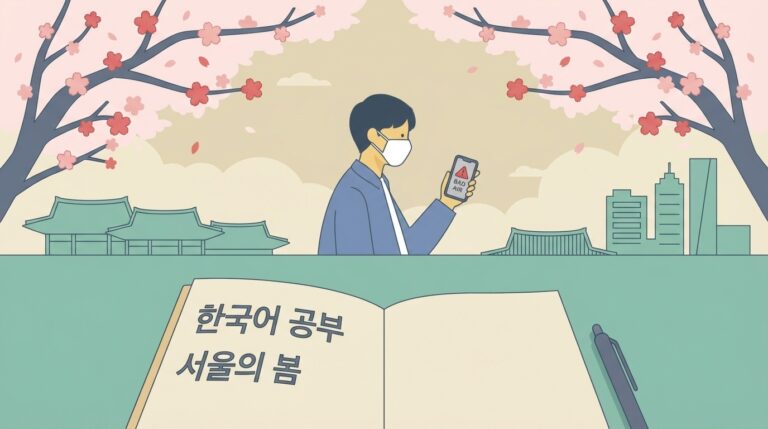
Surviving Seoul’s Sepia Filter: The Advanced Guide to Spring Dust & KF94
Phase 1: The Immersive Hook
Greeting: 안녕하세요! Daily Hangul’s Senior Editor here.
Imagine this: You wake up in Seoul on a mid-April morning. The weather app says it’s a pleasant 18°C. You open the curtains, expecting a crisp blue sky to match the blooming cherry blossoms. Instead, you’re greeted by a sepia-toned world. The N Seoul Tower is barely visible, shrouded in a beige mist. It looks like a scene from Mad Max or a vintage film with a dirty lens.
Your Korean friend texts you: “오늘 미세먼지 최악이야. 마스크 꽉 껴!” (Today’s fine dust is the worst. Wear your mask tight!)
For a C2 learner, spring in Korea isn’t just about beotkkot (cherry blossoms); it’s about mastering the survival vocabulary of Hwangsa (Yellow Dust) and Mise-meonji (Fine Dust). If you don’t know the difference between KF80 and KF94, or if you describe the sky as simply “cloudy” (흐림) instead of “dusty” (뿌연), you miss a massive chunk of daily Korean discourse.
Today, we move beyond basic weather terms to discuss air quality concentrations, health etiquette, and the cultural phenomenon of “oiling your throat.”
Phase 2: Deep Dive into Core Expressions
1. [오늘 미세먼지 농도가 ‘매우 나쁨’ 수준이에요.]
- Pronunciation: [Oneul mise-meonji nongdoga ‘maeu nappeum’ sujunieyo]
- Meaning:
- Literal: Today’s fine dust concentration is at the ‘very bad’ level.
- Real Nuance: “The air is toxic today. Don’t go outside unless necessary.”
- K-Culture Moment: You’ll hear this on every morning news forecast and see it flashing red on subway station displays. It sets the mood for the entire city’s day.
- Editor’s Insight: Note the word ‘농도’ (concentration). At an advanced level, we don’t just say “dust is much” (먼지가 많아요). We talk about density and levels. The scale usually goes: 좋음 (Good) → 보통 (Moderate) → 나쁨 (Bad) → 매우 나쁨 (Very Bad).
- Situation Spectrum:
[🚫 Strict Formal] ———— [✅ Universal] ———— [✅ Casual]
(This phrasing is standard and works everywhere, from news anchors to casual texts.) - 🤔 Think About It: Why does Korean have a specific distinct vocabulary for ‘Yellow Dust’ (sand from deserts) vs. ‘Fine Dust’ (pollution)? How does distinguishing the source of the dust affect how people perceive the problem?
2. [목이 칼칼해서 삼겹살로 기름칠 좀 해야겠어.]
- Pronunciation: [Mogi kalkalhaeseo samgyeopsallo gireumchil jom haeyagesseo]
- Meaning:
- Literal: My throat feels scratchy, so I need to grease it with some pork belly.
- Real Nuance: “The air quality is terrible, so let’s use that as an excuse to eat heavy BBQ tonight.”
- K-Culture Moment: This is a classic Korean urban myth—that the grease from pork belly ‘slides’ the dust out of your throat. Medically unproven? Yes. Culturally essential? Absolutely. You will hear this in offices around 5 PM on dusty days.
- Editor’s Insight: ‘칼칼하다’ is a high-level adjective. It describes a dry, scratchy, irritated feeling in the throat (or a spicy, refreshing taste in soup, depending on context). Using sensory words like this marks you as a near-native speaker.
- Situation Spectrum:
[🚫 Formal Presentations] ———— [⚠️ Colleagues] ———— [✅ Friends/Social]
(Don’t say this to your boss unless you are suggesting a dinner menu.)
3. [KF94 마스크 아니면 안심이 안 돼요.]
- Pronunciation: [KF-gusasa maseukeu animyeon ansimi an dwaeyo]
- Meaning:
- Literal: If it’s not a KF94 mask, I don’t feel relieved/safe.
- Real Nuance: “I don’t trust surgical masks or cloth masks in this weather.”
- K-Culture Moment: Standing in front of the mask aisle at Olive Young, debating between breathability and safety. KF (Korea Filter) implies a trusted government standard.
- Editor’s Insight: ‘안심이 안 되다’ (cannot feel at ease) is a great phrase to express anxiety or lack of trust in a product’s efficacy.
Phase 3: Textbook vs. Real Life
| Situation | 📖 Textbook Korean | 🗣️ Real Korean (C2/Native) | 💡 Why the difference? |
|---|---|---|---|
| Checking the air | 오늘 공기가 안 좋아요. (The air is bad today.) |
“오늘 미세미세 어플 봤어? 완전 검은색이야.” (Did you see the MiseMise app? It’s totally black.) |
Koreans rely heavily on specific apps like ‘MiseMise’ which use color codes (Black = Worst). |
| Complaining about weather | 날씨가 흐려요. (The weather is cloudy.) |
“하늘이 온통 뿌옇네. 곰탕인 줄.” (The sky is totally hazy. Looks like beef bone soup.) |
‘뿌옇다’ (milky/hazy) is the specific adjective for dust visibility. Comparing it to ‘Gomtang’ (soup) is witty sarcasm. |
| Buying a mask | 마스크 주세요. (Give me a mask.) |
“KF94 대형, 숨쉬기 편한 걸로 주세요.” (KF94 Large, one that’s easy to breathe in, please.) |
Specificity is key. Brands matter because some fit too tight (a ‘bird beak’ fit). |
Phase 4: Cultural Deep Dive
4-1. Non-verbal Communication: The “Cough” Etiquette
In the era of Yellow Dust (and post-COVID), a cough in public is sensitive. If the dust makes you cough on the subway:
1. Eye Contact: Do NOT make eye contact while coughing.
2. Gesture: Even if wearing a mask, cover your mouth with your arm. It signals, “I am trying my best to contain this.”
3. The “Dust” Nod: After a coughing fit, slightly fanning your hand in front of your face signals to others, “It’s the dust, not a virus.”
4-2. The “Sam-Han-Sa-Mi” (삼한사미) Phenomenon
Traditionally, Korea’s winter/early spring pattern was “Sam-Han-Sa-On” (3 days cold, 4 days warm).
However, in modern society, this idiom has evolved into a satirical news term: “Sam-Han-Sa-Mi” (3 days cold, 4 days Micro-dust).
– Why? When the Siberian cold wind blows, the air is clear but freezing. When the wind stops and it gets warmer, the stagnant air accumulates dust.
– Usage: Use this term when discussing climate change with Koreans to instantly gain intellectual respect.
Phase 5: Immersive Roleplay
Setting: Saturday morning, 10 AM. You and your friend Ji-eun planned a picnic to the Han River, but the sky is beige.
Characters:
– YOU: An expat who really wants to see the flowers.
– Ji-eun: A health-conscious Korean friend (30s).
(Dialogue)
Ji-eun: (Looking out the window with a sigh) 하… 오늘 날씨 실화야? 미세먼지 수치 봤어?
(Ha… oneul nalssi silhwaya? Mise-meonji suchi bwasseo?)
[Translation: Ha… is this weather for real? Did you check the fine dust figures?]
YOU: (Check your phone) 그러게. ‘매우 나쁨’이네. 그냥 안개인 줄 알았는데…
(Geureoge. ‘Maeu nappeum’ine. Geunyang angaein jul aratneunde…)
[Translation: You’re right. It’s ‘Very Bad’. I just thought it was fog…]
Ji-eun: 안개는 무슨. 이거 다 중국에서 넘어온 황사야. 오늘 한강 갔다가는 폐가 남아나지 않겠다.
(Angaeneun museun. Igeo da Junggugeseo neomeoon hwangsaya. Oneul Hangang gatdaganeun pyega namananji angetda.)
[Translation: Fog, my foot. This is all yellow dust from China. If we go to the Han River today, our lungs won’t survive.]
🔀 Decision Point: How do you respond?
A) “그래도 마스크 쓰고 가면 괜찮지 않을까? 꽃 다 지잖아.” (Insist on going with a mask)
B) “아쉽지만 할 수 없지. 그냥 실내 쇼핑몰이나 갈까?” (Propose an indoor alternative)
C) “삼겹살 먹으면 씻겨 내려간대! 고기나 먹으러 가자.” (Use the cultural myth)
✅ Best Choice: B — While C is funny, on a “Very Bad” day, most Koreans prefer to stay indoors (Starfield Mall, Lotte World Mall). B shows you respect her health concerns.
⚠️ Choice A Analysis: ‘KF94’ can only do so much. Insisting on outdoor activities during ‘Worst’ levels can be seen as lacking health awareness (or nunchi).
(Scenario continues with B)
YOU: 아쉽지만 할 수 없지. 그냥 코엑스 가서 영화나 볼까?
(Aswipjiman hal su eopji. Geunyang Coex gaseo yeonghwana bolkka?)
Ji-eun: 그래, 그게 낫겠다. 마스크는 꼭 KF94로 챙겨! 덴탈 마스크는 의미 없어.
(Geurae, geuge natgetda. Maseukeuneun kkok KF94-ro chaenggyeo! Dental mask-neun uimi eopseo.)
Phase 6: 10-Second Shadowing Drill
Practice saying this with a tone of frustrated resignation.
🥺 날씨가 / 왜 이러죠? // 봄만 되면 / 숨쉬기가 / 너무 힘들어요.
(Nalssiga / wae ireojyo? // Bomman doemyeon / sumswigiga / neomu himdeureoyo.)
[Why is the weather like this? Whenever spring comes, it’s so hard to breathe.]
Phase 7: K-Culture Glossary (Dust Edition)
| Korean | Romanization | Meaning | Context |
|---|---|---|---|
| 황사 | Hwangsa | Yellow Dust | Natural sand dust originating from deserts (Mongolia/China). |
| 미세먼지 | Mise-meonji | Fine Dust | Pollution-based dust (PM10). Industrial origin. |
| 초미세먼지 | Cho-mise-meonji | Ultrafine Dust | The really dangerous stuff (PM2.5). Penetrates the lungs. |
| KF94 | Ke-i-epeu-gusa | Korea Filter 94 | Blocks 94% of particles. The gold standard for protection. |
| 공기청정기 | Gonggi-cheongjeonggi | Air Purifier | A mandatory appliance in every Korean home/cafe. |
Phase 8: Traveler’s Survival Kit
Since you are traveling in spring, you will need to buy a mask. Don’t just point; ask specifically.
🆘 Survival Phrases @ The Pharmacy/Convenience Store
– 🇰🇷 “KF94 마스크 있나요? 대형으로 주세요.”
(KF94 maseukeu innayo? Daehyeong-euro juseyo.)
“Do you have KF94 masks? Please give me a Large size.” (Note: Adults usually need Large. ‘Medium’ is often too tight for Western facial structures).
– 🇰🇷 “미세먼지 차단 되는 거죠?”
(Mise-meonji chadan doeneun geojyo?)
“This blocks fine dust, right?”📌 Editor’s Travel Note
– Apps: Download ‘MiseMise’ (미세미세). It uses a smiling or crying face icon. If the face is red or black (👿), cancel your hiking plans.
– Emergency: If you forgot your mask, go to any convenience store (GS25, CU). Look for “황사 방역용” (For Yellow Dust Protection) on the package.
Phase 9: Think Deeper — “Nature vs. Industry”
🧠 The Politics of Air:
In Korea, air quality is not just weather; it’s a diplomatic and political issue. When the dust is bad, you might hear people blaming neighboring countries or domestic diesel cars. As a C2 learner, observe how the news frames the source of the dust. Is it “Hwangsa” (natural/external) or “Stagnant Atmospheric Conditions” (domestic/internal)?
💬 Your Turn: Does your country have a seasonal phenomenon that disrupts daily life (like wildfire smoke or pollen)? How does your language reflect that struggle?
Phase 10: FAQ & Troubleshooting
Q: Can I just wear a cloth mask or a fashion mask?
A: Strictly speaking, no one will arrest you. But socially? On a ‘Very Bad’ dust day, wearing a cloth mask might make you look uninformed or indifferent to health. Locals view KF94 as the only “real” defense against PM2.5.
Q: Is it rude to wear a mask while talking to an elder?
A: Pre-2019? Yes. Now? No. Health takes priority. However, if you are in a deep, formal conversation indoors (and the air is filtered), briefly lowering it to show your face at the start can be a sign of respect, then ask permission: “마스크 써도 될까요?” (May I wear my mask?)
❌ Common Mistake: Confusing KF-AD (Anti-Droplet) with KF94. KF-AD is for summer/hot weather to stop spit (viruses). It does not stop fine dust well. Don’t buy KF-AD for a dust storm!
Phase 11: Wrap-up & Missions
One-Liner: Spring in Korea is a battle between beautiful flowers and bad air—equip yourself with a KF94 and the word ‘칼칼하다’.
Action Missions:
– 🥉 Bronze: Check the ‘MiseMise’ app or a Korean weather site (Naver Weather) and read the ‘미세먼지’ level aloud.
– 🥈 Silver: Go to a convenience store and identify the difference between KF-AD, KF80, and KF94 packages.
– 🥇 Gold: On a dusty day, suggest eating Samgyeopsal to a Korean friend using the phrase: “목이 칼칼한데 기름칠 좀 할까?”
K-Culture Mission: Watch a K-Drama scene where a character checks the air purifier (often turns red) or complains about the sky. It’s a subtle PPL (Product Placement) staple!
Phase 12: Interactive Quiz
- Situational Judgment: Your boss says, “오늘 미세먼지가 최악이네요.” (The dust is the worst today.) What is the least appropriate response?
- A) 네, 마스크 꼭 쓰셔야 해요. (Yes, you must wear a mask.)
- B) 맞아요, 목이 너무 아파요. (Right, my throat hurts so much.)
- C) 와, 날씨 진짜 좋다! 산책 가요! (Wow, the weather is great! Let’s go for a walk!)
- True or False: “KF-AD masks are the best choice for protecting against Yellow Dust (Hwangsa).”
-
Real Korean: Translate this sentiment into natural Korean: “The sky is so hazy it looks like soup.”
- (Hint: Use ‘Gomtang’)
Answers:
1. C (Total lack of nunchi and reality check.)
2. False (KF-AD is for droplets. You need KF80 or KF94 for dust.)
3. “하늘이 곰탕처럼 뿌옇네요.”
Frequently Asked Questions (FAQ)
Q: What does "[오늘 미세먼지 농도가 '매우 나쁨' 수준이에요.]" mean in Korean and how do you pronounce it?
A: In Korean, "[오늘 미세먼지 농도가 '매우 나쁨' 수준이에요.]" is pronounced [Oneul mise-meonji nongdoga 'maeu nappeum' sujunieyo] and means: Literal: Today's fine dust concentration is at the 'very bad' level.
Q: What does "[목이 칼칼해서 삼겹살로 기름칠 좀 해야겠어.]" mean in Korean and how do you pronounce it?
A: In Korean, "[목이 칼칼해서 삼겹살로 기름칠 좀 해야겠어.]" is pronounced [Mogi kalkalhaeseo samgyeopsallo gireumchil jom haeyagesseo] and means: Literal: My throat feels scratchy, so I need to grease it with some pork belly.
Q: What does "[KF94 마스크 아니면 안심이 안 돼요.]" mean in Korean and how do you pronounce it?
A: In Korean, "[KF94 마스크 아니면 안심이 안 돼요.]" is pronounced [KF-gusasa maseukeu animyeon ansimi an dwaeyo] and means: Literal: If it's not a KF94 mask, I don't feel relieved/safe.







