

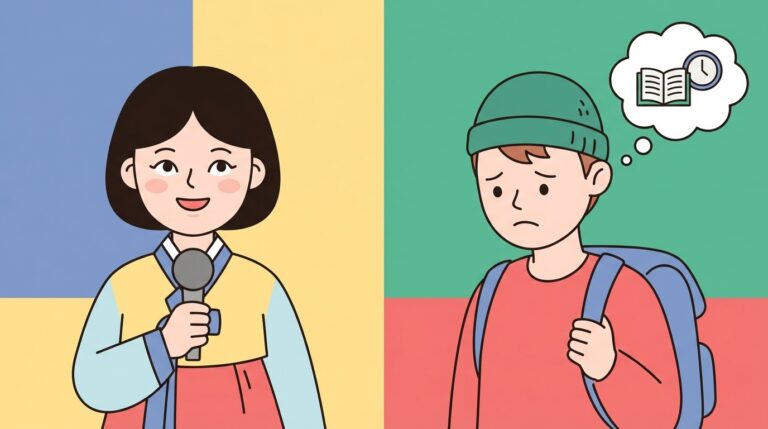
Saying “No” Like a K-Drama Protagonist: Polite Refusals 101
👋 Hello! This is your Daily Hangul Editor.
Imagine this: It’s Friday night in Seoul. You just finished your classes or work. Suddenly, your phone buzzes with a KakaoTalk message from a new Korean friend: “Tonight! Chimaek (Chicken & Beer)? 🍗🍺”
Your heart says YES, but your reality says NO. Maybe you have an exam tomorrow, or maybe you’re just exhausted and want to recharge with Netflix in bed.
In many Western cultures, a simple “No, I can’t” is perfectly fine. But in Korea? If you just reply with “아니요 (Aniyo)”, the air might freeze. ❄️
In K-Dramas, have you noticed how characters rarely say a direct “No”? They hesitate, they look apologetic, and they give a vague excuse. Today, we are going to learn the art of the polite refusal—specifically, how to say you are too busy, without losing a friend.
Let’s master the “Soft No” together!
Phase 2: Deep Dive into Core Expressions 🧐
Here are the top 3 phrases to decline an invitation like a polite local.
1. 약속이 있어요 (Yaksogi isseoyo)
- Pronunciation: [Yak-so-gi i-sseo-yo]
- Sound-alike: “Yak” sounds like Yak (the animal), “sog” sounds like soak.
- Meaning:
- Literal: I have a promise.
- Real Nuance: “I have plans.” (This is the magic shield!)
- K-Culture Moment: In almost every office drama, when the annoying manager asks the team to go for a sudden dinner (Hoesik), the clever protagonist saves themselves by saying this phrase.
- Editor’s Insight: You do not need to explain what the plan is. It could be a date, or it could be washing your hair. Saying you have a “Yaksok” is a socially accepted code for “I’m busy.”
- Situation Spectrum:
[🚫 Boss (Use slightly more formal)] ———— [⚠️ Colleagues] ———— [✅ Friends]
(Perfect for acquaintances and friends. For bosses, add ” 죄송하지만…” (I’m sorry but…) in front.) - 🤔 Think About It: Why is “Promise” (Yaksok) used for casual plans? It shows that you value your time commitments, making your refusal seem responsible rather than just lazy.
2. 오늘 좀 바빠요 (Oneul jom bappayo)
- Pronunciation: [O-neul jom ba-ppa-yo]
- Meaning:
- Literal: Today, a little busy.
- Real Nuance: “I’m a bit tied up today.”
- K-Culture Moment: Think of a busy K-Pop idol on a variety show explaining why they couldn’t meet their friends. “Ah, lately I’m a bit busy…”
- Editor’s Insight: The word 좀 (jom) here is crucial! It means “a little,” but it functions as a softener. Without it, “Oneul bappayo” sounds like “I’m busy! Go away!” Always add jom to sound softer.
- Situation Spectrum:
[🚫 Boss] ———— [⚠️ Colleagues] ———— [✅ Friends]
3. 어떡하죠? (Eotteokhajyo?)
- Pronunciation: [Eo-tteo-ka-jyo]
- Meaning:
- Literal: What should I do?
- Real Nuance: “Oh no… / That’s a shame…” (Used before giving the excuse)
- K-Drama Moment: The lead actor looks at the person asking for a favor, sighs slightly, tilts their head, and says, “Ah… Eotteokhajyo?” before rejecting them gently.
- Editor’s Insight: This isn’t a question asking for a solution. It’s an emotional cushion. It shows you want to say yes, but you can’t. It validates the other person’s offer.
Phase 3: Textbook vs. Real Life 🗣️
Let’s see how a real Seoulite speaks compared to a rigid textbook.
| Situation | 📖 Textbook Korean | 🗣️ Real Korean | 💡 Why is it different? |
|---|---|---|---|
| Friend asks for dinner | 미안합니다. 저는 시간이 없습니다. (I am sorry. I have no time.) |
아, 어떡하지? 나 오늘 약속 있는데… (Ah, what to do? I have plans today…) |
“Time is not existing” sounds robotic. “Plans” sounds social. |
| Colleague asks for help | 아니요. 지금 바쁩니다. (No. I am busy now.) |
죄송해요, 제가 지금 좀 바빠서요. (Sorry, it’s just that I’m a bit busy right now.) |
Ending with -seoyo leaves the sentence slightly open/soft, which is more polite. |
Bottom Note: Never just say “Aniyo” (No) to an invitation unless you want to end the friendship! 🙅♀️
Phase 4: Cultural Deep Dive — The Art of “Nunchi” 👀
4-1. Non-verbal: The “Sad Eyebrow” Technique
In Korea, how you say no is as important as what you say.
* Don’t: Smile brightly while saying “I’m busy.” It looks sarcastic.
* Do: Look slightly troubled or disappointed. Inhale a short breath (“Hah…”) before speaking. This non-verbal cue signals “I really wish I could!”
4-2. K-Culture Connection: The “Busy” Idol Life
In K-Pop fandom culture, fans often joke that their idols are “too busy.” But in real Korean society, being “busy” is often seen as a virtue—it means you are living a diligent life.
However, be careful! If you use the “I’m busy” excuse three times in a row without suggesting a reschedule date, Koreans will use their Nunchi (intuition) and realize: “Ah, they just don’t like me.”
Phase 5: Immersive Roleplay 🎭
Setting: It is Friday, 6:00 PM. You are packing your bag at a language exchange meetup in Hongdae.
Characters:
* YOU: An international student who has a big test on Monday.
* Min-su: A friendly, energetic Korean guy who loves partying.
Min-su:
(Clapping his hands)
“Hey! 끝나고 노래방 갈래? 내가 쏠게!” 🎤
(Hey! Wanna go to Karaoke after this? It’s on me!)
🔀 YOUR TURN! How do you reply?
Option A: “아니. 안 가.” (No. Not going.)
Option B: “아, 진짜요? 가고 싶은데… 오늘 약속이 있어요.” (Ah, really? I want to go but… I have plans today.)
Option C: “노래방? 좋아! 가자!” (Karaoke? Good! Let’s go!)
✅ Best Choice: Option B
* Why? You acknowledged his offer (“Ah, really?”), showed interest (“I want to go”), but gave a polite reason (“I have plans”). This protects Min-su’s feelings.
* ⚠️ Analysis of A: Too cold! Min-su might think he offended you.
* ⚠️ Analysis of C: Great if you want to fail your test on Monday! 😉
Min-su:
“아, 그래? 아쉽다. 그럼 다음에 같이 가자!”
(Ah, really? That’s too bad. Let’s go together next time!)
Phase 6: 10-Second Shadowing Drill 🎧
Practice this sentence to sound natural. Focus on the hesitation!
Sentence: “Ah… what should I do? I have plans today.”
Korean: 아… 어떡하죠? / 오늘 / 약속이 있어요.
Romanization: Ah… eo-tteo-ka-jyo? / o-neul / yak-so-gi i-sseo-yo.
- Emotion: 😢 Regretful & Apologetic (Imagine you are missing the best party ever).
- Intonation:
- Ah… (Long sigh)
- Eo-tteo-ka-jyo? (Pitch goes up slightly at the end)
- Isseoyo (Pitch drops calmly)
Phase 7: K-Culture Mini Glossary 📙
| Korean | Romanization | Meaning | Context |
|---|---|---|---|
| 약속 | Yaksok | Promise / Plan | Used for any appointment, from a doctor’s visit to a date. |
| 눈치 | Nunchi | Eye-measure / Intuition | The ability to read the room. If someone says “I’m busy” vaguely, use nunchi and don’t ask “Doing what?” |
| 쏘다 | Ssoda | To treat / To pay | Literally “to shoot (a gun),” but means “I’ll pay the bill!” (Like Min-su in the roleplay). |
| 밀당 | Mildang | Push & Pull | The psychological game in relationships. Refusing once before accepting is a form of mild mildang. |
Phase 8: Traveler’s Survival Kit 🎒
Even if you aren’t living in Korea, you will need to say “No” to street vendors or overly helpful strangers.
🆘 Survival Phrase #1: The Polite Refusal
* 🇰🇷 “괜찮아요.” (Gwaenchana-yo)
* 🗣️ Pronunciation: [Gwen-cha-na-yo]
* Meaning: “It’s okay” / “No thanks.”
* Gesture: 👋 Lightly wave your hand vertically in front of your chest (like chopping the air gently) while shaking your head slightly.
* Pro Tip: If a salesperson in Myeongdong is following you, just smile awkwardly, say “Gwaenchana-yo,” and keep walking. Don’t stop!
Phase 9: Think Deeper — “Why so indirect?” 🧠
Have you noticed that “No” is a dirty word in Korean culture? This is related to the concept of Chemyon (Face/Reputation) and Harmony. Direct refusal can be seen as “rejecting the person,” not just the request. By saying “I have plans” (even if the plan is sleeping), you are essentially saying, “It’s not you, it’s the situation.”
💬 Your Turn: In your country, is it rude to ask “Why?” when someone says they are busy? Or is it normal curiosity? Let us know in the comments!
Phase 10: FAQ & Troubleshooting 🛠️
Q: Can I use “약속이 있어요” with my boss?
A: Yes, but it’s better to add “죄송하지만” (I am sorry but…) at the beginning. Example: “죄송하지만, 오늘 선약(prior engagement)이 있습니다.”
Q: What if I really don’t want to go, ever?
A: If you say you are busy 3 times, most Koreans will get the hint. You don’t need to say “I dislike karaoke.” That’s too harsh!
❌ Common Mistake #1: Saying “바빠.” (Bappa) to people you don’t know well.
✅ Fix: “Bappa” is Banmal (casual language). Only use it with very close friends. Always add “-yo” (Bappayo) for politeness!
Phase 11: Wrap-up & Mission 🚀
One-Liner Summary: When refusing in Korean, soften the blow with “Eotteokhajyo?” and use the magic shield “Yaksogi isseoyo” instead of a direct “No.”
🎯 Action Mission:
* 🥉 Bronze: Look in the mirror and practice the “Sad Eyebrow” face while saying “Eotteokhajyo…”
* 🥈 Silver: Next time you are too busy to study, tell your textbook: “Mian, oneul yaksogi isseoyo.”
* 🥇 Gold: Try refusing a flyer on the street (or a sample at a cosmetic store) using the hand gesture and “Gwaenchana-yo!”
K-Culture Mission: Watch a K-Drama episode this week. Find a scene where a character refuses a drink or a date. Do they say “Aniyo”? Or do they make an excuse? Spot the Nunchi game!
Phase 12: Pop Quiz! 📝
1. Your co-worker asks you for lunch, but you brought a packed lunch. What is the BEST reply?
* A) 싫어요. (I hate it.)
* B) 아니요. 안 먹어요. (No. I don’t eat.)
* C) 아, 어떡하죠? 오늘 약속이 있어서요. (Ah, what to do? I have plans today.)
2. True or False?
* If you say “I have a Yaksok (Plan),” you must show proof of your plan to the other person.
3. Fill in the blank:
* “Sorry, I’m a bit busy.” -> “Mianhaeyo, oneul ____ bappayo.”
* (Hint: The softener word meant for “a little”)
(Scroll down for answers)
.
.
.
.
Answers:
1. C (A and B are too rude!)
2. False (Asking for proof is very rude in Korea!)
3. 좀 (Jom)
Frequently Asked Questions (FAQ)
Q: What does "약속이 있어요 (Yaksogi isseoyo)" mean in Korean and how do you pronounce it?
A: In Korean, "약속이 있어요 (Yaksogi isseoyo)" is pronounced [Yak-so-gi i-sseo-yo] and means: a key conversational Korean expression covered in this lesson.
Q: What does "오늘 좀 바빠요 (Oneul jom bappayo)" mean in Korean and how do you pronounce it?
A: In Korean, "오늘 좀 바빠요 (Oneul jom bappayo)" is pronounced [O-neul jom ba-ppa-yo] and means: Literal: Today, a little busy.
Q: What does "어떡하죠? (Eotteokhajyo?)" mean in Korean and how do you pronounce it?
A: In Korean, "어떡하죠? (Eotteokhajyo?)" is pronounced [Eo-tteo-ka-jyo] and means: Literal: What should I do?







