

Phase 1: The Panic Moment — “Wait, is that a siren?”
Annyeonghaseyo! It’s your Daily Hangul Editor. 👋
Picture this: You are in a cozy Airbnb in Hongdae, enjoying a late-night cup of ramyeon. Suddenly, a loud siren wails. 🚨 WEE-WOO-WEE-WOO! Then, a voice blasts through the speaker in the ceiling. It’s shouting in rapid-fire Korean.
Is it a drill? Is it a mistake? Or is it a scene straight out of a disaster movie like Exit (2019) where Cho Jung-seok is running for his life?
In K-Dramas, the hero always grabs the heroine’s wrist and knows exactly where the secret exit is. But in real life, you don’t have a script. You need to know if you should finish your noodles or run for the door.
Today, we aren’t just learning words; we are learning survival. This is the “Fire Alarm” unit, designed to keep you safe and “in the know” during emergencies in Korea.
Phase 2: Deep Dive — 3 Words That Could Save You
1. 불이야! (Bul-i-ya!)
- Pronunciation:
Bul-i-ya[Bul (sounds like ‘Bull’) + i-ya (sounds like ‘see ya’)] - Meaning: “Fire!” (Literal: It is fire!)
- K-Culture Moment: You’ve seen this in historical dramas (Sageuk) when a lantern falls on a straw roof. Everyone shouts this while running with buckets of water. It’s primal and urgent.
- Editor’s Insight: You don’t say “There is a fire.” You scream this. The ending “-ya” adds emotion and calls for attention. It’s not polite; it’s survival.
- Situation Spectrum:
[🚫 Formal Greeting] ———— [⚠️ Classroom] ———— [✅ Emergency Only] - 🤔 Think About It: In English, we just yell “Fire!” (one syllable). Why do you think Korean adds “-iya” (two syllables)? Does the extra length make the shout carry further?
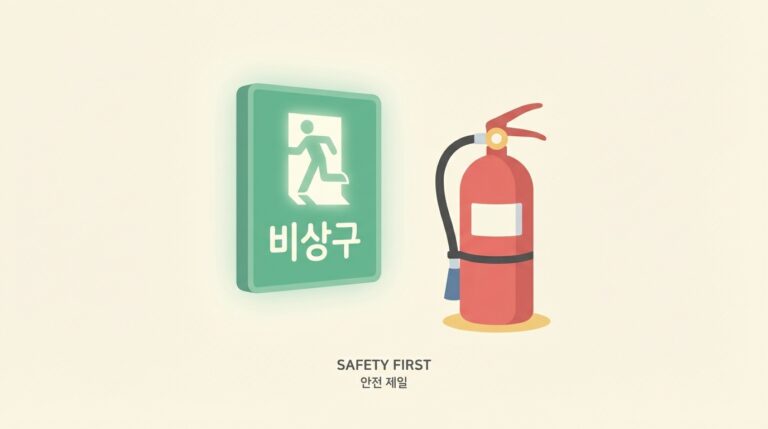
2. 비상구 (Bisang-gu)
- Pronunciation:
Bi-sang-gu[Bi (bee) + sang (song) + gu (goo)] - Meaning: Emergency Exit
- K-Culture Moment: In K-Pop music videos or survival shows, watch for the green light in the background. It’s universal, but knowing the word helps you ask for it.
- Editor’s Insight: “Bi-sang” means emergency, “Gu” means mouth/opening. It literally means “Emergency Mouth.” If you can’t find the sign, show this word to a Korean person.
- Situation Spectrum:
[✅ Use Freely](Use this to ask for directions in any building) - 🤔 Think About It: Why is the “Exit” sign green in Korea (and many places), but sometimes red in others? Green usually means “Go/Safety.”
3. 대피하세요 (Daepi-haseyo)
- Pronunciation:
Dae-pi-ha-se-yo - Meaning: Please evacuate / Please take shelter.
- K-Culture Moment: This is the voice you hear on the loudspeaker in the subway or apartment complex. It’s the “Voice of God” in disaster movies instructing citizens.
- Editor’s Insight: You won’t usually say this, but you must understand it. If you hear “Daepi,” drop your bag and move.
- Situation Spectrum:
[✅ Official Announcements] ———— [⚠️ Casual Talk] (Don't use it to say "leave the room")
Phase 3: Textbook vs. Real Life
| Situation | 📖 Textbook Korean | 🗣️ Real Survival Korean | 💡 Why the difference? |
|---|---|---|---|
| Smelling smoke | 화재가 발생한 것 같아요. (I think a fire has occurred.) | 불 냄새 나요! (Bul naem-sae na-yo!) | In panic, grammar disappears. “Fire smell!” is faster. |
| Finding the exit | 비상구가 어디에 있습니까? (Where is the emergency exit?) | 나가는 문 어디예요?! (Na-ga-neun mun eodi-yeyo?!) | “The door to go out” is easier to say than the formal term. |
| Warning others | 모두 밖으로 나가주세요. (Everyone please go outside.) | 나가요! 빨리! (Na-gayo! Ppalli!) | Efficiency over politeness creates urgency. |
💡 Editor’s Note: A1 Beginners, don’t worry about perfect sentences. Shouting “Bul!” (Fire) or “Ppalli!” (Quickly) works perfectly.
Phase 4: Cultural Context — Don’t Freeze, Read the Room (Nunchi)
4-1. The “Is it Real?” Nunchi
In Korea, fire drills (min-bang-wi) happen, but they are usually announced. If you see Koreans looking confused but staying put, it might be a false alarm or a drill.
* The Rule: If one person runs, you run. If everyone is calm but the alarm is ringing, ask: “Jin-jja-ye-yo?” (Is it real?).
4-2. K-Food Connection: The BBQ Smoke
Eating Korean BBQ (Samgyeopsal)? The room will be smoky.
* Scenario: Sometimes the smoke is so thick you worry the alarm will go off.
* Culture: The extendable vacuum tube above the grill is critical. If a waiter rushes over and pulls it down, don’t be offended—they are preventing a fire alarm!
* Think Deeper: Why are Korean tables designed with these tubes? It shows how food culture shapes interior design.
Phase 5: Immersive Roleplay — The Hotel Alarm 🏨
Setting: 2:00 AM. A boutique hotel in Gangnam. You are in your pajamas. A loud alarm starts ringing. You open your door and see a hotel staff member running down the hall.
Characters:
* YOU: A tourist, confused and sleepy.
* Staff (Min-ho): Young hotel clerk, looking anxious.
(Dialogue Start)
Alarm: 🚨 WEE-WOO-WEE-WOO
YOU: (Opening the door) 저기요! 무슨 일이에요?
(Jeogiyo! Museun ir-ieyo?)
(Excuse me! What’s happening?)
Min-ho: (Stops running, breathless) 불이야! 빨리 나오세요! 📢
(Bul-i-ya! Ppalli na-o-se-yo!)
(Fire! Come out quickly!)
YOU: (Shocked) 진짜요? 어디로 가요?
(Jinjja-yo? Eodi-ro ga-yo?)
(Really? Where do I go?)
Min-ho: 비상구! 저쪽 계단으로 가세요!
(Bisang-gu! Jeoj-jjok gye-dan-eu-ro ga-se-yo!)
(Emergency exit! Go to the stairs over there!)
(Stage Direction: Smoke starts to smell in the hallway)
🔀 YOUR TURN! What do you say/do next?
- A) “Wait, let me pack my bag!” (Wait…)
- B) “알겠습니다!” (Run immediately to the stairs)
- C) “Elevator is faster!” (Run to elevator)
✅ Best Choice: B — “Al-get-seum-ni-da!” (I understand!). Never use elevators (C) during a fire. Packing (A) puts you in danger.
Phase 6: 10-Second Shadowing Drill 🗣️
Practice this until it’s muscle memory. Emotional tagging included!
- (😤 Urgent/Loud): 불이야! / 도와주세요!
(Bul-i-ya! / Do-wa-ju-se-yo!)
“Fire! / Help me!” -
(😨 Scared/Fast): 비상구 / 어디예요?
(Bi-sang-gu / eo-di-ye-yo?)
“Emergency Exit / where is it?”
Phase 7: K-Culture Mini Glossary 📕
| Korean | Romanization | English | Context |
|---|---|---|---|
| 119 | Il-il-gu | 119 | The magic number. Police is 112, but for Fire/Ambulance, dial 119. |
| 소화기 | So-hwa-gi | Fire Extinguisher | You will see these in every subway station and hallway. Red cylinder. |
| 안전 불감증 | Anjeon bulgamjeung | Safety Insensitivity | A social term criticizing how people ignore safety rules because “it won’t happen to me.” |
Phase 8: Traveler’s Survival Kit 🧳
When staying in Korea, safety comes first.
🆘 Survival Card: The “Help Me” Trio
1. “도와주세요!” (Do-wa-ju-se-yo!) – Help me! (General)
2. “살려주세요!” (Sal-ryeo-ju-se-yo!) – Save me! (Life-threatening)
3. “신고해주세요!” (Sin-go-hae-ju-se-yo!) – Please report it (to 119)!📌 Editor’s Travel Note:
* App: Download “Emergency Ready App” (Korean government app for foreigners). It sends alerts in English.
* Location: If you call 119 and can’t speak Korean well, just say “Fire” and your location clearly. They have interpretation services.
Phase 9: Think Deeper — “Why so calm?”
🧠 Topic: The Paradox of Safety in Korea
You might notice that when an alarm rings, many locals don’t panic immediately. This is often called “Safety Insensitivity” (안전 불감증). Because false alarms happen, people hesitate to react.
However, Korea also has a strong “Speed” (Pablli-Pablli) culture. Once the danger is confirmed, the evacuation is incredibly fast and organized.
💬 Your Turn: In your country, if a fire alarm rings in a mall, does everyone run immediately, or do they finish their coffee first?
Phase 10: FAQ & Troubleshooting
- Q: Can I shout “Fire!” in English in Korea?
- A: Yes! But “Bul-i-ya!” works faster because locals react instinctively to their mother tongue.
- Q: I broke the fire alarm glass by mistake. Will I go to jail?
- A: If it was a genuine accident, usually no. But if it was a prank, the fine is heavy. Explain: “실수예요” (Sil-su-ye-yo – It was a mistake).
- ❌ Common Mistake: Trying to say “I am burning” (Te-wo-yo) vs “It is a fire” (Bul-i-ya).
- ✅ Fix: Just stick to “Bul-i-ya!” Simple is safe.
Phase 11: Wrap-up & Mission
One-Liner: Knowing “Bul-i-ya” and “Bisang-gu” changes panic into action.
🏆 Action Missions:
* 🥉 Bronze: Look around your room right now. Point to the door and say “Bisang-gu” three times.
* 🥈 Silver: Watch a scene from the movie Exit (2019) or a disaster K-Drama clip on YouTube. Listen for “Daepi-haseyo.”
* 🥇 Gold: Next time you enter a Korean restaurant or building, find the green running man sign and think, “That is the Bisang-gu.”
Phase 12: Quiz — Will You Survive?
- Situation: You smell smoke in the subway. What do you shout?
- A) 안녕하세요 (Annyeonghaseyo)
- B) 불이야! (Bul-i-ya!)
- C) 맛있어요 (Masisseoyo)
- True or False: You should wait for the hotel staff to knock on your door before moving when the alarm rings.
- (False). Trust the alarm (or check the hallway), don’t wait.
- Fill in the Blank: The number to call for fire/ambulance in Korea is 1-1-___?
- (Answer: 9 / Gu)
(Answers: 1-B, 2-False, 3-9)
Frequently Asked Questions (FAQ)
Q: What does "불이야! (Bul-i-ya!)" mean in Korean and how do you pronounce it?
A: In Korean, "불이야! (Bul-i-ya!)" is pronounced [Bul-i-ya [Bul (sounds like 'Bull'] and means: "Fire!" (Literal: It is fire!)
Q: What does "비상구 (Bisang-gu)" mean in Korean and how do you pronounce it?
A: In Korean, "비상구 (Bisang-gu)" is pronounced [Bi-sang-gu [Bi (bee] and means: Emergency Exit
Q: What does "대피하세요 (Daepi-haseyo)" mean in Korean and how do you pronounce it?
A: In Korean, "대피하세요 (Daepi-haseyo)" is pronounced [Dae-pi-ha-se-yo] and means: Please evacuate / Please take shelter.







