

Phase 1: The ‘Last Train’ Panic (Immersive Hook)
Hello! This is your Daily Hangul Editor. 👋
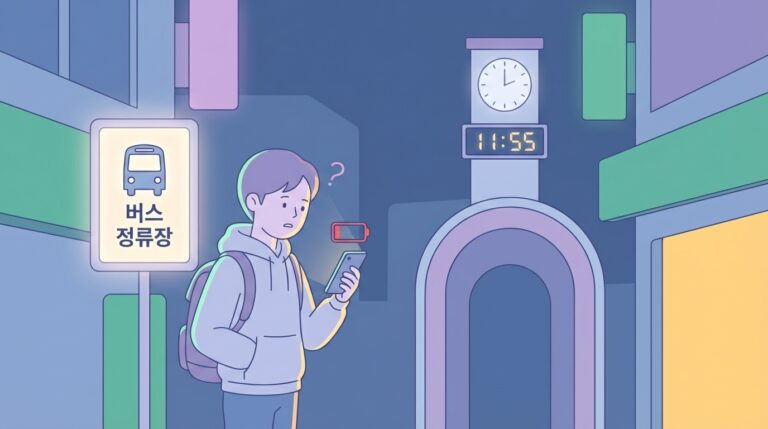
Picture this: You are in Hongdae, the vibrant heart of Seoul’s nightlife. You’ve just finished a delicious meal of Samgyeopsal, and your phone battery—tragically—hits 0%. The screen goes black. 😱
Suddenly, you realize you need to catch the ‘Makcha’ (막차 – last train) to get back to your hotel. In K-Dramas, this is usually the moment the male lead appears with a car, but in reality, you just need to know the time immediately so you don’t get stranded.
You see a kind-looking student walking by. You approach them. Your heart races. How do you ask without sounding rude or like a robot from a 1990s textbook?
If you don’t know this phrase, you might miss your train. But if you know it, you become an ‘Insider’ (Inssa) who can navigate Seoul analog-style. Let’s fix that right now.
Phase 2: Deep Dive into Time (Core Expressions)
Here are the top 3 ways to ask for the time, ranked by “Safety.”
1. 실례지만, 지금 몇 시예요? (Sil-lye-ji-man, ji-geum myeot-si-ye-yo?)
- Pronunciation: Sil-lye-ji-man (Sounds like ‘Silly-jee-man’) + Ji-geum (Gee-gum) + Myeot-si-ye-yo (My-ot-see-yay-yo?)
- Meaning: “Excuse me, but what time is it now?”
- K-Culture Moment: Think of a polite scene in a drama where a lost tourist asks a police officer for help. This is the gold standard.
- Editor’s Insight: The word ‘실례지만’ (Excuse me, but…) is your magic shield. It softens the question. Koreans value personal space, so interrupting someone’s walking requires this “cushion language.”
- Situation Spectrum:
[🚫 Boss/Elder] ———— [⚠️ Colleague] ———— [✅ Stranger/Shopkeeper]
(Wait, why 🚫 for Boss? For a boss, you rarely ask them the time; you should know it! But grammatically, it is polite enough.) - 🤔 Think About It: Why does Korean require an apology (“Excuse me”) before asking a simple question? It reflects the cultural value of not inconveniencing others.
2. 지금 몇 시예요? (Ji-geum myeot-si-ye-yo?)
- Pronunciation: Ji-geum myeot-si-ye-yo?
- Meaning: “What time is it now?”
- Editor’s Insight: This is the standard polite form (Haeyo-che). It’s perfectly fine, but dropping the “Excuse me” (Sil-lye-ji-man) makes it slightly more direct. Use this if you are already in a conversation with someone.
- Situation Spectrum:
[🚫 President] ———— [⚠️ Stranger] ———— [✅ Colleague/Acquaintance]
3. 지금 몇 시야? (Ji-geum myeot-si-ya?)
- Pronunciation: Ji-geum myeot-si-ya?
- Meaning: “What time is it?” (Casual)
- K-Drama Moment: The lead actor grabs his friend’s wrist to check the watch and asks, “Ya! Myeot si ya!” (Hey! What time is it!).
- Editor’s Insight: This is Banmal (informal speech). Only use this with close friends or people younger than you.
- Situation Spectrum:
[🚫 Stranger/Older] ———— [⚠️ New Friend] ———— [✅ Best Friend]
Phase 3: Textbook vs. Real Life
| Situation | 📖 Textbook Korean | 🗣️ Real Korean (In Seoul) | 💡 Why the difference? |
|---|---|---|---|
| Asking a Stranger | 지금 몇 시입니까? (Ji-geum myeot-si-im-ni-kka?) | 저기요, 혹시 시계 있으세요? (Excuse me, do you happen to have a watch?) | “~Imnikka” sounds like the military. Asking if they have a watch is softer. |
| Checking with a Friend | 지금 시간이 어떻게 됩니까? | 야, 지금 몇 시냐? (Ya, jigeum myeot-si-nya?) | Real friends value speed and intimacy over grammar structure. |
| Realizing the time | 지금은 7시입니다. | 헐, 벌써 7시야? (Heol, beolsseo 7-si-ya?) | We add emotions! “Heol” (OMG) and “Beolsseo” (Already). |
Bottom Note: Never use “몇 시입니까?” on the street unless you are filming a historical drama about soldiers. Stick to “몇 시예요?”
Phase 4: Cultural Deep Dive — The ‘Pali-Pali’ Clock ⏱️
4-1. Non-verbal: The Eye Contact Rule
When asking “Myeot si yeyo?” to a stranger, do not stare intensely into their eyes. In Western culture, eye contact shows confidence. In Korea, too much eye contact can be burdensome (Burdamsureowo). Look slightly at their chin or shoulder level, bow your head slightly, and ask.
4-2. K-Culture Connection: The ‘Ticketing War’ (Piket-ting)
In K-Pop culture, time isn’t just numbers; it’s war. We call buying concert tickets “Piket-ting” (Blood + Ticketing). Fans use “Navyism” (a server time clock) to see the exact millisecond. asking “What time is it?” isn’t enough; you need to know the seconds.
- Critical View: Why is Korea so obsessed with time? The ‘Pali-pali’ (Hurry, hurry) culture drove Korea’s rapid economic growth, but it also creates high stress. Being 1 minute late to a meeting is considered disrespectful.
Phase 5: Immersive Roleplay (Survival Scenario)
Setting: It is Friday night, 10:55 PM. You are at a bus stop in Gangnam. Your phone is dead. You need to catch the 11:00 PM bus. A university student is standing next to you looking at her phone.
Characters:
* YOU: Desperate tourist.
* Student (Ji-min): 20s, wearing headphones, looking at Instagram.
(Dialogue Start)
YOU: (Tapping her shoulder gently) 저기요…
(Jeo-gi-yo… / Excuse me…)
Ji-min: (Takes off one headphone) 네?
(Ne? / Yes?)
YOU: [ 🔀 Your Choice! Select A, B, or C ]
Options:
* A) 지금 몇 시야? (Hey, what time is it?)
* B) 실례지만, 지금 몇 시예요? (Excuse me, but what time is it?)
* C) 시간 있어? (Do you have time?)
✅ Best Choice: B
* Why: A is rude (Banmal). C sounds like you are hitting on her (“Do you have time to date?”). B is the perfect polite request.
(Continuing with Choice B)
Ji-min: 아, 지금 10시 58분이에요.
(Ah, ji-geum yeol-si o-sip-pal-bun-i-e-yo. / Ah, it’s 10:58.)
YOU: 헉! 감사합니다!
(Heok! Gam-sa-ham-ni-da! / Gasp! Thank you!)
(🎭 Stage Direction: You run to the bus approaching in the distance!)
Phase 6: 10-Second Shadowing Drill
Let’s practice the “Polite Cushion” technique. Repeat this 3 times.
😰 Emotion: Anxious but polite (You are in a hurry!)
Sentence: 실례지만 / 지금 / 몇 시예요?
Pronunciation: Sil-lye-ji-man / ji-geum / myeot-si-ye-yo?
Phase 7: K-Culture Mini Glossary
| Korean | Romanization | Meaning | Context |
|---|---|---|---|
| 막차 | Makcha | Last train/bus | The most important time of the day for commuters. Missing it means an expensive taxi ride. |
| 칼퇴 | Kal-toe | Leaving work exactly on time | Literal meaning: “Knife leave.” Leaving right at 6:00 PM sharply. |
| 코리안 타임 | Korean Time | Being slightly late | Ironically, while work is strict, social gatherings often start 10-15 mins late. This is called “Korean Time.” |
Phase 8: Traveler’s Survival Kit 🧳
Since time is essential for travel, here are your life-savers:
🆘 Survival Phrases
1. “When does it start?”
* 🇰🇷 언제 시작해요? (Eon-je si-jak-hae-yo?)
2. “How long does it take?”
* 🇰🇷 얼마나 걸려요? (Eol-ma-na geol-lyeo-yo?)
* 📍 Use at: Taxi, Restaurant (waiting for food), Hair salon.
3. “Is it open now?”
* 🇰🇷 지금 문 열었어요? (Ji-geum mun yeol-eoss-eo-yo?)📌 Editor’s Travel Note
Most Korean bus stops have digital screens showing “3분 후 도착” (Arriving in 3 mins). You don’t always need to ask, but knowing how to read numbers is key!
Phase 9: Think Deeper — “Pure Korean vs. Sino-Korean Numbers”
Here is the biggest headache for learners: Korea uses TWO number systems at the same time to tell time.
- Hours: Native Korean Numbers (Hana, Dul, Set…) ➝ Hana-si (1 o’clock)
- Minutes: Sino-Korean Numbers (Il, Ee, Sam…) ➝ Il-bun (1 minute)
🧠 Think Deeper: Why keep both? Native numbers feel more “physical” and “countable” (like counting hours on your fingers), while Sino-Korean numbers are used for math, money, and calculation (minutes are precise). It reflects a culture that balances indigenous tradition (hours) with external systems (minutes).
💬 Your Turn: Does your language change numbers depending on what you are counting?
Phase 10: FAQ & Troubleshooting
- Q: Can I just show my phone screen to someone instead of speaking?
- A: Yes! But don’t just shove the phone in their face. Say “Jeo-gi-yo…” (Excuse me) first, then show the dead screen. Body language works, but manners matter more.
- Q: I heard “Myeot si?” in a K-Drama. Can I use it?
- A: ❌ Common Mistake! In dramas, characters are often friends or enemies. As a learner/traveler, you are usually talking to strangers. Stick to ending with “-yo” (Myeot si-ye-yo).
- Q: How do I say AM and PM?
- A: AM is O-jeon (오전), PM is O-hu (오후). Put it before the time. (e.g., O-hu 2-si = 2 PM).
Phase 11: Wrap-up & Mission
One-Liner Summary: To ask the time, soften your approach with “Sil-lye-ji-man” and never use Banmal with strangers!
🚀 Action Mission:
* 🥉 Bronze: Look at your watch right now and say the time using “___ Si, ___ Bun” (Use a cheat sheet for numbers!)
* 🥈 Silver: Post a photo of a clock on social media and write the time in Korean letters (Hangeul).
* 🥇 Gold: Next time you watch a K-Drama, shout out the time in Korean whenever a clock appears on screen!
Phase 12: Interactive Quiz
Question: You are late for a meeting with your Korean professor. You arrive and want to check if you are very late. How do you ask the professor for the time?
- 야, 지금 몇 시야? (Ya, jigeum myeot-si-ya?)
- 실례지만, 지금 몇 시예요? (Sil-lye-ji-man, ji-geum myeot-si-ye-yo?)
- 시간 있어? (Sigan isseo?)
Answer: 2
Explanation: #1 is for friends (rude to a professor). #3 means “Do you have time (to hang out)?” #2 is the only polite option.
Frequently Asked Questions (FAQ)
Q: What does "실례지만, 지금 몇 시예요? (Sil-lye-ji-man, ji-geum myeot-si-ye-yo?)" mean in Korean and how do you pronounce it?
A: In Korean, "실례지만, 지금 몇 시예요? (Sil-lye-ji-man, ji-geum myeot-si-ye-yo?)" is pronounced [Sil-lye-ji-man (Sounds like 'Silly-jee-man'] and means: "Excuse me, but what time is it now?"
Q: What does "지금 몇 시예요? (Ji-geum myeot-si-ye-yo?)" mean in Korean and how do you pronounce it?
A: In Korean, "지금 몇 시예요? (Ji-geum myeot-si-ye-yo?)" is pronounced [Ji-geum myeot-si-ye-yo?] and means: "What time is it now?"
Q: What does "지금 몇 시야? (Ji-geum myeot-si-ya?)" mean in Korean and how do you pronounce it?
A: In Korean, "지금 몇 시야? (Ji-geum myeot-si-ya?)" is pronounced [Ji-geum myeot-si-ya?] and means: "What time is it?" (Casual)







