

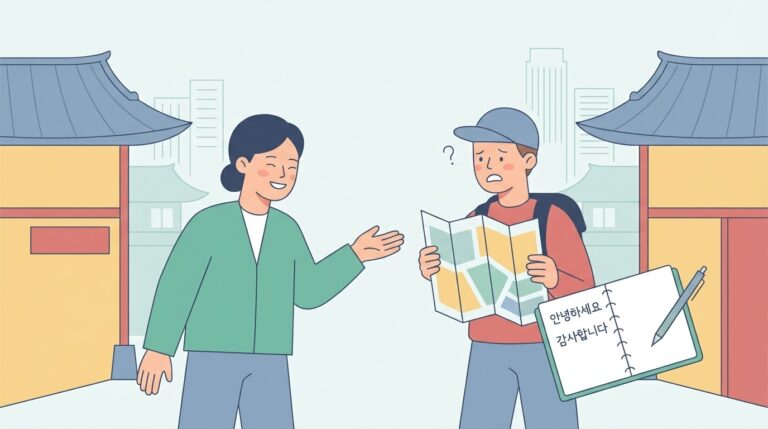
Unit: Getting Lost is Part of the Fun (Asking for Directions)
Phase 1: Immersive Hook — The “Jeong” GPS
👋 안녕하세요! (Hello!) This is your Daily Hangul Editor.
Picture this: You are in a K-Drama scene. You are the protagonist, standing in the middle of a bustling market in Seoul, looking at your phone with a confused face. In many Western countries, someone might point a finger and say, “Two blocks that way.”
But in Korea? A local Halmeoni (grandma) might stop, look at your screen, grab your wrist gently, and physically walk you to the destination while chatting away in Korean you don’t understand.
That is Jeong (정). It’s not just about efficiency; it’s about the connection. In Korea, giving directions isn’t just data transfer; it’s an act of care.
Today, we aren’t just learning how to find the subway station. We are learning how to unlock this kindness. Ready to navigate Seoul like a local? Let’s go!
Phase 2: Deep Dive into Key Expressions
Here are the magic words to activate a Korean’s “Help Mode.”
1. 실례합니다, [Place] 어디예요?
(Sillyehamnida, [Place] eodiyeyo?)
- Pronunciation: [Shill-lay-ham-nee-da], [Place] [Uh-dee-ye-yo?]
- Tip: “Sillye” sounds like “Silly” + “Yeah”. “Eodi” sounds like “Audi” (the car) but with an ‘Uh’ sound.
- Meaning: “Excuse me, where is [Place]?”
- K-Culture Moment: In reality TV shows like Run BTS!, members often ask locals this when they are dropped in unknown locations. It’s the polite opener that signals respect.
- Editor’s Insight: The word Sillye (Excuse) is crucial. It acknowledges that you are interrupting their path. It shows you have nunchi (social sense).
- Situation Spectrum:
[🚫 Friends] ———— [✅ Strangers/Elders] ———— [✅ Staff]- 🤔 Think About It: Why do Koreans apologize (“Excuse me”) before asking for help? Does this reflect a culture that values collective harmony over individual convenience?
2. 이쪽으로 쭉 가세요.
(Ijjogeuro jjuk gaseyo.)
- Pronunciation: [Ee-jjog-eu-ro] [Jjook!] [Ga-say-yo]
- Tip: “Jjuk” sounds like the sound of sipping a thick milkshake through a straw. It means “straight through.”
- Meaning: “Please go straight this way.”
- K-Drama Note: Often accompanied by a very enthusiastic hand gesture chopping the air forward.
- Editor’s Insight: You will hear this answer more than you say it. But if you hear “Jjuk,” just keep walking until you hit a wall!
- Situation Spectrum:
[✅ Casual] ———— [✅ Polite] ———— [✅ Formal]3. 길을 잃었어요.
(Gireul ireosseoyo.)
- Pronunciation: [Gil-eul] [Ee-ross-uh-yo]
- Tip: “Gil” sounds like the “Gill” of a fish.
- Meaning: “I am lost.”
- K-Culture Moment: The classic “Damsel/Gentleman in distress” moment in dramas before the lead character appears to save the day.
- Situation Spectrum:
[✅ Universal Usage]
Phase 3: Textbook vs. Real Life
| Situation | 📖 Textbook Korean | 🗣️ Real Korean (Street Vibe) | 💡 Why is it different? |
|---|---|---|---|
| Asking where the subway is | 지하철역이 어디입니까? (Jihacheol-yeogi eodi-imnikka?) |
저기요, 지하철역… 어디예요? (Jeogiyo, jihacheol-yeok… eodiyeyo?) |
The textbook version sounds like a soldier reporting for duty. “Jeogiyo” (Excuse me) is softer and more natural. |
| Pointing direction | 오른쪽으로 도십시오. (Oreunjjogeuro dosipsio.) |
요기로 쏙 들어가세요. (Yogiro ssok deureogaseyo.) |
Koreans use sound words (mimetic words) like Ssok (popping into) to make directions feel friendlier and vivid. |
Bottom Note: For A2 learners, sticking to standard polite forms (ending in -yo) is safest, but understanding the “Real Korean” helps your listening skills!
Phase 4: Cultural Deep Dive — The Art of Pointing
4-1. Non-verbal Communication: The “Open Hand”
When a Korean shows you the way, notice their hand. They rarely point with a single index finger (which can be seen as accusing or rude). Instead, they use an open hand, palm facing up or to the side, as if they are presenting a gift.
4-2. K-Travel Connection: The Human GPS
Because of Jeong (warm affection/attachment), Koreans often feel a sense of responsibility when a foreigner asks for help.
– Scenario: You ask for a restaurant. The local doesn’t just explain; they say “Follow me” (Ttar-a oseyo) and walk you there, even if it’s 5 minutes out of their way.
– Don’t Panic: They aren’t kidnapping you! They just want to ensure you arrive safely. This is the ultimate expression of Korean hospitality.
Phase 5: Immersive Roleplay
Setting: It’s Friday night in Hongdae, the energetic youth district. Neon lights are everywhere, buskers are singing, and the streets are maze-like. You are looking for a famous Chicken & Beer (Chimaek) place.
Characters:
– YOU: Hungry traveler who loves Korean fried chicken.
– Student (Minji): A helpful university student passing by.
Start Dialogue:
YOU: (Approaching carefully) 저기요, 실례합니다.
(Jeogiyo, sillyehamnida.)
(Excuse me, sorry to bother you.)
Minji: (Stops and takes out earbuds) 네?
(Ne?)
(Yes?)
YOU: 혹시… ‘BBQ 치킨’ 어디예요?
(Hoksi… ‘BBQ Chicken’ eodiyeyo?)
(By any chance… where is ‘BBQ Chicken’?)
Minji: 아! 저도 거기 알아요. 음… 설명하기 어려운데.
(Ah! Jeodo geogi arayo. Eum… seolmyeonghagi eoryeounde.)
(Ah! I know that place too. Hmm… it’s hard to explain.)
Minji: (Points straight) 저기 편의점 보이죠?
(Jeogi pyeonuijeom boijyo?)
(You see that convenience store over there?)
🔀 Decision Point: How do you respond?
- A) “네, 보여요!” (Yes, I see it!)
- B) “안 보여요.” (I don’t see it.)
- C) Just stare blankly.
✅ Best Choice: A) Even if you barely see it, acknowledging the landmark helps Minji continue.
YOU: 네, 보여요!
(Ne, boyeoyo!)
Minji: 거기서 오른쪽으로 쭉 가세요. 그럼 바로 있어요.
(Geogiseo oreunjjogeuro jjuk gaseyo. Geureom baro isseoyo.)
(Go straight to the right from there. Then it’s right there.)
YOU: 감사합니다!
(Gamsahamnida!)
Phase 6: 10-Second Shadowing Drill
Repeat these aloud to build muscle memory. Watch the emotion!
- 🥺 (Desperate/Lost):
저기요 / 길을 / 잃었어요.
(Jeogiyo / gireul / ireosseoyo.)
[Excuse me… / the way / I lost.] -
😊 (Polite/Asking):
혹시 / 이 근처에 / 화장실 / 있어요?
(Hoksi / i geuncheo-e / hwajangsil / isseoyo?)
[By any chance / near here / restroom / is there?] -
😤 (Confident/Checking):
여기서 / 멀어요?
(Yeogiseo / meoreoyo?)
[From here / is it far?]
Phase 7: K-Culture Mini Glossary
| Korean | Romanization | English | Context in Korea |
|---|---|---|---|
| 근처 | geuncheo | Near/Vicinity | Used when asking if something is nearby. “Geuncheo-e isseoyo?” |
| 쭉 | jjuk | Straight | Used for emphasis. “Go all the way.” |
| 네이버 지도 | Naver Jido | Naver Map | The Google Maps of Korea. Essential for survival. |
| 왼쪽 / 오른쪽 | Oen-jjok / O-reun-jjok | Left / Right | Essential directions. Mnemonic: O-reun starts with ‘O’, like Okay (Right hand is often the ‘okay’ hand). |
Phase 8: Traveler’s Survival Kit
Asking for directions is great, but apps are better.
🆘 Survival Expression #1
– 🇰🇷 “여기 찍어주세요.” (Yeogi jjigeojuseyo.)
– 🗣️ Pronunciation: [Yuh-gee] [Jji-guh-ju-say-yo]
– 📍 Meaning: “Please type it in here.”
– 💡 Pro Tip: Hand your phone with Naver Map or Kakao Map open to a local. They will type the destination for you. Google Maps does not work well for walking directions in Korea due to security laws!📌 Editor’s Travel Note
– Landmarks over Street Names: Koreans navigate by landmarks (e.g., “Turn right at the Starbucks,” “Left at the GS25”), not by street names like “Turn right on Gangnam-daero.”
Phase 9: Think Deeper — Why “Jeong” Matters in Directions
🧠 Language & Culture:
In many cultures, independence is a virtue. Asking for help might feel like a failure. But in Korea, rooted in Jeong (interpersonal affection), the boundary between “you” and “me” is porous. When you ask a Korean for directions, you aren’t just asking for data; you are inviting them into your situation.
This is why they might worry about you being cold, or hungry, or walking too far. The language reflects this: we use “Uri” (Our/Us) often. When they help you, for that brief moment, you are part of their “Us.”
💬 Your Turn: In your country, if a stranger asks for directions, do people stop to help, or do they keep walking? Tell us in the comments!
Phase 10: FAQ & Troubleshooting
Q: Can I just show them the address in English?
A: Honestly? Maybe not. Older taxi drivers or locals might struggle with English addresses. Always have the Korean address (Hangul) saved or a screenshot of the map.
Q: Is it rude to ask a random person on the street?
A: No! But for the best success rate, look for:
1. Young people (university students) – they likely speak some English.
2. Convenience store (GS25, CU) staff – they know the neighborhood best.
❌ Common Mistake: asking “North/South/East/West.”
✅ Fix: Koreans rarely use cardinal directions for walking. Use Left/Right/Straight and Landmarks.
Phase 11: Wrap-up & Mission
One-Liner Summary: asking for directions in Korea is your first step to experiencing Jeong—don’t be afraid to connect!
🔥 Action Mission:
– 🥉 Bronze: Say “Sillyehamnida, Subway eodiyeyo?” three times in front of a mirror.
– 🥈 Silver: Download Naver Map and try to find a route from your current location to “Seoul City Hall” (just to see the interface!).
– 🥇 Gold: Next time you are in a Korean restaurant/mart, ask “Hwajangsil (Restroom) eodiyeyo?” even if you don’t need to go!
K-Culture Mission: Watch a K-Drama travel scene. Notice how they use their hands when pointing directions. Is it an open hand or a finger?
Phase 12: Interactive Quiz
- Situation Judgment: You are in a taxi. You want to show the driver the map on your phone. What do you say?
- A) Eodiyeyo? (Where is it?)
- B) Yeogi jjigeojuseyo. (Please type/look here.)
- C) Annyeonghaseyo. (Hello.)
- True or False: It is considered rude if a Korean person touches your arm to guide you in the right direction.
- (True / False)
- Fill in the Blank:
“Excuse me, I am lost.”
= “Jeogiyo, ______ ireosseoyo.”
🔑 Answers:
1. B (A is for asking location, C is just a greeting).
2. False (It is a sign of Jeong and helpfulness, not aggression!)
3. Gireul (Gil = Way/Road).






