

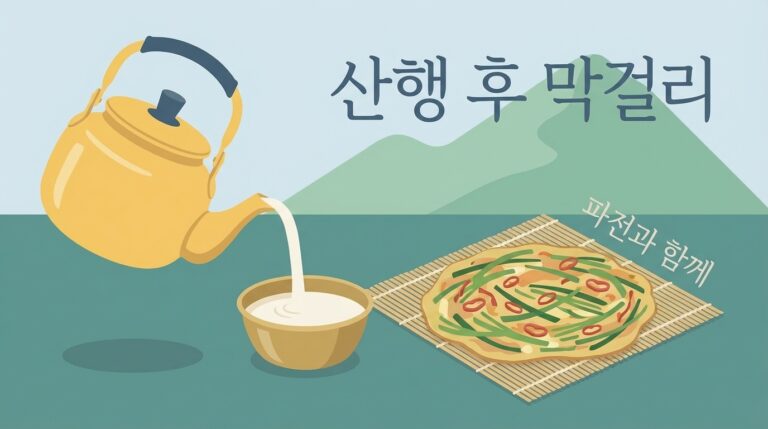
The Real Summit is Here: Pajeon, Makgeolli, and the Art of “Siwonhada”
Phase 1: The Immersive Hook
👋 안녕하세요! Hello from your Daily Hangul editor.
Picture this: You’ve just finished a grueling 4-hour hike up Bukhansan in Seoul. Your legs are trembling, you’re drenched in sweat, and you’re starving. You might think the highlight was the view from the peak, right?
Wrong.
In Korea, the real purpose of hiking often begins after you come down. Imagine walking into a bustling street at the foot of the mountain. You hear the loud sizzle of oil meeting batter—chijijik—resembling the sound of rain. You smell savory green onions and sesame oil.
In K-Dramas, have you seen the protagonist gulp down a bowl of cloudy white rice wine and shout, “Kyah, siwonhada!”?
Today, we’re not just learning how to order food. We’re learning the soul of Korean hiking culture: the “Twipuri” (뒷풀이 – After-party). Let’s get you ready to join the locals.
Phase 2: Deep Dive into Key Expressions
1. 시원하다 (Siwonhada)
- Pronunciation: [Si-won-ha-da] Sounds like “She-won-ha-da”
- Meaning:
- Literal: To be cool (temperature).
- Real Nuance: To be refreshing, relieving, or cathartic.
- K-Culture Moment: You’ll see this in every K-Drama sauna scene or when a dad drinks hot soup. It’s the feeling of tension leaving your body.
- Editor’s Insight: This is the most confusing word for beginners! If you drink ice-cold Makgeolli, it is siwonhada (cool). But if you eat hot, spicy tofu stew, it is also siwonhada (relieving). It’s about the feeling inside, not just the temperature.
- Situation Spectrum:
[🚫 Formal Speech] ———— [⚠️ Semi-Formal] ———— [✅ Casual]
(It’s an adjective, so use polite endings like “Siwonhaeyo” for ⚠️) - 🤔 Think About It: Why do Koreans express physical relief (like massage or hot soup) as “cool”? Does your language have a word that describes a physical sensation that doesn’t match the temperature?
2. 등산은 핑계고… (Deungsaneun pinggyego…)
- Pronunciation: [Deung-san-eun ping-gye-go]
- Meaning: Hiking is just an excuse (and…)
- K-Culture Moment: Used jokingly among friends when you order way too much food after a short walk. It admits the food was the real goal.
- Editor’s Insight: Use this to be witty! If someone asks, “Why did we hike if we are going to eat 2,000 calories now?” you drop this line.
- Situation Spectrum:
[🚫 Boss/Elders] ———— [⚠️ Close Colleagues] ———— [✅ Friends]
3. 짠! (Jjan!)
- Pronunciation: [Jjan!] High pitch, sharp sound
- Meaning: Cheers! / Clink!
- K-Culture Moment: The sound of glasses hitting each other. In K-Pop livestreams, idols often say “Jjan!” when showing something new or toasting with water.
- Editor’s Insight: “Geonbae” (건배) is the textbook word for cheers, but it sounds a bit formal or like a company dinner. Friends hiking? Always “Jjan!”
Phase 3: Textbook vs. Real Life
| Situation | 📖 Textbook Korean | 🗣️ Real Korean (Street Vibe) | 💡 Why the difference? |
|---|---|---|---|
| Suggesting a drink | 술 한잔 하실래요? (Would you like to have a drink?) | 막걸리 콜? (Makgeolli Call?) | “Call?” (from poker/English) is common slang for “I’m in/Let’s do it.” |
| Commenting on taste | 맛이 있습니다. (It is delicious.) | 미쳤다… (Crazy…) | Hyperbole is key in modern Korean slang. |
| Ordering | 파전 하나 주세요. (Please give me one Pajeon.) | 여기 파전 하나랑 막걸리요! (Here, Pajeon and Makgeolli!) | In busy places, efficiency wins. “Yeogi” gets attention fast. |
Bottom Note: If you are with your boss, stick to the Textbook column. If you are with friends or a friendly tutor, try the Real Korean column to make them laugh.
Phase 4: Cultural Deep Dive
4-1. Non-verbal: The Two-Hand Rule
Even after a sweaty hike, hierarchy exists. When pouring Makgeolli for someone older:
1. Hold the bottle with two hands. (Right hand pours, left hand supports the wrist/elbow).
2. Receive with two hands. If they pour for you, lift your cup with both hands.
Pro Tip: Turn your head slightly away when drinking if the person is much older or a senior boss. This is the ultimate sign of respect.
4-2. K-Food Connection: Why Pajeon & Makgeolli?
Why this specific combo?
* The Sound: Frying Pajeon sounds like rain. In Korea, when it rains, people say, “I crave Pajeon.” Since mountains often have unpredictable weather, this became the go-to meal.
* The Science: Makgeolli is rich in amino acids and protein (from rice/wheat), and Pajeon provides carbs and vitamins (green onions). It was historically the perfect energy recovery food for farmers—and now, hikers.
Phase 5: Immersive Roleplay
Setting: It’s 2:00 PM on a Saturday at the base of Cheonggyesan. The air is filled with the smell of sesame oil. You are sitting on a plastic stool at an outdoor table with Min-su (32, your Korean hiking buddy).
Min-su: 와, 사람 진짜 많다. 일단 앉자.
(Wa, saram jinjja manta. Ildan anja.)
Wow, so many people. Let’s sit first.
YOU: (Looking at the menu)
Min-su: 뭐 먹을래? 파전에 막걸리 어때?
(Mwo meogeullae? Pajeone makgeolli eottae?)
What do you want to eat? How about Pajeon and Makgeolli?
🔀 Your Turn! Choose your response:
- A) 좋아요! 등산 후에는 역시 막걸리죠. (Good! After hiking, it’s definitely Makgeolli.)
- B) 전 술 못 마셔요. 사이다 주세요. (I can’t drink alcohol. Cider please.)
- C) 콜! 제가 쏠게요. (Call! I’ll treat you.)
If you chose A: Classic and safe! You show you understand the culture.
If you chose C: (Best Choice for “Inssa”/Insider vibes) offering to pay (“Ssonda”) creates a warm bond (Jeong).
(Continuing with Choice A…)
Min-su: (Pours yellow aluminum kettle) 자, 받으세요.
(Ja, badeuseyo.)
Here, accept this (drink).
YOU: (Remembering the two-hand rule!) 감사합니다.
(Gamsahamnida.)
Min-su: 짠! 고생했어요.
(Jjan! Gosaeng-haesseoyo.)
Cheers! Good job today.
YOU: 짠! 캬~ __________!
(Jjan! Kya~ __________!)
Fill in the blank: What is the word for “refreshing” we learned?
Answer: 시원하다 (Siwonhada)
Phase 6: 10-Second Shadowing Drill
Practice this sentence to sound like a local after the first sip.
- Emotion: 😊 Pure Bliss / Relief (Close your eyes for effect!)
- Sentence: 와 / 진짜 / 시원하네요!
- Pronunciation: Wa / jinjja / si-won-ha-ne-yo!
- Meaning: Wow / seriously / it’s so refreshing!
Phase 7: K-Culture Mini Glossary
| Korean | Romanization | Meaning | Context |
|---|---|---|---|
| 안주 | Anju | Food for alcohol | Pajeon is the anju for Makgeolli. |
| 도토리묵 | Dotori-muk | Acorn Jelly Salad | The 2nd most popular hiking food. Very refreshing! |
| N빵 | N-bbang | Splitting the bill | “N” (variable number) + “Bbang” (splitting). |
| 낮술 | Nat-sul | Day drinking | Drinking while the sun is up. Common after hiking! |
Phase 8: Traveler’s Survival Kit
Hiking Food Spots (Mt. Bukhansan, Mt. Cheonggyesan, etc.)
🆘 Survival Phrases
1. “사장님, 여기 주문이요!” (Sajangnim, yeogi jumun-iyo!)
* Meaning: Boss, we’d like to order here!
* Tip: Raise your hand high. Don’t wait for eye contact; it’s busy!
2. “막걸리 흔들까요?” (Makgeolli heundeulkkayo?)
* Meaning: Should I shake the Makgeolli?
* Context: Makgeolli has sediment. Asking this shows you know the drink mechanics.
3. “반찬 좀 더 주세요.” (Banchan jom deo juseyo.)
* Meaning: Please give us more side dishes.
* Culture: Side dish refills are free and unlimited!📌 Editor’s Travel Note
Most hiking entrance restaurants look humble (plastic chairs, tents), but these are often the best culinary experiences. Don’t be afraid to walk in even if you don’t see an English menu. Just point at what other tables are eating and say “Igeo juseyo” (Give me this).
Phase 9: Think Deeper — “Why We Hike”
Topic: Food and Identity (Communal Eating)
Have you noticed that in Korea, hiking is rarely a solitary activity? It is almost always a group event ending in a shared meal. The pot of stew or the large Pajeon is placed in the center, and everyone picks from the same plate.
This reflects the Korean concept of “Uri” (Us/We). The hike itself is the struggle (building camaraderie), and the meal afterwards is the reward (solidifying the bond). In many Western cultures, hiking might be about individual achievement or solitude. In Korea, if you skip the meal, you missed 50% of the hike.
💬 Your Turn: In your country, do you usually eat together after exercising, or do you go home to shower immediately? Let me know in the comments!
Phase 10: FAQ & Troubleshooting
- Q: Can I pour my own drink?
- A: No! In Korean culture, pouring your own drink is seen as lonely or bad luck. Wait for someone to pour for you, and you pour for them. It’s a way of taking care of each other.
- Q: Is it okay to drink Makgeolli during the hike?
- A: Technically, drinking on the trail is now restricted in many national parks for safety. Save it for the bottom of the mountain!
- Q: I don’t like alcohol. What should I do?
- A: Just say “Jeoneun sul mot haeyo” (I can’t do alcohol). It’s perfectly fine to toast with water or Cider (Sprite). The act of clinking glasses is what matters, not the liquid.
Phase 11: Wrap-up
One-Liner: Hiking in Korea is 50% walking up and 50% eating Pajeon on the way down.
🚀 Action Missions:
* 🥉 Bronze: Say “Kyah, siwonhada!” next time you drink something cold (or hot soup).
* 🥈 Silver: Go to a Korean restaurant in your city and order Pajeon. Try eating it with chopsticks!
* 🥇 Gold: Hike a local hill/mountain, and when you finish, treat yourself to a savory pancake and post a photo with the caption: “Deungsaneun pinggyeya!” (Hiking is just an excuse!).
Phase 12: Quiz — Interactive Challenge
1. Situation Judgment:
Your boss pours you a glass of Makgeolli. How should you receive it?
* A) Hold the cup with one hand and look him in the eye.
* B) Hold the cup with two hands and look him in the eye.
* C) Hold the cup with two hands and turn your head slightly away when drinking.
2. True or False (K-Culture):
Koreans believe that Pajeon and Makgeolli taste best on a sunny, dry day.
* (True / False)
Answers:
1. C (Polite culture dictates two hands + turning away for elders/bosses.)
2. False (Rainy days are the traditional “Pajeon days” because the sound of rain resembles frying!)
Frequently Asked Questions (FAQ)
Q: What does "시원하다 (Siwonhada)" mean in Korean and how do you pronounce it?
A: In Korean, "시원하다 (Siwonhada)" is pronounced [Si-won-ha-da] and means: Literal: To be cool (temperature).
Q: What does "등산은 핑계고... (Deungsaneun pinggyego...)" mean in Korean and how do you pronounce it?
A: In Korean, "등산은 핑계고... (Deungsaneun pinggyego...)" is pronounced [Deung-san-eun ping-gye-go] and means: Hiking is just an excuse (and...)
Q: What does "짠! (Jjan!)" mean in Korean and how do you pronounce it?
A: In Korean, "짠! (Jjan!)" is pronounced [Jjan!] and means: Cheers! / Clink!







