

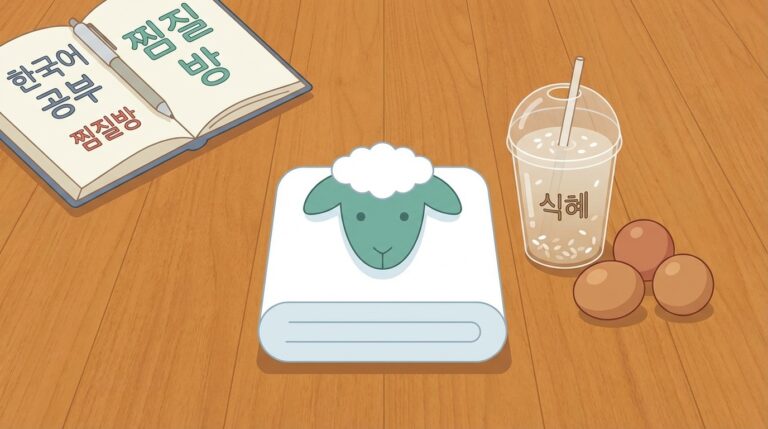
Phase 1: The Immersive Hook
Annyeonghaseyo! This is your Daily Hangul Editor. 👋
Picture this: You are watching your favorite K-Drama or a variety show like Running Man. The characters are sitting on a wooden floor, wearing matching t-shirts and shorts. But the most distinct feature? They have white towels folded on their heads looking like sheep ears, and they are cracking brown eggs on each other’s foreheads.
Welcome to the Jjimjilbang (찜질방)—the Korean dry sauna.
While Western saunas are often solitary or strictly for wellness, the Korean Jjimjilbang is a massive social hub. It’s a top-tier date spot for couples and a weekend getaway for families. Why? Because there is nothing more intimate than sweating it out together, looking slightly goofy in uniform pajamas, and sipping on sweet rice punch.
Today, we aren’t just learning words; we are learning how to survive and thrive in this unique Korean social playground. Let’s get your Korean level from “Tourist” to “Local Insider.”
Phase 2: Deep Dive into Core Expressions
Here are the three expressions that will make your Korean friends say, “Wow, how did you know that?”
1. 양머리 (Yangmeori)
- Pronunciation: [yang-meo-ri] + Sounds like ‘Young’ + ‘Muh’ (like mud) + ‘Ri’ (like read).
- Meaning: Literal: Sheep Head / Real: The towel art folded to look like sheep ears.
- K-Culture Moment: In the drama My Name is Kim Sam-soon or almost any romantic comedy, the couple inevitably ends up here. Putting a Yangmeori on your partner is a sign of affection (and a great photo op).
- Editor’s Insight: You don’t buy a Yangmeori; you make it. Knowing how to fold this towel instantly signals that you understand the culture. It’s the visual ticket to fitting in.
- Situation Spectrum:
[🚫 Formal Meeting] ———— [⚠️ With Boss] ———— [✅ Friends/Dates]- 🤔 Think About It: Why do you think adults in Korea are comfortable looking “cute” or silly in public spaces like this? How does this contrast with the serious atmosphere of a Korean workplace?
2. 몸 좀 지지다 (Mom jom jijida)
- Pronunciation: [mom jom ji-ji-da] + ‘Jiji’ sounds like the ‘Gi’ in Gigi Hadid.
- Meaning: Literal: To sear/fry one’s body a little. / Real: To relax in a hot place to relieve muscle pain.
- K-Culture Moment: You enter a room that is 60°C (140°F). An older Korean person lies down on the hot floor and sighs, “Eu, siwonhada!” (It’s refreshing!). That act of lying on the hot floor is jijida.
- Editor’s Insight: This is a B2+ level expression. Beginners say “It is hot” (뜨거워요). Locals say “I’m going to roast/sear my body” to imply therapeutic healing. Use this, and you sound like a native.
- Situation Spectrum:
[🚫 To a Stranger] ———— [⚠️ Politeness Level Check] ———— [✅ Family/Friends]- 🤔 Think About It: The verb jijida is also used when pan-frying Korean pancakes (Jeon). Why do Koreans metaphorically compare themselves to cooking food when relaxing?
3. 식혜 (Sikhye)
- Pronunciation: [si-kye] + Sounds like ‘Shi’ + ‘K-yeh’.
- Meaning: Traditional sweet rice beverage.
- K-Culture Moment: You cannot leave a Jjimjilbang without drinking this. It’s usually served in a large plastic bottle or cup with ice floating in it. It restores the sugar you lost while sweating.
- Editor’s Insight: It’s the unofficial “official” drink of the sauna. Asking for Coke or Sprite here is a rookie move.
- Situation Spectrum:
[✅ Anytime, Anywhere]
Phase 3: Textbook vs. Real Life
| Situation | 📖 Textbook Korean | 🗣️ Real Korean (In the Jjimjilbang) | 💡 Why the difference? |
|---|---|---|---|
| Suggesting to go | 찜질방에 갈까요? (Shall we go to the Jjimjilbang?) |
찜방 콜? (Jjimbang Call?) |
Jjimbang is the slang short form. “Call?” is used to ask “Are you in?” |
| Feeling Hot | 너무 뜨거워요. (It is too hot.) |
아, 시원하다~ (Ah, refreshing~) |
Koreans use “refreshing” to describe the relief of hot heat relaxing the muscles. It’s a cultural paradox! |
| Buying Snacks | 계란 주세요. (Give me eggs, please.) |
맥반석 있어요? (Do you have Maekbanseok?) |
Saunas don’t just sell regular boiled eggs; they sell Maekbanseok (stone-roasted) eggs which are brown and chewier. |
Bottom Note: When you say “Siwonhada” in a boiling hot room, expect older Koreans to look at you with proud approval.
Phase 4: Cultural Deep Dive
4-1. The Magic Key (Non-verbal Tip)
In a Jjimjilbang, your locker key (worn as a bracelet) is your credit card. You beep it to buy food, massages, or games.
* Warning: Since you aren’t opening a wallet, it’s easy to overspend. We call it the “Magic Key” because the bill magically explodes when you leave!
4-2. K-Drama Connection: The Head Crack 🥚
Have you seen variety shows where they play Rock-Paper-Scissors, and the winner gets to smash a hard-boiled egg on the loser’s head?
* Context: This is a classic Jjimjilbang trope.
* Critical View: While funny on TV, be careful doing this to someone you just started dating or an elder. It can hurt more than you think! The Maekbanseok eggs are harder than normal boiled eggs.
Phase 5: Immersive Roleplay Scenario
Setting: A large Jjimjilbang in Yongsan, Seoul. It’s a Saturday night date. You are wearing the orange sauna uniform.
Characters:
* YOU: Want to impress your date with your knowledge.
* MINJI (Date): Korean, loves saunas but hates extreme heat.
Dialogue:
YOU: (Looking at the different rooms) 와, 여기 진짜 넓다. 어디부터 갈까?
(Wa, yeogi jinjja neolda. Eodibuteo galkka?)
Wow, this place is huge. Where should we go first?
MINJI: 음… 소금방은 너무 뜨거울 것 같아. 아이스방은 어때?
(Eum… Sogeumbang-eun neomu ddeugeoul geot gata. Aiseubang-eun eoddAe?)
Hmm… The Salt Room seems too hot. How about the Ice Room?
🔀 Decision Point: How do you respond?
* A) 좋아! 아이스방 가자. (Okay! Let’s go to the Ice Room.)
* B) 에이, 찜질방은 땀을 빼야지! 불가마 도전? (Ay, Jjimjilbang is for sweating! Challenge the Bul-gama/Fire Oven?)
* C) 배고픈데 식혜랑 계란부터 먹자. (I’m hungry, let’s eat Sikhye and eggs first.)
✅ Best Choice: C
Why? Eating is 50% of the Jjimjilbang experience. It sets a relaxed mood before the extreme temperatures.
⚠️ Choice B Analysis: The “Bulgama” is often over 80°C. If your date hates heat, this might end the date early!
(Continuing from C)
YOU: 금강산도 식후경이라는데, 식혜랑 맥반석 계란 콜?
(Geumgangsando sikhugyeong-iraneunde, sikhye-rang maekbanseok gyeran call?)
They say even Mt. Geumgang should be seen after eating… Sikhye and roasted eggs, you in?
MINJI: (Laughing) 오~ 그 속담은 어떻게 알았어? 콜! 내가 머리에 깨 줄게!
(O~ geu sokdam-eun eoddoke arasseo? Call! Naega meori-e kkae julge!)
Oh~ how did you know that proverb? Deal! I’ll crack the egg on your head!
Phase 6: 10-Second Shadowing Drill
Let’s practice the “Old Man” satisfaction sound. Try to sound relieved, not pained!
😊 Relaxed & Happy:
아~ / 뜨끈하다! / 몸이 / 확 / 풀리네.
(Ah~ / ddeukkeunhada! / momi / hwak / pulline.)
Ah~ / It’s nice and warm! / My body / totally / relaxes.
Phase 7: K-Culture Mini Glossary
| Korean | Romanization | Meaning | Context |
|---|---|---|---|
| 한증막 | Hanjeungmak | Traditional Kiln Sauna | The very hot, dome-shaped stone saunas. Intense heat! |
| 맥반석 계란 | Maekbanseok Gyeran | Stone-roasted Egg | Brown shell, nutty flavor. The quintessential sauna snack. |
| 안마 의자 | Anma Uija | Massage Chair | You’ll see rows of these. Usually costs 2,000-3,000 KRW for 20 mins. |
| 이모 | Imo | Auntie | How you call the staff working at the snack bar (Snack Corner). |
Phase 8: Traveler’s Survival Kit
Going to a Jjimjilbang for the first time? Don’t panic.
🆘 Survival Expression #1
* 🇰🇷 “락커 키로 결제할게요.” (Rak-keo ki-ro gyeol-je-hal-ge-yo)
* 🗣️ Sounds like: Locker Key-ro gyul-jeh-hal-ge-yo.
* Meaning: “I will pay with my locker key.”
* Use: At the snack bar or restaurant inside.📌 Editor’s Travel Note: The Nudity Shock
* The Split: The actual bathing area (Sauna) is gender-segregated and you must be fully naked. No swimsuits allowed.
* The Meeting Point: After bathing, you put on the provided pajamas (shorts/t-shirt) and meet your friends/date in the communal area (Jjimjilbang). This area is mixed-gender.
* Pro Tip: Always shower before entering the tubs. It’s super rude to enter the water dry!
Phase 9: Think Deeper — “Skinship & Jeong”
Why is getting naked (or semi-naked in pajamas) considered a bonding experience in Korea?
In Korean culture, there is a concept called “Mogyok Tang” (Bathhouse) friendship. Stripping away your clothes symbolizes stripping away your social status, rank, and pretenses. Whether you are a CEO or a student, everyone looks the same in a towel or sauna pajamas. This vulnerability fosters Jeong (deep emotional connection/attachment).
💬 Your Turn: Does your culture have a similar communal bathing culture, or is bathing strictly private? How do you build intimacy without words in your country?
Phase 10: FAQ & Troubleshooting
Q: Can I go to a Jjimjilbang with a tattoo?
A: Generally, yes. In the past, it was associated with gangs, but nowadays small fashion tattoos are common. However, if you have full-body tattoos, you might get some stares in the bathing area, though you likely won’t be kicked out.
Q: Can we hold hands or kiss in the common area?
A: ⚠️ Be careful. Holding hands or resting a head on a shoulder is fine. But excessive PDA (kissing, making out) is considered very rude (Min-pye) because families with children are around. Keep it PG!
❌ Common Mistake: Wearing the sauna pajamas into the wet bath area.
✅ Fix:
1. Entrance -> 2. Shoe Locker -> 3. Gender Locker Room (Get Naked) -> 4. Shower -> 5. Bath -> 6. Dry Off -> 7. Put on Pajamas -> 8. Go to Common Area (Jjimjilbang).
Phase 11: Wrap-up & Mission
One-Liner Summary: A Jjimjilbang date is about casual intimacy—wear the Yangmeori, drink Sikhye, and say “Siwonhada” even when it’s hot!
🎯 Action Mission:
* 🥉 Bronze: Search “How to fold Yangmeori” on YouTube and try it with a towel at home.
* 🥈 Silver: Go to a Korean grocery store (or Amazon) and buy “Sikhye.” Taste it!
* 🥇 Gold: Visit a Korean Spa in your city (or in Korea) and order eggs and Sikhye using the phrase: “Imo, gyeran hago sikhye juseyo!”
K-Culture Mission: Watch an episode of the drama Reply 1988 or Legend of the Blue Sea to spot the sauna scenes. How do they act differently than in Western shows?
See you in the hot room! 🔥
Frequently Asked Questions (FAQ)
Q: What does "양머리 (Yangmeori)" mean in Korean and how do you pronounce it?
A: In Korean, "양머리 (Yangmeori)" is pronounced [yang-meo-ri] and means: Literal: Sheep Head / Real: The towel art folded to look like sheep ears.
Q: What does "몸 좀 지지다 (Mom jom jijida)" mean in Korean and how do you pronounce it?
A: In Korean, "몸 좀 지지다 (Mom jom jijida)" is pronounced [mom jom ji-ji-da] and means: Literal: To sear/fry one's body a little. / Real: To relax in a hot place to relieve muscle pain.
Q: What does "식혜 (Sikhye)" mean in Korean and how do you pronounce it?
A: In Korean, "식혜 (Sikhye)" is pronounced [si-kye] and means: Traditional sweet rice beverage.







