

Seoul’s Skyline: Reading the City Between the Lines
Phase 1: Immersive Hook
안녕하세요! This is your Daily Hangul Editor.
Picture this: You are watching a hit K-Drama like Penthouse or Itaewon Class. The camera pans over the glittering Han River at night, zooming in on a character standing on a rooftop, looking down at the sprawling city of Seoul. In K-Dramas, this scene is never just about the view. It represents ambition, success, or sometimes, profound loneliness.
When you visit a landmark like the Lotte World Tower or walk through the regenerated streets of Seongsu-dong, do you just say, “Wow, it’s tall”?
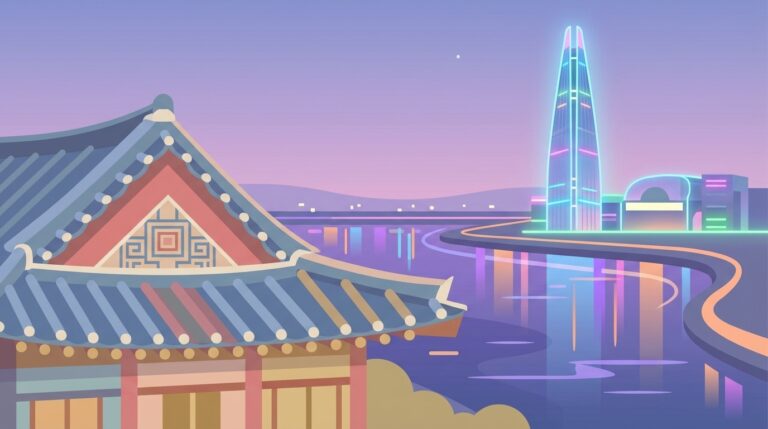
At the C1 level, your Korean needs to match the complexity of Seoul’s architecture—a city where 600-year-old palaces reflect on the glass walls of 123-story skyscrapers. Today, we aren’t just learning words; we are learning how to read the city’s context. Let’s upgrade your vocabulary from “tourist” to “urban connoisseur.”
Phase 2: Deep Dive into Key Expressions
Here are three advanced expressions to describe architecture and urban change that will make Koreans ask, “How long have you lived here?”
1. 상전벽해 (Sangjeonbyeokhae)
- Pronunciation: [Sang-jeon-byeok-hae] + Sounds like ‘Sang-jeon-byuck-heh’
- Meaning: Literally “Mulberry fields turn into a blue sea.” It describes a complete, unrecognizable transformation of a place.
- K-Culture Moment: You are standing in Gangnam or Jamsil. An elderly Korean taxi driver points out the window and says, “Forty years ago, this was all pear orchards.” That is the definition of Sangjeonbyeokhae.
- Editor’s Insight: This is a Sajeoseong-eo (four-character idiom). Using this elevates your speech instantly. It captures the essence of the “Miracle on the Han River.”
- Situation Spectrum:
[🚫 Casual Slang] ———— [✅ Intellectual/Descriptive] ———— [✅ Formal]- 🤔 Think About It: Why does Korean have so many idioms about rapid change? How does the speed of Korea’s modern history influence the language?
2. 압도적이다 (Apdoseok-ida)
- Pronunciation: [Ap-do-jeok-i-da] + The ‘p’ is unreleased, like stopping your breath.
- Meaning: To be overwhelming; magnificent; dominant.
- K-Culture Moment: Standing at the base of Lotte World Tower (555m tall) and looking straight up until your neck hurts. Or seeing a K-Pop fandom’s “ocean” of lightsticks.
- Editor’s Insight: It’s not just “big” (크다). It implies a force or scale that makes you feel small or humbled.
- Situation Spectrum:
[✅ Friends] ———— [✅ Colleagues] ———— [✅ Formal Presentations]3. 신구의 조화 (Singu-ui Johwa)
- Pronunciation: [Sin-gu-ui Jo-hwa] + ‘Sin’ (New), ‘Gu’ (Old).
- Meaning: Harmony of the new and the old.
- K-Culture Moment: Architecture documentaries or travel vlogs visiting Bukchon Hanok Village where traditional roofs meet modern coffee shops.
- Editor’s Insight: This is a key phrase in “Urban Regeneration” (도시 재생). It’s a compliment used for places that modernized without destroying history.
- Situation Spectrum:
[⚠️ Casual Chat] ———— [✅ Discussion/Review] ———— [✅ Professional]
Phase 3: Textbook vs. Real Life
| Situation | 📖 Textbook Korean | 🗣️ Real Korean (C1 Level) | 💡 Why the difference? |
|---|---|---|---|
| Seeing a nice view | 경치가 좋아요. (The scenery is good.) | 탁 트인 전망이 일품이네요. (The panoramic view is a masterpiece.) | ‘일품’ (First class) adds sophistication and appreciation of quality. |
| Describing a hot place | 여기가 유명해요. (This place is famous.) | 여기가 요즘 뜨는 핫플이에요. (This is the rising ‘hot place’ these days.) | ‘핫플’ (Hot place) is the standard slang for trendy spots, even in news. |
| Looking at a tall building | 건물이 정말 높아요. (The building is really tall.) | 마천루가 즐비하네요. (The skyscrapers are lined up/plentiful.) | ‘마천루’ is a literary term for skyscrapers, used in intellectual observation. |
Bottom Note: At the C1 level, avoid simple adjectives like ‘좋다’ or ‘크다’. Use specific descriptors like ‘웅장하다’ (grand) or ‘아늑하다’ (cozy/intimate).
Phase 4: Cultural Deep Dive
4-1. The “Apartment Republic” (아파트 공화국)
In many Western countries, the wealthy often live in suburban mansions. In Korea, the higher you go, the more expensive it gets. The “Royal Floor” (로얄층) in a high-rise apartment complex is a symbol of status. When talking about buildings, Koreans often discuss “조망권” (Right to a view). A view of the Han River can add millions of dollars to a property’s value.
4-2. Urban Regeneration (도시 재생) & Cafe Culture
Instead of tearing down old buildings, the trend in areas like Seongsu-dong or Euljiro is Urban Regeneration. Old shoe factories or printing presses are converted into brutalist-style cafes and galleries.
- K-Drama Trope: The protagonist runs a small, aesthetic workshop in a renovated brick building, contrasting with the antagonist who works in a cold, glass skyscraper.
Phase 5: Immersive Roleplay
Scenario: It is Friday night. You are at a rooftop bar in Seongsu-dong. You are with Min-ji (30, Architect, sophisticated and passionate about design). The view shows the contrast between the old factory district and the sleek skyscrapers of Gangnam across the river.
Min-ji: (Sipping wine) 와, 여기서 보니까 서울이 진짜 다이나믹하지 않아? 저기 롯데타워 보이는 것 좀 봐.
(Wa, yeogiseo bonikka Seouri jinjja dainamik-haji ana? Jeogi Lotte Tower boineun geot jom bwa.)
(Wow, seeing it from here, isn’t Seoul truly dynamic? Look at Lotte Tower over there.)
🔀 YOUR TURN! How do you respond to match her intellectual vibe?
- Option A: 응, 건물이 진짜 높아. 야경이 예쁘네. (Standard & Safe)
- Option B: 진짜 상전벽해다. 옛날 공장지대랑 마천루가 같이 보이니까 묘한데? (Intellectual & Insightful)
- Option C: 뷰 맛집이네! 사진 찍자. (Trendy & Casual)
You (Choosing B): 진짜 상전벽해다. 옛날 공장지대랑 마천루가 같이 보이니까 기분이 묘한데?
(Jinjja sangjeonbyeokhae-da. Yennal gongjang-jidae-rang macheollu-ga gachi boinikka gibuni myohande?)
(It’s truly a complete transformation. Seeing the old factory district and skyscrapers together feels strange/intriguing.)
Min-ji: (Eyes widening) 대박. ‘상전벽해’라는 말도 알아? 맞아, 그게 바로 서울의 매력이지. 신구의 조화가 있잖아.
(Daebak. ‘Sangjeonbyeokhae’-raneun mal-do ara? Maja, geuge baro Seoul-ui maeryeogi-ji. Singu-ui johwa-ga itjana.)
(Wow. You know the word ‘Sangjeonbyeokhae’? Exactly, that’s the charm of Seoul. It has the harmony of the new and old.)
Phase 6: 10-Second Shadowing Drill
Practice this sentence to use when looking at a breathtaking cityscape.
Sentence: “서울의 스카이라인은 / 과거와 현재가 / 공존하는 느낌이라 / 압도적이네요.”
Romanization: Seoul-ui seukairain-eun / gwageowa hyeonjaega / gongjonhaneun neukkimi-ra / apdojeogi-neyo.
Meaning: “Seoul’s skyline feels like the past and present coexist, so it’s overwhelming/magnificent.”
Emotion: 🧐 Intellectual & Impressed (Speak slowly, emphasizing ‘gongjon’ and ‘apdojeok’.)
Phase 7: K-Culture Glossary (Architecture Edition)
| Korean | Romanization | Meaning | Context |
|---|---|---|---|
| 마천루 | Macheollu | Skyscraper | A literary/formal word for very tall buildings. |
| 도시 재생 | Dosi Jaesaeng | Urban Regeneration | Turning old areas into trendy spots (e.g., Seongsu, Euljiro). |
| 조망권 | Jomang-gwon | Right of View | Legal/Real estate term regarding the right to a view (usually Han River). |
| 핫플레이스 (핫플) | Hot Place (Hat-peul) | Trendy Spot | The most popular, Instagrammable locations. |
| 랜드마크 | Raendeu-makeu | Landmark | Used exactly as in English. |
Phase 8: Traveler’s Survival Kit (Landmark Edition)
If you are visiting N Seoul Tower or Lotte World Tower, keep these in your pocket.
🆘 Survival Expressions
1. “창가 쪽 자리 있나요?” (Chang-ga jjok jari innayo?) – Do you have a seat by the window?
* Essential for cafes/restaurants in high-rise buildings.
2. “야경이 제일 잘 보이는 곳이 어디예요?” (Yagyeong-i jeil jal boineun gosi eodiyeyo?) – Where is the best spot to see the night view?
3. “입장 마감 시간이 언제인가요?” (Ipjang magam sigani eonje-ingayo?) – When is the last admission time?📌 Editor’s Travel Note:
Most observation decks (전망대) require reservations or have long lines on weekends. Use idioms like “인산인해” (In-san-in-hae – People mountain, people sea) if it’s crowded to complain like a local!
Phase 9: Think Deeper — “Concrete Jungle or Home?”
Think Deeper: The Speed of Change
In Seoul, a building built 30 years ago is often considered “old” and ready for reconstruction (재건축). This is vastly different from Europe, where centuries-old buildings are the norm. The word ‘상전벽해’ isn’t just an idiom; it’s the reality of Korean life. This rapid development brought economic success but also gentrification (젠트리피케이션), pushing original residents out of neighborhoods like Seochon or Seongsu.
💬 Your Turn: Does your country prefer preserving old buildings or building new, efficient skyscrapers? How does that affect the “feeling” of your cities?
Phase 10: FAQ & Troubleshooting
- Q: Can I use “아파트” (Apartment) to describe any flat/condo?
- A: In Korea, “아파트” specifically refers to large apartment complexes (usually branded). Smaller, lower buildings are often called “빌라” (Villa) or “오피스텔” (Officetel). Calling a Villa an Apartment might confuse a taxi driver.
- Q: Is it rude to take photos of buildings?
- A: Generally no, but be careful in residential areas (like Bukchon Hanok Village). Residents are sensitive to noise and privacy violations. Look for “정숙” (Quiet) signs.
- ❌ Common Mistake: Saying “High building” as “키가 큰 건물” (Tall height building).
- ✅ Correction: Buildings are “높다” (high), not “키가 크다” (tall in stature/height). “키” is for living things.
Phase 11: Wrap-up & Action Items
One-Liner: To sound like a C1 speaker, describe the city not just by its size, but by its history and atmosphere using words like 상전벽해 and 압도적.
🚀 Action Missions:
* 🥉 Bronze: Look out your window and describe the view using “탁 트인” or “답답한” (stuffy/blocked) aloud.
* 🥈 Silver: Search for “Seoul Night View” (서울 야경) on Instagram and comment: “서울의 야경은 정말 압도적이네요!” (Seoul’s night view is truly overwhelming!)
* 🥇 Gold: Visit a high place in your city (or Seoul) and tell a friend (or yourself): “Use the shadowing sentence from Phase 6.”
K-Culture Mission: Watch an episode of a drama set in a penthouse (like Penthouse or Sky Castle) and notice how the characters treat the “view” as power.
Phase 12: Quiz — Interactive Challenge
1. Situation Judgment:
You are at a historic palace surrounded by modern skyscrapers. Which expression best captures this scene?
* A) 건물이 아주 많네요. (There are many buildings.)
* B) 신구의 조화가 절묘하네요. (The harmony of new and old is exquisite.)
* C) 집값이 비싸 보이네요. (The house prices look expensive.)
Answer: B. While C might be true (!), B is the culturally appreciative and sophisticated C1 expression.
2. True or False:
“In Korea, ‘Villa’ (빌라) usually refers to a luxury vacation house.”
Answer: False. In Korea, a ‘Villa’ is typically a low-rise, multi-household residential building, often less expensive than a branded ‘Apartment’ complex.
Frequently Asked Questions (FAQ)
Q: What does "상전벽해 (Sangjeonbyeokhae)" mean in Korean and how do you pronounce it?
A: In Korean, "상전벽해 (Sangjeonbyeokhae)" is pronounced [Sang-jeon-byeok-hae] and means: Literally "Mulberry fields turn into a blue sea." It describes a complete, unrecognizable transformation of a place.
Q: What does "압도적이다 (Apdoseok-ida)" mean in Korean and how do you pronounce it?
A: In Korean, "압도적이다 (Apdoseok-ida)" is pronounced [Ap-do-jeok-i-da] and means: To be overwhelming; magnificent; dominant.
Q: What does "신구의 조화 (Singu-ui Johwa)" mean in Korean and how do you pronounce it?
A: In Korean, "신구의 조화 (Singu-ui Johwa)" is pronounced [Sin-gu-ui Jo-hwa] and means: Harmony of the new and the old.







