

👋 Phase 1: Welcome to the Real Korea
Greeting: Hello! I’m your Daily Hangul Editor, your local guide to surviving and thriving in Korea.
Picture this: You’ve just walked into a bustling K-BBQ restaurant in Hongdae. The air smells like delicious grilled pork belly (Samgyeopsal), K-Pop is blasting from the speakers, and the energy is chaotic. You sit down, but… there’s no menu on the table.
In Western countries, a waiter usually approaches you immediately. But here? The staff is running around with scissors and tongs, ignoring you. You feel invisible.
The ‘K-Drama Moment’: You’ve seen it in dramas—the main character confidently raises their hand and shouts something cool to get attention. But if you sit there waiting silently like a well-mannered Western diner, you might starve!
Today, we are going to learn how to break the silence, get that menu, and start your K-Food journey like a pro. This isn’t just about words; it’s about confidence.
🔍 Phase 2: Deep Dive (Core Expressions)
Here are the 3 essential tools you need to get the staff’s attention and the menu.
1. 여기요 / 저기요 (Yeogiyo / Jeogiyo)
- Pronunciation: [Yeo-gi-yo] / [Jeo-gi-yo]
- Sound Analogy: Yeo sounds like “Yuh” in “Yuck”, Gi like “Key”, Yo like “Yo-yo”.
- Meaning: “Over here!” / “Excuse me!”
- K-Culture Moment: In a noisy fried chicken place, you’ll hear “Yeogiyo!” shouting from every table. It’s the magic spell to summon staff.
- Editor’s Insight: Use Yeogiyo (Here please) when you want them to come to you. Use Jeogiyo (Excuse me/Hey there) when you are trying to catch someone’s attention from afar, but it can sound slightly more distant. Yeogiyo is your best bet in a restaurant.
- Situation Spectrum:
[🚫 Formal Biz Meeting] ———— [⚠️ Quiet Cafe] ———— [✅ Loud Restaurant]- 🤔 Think About It: In many Western cultures, shouting for a waiter is rude. In Korea, not calling them is confusing. Why do you think Korean service relies on the customer initiating the interaction?
2. 메뉴판 좀 주세요 (Menyupan jom juseyo)
- Pronunciation: [Me-nyu-pan jom ju-se-yo]
- Meaning: Please give me the menu.
- Breakdown: Menyupan (Menu board) + Jom (A little/Please – softens the request) + Juseyo (Please give).
- K-Culture Moment: This is the standard phrase used by everyone from college students to grandmothers.
- Editor’s Insight: The word ‘Jom’ is magic. It literally means “a little,” but in requests, it acts like a polite lubricant. Without it, you sound a bit demanding (like a robot).
- Situation Spectrum:
[✅ Casual] ———— [✅ Polite] ———— [✅ Formal]3. 사장님! (Sajang-nim!)
- Pronunciation: [Sa-jang-nim]
- Meaning: Boss! / CEO!
- K-Culture Moment: You enter a small Gimbap shop. The lady cooking is clearly the owner. You don’t say “Excuse me,” you say “Boss!” (Sajangnim). It shows respect.
- Editor’s Insight: Even if the person isn’t actually the owner, calling them Sajangnim is a huge compliment. It makes them feel good. Flattery gets you better service (and maybe extra side dishes)!
- Situation Spectrum:
[🚫 Fancy Hotel] ———— [⚠️ Franchise Staff] ———— [✅ Local Restaurant]
🆚 Phase 3: Textbook vs. Real Life
| Situation | 📖 Textbook Korean | 🗣️ Real Korean | 💡 Why is it different? |
|---|---|---|---|
| Calling a waiter | 종업원 분? (Employee?) | 여기요! (Over here!) or 사장님! (Boss!) | “Employee” sounds too clinical. Koreans prefer relational terms. |
| Asking for menu | 메뉴판을 주시겠습니까? (Would you give me…?) | 메뉴판 좀요~ (Menu, please~) | In busy restaurants, speed is key. Short & sweet is better. |
| Missing menu | 메뉴가 없습니다. (There is no menu.) | 여기 메뉴판이 없어요. (Menu board isn’t here.) | “Menu-pan” refers to the physical book/board. |
Bottom Note: As an A2 learner, stick to “Menyupan jom juseyo”. It’s polite, clear, and works 100% of the time. “Menyupan jomyo” is for when you get more comfortable!
🎭 Phase 4: Cultural Deep Dive
4-1. The “Ding Dong” Button (The Introvert’s Savior)
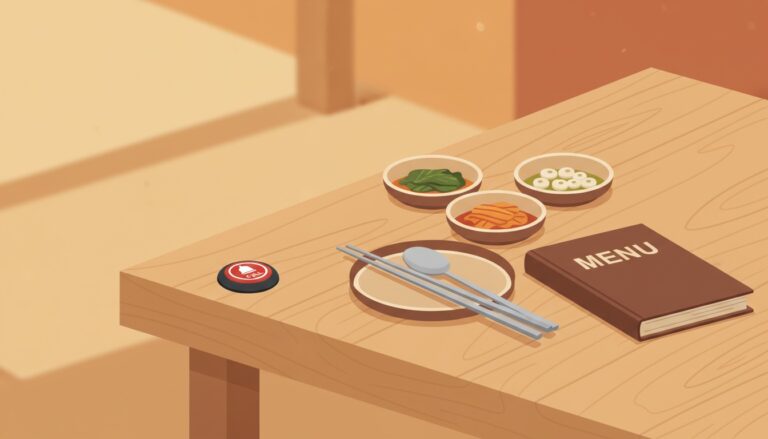
Before you shout “Yeogiyo!”, look at your table. Do you see a small button?
* The Bell: In about 80% of Korean casual restaurants, there is a call button (ho-chul bel).
* The Rule: If there is a button, press it. Don’t shout. When you press it, it goes Ding-Dong and your table number lights up on the wall. The server will come running.
* Nunchi (Eye Measure): If there is no button, you must use your voice. Raise your hand slightly, make eye contact, and say “Yeogiyo!”
4-2. K-Drama Connection: The “Imo-nim” (Auntie)
In dramas, you often hear characters shout “Imo!” (Auntie) at restaurants.
* Can you use it? Yes, BUT be careful. It’s best used in old-school, homely places where the server is an older lady who looks friendly.
* Critical View: If the server is young or male, never use Imo. Stick to Yeogiyo or Sajangnim. Calling a young part-time worker “Auntie” might offend them!
🎬 Phase 5: Immersive Roleplay
Setting: It’s Friday night in a crowded Dakgalbi (Spicy Chicken Stir-fry) restaurant in Myeongdong. It’s loud. You are hungry. There is no button on the table.
Characters:
* YOU: Hungry traveler, A2 Korean level.
* Server: A busy young man running between tables.
(The Scene: You sit down. 5 minutes pass. No one comes.)
YOU: (You realize you need to act. You raise your hand.)
YOU: 저기요! (Jeogiyo!)
(English: Excuse me!)
Server: (Doesn’t hear you because of the loud K-Pop music.)
🔀 Decision Point! What do you do?
A) Wait another 10 minutes silently. (Passive)
B) Shout louder: “YEOGIYO!” (Assertive)
C) Walk into the kitchen to find him. (Aggressive)✅ Best Choice: B. In Korea, being loud in a restaurant isn’t rude; it’s necessary communication.
(You try again, louder and with confidence.)
YOU: 여기요!! (YEOGIYO!!)
Server: (Turns around immediately) 네! 갈게요! (Ne! Gal-ge-yo!)
(English: Yes! I’m coming!)
(Server arrives at your table)
YOU: 안녕하세요. 메뉴판 좀 주세요. (Annyeonghaseyo. Menyupan jom juseyo.)
(English: Hello. Please give me the menu.)
Server: 아, 죄송합니다. 여기 있습니다. (Ah, sorry. Here it is.)
🗣️ Phase 6: 10-Second Shadowing Drill
Practice these until they feel natural. Pay attention to the emotion tags!
- To get attention (Loud & Clear):
😤 여기요! / 메뉴판 좀 / 주세요!
(Yeogiyo! / menyupan jom / juseyo!) -
Polite request (Softly):
😊 저기요~ / 메뉴판이 / 없어요.
(Jeogiyo~ / menyupani / eopseoyo.)
(Meaning: Excuse me, there is no menu here.)
📚 Phase 7: K-Culture Mini Glossary
| Korean | Romanization | Meaning | Context |
|---|---|---|---|
| 메뉴판 | Menyu-pan | Menu Board | ‘Pan’ means board/plate. Koreans differentiate ‘Menu’ (food list) and ‘Menu-pan’ (the physical object). |
| 벨 | Bel | Bell/Button | The call button on the table. The greatest invention for introverts. |
| 사장님 | Sajang-nim | Boss | Universal title for shop owners or older staff to show respect. |
| 이모님 | Imo-nim | Auntie | Friendly term for older female servers in casual diners (use with caution). |
🎒 Phase 8: Traveler’s Survival Kit
Essential phrases for when you finally get that menu but can’t read it!
🆘 Survival Phrases
1. 🇰🇷 “영어 메뉴 있어요?” (Yeong-eo menyu isseoyo?)
– Meaning: Do you have an English menu?
2. 🇰🇷 “사진 메뉴 있어요?” (Sajin menyu isseoyo?)
– Meaning: Do you have a picture menu?
3. 🇰🇷 “이거 주세요.” (Igeo juseyo.)
– Meaning: Please give me this. (Point at the picture!)📌 Editor’s Pro Tip:
If there is no English menu, download Naver Papago or Google Translate. Use the Image Translate function. It’s a lifesaver in local restaurants that only have Korean wall menus!
🧠 Phase 9: Think Deeper — “Family Everywhere”
Language & Relationship:
Have you noticed the terms we use? Imo (Aunt), Eonni (Older Sister), Samchon (Uncle). Korean culture tries to turn strangers into family. By calling a server “Auntie” or “Boss,” you are establishing a human connection (Jeong, 정) rather than just a transaction between a customer and a worker.
💬 Your Turn: In your country, how do you address a server? Is it strictly professional (“Excuse me”, “Sir/Ma’am”), or is it friendly (“Mate”, “Buddy”)? Think about what that says about your culture’s view on service.
🛠️ Phase 10: FAQ & Troubleshooting
- Q: Can I just raise my hand without saying anything?
- A: You can, but in a busy place, you might be ignored. The combination of Hand + “Yeogiyo” is the golden combo.
- Q: Is it rude to shout across the room?
- A: In a fine dining restaurant or a quiet cafe? Yes, walk to the counter. In a BBQ place, pub, or casual eatery? No! It’s expected. If you whisper, you won’t eat.
- ❌ Common Mistake: Snapping your fingers.
- Warning: NEVER snap your fingers at a Korean server. This is considered extremely rude, like calling a dog. Always use your voice or the bell.
🎁 Phase 11: Wrap-up & Mission
Summary: To get a menu, check for a Bell first. If no bell, raise your hand and confidently say “Yeogiyo! Menu-pan jom juseyo.”
🚀 Action Mission:
* 🥉 Bronze: Look at a photo of a Korean restaurant interior (Google “Korean BBQ restaurant interior”). Try to spot the Call Button on the tables.
* 🥈 Silver: Practice saying “Yeogiyo!” loudly in your room. Imagine the noise of the restaurant. Don’t whisper!
* 🥇 Gold: Go to a Korean restaurant in your city. Try asking for the menu in Korean. If they are busy, try the “Yeogiyo!” shout.
K-Culture Mission: Watch a scene from a K-Drama where they are drinking Soju. Watch how they call the server to order more bottles. Do they say “Excuse me” or “Yeogiyo/Sajangnim”?
🧩 Phase 12: Interactive Quiz
- Situation: You are in a very quiet, fancy cafe. You need a menu. What do you do?
- A) Shout “YEOGIYO!” at the top of your lungs.
- B) Walk to the counter or quietly signal the staff.
- C) Snap your fingers.
- True or False?
- “Sajangnim” means “Employee.”
- Fill in the blank:
- “_______ jom juseyo.” (Please give me the menu board.)
Answers:
1. B (Context matters! Shouting is for loud/casual places.)
2. False (It means Boss/Owner.)
3. Menyupan (Menu board)
Frequently Asked Questions (FAQ)
Q: What does "여기요 / 저기요 (Yeogiyo / Jeogiyo)" mean in Korean and how do you pronounce it?
A: In Korean, "여기요 / 저기요 (Yeogiyo / Jeogiyo)" is pronounced [Yeo-gi-yo] and means: "Over here!" / "Excuse me!"
Q: What does "메뉴판 좀 주세요 (Menyupan jom juseyo)" mean in Korean and how do you pronounce it?
A: In Korean, "메뉴판 좀 주세요 (Menyupan jom juseyo)" is pronounced [Me-nyu-pan jom ju-se-yo] and means: Please give me the menu.
Q: What does "사장님! (Sajang-nim!)" mean in Korean and how do you pronounce it?
A: In Korean, "사장님! (Sajang-nim!)" is pronounced [Sa-jang-nim] and means: Boss! / CEO!







