

Phase 1: The ‘Wait, How Much?’ Moment 🤯
Greeting: Hello! It’s your Daily Hangul editor here. 👋
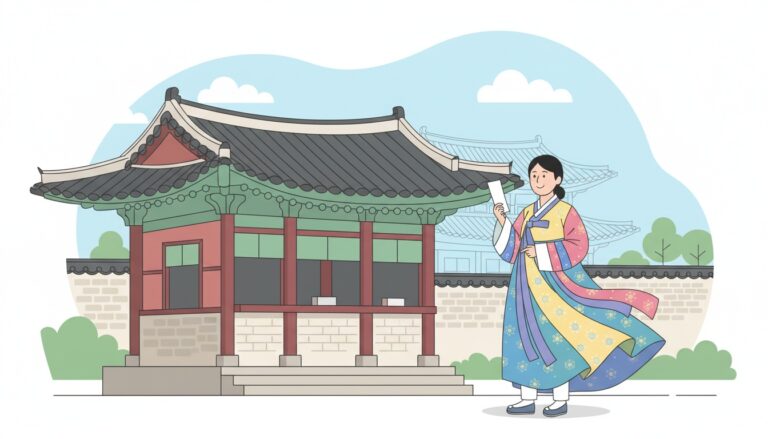
The Scene: Imagine this. You’ve finally arrived at Gyeongbokgung Palace. You’re wearing a beautiful Hanbok (traditional Korean dress) because you saw it in a K-Drama and wanted that main character moment. You walk up to the ticket booth. The line is long, people are moving fast. The clerk looks at you, waiting.
Suddenly, your mind goes blank. You see the numbers on the board, but how do you say, “Two adults, please” or “How much is the ticket?”
In Korea, hesitation at the ticket line causes a “traffic jam” of impatient stares! 😅 Don’t worry. Today, I’ll give you the magic keys to breeze through any ticket booth—whether it’s a palace, a K-Pop museum, or Lotte World.
Phase 2: Deep Dive — Key Expressions 🗣️
Here are the 3 phrases that will save your life at the ticket counter.
1. 입장료 얼마예요? (How much is the entrance fee?)
- Pronunciation: [Ip-jang-nyo eol-ma-ye-yo?]
- Sound Analogy: Ip (like ‘hip’ without h) + Jang (like ‘Django’) + Nyo (sounds like ‘New’ with a Y) + Eol-ma-ye-yo.
- Meaning: “How much is the admission fee?”
- K-Culture Moment: You’ll hear this word 입장 (Ipjang) a lot at K-Pop concerts when fans are waiting to enter the venue. “입장 시작합니다!” (Entrance is starting!)
- Editor’s Insight: Notice the pronunciation change? We write it as
ryobut pronounce it asnyo. It flows smoother!- Situation Spectrum:
[🚫 Formal Boss] ———— [✅ Ticket Booth/Shop] ———— [✅ Friend]- 🤔 Think About It: Why do you think Korean has a specific word for “Entrance Fee” (Ipjangnyo) rather than just saying “How much is it?” It shows specificity, which is valued in service interactions.
2. 어른 두 명 주세요. (Two adults, please.)
- Pronunciation: [Eo-reun du myeong ju-se-yo]
- Sound Analogy: Eo-reun (sounds like ‘Run’ with an ‘Uh’ in front) + Du (Do) + Myeong (Myung).
- Meaning: Literal: “Adult two people give please.” -> Real: “Two tickets for adults, please.”
- Grammar Note: 명 (Myeong) is the counter for people. You cannot use it for things (like apples or tickets). It acknowledges the humanity of the person entering.
- Editor’s Insight: If you are with a child, say “아이 (Ai)” for child.
- Situation Spectrum:
[🚫 Rude] ———— [⚠️ Standard] ———— [✅ Polite]3. 할인 돼요? (Is there a discount?)
- Pronunciation: [Ha-rin dwae-yo?]
- Sound Analogy: Ha (Ha-ha) + Rin (Ring without g) + Dwae (Day with a w) + Yo.
- Meaning: “Is a discount possible?” / “Can I get a discount?”
- K-Travel Tip: This is the most profitable phrase you will learn! Many places give discounts for foreigners, students, or credit card partnerships.
- Situation Spectrum:
[🚫 Formal Meeting] ———— [✅ Shops/Attractions] ———— [✅ Casual]
Phase 3: Textbook vs. Real Life 🥊
| Situation | 📖 Textbook Korean | 🗣️ Real Street Korean | 💡 Why the difference? |
|---|---|---|---|
| Buying a ticket | 입장권 한 장 주십시오. (Please give me one admission ticket.) | 성인 한 명이요. (One adult, please.) | Efficiency! At busy spots, we skip the “ticket” part and just say who is entering. |
| Asking price | 가격이 어떻게 됩니까? (How does the price become?) | 얼마예요? (How much?) | The textbook version is too formal for a quick transaction. |
| Asking about discounts | 할인 가능한 카드가 있습니까? (Is there a discount-possible card?) | 할인 돼요? (Discount okay?) | Korean “Palli-palli” (Hurry-hurry) culture prefers short questions. |
Phase 4: Cultural Context — The “Nunchi” of Ticketing 🎟️
4-1. The “Two Hands” Rule 🤲
Even if the transaction is fast, always hand your credit card or cash with two hands (or support your right elbow with your left hand). This small gesture screams, “I respect your culture,” and the ticket seller will instantly be kinder to you.
4-2. K-Drama Connection: The “Free Pass” Magic ✨
Have you seen historical dramas like Kingdom or The Red Sleeve? In real life, if you wear a Hanbok to Gyeongbokgung Palace, the 입장료 (entrance fee) is FREE!
- Critical View: Why does Korea do this? It’s not just for tourists. It encourages young Koreans to connect with their traditional identity in a modern, fun way (taking selfies for Instagram). It keeps the history “alive” rather than just in a museum.
Phase 5: Roleplay — At the Palace Gate 🎬
Setting: A sunny Saturday at the ticket booth of a grand Palace in Seoul. You are next in line.
Characters:
* YOU: An excited tourist.
* Clerk: A busy staff member working fast.
Clerk: (Looking at screen) 안녕하세요. 몇 분이세요? (Hello. How many people?)
* (Pronunciation: Annyeong-haseyo. Myeot bun-iseyo?)
YOU: 안녕하세요! [ 1 ]
* (Option A: Uh… ticket?)
* (Option B: 성인 두 명이요! / Seong-in du myeong-iyo!)
Clerk: 네, 만 원입니다. (Okay, that’s 10,000 won.)
* (Stage Direction: Clerk holds out hand for payment)
🔀 Decision Point! You are wearing a Hanbok. What do you say?
A) (Just pay the money silently)
B) “잠깐만요! 저 한복 입었어요!” (Wait! I’m wearing Hanbok!)
C) “할인 돼요?” (Is a discount possible?)
✅ Best Choice: C
Even though Hanbok entry is usually free, asking “Harin dwaeyo?” or pointing to your clothes prompts the clerk to hit the “0 won” button.
Clerk: 아! 한복 입으셨네요. 무료입장입니다. (Ah! You are wearing Hanbok. It’s free entry.)
Phase 6: 10-Second Shadowing Drill 🎤
Read this out loud. Imagine you are confident and ready to enter!
😊 저기요 / 어른 한 명 / 입장료 / 얼마예요?
(Excuse me / one adult / entrance fee / how much is it?)[Jeo-gi-yo / eo-reun han myeong / ip-jang-nyo / eol-ma-ye-yo?]
Phase 7: K-Culture Mini Glossary 📒
| Korean | Romanization | English | Context |
|---|---|---|---|
| 매표소 | Maepyoso | Ticket Office | Look for this sign at any tourist site! |
| 무료 | Muryo | Free | The best word in the Korean language. 😉 |
| 소인 | Soin | Child (on signs) | On price boards, “Child” is often written as 소인 (Soin) or 아동 (Adong). |
Phase 8: Traveler’s Survival Kit 🧳
Don’t leave your hotel without knowing these!
🆘 Survival Phrases (Ticket Edition)
1. “매표소 어디예요?” (Where is the ticket office?)
* Mae-pyo-so eo-di-ye-yo?
2. “카드 돼요?” (Do you take cards?)
* Ka-deu dwae-yo?
* Pro Tip: Korea is a nearly cashless society. Cards work 99% of the time, even for small fees.
3. “영수증 주세요.” (Please give me the receipt.)
* Yeong-su-jeung ju-se-yo.
Phase 9: Think Deeper — Language & Society 🧠
Why do Koreans count people differently?
In English, you say “One apple” and “One person.” The number “One” is the same.
But in Korean, you use different counters: 개 (gae) for things, and 명 (myeong) or 분 (bun) for people.
🤔 Think About It: This distinction reflects a culture that places high importance on human hierarchy and respect. Using a “thing” counter for a person can sound very rude, like treating them as an object.
💬 Your Turn: Does your language have special words used only for counting people? How does that reflect your culture’s view on humanity? Let me know in the comments!
Phase 10: FAQ & Troubleshooting 🛠️
- Q: Can I just use English numbers like “One, Two”?
- A: Most ticket sellers in Seoul understand “One, Two.” But saying “Han myeong” (One person) shows you are trying! Also, holding up fingers helps avoid any noise confusion.
- Q: I saw a sign saying ‘Foreigner Discount’. How do I ask for it?
- A: Show your passport and say: “외국인 할인 돼요?” (Oegugin harin dwaeyo?).
- ❌ Common Mistake:
- Don’t say “사람 하나 (Saram Hana)” for “One person.” It sounds a bit like “One human.”
- ✅ Use “한 명 (Han Myeong)” instead.
Phase 11: Wrap-up & Mission 🚀
Summary: Today we learned how to ask for ticket prices (입장료 얼마예요?), count people (~명), and ask for discounts (할인 돼요?).
🎯 Action Mission:
* 🥉 Bronze: Stand in front of a mirror and practice asking “Harin dwaeyo?” with a hopeful face. 🥺
* 🥈 Silver: Look up the ticket prices for Lotte World or N Seoul Tower online and try to read the Korean numbers.
* 🥇 Gold: Next time you buy a ticket (movie, museum, etc.), try whispering the Korean phrase to yourself before you pay!
Phase 12: Pop Quiz 📝
1. Which phrase should you use to ask if a discount is possible?
a) Ka-deu dwaeyo?
b) Harin dwaeyo?
c) Muryo-ibnida.
2. True or False?
You should count people using the word “Gae” (개).
( T / F )
3. Situation Check:
The clerk asks “Myeot bun-iseyo?” (How many people?). You are with your friend (2 people total). You say:
a) Two!
b) Du gae!
c) Du myeong-iyo!
Answers:
1. (b) Harin dwaeyo?
2. False! Use “Myeong” for people. “Gae” is for things.
3. (c) Du myeong-iyo! (Most polite and natural).
Frequently Asked Questions (FAQ)
Q: What does "입장료 얼마예요? (How much is the entrance fee?)" mean in Korean and how do you pronounce it?
A: In Korean, "입장료 얼마예요? (How much is the entrance fee?)" is pronounced [Ip-jang-nyo eol-ma-ye-yo?] and means: a key conversational Korean expression covered in this lesson.
Q: What does "어른 두 명 주세요. (Two adults, please.)" mean in Korean and how do you pronounce it?
A: In Korean, "어른 두 명 주세요. (Two adults, please.)" is pronounced [Eo-reun du myeong ju-se-yo] and means: a key conversational Korean expression covered in this lesson.
Q: What does "할인 돼요? (Is there a discount?)" mean in Korean and how do you pronounce it?
A: In Korean, "할인 돼요? (Is there a discount?)" is pronounced [Ha-rin dwae-yo?] and means: a key conversational Korean expression covered in this lesson.







