

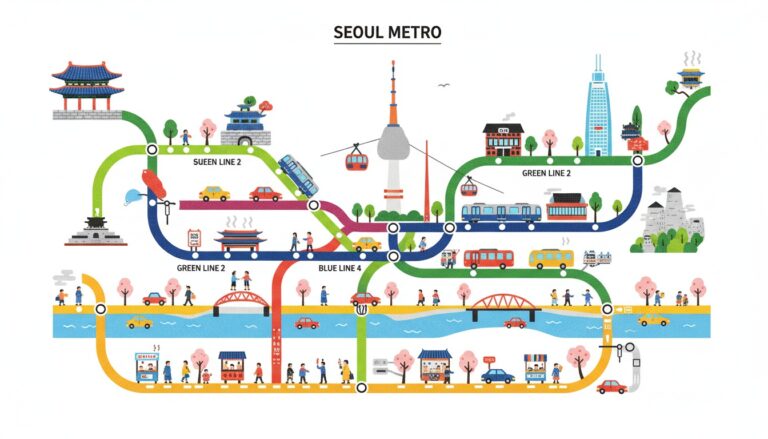
Phase 1: Welcome to the Jungle (of Seoul) 🚌
Greeting: 안녕하세요! It’s your Daily Hangul editor. Today, we are diving into the beautiful chaos that is Seoul Traffic.
K-Culture Cold Open: Picture this. You’ve seen it in a dozen K-Dramas. The main character is running late for a job interview or a date. They sprint towards a bus that is already pulling away. They wave frantically, but the bus driver—cool as ice—keeps going. Or maybe you’ve seen the subway scene in Squid Game (okay, maybe less slapping involved in real life), but the sheer number of people? That is real.
The ‘Why’: Seoul’s public transport is world-class—clean, fast, and Wi-Fi enabled. But it is also a complex beast. Knowing how to express that “I’m stuck” or “It’s crowded” isn’t just about complaining; it’s the #1 excuse used by locals when they are late! If you master these expressions, no one will blame you for being late; they will just nod and say, “Ah, Seoul traffic… I understand.”
Transparency: This guide is built on real panic moments from my students who got lost in Gangnam Station (it happens to the best of us).
Phase 2: Core Expressions Deep Dive 🧠
Here are the 3 expressions you need to survive the rush hour.
1. 지옥철 (Jiok-cheol)
- Pronunciation: [Ji-ok-cheol] (Think of “G” as in Gee-whiz + “oak” tree + “cheol”)
- Meaning: Hell (Jiok) + Subway (Jihacheol). Literally: “Hell Subway.”
- K-Culture Moment: Every morning between 7:30 AM and 9:00 AM on Line 2 (The Green Line). You don’t walk into the train; the wave of people pushes you in. It’s like a mosh pit at a K-Pop concert, but without the music.
- Editor’s Insight: This is a slang term, but it’s so widely used that it’s practically official. Use this when you are squeezed against the door like a sticker.
- Situation Spectrum:
[🚫 Formal Report] ———— [✅ Boss (Lightly)] ———— [✅ Friends]- 🤔 Think About It: Why do Koreans combine “Hell” with “Subway”? It reflects the intense competitiveness and the “Pali-pali” (Hurry, hurry) culture of modern Korean society.
2. 꽉 막히다 (Kkwak makhida)
- Pronunciation: [Kkwak ma-ki-da] (The ‘Kk’ is a strong, tense sound. Imagine stepping on a crunchy leaf—KKwak!)
- Meaning: Completely blocked / Jammed tight.
- K-Drama Moment: The CEO is in his luxury sedan, looking at his watch, frustrated because the road is a parking lot. He calls his secretary and yells, “The road is kkwak makhida!”
- Editor’s Insight: “Makhida” means blocked. Adding “Kkwak” (tightly) adds emphasis. It’s not just traffic; you can use it when your nose is stuffed (kkwak makhida) or your drain is clogged!
- Situation Spectrum:
[✅ Formal] ———— [✅ Casual] ———— [✅ Everywhere]3. 환승(하다) (Hwanseung-hada)
- Pronunciation: [Hwan-seung-ha-da]
- Meaning: To transfer (bus/subway).
- K-Culture Moment: Have you heard of the dating show Transfer Love (환승연애)? The show uses this transport term as a metaphor for moving from one lover to another. But in daily life, you’ll hear the machine say “Hwanseung-imnida” (Transfer complete) when you tap your card.
- Editor’s Insight: Seoul’s transfer system is magic. You get free transfers between bus and subway within 30 minutes. If you don’t “tag out” when you leave, you pay extra. Don’t forget!
- Situation Spectrum:
[✅ Formal] ———— [✅ Casual] ———— [✅ Everywhere]
Phase 3: Textbook vs. Real Life 🥊
| Situation | 📖 Textbook Korean | 🗣️ Real Korean | 💡 Why the difference? |
|---|---|---|---|
| Traffic is bad | 교통이 복잡해요. (Traffic is complex.) | 차가 너무 막혀요. (Cars are blocked.) | “Complex” sounds too academic. “Blocked” is the physical reality. |
| Being late | 늦어서 죄송합니다. (Sorry for being late.) | 차가 안 움직여요 ㅠㅠ (Cars won’t move ㅠㅠ) | Koreans accept traffic as a valid excuse because everyone suffers from it. |
| Too many people | 사람이 많습니다. (There are many people.) | 발 디딜 틈도 없어요. (No space to set a foot.) | A common idiom emphasizes the physical lack of space. |
Bottom Note: In B1 level, try using “차가 안 움직여요” (The cars aren’t moving) instead of just saying traffic is bad. It sounds more dramatic and local.
Phase 4: Cultural Context — K-Travel Deep Dive 🇰🇷
4-1. The Art of “Nunchi” (Eye Measure) on the Subway
In Seoul, the subway is a library. It is silent. If you talk loudly, you will feel the “laser beam eyes” of the ajumma (middle-aged ladies) staring at you. That is Nunchi. Also, never sit in the Pink Seats (Pregnant women) or the Ends of the carriage (Elderly/Disabled), even if they are empty. It’s a sacred rule.
4-2. K-Drama Trope: The Bus U-Turn
Ever notice how bus drivers in Korea drive… enthusiastically? We call it the “Bus Drift.” Drivers are on strict schedules. If you are standing up before the bus stops, hold the handle tight (Son-jabi). In dramas, this is when the guy catches the girl falling. In reality, you just hit the floor. Hold on tight!
Phase 5: Immersive Roleplay 🎭
Setting: It’s Friday night, 6:30 PM. You are in Gangnam. You need to meet your friend Minji in Hongdae (across the river) by 7:30 PM. It is rush hour.
Characters:
– YOU: A foreign student who hates being late.
– Minji: Your Korean friend who knows Seoul well.
(Phone Call)
Minji: 지금 어디야? 벌써 출발했어? 📱
(Jigeum eodiya? Beolsseo chulbalhaesseo?)
(Where are you now? Did you leave already?)
YOU: 어, 지금 강남역이야. 택시 탈까 생각 중이야.
(Eo, jigeum Gangnam-yeogiya. Taeksi talkka saenggak jungiya.)
(Yeah, I’m at Gangnam station. I’m thinking of taking a taxi.)
Minji: 야! 지금 시간이 몇 신데 택시를 타? 절대 안 돼! 🙅♀️
(Ya! Jigeum sigani myeot sinde taeksireul ta? Jeoldae an dwae!)
(Hey! Look at the time, taxi? Absolutely not!)
🔀 Decision Point! How do you respond?
- A) “왜? 택시가 더 편하잖아.” (Why? Taxi is more comfortable.)
- B) “그럼 지하철 탈까? 사람 진짜 많을 텐데…” (Then subway? There will be so many people…)
- C) “알았어, 걸어갈게.” (Okay, I will walk.)
✅ Best Choice: B
– Reason: Option A is suicide on a Friday night (you will be stuck for 2 hours). Option C is impossible (it’s too far). B shows you understand the “Jiok-cheol” situation but are willing to listen.
Minji: 맞아, 사람 많아. 지옥철일 거야. 그래도 택시보다는 빨라. 빨리 와!
(Maja, saram mana. Jiokcheol-il geoya. Geuraedo taeksibodaneun ppalla. Ppalli wa!)
(Right, many people. It will be a Hell-Subway. But faster than a taxi. Come quickly!)
Phase 6: 10-Second Shadowing Drill 🗣️
Practice this sentence to use when you are late!
Emotion: 😰 Frustrated and Apologetic
“차가 / 너무 / 막혀서 / 늦었어요!”
(Chaga / neomu / makyeoseo / neujeosseoyo!)
Meaning: “Traffic / is so / blocked / (so) I’m late!”
Phase 7: K-Culture Mini Glossary 📚
| Korean | Romanization | English | Context |
|---|---|---|---|
| 막차 | Makcha | Last Train/Bus | “Missing the makcha” is a classic K-Drama romance starter (or tragedy). |
| 티머니 | T-money | T-money Card | The magical card for all transport (and convenience stores!). |
| 따릉이 | Ttareungi | Seoul Bike | Public rental bikes. Great for avoiding traffic if the distance is short. |
| 마을버스 | Maeul Bus | Village Bus | Small green buses that go into deep neighborhoods/hills. |
Phase 8: Traveler’s Survival Kit 🧳
🆘 Survival Expression #1
– 🇰🇷 “홍대입구역 가요?” (Hongdae-ipgu-yeok gayo?)
– 🗣️ Pronunciation: [Hong-dae ip-gu yuck ga-yo?]
– 📍 Use: When boarding a bus to check direction.
– 💡 Pro Tip: Drivers are busy. Keep it short. Just say “Destination + Gayo?”📌 Editor’s Travel Note
– Google Maps 🚫: Google Maps does NOT work well for walking/driving directions in Korea due to security laws. You can see the map, but it won’t navigate well.
– Use This ✅: Download Naver Map or KakaoMap. They have English settings and are accurate to the second.
– Subway App: Download “Subway Korea” app. It tells you which door (e.g., 4-1) is closest to your transfer.
Phase 9: Think Deeper — “The Pali-Pali Paradox” 🧠
Why is Korean transport so fast?
Korea’s rapid economic growth created the “Pali-pali” (Hurry, hurry) culture. Efficiency is valued above relaxation during commutes. This makes the system incredibly punctual but also stressful. The “Jiokcheol” isn’t just about population density; it’s about a society where being on time is a strict moral duty. In your country, is public transport seen as a public service or a business efficiency model?
💬 Your Turn: How do you handle rush hour in your city? Do you push, or do you wait? Tell us in the comments!
Phase 10: FAQ & Troubleshooting 🛠️
Q: Can I eat/drink on the bus?
A: NO! Since 2018, Seoul buses forbid takeaway cups (coffee, soda) that can spill. If you hold an iced americano, the driver will not open the door for you. Bottled water with a cap is okay.
Q: Do I tip the taxi driver?
A: No. Tipping is not a Korean culture. However, if the fare is 9,800 won and you give 10,000 won, you can say “Keep the change” (잔돈은 됐어요), but it’s optional.
❌ Common Mistake #1: Not tagging out when getting off the bus.
✅ Fix: Always tap your card when you exit (Hacha). If you don’t, you get charged double next time!
Phase 11: Wrap-up & Action Mission 🎬
Summary: Today we learned how to complain about Jiokcheol (Hell Subway), emphasize traffic is Kkwak makhida (Blocked tight), and the importance of Hwanseung (Transfer).
🚀 Action Mission:
– 🥉 Bronze: Say “차가 너무 막혀요” 3 times while imagining you are stuck in traffic.
– 🥈 Silver: Download Naver Map and find the route from “Gangnam Station” to “Gyeongbokgung Palace.”
– 🥇 Gold: Next time you are late (even in your country), text your friend jokingly: “Sorry, Jiokcheol situation!”
K-Culture Mission: Watch a “Subway Mukbang” or “Seoul Walk” video on YouTube. Listen for the subway announcement sounds (the famous trumpet music!). Can you hear it?
See you on the next ride! 🚇
Frequently Asked Questions (FAQ)
Q: What does "지옥철 (Jiok-cheol)" mean in Korean and how do you pronounce it?
A: In Korean, "지옥철 (Jiok-cheol)" is pronounced [Ji-ok-cheol] and means: Hell (Jiok) + Subway (Jihacheol). Literally: "Hell Subway."
Q: What does "꽉 막히다 (Kkwak makhida)" mean in Korean and how do you pronounce it?
A: In Korean, "꽉 막히다 (Kkwak makhida)" is pronounced [Kkwak ma-ki-da] and means: Completely blocked / Jammed tight.
Q: What does "환승(하다) (Hwanseung-hada)" mean in Korean and how do you pronounce it?
A: In Korean, "환승(하다) (Hwanseung-hada)" is pronounced [Hwan-seung-ha-da] and means: To transfer (bus/subway).







