

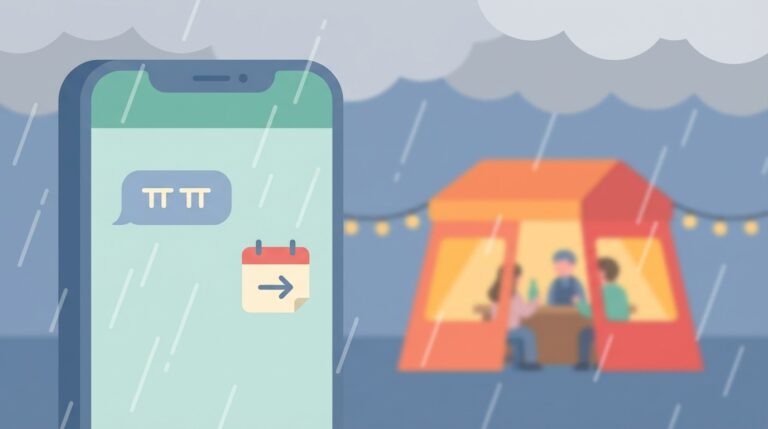
Phase 1: The “Sudden Rain” in Seoul ☔
안녕하세요! (Annyeonghaseyo!) This is your Daily Hangul Editor.
Imagine this scene: You are watching a K-Drama. The male lead is running towards a fancy restaurant to meet his first love. Suddenly, his phone rings. The camera zooms in on his shaking eyes. He stops, sighs, and looks up at the sky. Next scene? He’s drinking Soju alone at a Pojangmacha (street food tent).
In real life, we don’t always have dramatic secrets, but we do have sudden overtime work, unexpected colds, or just… a desperate need to recharge. In Korea, changing plans is an art form. It requires a delicate balance of apology, excuse, and promise for the future.
Today, we learn how to say “Can we postpone it to tomorrow?” without losing your friend. If you master this, you won’t just be a foreigner who cancels; you’ll be a considerate friend who knows Jeong (affection).
Let’s dive into the real Korean way to change plans. 🎬
Phase 2: Core Expressions Deep Dive 🕵️♂️
1. 내일로 미뤄도 될까요?
- Pronunciation: [Nae-il-lo mi-rwo-do doel-kka-yo?]
- Nae-il-lo: Sounds like “Nail” + “Low”
- mi-rwo: “Me” + “Raw” (Imagine raw fish!)
- doel-kka-yo: “Dwel” + “Ka” + “Yo”
- Meaning:
- Literal: Is it okay if I push it to tomorrow?
- Real Nuance: “I really want to see you, but can we move it to tomorrow?” (Polite & Standard)
- K-Culture Moment: Think of a K-Pop idol announcing a delay in their album release. They might not use this exact phrase, but the sentiment of “mi-ru-da” (to postpone) fills the Weverse comments.
- Editor’s Insight: The verb 미루다 (miruda) literally means to “push” or “delay.” It’s not cancelling; it’s moving. This is key! cancelling feels final; postponing shows you still care.
- Situation Spectrum:
[🚫 Boss/Elder] ———— [⚠️ Colleague] ———— [✅ Friend/Tutor]
(Note: For bosses, we use much formal language. This is for peers/polite acquaintances.) - 🤔 Think About It: Why does Korean distinguish so clearly between “cancelling” (취소) and “postponing” (연기/미루다)? Is it harder to say a flat “No” in your culture, too?
2. 갑자기 일이 생겼어요.
- Pronunciation: [Gap-ja-gi i-ri saeng-gyeoss-eo-yo]
- Gap-ja-gi: “Gap” (like the clothing store) + “Jagi” (honey)
- i-ri: “Eerie” (like a ghost)
- Meaning:
- Literal: Suddenly, work/matter appeared.
- Real Nuance: “Something came up.” (The Ultimate Magic Shield 🛡️)
- Editor’s Insight: You don’t need to explain what happened. Did you oversleep? Did your cat vomit? Did you just want to watch Netflix? In Korea, “Il-i saeng-gyeoss-eo-yo” covers everything. It protects your privacy and saves face.
- Situation Spectrum:
[✅ Boss/Elder] ———— [✅ Colleague] ———— [✅ Friend]
(Universally useful!)
3. 다음에 봐요 / 나중에 봐요
- Pronunciation: [Da-eum-e bwa-yo] / [Na-jung-e bwa-yo]
- Meaning: Let’s meet next time / later.
- K-Culture Moment: Every music show ending. The idols wave and shout “Da-eum-e bwa-yo!” It’s a promise, not a goodbye.
- Editor’s Insight: If you cancel without saying this, it feels cold. Even if you don’t have a specific date, saying this softens the blow.
Phase 3: Textbook vs. Real Life 🥊
| Situation | 📖 Textbook Korean | 🗣️ Real Street Korean | 💡 Why the difference? |
|---|---|---|---|
| Postponing | 약속을 변경하고 싶습니다. (I would like to change the appointment.) |
우리 내일 볼까? (Shall we see tomorrow?) |
“Change the appointment” sounds like a business transaction. “Shall we?” builds togetherness. |
| Apologizing | 죄송합니다. (I am sorry – stiff) |
미안, 어떡하지? ㅠㅠ (Sorry, what to do? ㅠㅠ) |
Showing distress (“what to do?”) shows you care more than just saying sorry. |
| Reason | 개인적인 사정이 있습니다. (I have a personal matter.) |
급한 일이 생겨서… (Urgent thing came up…) |
“Personal matter” sounds distant. “Urgent thing” sounds like an unavoidable accident. |
💡 Editor’s Note: Notice the “ㅠㅠ” in the Real Korean column? In text messages, using crying emojis (ㅠㅠ, 😭😭) is crucial when changing plans. It visually proves your regret!
Phase 4: Cultural Deep Dive — The Art of “Nunchi” 👀
4-1. The “Raincheck” Dance
In Western culture, you might rebook immediately. In Korea, if someone says “Da-eum-e bwa-yo” (Let’s meet next time) without a specific date, use your Nunchi (intuition).
– If they give a date (“Next Tuesday?”) → It’s a plan.
– If they just say “Next time” and drift away → It’s a polite soft rejection.
Don’t pressure them by asking “Exactly when?” immediately unless you are very close friends!
4-2. K-Food Context: The “Bob” Promise 🍚
“Let’s eat together sometime” (언제 밥 한번 먹자) is the most common Korean greeting and also the most common lie. When you postpone a plan, you might hear: “그래, 다음에 맛있는 거 먹자!” (Okay, let’s eat something delicious next time!). This isn’t just about food; it’s about restoring the harmony of the relationship.
Phase 5: Immersive Roleplay 🎭
Setting: It’s Friday afternoon. You are supposed to meet your Korean friend, Minji, for Chimaek (Chicken & Beer) at Han River. But suddenly, your boss gave you extra work.
Characters:
– YOU: An exhausted office worker.
– Minji: Your cheerful Korean friend who loves chicken.
(Phone call connects) 📞
Minji: 야! 나 벌써 한강 가고 있어. 날씨 진짜 좋다! ☀️
(Ya! I’m already going to Han River. The weather is so good!)
YOU: 민지야, 진짜 미안해… [ 1 ].
(Minji, I’m really sorry… [ 1 ].)
Minji: 엥? 무슨 일 있어? 😲
(Huh? Is something wrong?)
YOU: 회사에 갑자기 [ 2 ].
(Suddenly [ 2 ] at the company.)
Minji: 아, 진짜? 어쩔 수 없지… 😢
(Ah, really? Can’t be helped…)
🔀 Decision Point: How do you save this friendship?
- A) “응, 끊어.” (Okay, bye.)
- B) “내일로 미뤄도 될까요? 내가 치킨 살게!” (Can we postpone to tomorrow? I’ll buy the chicken!)
- C) “다음에 봐.” (See you next time.)
✅ Best Choice: B
Why? You offered a specific alternative (tomorrow) AND a compensation (buying chicken). This is the perfect Korean apology combo! Option A is rude, and C is too vague for a close friend already on their way.
Phase 6: 10-Second Shadowing Drill 🗣️
Mimic the emotion! Don’t be a robot!
- 🥺 Regretful:
정말 / 미안해요! / 갑자기 / 일이 / 생겼어요.
(Jeong-mal / mi-an-hae-yo! / Gap-ja-gi / i-ri / saeng-gyeoss-eo-yo.) -
🙏 Proposing:
우리 / 내일로 / 미뤄도 / 될까요?
(U-ri / nae-il-lo / mi-rwo-do / doel-kka-yo?) -
👋 Promising:
다음에 / 꼭 / 봐요!
(Da-eum-e / kkok / bwa-yo!)
Phase 7: K-Culture Mini Glossary 📘
| Korean | Romanization | English | Context |
|---|---|---|---|
| 약속 | Yaksok | Promise/Plan | Used for both serious promises and casual appointments. |
| 번개 | Beon-gae | Lightning | An impromptu, sudden meetup. “Let’s have a beon-gae!” |
| 펑크 내다 | Peong-keu | Punk (Puncture) | Slang for flaking or cancelling last minute. (Like a tire puncture!) |
| 잠수 타다 | Jamsu | Submarine | Ghosting someone. Diving underwater and disappearing. |
Phase 8: Traveler’s Survival Kit 🎒
Scenario: You booked a tour guide but missed your train.
🆘 Survival Card
– 🇰🇷 “혹시 시간 변경 가능해요?” (Hoksi sigan byeon-gyeong ga-neung-hae-yo?)
– 🗣️ Meaning: Is it possible to change the time by any chance?
– 📍 Where: Hair salons, restaurants, tour guides.
– 💡 Pro Tip: Start with “Hoksi” (By any chance…). It makes you sound 10x more polite and humble.📌 Editor’s Travel Note
Most Korean booking systems (Naver Booking, CatchTable) have strict cancellation policies. If you can’t speak Korean, text them using Papago translation. Koreans prefer text over calls for changes because it leaves a record!
Phase 9: Think Deeper — “The Vague Excuse” 🧠
Why do Koreans just say “Something came up” (일이 생겼어요)?
In high-context cultures like Korea, giving too much detail about why you can’t come (e.g., “I have diarrhea” or “I’m fighting with my boyfriend”) is considered TMI (Too Much Information) and can burden the listener. A vague excuse is actually a form of politeness—it says, “I respect your time enough not to burden you with my messy details, but I acknowledge I cannot make it.”
💬 Your Turn: In your country, do you explain exactly why you are cancelling, or do you use a “white lie”? Tell us in the comments!
Phase 10: FAQ & Troubleshooting 🛠️
Q: Can I use “Cancel” (취소) to my Korean friend?
A: Yes, but “취소” sounds a bit technical/cold, like cancelling a credit card. It’s better to say “못 갈 것 같아” (I don’t think I can go) or “미뤄야 할 것 같아” (I think we need to postpone).
Q: What if I am late, not cancelling?
A: Don’t say “Postpone.” Say “조금 늦을 것 같아요” (I think I’ll be a little late).
❌ Common Mistake #1: Saying “No” directly.
Instead of “No, I can’t meet tomorrow,” say “내일은 조금 힘들 것 같아요” (Tomorrow seems a bit difficult). It’s the soft Korean “No.”
Phase 11: Wrap-up & Mission 🚀
One-Liner: Postponing is better than cancelling, and a vague excuse is better than a messy truth!
🎯 Action Mission:
– 🥉 Bronze: Look in the mirror and practice the “pity face” 🥺 while saying “Jeongmal mianhaeyo.”
– 🥈 Silver: Text a friend (or me!) using the phrase “Da-eum-e bwa-yo” at the end of a conversation.
– 🥇 Gold: Next time you are late or busy, try typing “갑자기 일이 생겼어요 ㅠㅠ” to your Korean friend.
📺 K-Culture Mission: Watch a K-Drama episode. Count how many times a character says “Mianhae” (Sorry) vs. “Gomawo” (Thanks). You might be surprised!
Phase 12: Interactive Quiz 📝
1. Your boss asks to have dinner, but you are tired. What is the BEST response?
– A) 싫어요. (I hate it.)
– B) 죄송해요, 오늘 선약이 있어서요. (Sorry, I have a prior engagement.)
– C) 내일로 미뤄도 될까요? (Can we postpone to tomorrow? – asking the BOSS?)
2. True or False?
– “In Korea, if someone says ‘Let’s eat sometime’, you must open your calendar and pick a date immediately.”
Answers:
1. B. (A is suicidal, C is too casual for a boss unless you are very close. “Prior engagement” is the politest excuse.)
2. False. It’s usually just a greeting! Read the Nunchi.
See you next time! 다음에 봐요! 👋
Frequently Asked Questions (FAQ)
Q: What does "내일로 미뤄도 될까요?" mean in Korean and how do you pronounce it?
A: In Korean, "내일로 미뤄도 될까요?" is pronounced [Nae-il-lo mi-rwo-do doel-kka-yo?] and means: a key conversational Korean expression covered in this lesson.
Q: What does "갑자기 일이 생겼어요." mean in Korean and how do you pronounce it?
A: In Korean, "갑자기 일이 생겼어요." is pronounced [Gap-ja-gi i-ri saeng-gyeoss-eo-yo] and means: a key conversational Korean expression covered in this lesson.
Q: What does "다음에 봐요 / 나중에 봐요" mean in Korean and how do you pronounce it?
A: In Korean, "다음에 봐요 / 나중에 봐요" is pronounced [Da-eum-e bwa-yo] and means: Let's meet next time / later.






