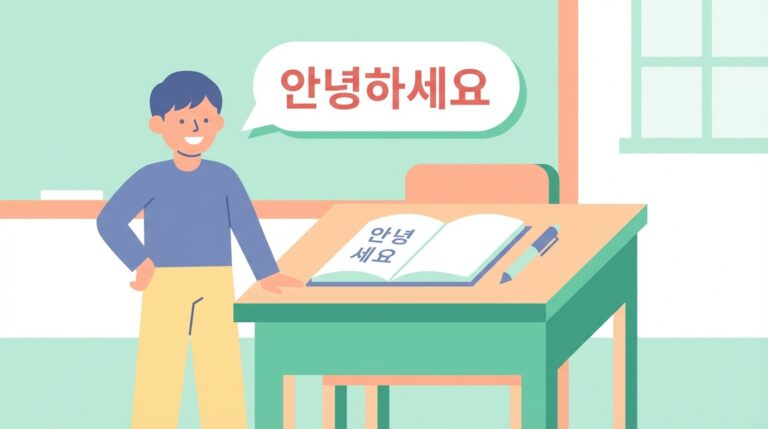
Don’t Freeze in Korean Class! The Ultimate Guide to Your First “Self-Introduction” (자기소개)
Phase 1: The Immersive Hook
Greeting: 안녕하세요! Hello, Daily Hangul readers! I’m your editor, here to save you from awkward silences.
The Scene: Picture this. You are watching a K-Drama. The main character—let’s say, a transfer student with a mysterious past—walks into a chaotic classroom. The teacher taps the chalkboard with a stick. Tak. Tak. Silence falls. The student stands at the podium, takes a deep breath, and writes their name on the board.
Then, they turn around and say that one magic phrase. The bullies stop chewing their gum. The love interest looks up from their book.
In your textbook’s “써 보세요” (Try writing it) section, you are asked to write a self-introduction. But in real life, how do you say it so you sound like a confident local, not a translation robot?
The ‘Why’: Your self-introduction (자기소개, Jagi-sogae) is your first impression. Mess this up, and you’re the “foreigner who speaks weirdly.” Nail it, and you’re instantly respected.
Transparency: I’ve seen hundreds of students freeze during this moment. Today, we fix that.
Phase 2: Deep Dive into Key Expressions
Here are the top 3 expressions you need for the “Write/Speak about yourself” unit.
1. 저는 [Name]입니다 (Jeoneun [Name]-imnida)
- Pronunciation: [Jeo-neun] + [Your Name] + [im-ni-da]
(Tip: ‘Jeo’ sounds like ‘Juh’ in ‘Judge’, but softer. ‘Imnida’ sounds like ‘Im-nee-da’.)- Meaning: “I am [Name].” (Formal & Polite)
- K-Culture Moment: Think of Squid Game or any workplace drama. When characters introduce themselves to a group, they almost always use this structure. It is crisp, professional, and clean.
- Editor’s Insight: Beginners often say “제 이름은 [Name]입니다” (My name is…). While grammatically correct, it sounds like a translated textbook. “저는 [Name]입니다” is what Koreans actually use 90% of the time. It implies humility.
- Situation Spectrum:
[🚫 Casual Party] ———— [⚠️ Semi-formal] ———— [✅ Class/Office]- 🤔 Think About It: Why does Korean have a specific word for “I” (저, jeo) that lowers yourself? What does this say about the importance of humility in Korean society?
2. [Country] 사람입니다 ([Country] saram-imnida)
- Pronunciation: [Country Name] + [Sa-ram] + [im-ni-da]
(Tip: ‘Saram’ means person. Roll the ‘r’ slightly, like a soft Spanish ‘r’.)- Meaning: “I am a person of [Country].” (I am from [Country].)
- K-Travel Moment: You’re at a guesthouse party in Hongdae. Someone asks where you’re from. You drop this phrase.
- Editor’s Insight: You can also say “[Country]에서 왔어요” (I came from [Country]), but “[Country] 사람입니다” fits perfectly in the formal pattern of a first introduction.
- Situation Spectrum:
[🚫 Best Friend] ———— [⚠️ Date] ———— [✅ Class/First Meeting]3. 잘 부탁드립니다 (Jal butak deurimnida)
- Pronunciation: [Jal] + [Bu-tak] + [Deu-rim-ni-da]
(Tip: ‘Jal’ rhymes with ‘Pal’. This is a mouthful, but practice it!)- Meaning: Literal: “I ask you to look after me well.” / Real Nuance: “Nice to meet you, please treat me well/help me out.”
- K-Pop Moment: Every time a new K-Pop group debuts, they bow 90 degrees and shout this. It is the ultimate sign of a rookie asking for love and support.
- Editor’s Insight: This phrase has NO English equivalent. If you end your intro without this, it feels like hanging up the phone without saying “Bye.” It signals you are ready to be part of the group.
- Situation Spectrum:
[🚫 Mom] ———— [⚠️ Close Friend] ———— [✅ Everyone Else]
Phase 3: Textbook vs. Real Life
| Context | 📖 Textbook Korean | 🗣️ Real Korean | 💡 Why different? |
|---|---|---|---|
| Your Name | 제 이름은 마이클입니다. (My name is Michael.) |
저는 마이클입니다. (I am Michael.) |
“My name is…” is too wordy. Koreans prefer efficiency and humility. |
| Job | 저는 학생입니다. (I am a student.) |
(Just implies it by context or uniform) | Koreans often guess status by context (nunchi), but in class, stating it is fine. |
| Ending | 반갑습니다. (Nice to meet you.) |
잘 부탁드립니다! (Please look after me!) |
“Ban-gap-seumnida” is good, but “Jal butak…” shows a relationship has started. |
Bottom Note: For A1 beginners, stick to the “~입니다” (Imnida) ending for introductions. It acts like a shield. It keeps you polite and safe until you know people better.
Phase 4: Cultural Deep Dive
4-1. The Art of the Bow (Insa)
You cannot just say these words. You must perform them. When you say “잘 부탁드립니다,” you should bow slightly.
– Eye Contact: Do not stare intensely into their eyes like in Western business culture. It can be seen as challenging. Look at their nose or chin, then lower your head.
– The Nunchi: Read the room. If everyone is casual, don’t do a rigid military salute. If everyone is formal, don’t just wave your hand.
4-2. K-Drama Connection: The “New Kid” Trope
In dramas like The Heirs or True Beauty, the new student writes their name on the chalkboard.
– Observation: Notice how the class creates a hierarchy immediately?
– Reality Check: In real life, Korean classes for foreigners are super friendly! But the desire to know your age and job exists because Koreans need to know how to address you (titles) rather than judging you.
Phase 5: Immersive Roleplay
Setting: It’s your first day at a Korean language school in Seoul. 9:00 AM. Bright classroom. 10 other students from around the world are looking at you. The teacher smiles.
Characters:
– YOU: A nervous but excited student.
– Teacher Kim: Encouraging, holding a marker.
Dialogue:
Teacher Kim: 자, 자기소개 한번 해볼까요? (Shall we do a self-introduction?)
YOU: (Standing up) …
🔀 Decision Point! What do you say first?
- A) “안녕? 나는 [Name]이야.” (Casual: Hi? I’m [Name].)
- B) “안녕하세요. 저는 [Name]입니다.” (Formal: Hello. I am [Name].)
- C) “Yo, what’s up!” (English)
✅ Best Choice: B
– Why: Classrooms are formal spaces in Korea. Showing respect to the teacher and classmates is crucial.
YOU: 안녕하세요. 저는 [Name]입니다. 미국에서 왔습니다. (Hello. I am [Name]. I am from the USA.)
Teacher Kim: 네, 반가워요! 직업이 뭐예요? (Nice to meet you! What is your job?)
YOU: 저는 회사원입니다. (I am an office worker.)
Teacher Kim: 아, 네. 잘 부탁해요!
YOU: …
🔀 Decision Point! How do you end it?
- A) “Bye!” (Sit down)
- B) “잘 부탁드립니다!” (Bow and sit)
- C) “Thank you.”
✅ Best Choice: B
– Why: This creates a connection. You are asking the teacher and classmates to help you learn.
Phase 6: 10-Second Shadowing Drill
Practice this until it flows smoothly.
- 😊 Brightly & Confidently:
안녕하세요! / 저는 [Name]입니다. / 잘 부탁드립니다!
(An-nyeong-ha-se-yo! / Jeo-neun [Name]-im-ni-da. / Jal bu-tak deu-rim-ni-da!)
Phase 7: K-Culture Glossary
| Korean | Romanization | Meaning | Context |
|---|---|---|---|
| 자기소개 | Jagi-sogae | Self-introduction | The act of introducing yourself. Crucial in first meetings. |
| 존댓말 | Jondaetmal | Polite/Formal language | The language style ending in -yo or -nida. Used in classes. |
| 눈치 | Nunchi | Social intuition | Putting text in the context. Reading the room before speaking. |
Phase 8: Traveler’s Survival Kit
You might not do a full intro while traveling, but you will need to fill out forms or meet guides.
🆘 Survival Phrase #1
– 🇰🇷 “한국말 잘 못해요.” (Hanguk-mal jal mot-haeyo.)
– 🗣️ Pronunciation: [Han-guk-mal] [Jal] [Mo-te-yo]
– 📍 Where: Shops, Taxis, Hotels.
– 💡 Pro Tip: Say this before you panic. Koreans will instantly switch to easier words or body language to help you.📌 Editor’s Travel Note
– Guestbooks: Many cafes and guesthouses in Korea have guestbooks. Practice writing “저는 [Name]입니다” there!
– Name: Learn to write your name in Hangul immediately. It helps with Starbucks orders and hotel check-ins!
Phase 9: Think Deeper — Language & Power
Topic: Why is Korean so obsessed with titles?
In English, you are just “I”. In Korean, you are “Jeo” (humble I) or “Na” (casual I). You are not just a person; you are a “student,” an “office worker,” or an “older brother.”
🧠 Think Deeper:
When you introduce yourself in Korean, you are placing yourself on a social map. You are telling people how to treat you and how you will treat them. It’s not just about information; it’s about harmony.💬 Your Turn: Does your language change depending on who you are talking to? Tell us in the comments!
Phase 10: FAQ & Troubleshooting
Q: Can I use “Hello” instead of “Annyeonghaseyo”?
A: No. “Hello” is understood, but “Annyeonghaseyo” is the key to the culture. Use the Korean greeting.
Q: Should I shake hands?
A: In a formal setting, wait for the senior person to offer their hand. If they do, shake it gently while supporting your right forearm with your left hand. This is the “Polite Handshake.”
❌ Common Mistake #1: Saying “나는…” (Na-neun) in class.
✅ Fix: “Na-neun” is informal (Banmal). Unless you are talking to a child or a close friend, always use “Jeo-neun” (I am).
Phase 11: Wrap-up & Action Items
Summary: To introduce yourself, use “Jeoneun [Name]imnida” and always end with the magic phrase “Jal butak deurimnida.”
🚀 Action Mission:
– 🥉 Bronze: Stand in front of a mirror and bow while saying “Jal butak deurimnida” 3 times.
– 🥈 Silver: Write your self-introduction in Hangul in the comments section below.
– 🥇 Gold: Find a Korean speaker (or a learner) and introduce yourself using the full script!
📺 K-Culture Mission: Watch the first episode of any K-Drama involving a school or office. Find the scene where the main character introduces themselves. Do they look nervous? Confident?
See you in the next lesson! 다음에 또 만나요!
Frequently Asked Questions (FAQ)
Q: What does "저는 [Name]입니다 (Jeoneun [Name]-imnida)" mean in Korean and how do you pronounce it?
A: In Korean, "저는 [Name]입니다 (Jeoneun [Name]-imnida)" is pronounced [Jeo-neun] and means: "I am [Name]." (Formal & Polite)
Q: What does "[Country] 사람입니다 ([Country] saram-imnida)" mean in Korean and how do you pronounce it?
A: In Korean, "[Country] 사람입니다 ([Country] saram-imnida)" is pronounced [Country Name] and means: "I am a person of [Country]." (I am from [Country].)
Q: What does "잘 부탁드립니다 (Jal butak deurimnida)" mean in Korean and how do you pronounce it?
A: In Korean, "잘 부탁드립니다 (Jal butak deurimnida)" is pronounced [Jal] and means: Literal: "I ask you to look after me well." / Real Nuance: "Nice to meet you, please treat me well/help me out."