

Phase 1: Immersive Hook
Greeting: 안녕하세요! Welcome back to Daily Hangul. I’m your editor, your local hiking buddy who owns three different hiking jackets but only climbs the neighborhood hill once a month.
The Scene: Picture this. It’s a crisp Sunday morning at Gupabal Station (the gateway to Bukhansan National Park). You step out of the subway, and suddenly, you are blinded by a sea of neon colors. 🌈
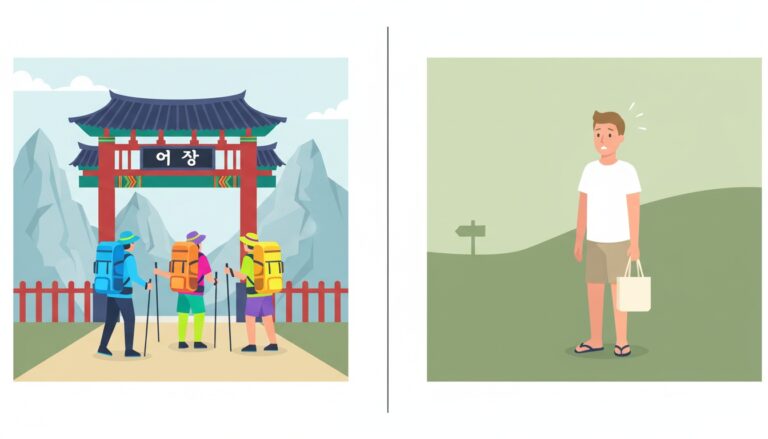
Is it a K-Pop rave? No. It’s middle-aged Koreans ready to hike. Everyone looks like they are about to conquer Mount Everest, even though the peak is only 800 meters high. They have the expensive sticks, the specialized backpacks, the UV-blocking sunglasses, and gloves.
Meanwhile, you are standing there in your comfortable gym shorts and a cotton t-shirt. You might feel a sudden gaze—the “scanning” of your outfit. In Korea, hiking isn’t just exercise; it’s a runway. If you don’t want to feel out of place (or if you want to compliment your Korean friend’s flashy new gear), you need to master the language of “Gear Pride.”
Let’s dive into the vocabulary of the Korean mountains, where fashion meets function!
Phase 2: Deep Dive Expressions
1. 장비빨 (Jangbi-bbal)
- Pronunciation: [Jangbi-bbal] (Sounds like: Jang + Bee + Bbal as in ‘Pal’)
- Meaning: The power/effect of equipment (Gear-dependence)
- Context: In English, you might say “all the gear, no idea,” but in Korea, admitting to 장비빨 can be a humble brag or a cute excuse. It implies, “My skills are lacking, so I rely on good equipment.”
- K-Culture Moment: Think of a variety show where a celebrity shows up to a cooking battle with a $500 knife but can’t chop onions. The caption would definitely say “장비빨.”
- Editor’s Insight: The suffix -빨 (-bbal) means “receiving the help/effect of.” You can use it for anything: 화장빨 (makeup effect), 조명빨 (lighting effect).
- Situation Spectrum:
[🚫 Formal(Boss)] ———— [⚠️ Semi-formal] ———— [✅ Casual(Friends)]- 🤔 Think About It: Why do you think Koreans value “good gear” so much even for hobbies? Is it about efficiency, or is it about showing respect for the activity?
2. 풀장착 (Pul-jangchak)
- Pronunciation: [Pul-jangchak]
- Meaning: Fully equipped / Decked out from head to toe
- Context: Derived from English “Full” + Sino-Korean “Jangchak” (equip/install). It’s used when someone is wearing the complete set: hat, jacket, pants, socks, boots, and accessories.
- K-Drama Moment: The rich CEO in a drama goes on a casual fishing trip but arrives wearing a luxury fishing vest and professional boots. That is 풀장착.
- Editor’s Insight: Use this to compliment your Korean friend. “와, 오늘 등산복 풀장착했네요!” (Wow, you are fully decked out in hiking gear today!) It shows you notice their effort.
- Situation Spectrum:
[🚫 Formal] ———— [⚠️ Semi-formal] ———— [✅ Casual]3. 등린이 (Deung-rin-i)
- Pronunciation: [Deung-rin-i]
- Meaning: Hiking Novice / Hiking Baby
- Context: A combination of 등산 (Hiking) + 어린이 (Child). It refers to a beginner. Koreans love combining “Topic + Child” to mean a newbie (e.g., Yori-n-i = Cooking beginner).
- K-Culture Moment: On Instagram, you will see thousands of hashtags saying #등린이 on photos of young people wearing trendy leggings and oversized socks at the summit.
- Editor’s Insight: Calling yourself a 등린이 is a great social shield. If you walk slowly or struggle, just say, “저는 등린이예요.” Everyone will instantly become kind and offer you chocolate.
- Situation Spectrum:
[🚫 Formal Reports] ———— [⚠️ Semi-formal] ———— [✅ Casual/Social Media]
Phase 3: Textbook vs. Real Korean
| Situation | 📖 Textbook Korean | 🗣️ Real Korean (Insa Style) | 💡 Why different? |
|---|---|---|---|
| Complimenting gear | 옷이 예쁘네요. (Your clothes are pretty.) | 전문가 포스가 나는데요? (You have a professional vibe!) | Koreans prefer complimenting the aura or professionalism rather than just the object. |
| Admitting you are new | 저는 등산을 잘 못해요. (I am not good at hiking.) | 저 완전 등린이예요. (I’m a total hiking baby.) | Using “-rin-i” slang creates instant bonding and lowers expectations playfully. |
| Asking about price | 이거 비싸요? (Is this expensive?) | 이거 신상이에요? (Is this a new arrival?) | Asking if it’s a “new arrival” (Sinsang) is a polite, indirect way to acknowledge it looks fancy/expensive. |
Bottom Note: B2 learners, try using “포스” (Force/Vibe). It’s widely used to describe someone who looks cool and capable.
Phase 4: Cultural Context — K-Culture Deep Dive
4-1. The “Anjeon” (Safety) Obsession & Nunchi
In Western culture, hiking is often about “getting lost in nature” in your old t-shirt. In Korea, hiking is a group activity where safety (안전) is paramount. If you wear jeans and Converse shoes to a rocky mountain (like Bukhansan), older hikers might click their tongues (tsk-tsk) or openly scold you: “It’s dangerous!”
This isn’t just nosiness; it’s Jeong (정 – affection/care). Wearing proper gear (non-slip boots, moisture-wicking shirts) is seen as having “good manners” towards the mountain and your group. It shows you prepared properly so you won’t become a burden to others.
4-2. K-Drama Connection: The “Summit Photo” (Injeung-shot)
Have you seen drama scenes where characters finally reach the top and take a photo? In reality, there is often a long line to take a photo with the rock that has the peak’s name carved on it. This is the 인증샷 (Injeung-shot, Proof Shot) culture.
Your 풀장착 (Full gear) isn’t just for climbing; it’s for this photo. The brightly colored jackets contrast beautifully with the grey rocks and green trees, making you pop in the picture. It’s the K-Hiking aesthetic!
Phase 5: Immersive Roleplay
Setting: Saturday, 9:00 AM. Entrance of Cheonggyesan. The air is fresh. You are meeting Min-su (30s, Korean friend, gear enthusiast) for a hike. You are wearing gym shorts and running shoes.
Characters:
* YOU: An expat who treats hiking as a casual walk.
* Min-su: Wearing a Osprey backpack, Black Yak trekking poles, and polarized sunglasses.
Dialogue:
Min-su: (Looking you up and down) 오~ 왔어? 근데… 신발 그거 괜찮겠어?
(Oh~ wasseo? Geunde… sinbal geugeo gwaenchankesseo?)
(Oh, you’re here? But… are those shoes going to be okay?)
YOU: (Looking at his heavy boots) Why? Is the course difficult today?
Min-su: 한국 산은 바위가 많아서 미끄러워. 나는 오늘 풀장착 하고 왔지. 😎
(Hanguk saneun bawiga manaseo mikkeureowo. Naneun oneul pul-jangchak hago watji.)
(Korean mountains have lots of rocks so it’s slippery. I came fully decked out today.)
🔀 Your Turn! How do you respond?
- A) “Wow, you look like a pro mountaineer! Is it the equipment power?”
- B) “I don’t need that stuff. I’m strong.”
- C) “Should I go buy some sticks now?”
✅ Best Choice: A
* Korean: “우와, 완전 전문가 같아요! 역시 장비빨인가요?”
* Why: You acknowledge his effort (compliment) and use the witty word 장비빨 to keep it lighthearted. He will likely laugh and say “Safety first!”⚠️ Choice B Analysis: This might sound arrogant. In Korea, dismissing safety gear can be seen as immature.
Phase 6: 10-Second Shadowing Drill
Let’s practice the “Envious Compliment.” Say this when you see your friend’s new gear.
😊 Emotion: Impressed and slightly playful.
Korean: 우와, / 등산복이 / 완전 / 풀장착이네요! / 전문가 같아요!
Pronunciation: Uwa, / deungsanbogi / wanjeon / pul-jangchak-ineyo! / Jeonmunga gatayo!
Meaning: Wow, / your hiking clothes / are totally / full-set! / You look like a professional!
Phase 7: K-Culture Mini Glossary
| Korean | Romanization | English | Context |
|---|---|---|---|
| 신상 | Sinsang | New Arrival/Product | Short for Sin-sang-pum. Used when spotting new gear. |
| 등산 스틱 | Deungsan-stick | Trekking Poles | Essential item for “Gear Pride.” |
| 기능성 | Gineung-seong | Functional (wear) | Clothes that wick sweat (Coolmax, Gore-tex, etc.). |
| 뒤풀이 | Dwipuri | After-party | The eating/drinking session after the hike (essential!). |
| 국룰 | Guk-rul | National Rule | An unwritten rule everyone follows (e.g., Eating Pajeon after hiking is Guk-rul). |
Phase 8: Traveler’s Survival Kit
If you decide to join the “Gear Pride” and buy some equipment in Korea (which is famous for high-quality outdoor gear):
🆘 Shopping Survival Phrases
* 🇰🇷 “이거 땀 흡수 잘 돼요?” (Igeo ttam heupsu jal dwaeyo?)
* Meaning: Does this absorb sweat well?
* 🇰🇷 “미끄럼 방지 되나요?” (Mikkeureom bangji dwenayo?)
* Meaning: Is this anti-slip? (Crucial for hiking boots!)
* 🇰🇷 “입어봐도 돼요?” (Ibeobwado dwaeyo?)
* Meaning: Can I try this on?📌 Editor’s Travel Note
Visit the entrance of huge mountains (like Bukhansan or Dobongsan). The streets leading to the trail are lined with outlet stores (North Face, Black Yak, K2). You can find great “Shin-sang” (new items) or discount bins there!
Phase 9: Think Deeper — “Language & Identity”
Does “Kit” define the “Member”?
In many Western cultures, you become a “hiker” by hiking. In Korea, visually looking the part is a crucial step in claiming that identity. This is related to the concept of Chemyon (체면 – Face/Social Appearance). Showing up in casual clothes might imply you don’t take the group activity seriously. By investing in “Full Jangchak,” you are signaling: “I am committed to this group and this activity.”
🧠 Think Deeper: In your country, if someone wore professional gear for a beginner-level hobby, would people admire them or think they are trying too hard?
Phase 10: FAQ & Troubleshooting
- Q: Do I really need hiking boots for mountains in Seoul?
- A: For Bukhansan or Gwanaksan: Yes. They are very rocky (granite). Sneakers are slippery and dangerous. For Namsan (Park): No, sneakers are fine.
- Q: Can I wear leggings?
- A: Yes! It’s a huge trend among the younger generation (20s-30s). However, older hikers (50s+) usually prefer loose hiking trousers. If you wear leggings, wearing long socks over them is the trendy “Deung-rin-i” look.
❌ Common Mistake: wearing Jeans (Denim).
Why? When jeans get wet (sweat/rain), they become heavy and cold. Koreans will look at you with extreme worry. Avoid jeans on the trail!
Phase 11: Wrap-up & Action Items
One-Liner Summary: hiking in Korea is 50% climbing and 50% fashion, so don’t be afraid to compliment someone’s “Jangbi-bbal”!
Action Mission:
* 🥉 Bronze: Look in the mirror wearing your favorite outfit and say, “완전 풀장착인데?” (Totally decked out!).
* 🥈 Silver: Watch a Korean variety show clip about camping or hiking. Listen for the word “장비 (Jangbi)” or “포스 (Pose/Force).”
* 🥇 Gold: Go to an outdoor store (even in your country) and ask if a jacket is “Functional” (Gineung-seong) in Korean!
💬 Your Turn: What is the most expensive piece of gear you bought for a hobby that you rarely use? Tell us about your 장비빨 moment in the comments!
Phase 12: Quiz — Interactive Challenge
- [Situation] Your friend is struggling to climb a small hill. What is the cutest/funniest way for them to excuse themselves?
- a) 저는 프로예요. (I am a pro.)
- b) 저는 등린이예요. (I am a hiking baby.)
- c) 저는 장비빨이에요. (I am gear-dependent.)
- [True or False] In Korea, wearing jeans to hike a rocky mountain is considered cool and rebellious.
- (True / False)
- [Fill in the blank] You see a hiker with a GPS watch, high-tech boots, and a tactical backpack. You say: “Wow, today you are
_______!”- a) 풀장착 (Pul-jangchak)
- b) 뒤풀이 (Dwipuri)
Answers:
1. b) (Calling oneself a ‘baby’ lowers expectations.)
2. False (It is considered dangerous and amateurish.)
3. a) (Meaning ‘Fully equipped’.)
Frequently Asked Questions (FAQ)
Q: What does "장비빨 (Jangbi-bbal)" mean in Korean and how do you pronounce it?
A: In Korean, "장비빨 (Jangbi-bbal)" is pronounced [Jangbi-bbal] and means: The power/effect of equipment (Gear-dependence)
Q: What does "풀장착 (Pul-jangchak)" mean in Korean and how do you pronounce it?
A: In Korean, "풀장착 (Pul-jangchak)" is pronounced [Pul-jangchak] and means: Fully equipped / Decked out from head to toe
Q: What does "등린이 (Deung-rin-i)" mean in Korean and how do you pronounce it?
A: In Korean, "등린이 (Deung-rin-i)" is pronounced [Deung-rin-i] and means: Hiking Novice / Hiking Baby







