

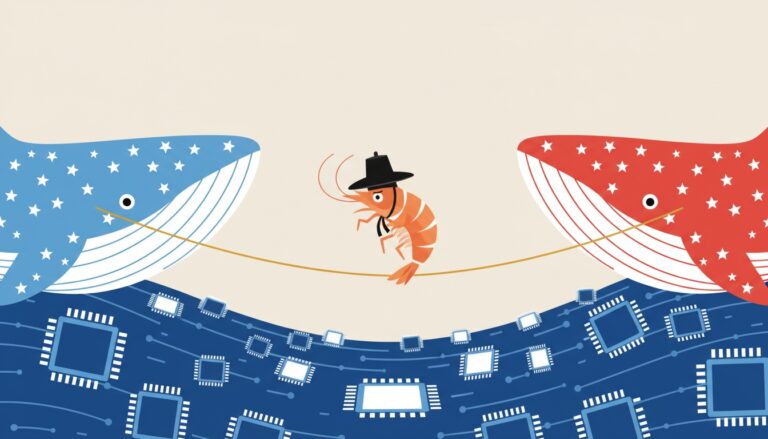
Caught Between Whales: Discussing the US-China Trade War & Economic Security like a Korean Intellectual
Phase 1: Immersive Hook — The “Shrimp” Complex
Hello! This is your Daily Hangul Senior Editor. ☕
Picture this: You are watching a tense political K-Drama like Chief of Staff (보좌관) or a corporate thriller like Misaeng. The boardroom is silent. The CEO slams a newspaper onto the table. The headline screams about semiconductor restrictions. He sighs deeply and says, “This is exactly like a shrimp’s back breaking in a fight between whales.”
Wait, whales? Shrimp? 🦐🐳
If you want to understand the Korean psyche regarding international relations—specifically the US-China trade war—you must understand this deep-seated anxiety. Korea is a powerhouse, yes, but geographically and economically, it often feels squeezed between superpowers.
Today, we aren’t just learning words; we are learning how to discuss Economic Security (경제 안보) with the nuance of a CNN Seoul correspondent or a refined business executive. Let’s upgrade your Korean from “survival” to “intellectual.”
Phase 2: Deep Dive into Key Expressions
Here are the top 3 expressions you need to discuss geopolitical tension.
1. 고래 싸움에 새우 등 터진다 (Gorae ssaume saeu deung teojinda)
- Pronunciation: [Go-rae ssa-um-e sae-u deung teo-jin-da]
- Meaning: “A shrimp’s back is broken in a fight between whales.” (Innocent bystanders get hurt in a fight between powerful figures.)
- K-Culture Moment: This is the ultimate idiom for Korean history and modern diplomacy. You’ll hear this on the 9 PM News, in history classes, and even in casual drinking sessions when complaining about two bosses fighting.
- Editor’s Insight: It sounds poetic, but it carries a nuance of helplessness and victimhood. However, modern Koreans often challenge this, saying, “We are not a shrimp anymore, maybe a dolphin?” (우린 이제 새우가 아니라 돌고래쯤 되지 않나?)
- Situation Spectrum:
[🚫 Formal Report] ———— [✅ News/Debate] ———— [✅ Casual]
(Note: Avoid in a formal written report, but excellent for spoken debate or metaphors.)- 🤔 Think About It: Why does Korea identify with the shrimp? Historically, Korea suffered between China, Japan, and Russia. Does your country have a similar metaphor for being caught in the middle?
2. 줄타기 외교 (Jultagi oegyo)
- Pronunciation: [Jul-ta-gi wae-gyo] (sounds like ‘Jewel-ta-gi’ without the ‘el’)
- Meaning: Tightrope Diplomacy (Walking a fine line between two sides).
- K-Culture Moment: Imagine the traditional Korean performance Jultagi (tightrope walking) seen in historical movies like The King and the Clown. It requires perfect balance. In news, this describes Korea trying to please the US (security ally) and China (largest trading partner) simultaneously.
- Editor’s Insight: This word implies skill and danger. It’s not just indecision; it’s a calculated survival strategy.
- Situation Spectrum:
[✅ Formal News] ———— [✅ Business Meeting] ———— [✅ Intellectual Chat]3. 전략적 모호성 (Jeollyakjeok mohoseong)
- Pronunciation: [Jeol-lyak-jeok mo-ho-seong]
- Meaning: Strategic Ambiguity.
- K-Culture Moment: This is the “grown-up” version of a K-Pop idol’s dating denial. You neither confirm nor deny. In diplomacy, it means not explicitly picking a side to avoid retaliation.
- Editor’s Insight: Use this when you want to sound incredibly smart. “I think the government is maintaining strategic ambiguity.” (정부가 전략적 모호성을 유지하는 것 같아요.)
- Situation Spectrum:
[✅ Academic/Professional] ———— [⚠️ Casual (Too stiff)]
Phase 3: Textbook vs. Real Life
How do Koreans actually talk about the Trade War over a beer versus in a report?
| Situation | 📖 Textbook / News Report | 🗣️ Real Korean (The “Soju” Truth) | 💡 Why the difference? |
|---|---|---|---|
| Impact on Economy | 미중 무역 갈등으로 수출이 감소했습니다. (Exports decreased due to US-China trade conflict.) | 아, 진짜 먹고살기 힘드네. (Ah, it’s seriously hard to make a living.) | The textbook states facts; real life expresses the pain of inflation and job insecurity. |
| Korea’s Position | 균형 잡힌 외교 정책이 필요합니다. (Balanced foreign policy is needed.) | 우리만 중간에서 죽어나는 거지 뭐. (We’re just the ones dying in the middle, as always.) | Cynicism is a staple of Korean political talk among friends. |
| Choosing Sides | 신중한 접근이 요구됩니다. (A cautious approach is required.) | 눈치싸움 장난 아니다. (The battle of wits/nunchi is no joke.) | “Nunchi” explains the vibe better than “Caution.” |
Phase 4: Cultural Context — The “Nunchi” of Nations
4-1. Global Nunchi (글로벌 눈치)
You know Nunchi (the art of reading the room)? In International Relations, Korea practices “Global Nunchi.”
– When the US asks for something, Korea looks at China’s reaction.
– When China complains, Korea looks at the US’s reaction.
– Non-verbal tip: When discussing this topic with Koreans, a “tsk tsk” sound (tongue clicking) combined with a head shake is a common non-verbal cue expressing frustration at the geopolitical situation.
4-2. K-Drama Connection: The “Chaebol” Trope
In dramas like Reborn Rich (재벌집 막내아들), you see the grandfather worrying about “Semiconductors” (반도체). This isn’t just fiction. For Koreans, economic security = national security.
– Critical View: In the West, business and government are often seen as separate. In Korea (and K-Dramas), the government and major conglomerates (Samsung, Hyundai, SK) are viewed as a single team fighting a global economic war. If Samsung sneezes, the Korean economy catches a cold.
Phase 5: Immersive Roleplay — The Business Dinner
Setting: A private room in a high-end Hanwoo (Korean beef) restaurant in Yeouido (Korea’s Wall Street). You are dining with Director Kim, a veteran strategist.
Characters:
– YOU: An Expat Consultant.
– Director Kim (50s): Serious, patriotic, worried about the stock market.
(Dialogue Start)
Director Kim: (Sighs while turning the meat) 요즘 뉴스 보셨습니까? 미국이랑 중국이 또 관세 전쟁을 시작한다네요.
(Have you seen the news lately? The US and China are starting another tariff war.)
YOU: 네, 봤습니다. 고래 싸움에 새우 등 터지는 꼴이 되지 않을까 걱정입니다.
(Yes, I saw. I’m worried it will be a case of a shrimp’s back breaking amongst whales.)
Director Kim: (Visibly impressed) 허허, 그 표현을 아시는군요! 맞습니다. 우리 같은 수출 국가는 타격이 크죠.
(Haha, you know that expression! Correct. Export countries like us take a big hit.)
YOU: 특히 반도체 공급망 문제가 심각해 보이더군요.
(Especially the semiconductor supply chain issue looks serious.)
Director Kim: 그러니까 말입니다. 우리 회사는 어느 편에 서야 할지… 참 난감합니다. 당신 생각은 어떻습니까?
(Exactly. Which side should our company stand on… it’s very awkward. What do you think?)
🔀 Decision Point: How do you answer?
– A) “무조건 미국 편을 들어야죠!” (We must side with the US no matter what!)
– B) “지금은 전략적 모호성이 필요한 때인 것 같습니다.” (I think now is the time for strategic ambiguity.)
– C) “중국 시장을 무시할 수 없어요.” (We can’t ignore the Chinese market.)✅ Best Choice: B
– Reason: In a C1 level context, showing balance is seen as wiser (and safer) than aggressive partisanship. It uses the key vocabulary learned today.
– Analysis of A: Too direct. Koreans prefer indirect approaches in business to minimize risk.
Phase 6: 10-Second Shadowing Drill
Practice the rhythm of a news anchor.
Tag: 😤 Serious & Analytical
한국은 / 미국과 중국 사이에서 / 아슬아슬한 / 줄타기를 하고 있습니다.
(Hanguk-eun / Miguk-gwa Jungguk sa-i-e-seo / a-seul-a-seul-han / jultagi-reul hago isseumnida.)
Translation: Korea is doing a risky tightrope walk between the US and China.
Phase 7: K-Culture Mini Glossary (The “News” Edition)
| Korean | Romanization | English | Context |
|---|---|---|---|
| 반도체 | Bandoche | Semiconductor | The “rice” of the Korean economy. The most sensitive item in the trade war. |
| 공급망 | Gonggeu-mang | Supply Chain | A buzzword heard daily on news channels. |
| 보복 | Bobok | Retaliation | Often used regarding China’s response (e.g., stopping tourism). |
| 샌드위치 신세 | Sandwich sinse | Sandwich situation | Being stuck between two forces (similar to the shrimp idiom). |
Phase 8: Traveler’s Survival Kit (Intellectual Edition)
Since this is a C1 topic, let’s look at how to discuss this when you meet Koreans in Korea.
🆘 Survival Expression #1: asking about the Economy
– 🇰🇷 “요즘 경기가 많이 안 좋죠?” (Yojeum gyeong-gi-ga mani an jojyo?)
– Meaning: “The economy isn’t great these days, is it?”
– Use: Taxi drivers, shop owners, business partners. It’s a universal ice-breaker to show empathy.
– Why? Koreans love to bond over shared hardship (Han – 한).📌 Editor’s Travel Note
– Exchange Rates: During trade wars, the KRW/USD rate fluctuates wildy. If the news says “Hwanyul (Exchange rate) is rising,” your dollar is worth more!
– Pro Tip: Don’t criticize Korean politicians openly unless your Korean friend starts first. Just nod and say, “It must be difficult” (힘드시겠어요).
Phase 9: Think Deeper — “Strategic Ambiguity” or “Indecision”?
🧠 Think Deeper:
Western diplomacy often values “Clarity” and “Transparency.” Korean diplomacy often values “Ambiguity” (saving face for everyone).When Korea refuses to explicitly condemn a trade partner, Westerners might see it as weak. But in the context of Nunchi, it is seen as the only way to survive without making enemies on your border. Is silence a form of cowardice, or a form of wisdom?
💬 Your Turn: Does your culture prefer direct confrontation or indirect maneuvering in business? Tell us in the comments!
Phase 10: FAQ & Troubleshooting
- Q: Can I use the “Shrimp” idiom with my boss?
- A: Yes! It is a very respectable idiom. It shows you understand Korean history and context. It is not slang.
-
Q: Is it safe to talk about China in Korea?
- A: It’s a sensitive topic. Many Koreans have strong feelings about “Economic Retaliation” (like the THAAD issue in the past). Listen more than you speak. Use phrases like “It seems complicated” (복잡한 문제네요) rather than strong opinions.
❌ Common Mistake: Confusing 무역 (Trade) with 무용 (Dance).
– “미중 무용 전쟁” means “US-China Dance War.”
– While that sounds entertaining, please say 무역 (Muyeok)!
Phase 11: Wrap-up & Action Mission
Summary: Today we learned how to navigate the stormy seas of the US-China Trade War using idioms like “Shrimp vs. Whales” and concepts like “Strategic Ambiguity.”
🚀 Action Mission:
– 🥉 Bronze: Say “고래 싸움에 새우 등 터진다” out loud 3 times to nail the rhythm.
– 🥈 Silver: Go to Naver News (news.naver.com), search for “미중” (US-China), and try to find the word “관세” (Tariff) or “반도체” (Semiconductor) in the headlines.
– 🥇 Gold: Ask a Korean friend/tutor: “Do you think Korea is still a shrimp?” (한국이 아직도 새우라고 생각하세요?)
Phase 12: Quiz — Interactive Challenge
1. Which metaphor is most appropriate for a small country stuck between two superpowers?
– A) 호랑이 굴 (Tiger’s Den)
– B) 고래 싸움에 새우 (Shrimp in Whale Fight)
– C) 우물 안 개구리 (Frog in the well)
2. Fill in the blank:
“The government is maintaining _______ to avoid angering either side.”
– ( ____________ 모호성 )
3. True or False (Culture):
– Koreans generally view Samsung’s success as separate from national security. (T/F)
🔑 Answer Key:
1. B (A is for dangerous situations, C is for narrow-mindedness)
2. 전략적 (Strategic)
3. False (They are deeply connected; corporate success is national pride and security.)
Frequently Asked Questions (FAQ)
Q: What does "고래 싸움에 새우 등 터진다 (Gorae ssaume saeu deung teojinda)" mean in Korean and how do you pronounce it?
A: In Korean, "고래 싸움에 새우 등 터진다 (Gorae ssaume saeu deung teojinda)" is pronounced [Go-rae ssa-um-e sae-u deung teo-jin-da] and means: "A shrimp's back is broken in a fight between whales." (Innocent bystanders get hurt in a fight between powerful figures.)
Q: What does "줄타기 외교 (Jultagi oegyo)" mean in Korean and how do you pronounce it?
A: In Korean, "줄타기 외교 (Jultagi oegyo)" is pronounced [Jul-ta-gi wae-gyo] and means: Tightrope Diplomacy (Walking a fine line between two sides).
Q: What does "전략적 모호성 (Jeollyakjeok mohoseong)" mean in Korean and how do you pronounce it?
A: In Korean, "전략적 모호성 (Jeollyakjeok mohoseong)" is pronounced [Jeol-lyak-jeok mo-ho-seong] and means: Strategic Ambiguity.







