

Phase 1: The Immersive Hook
Greeting: 안녕하세요! This is your Daily Hangul Senior Editor. 👋
The K-Drama Moment:
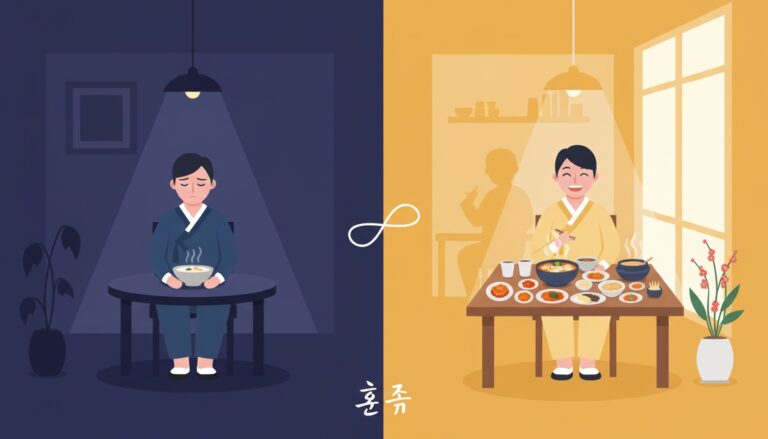
Picture this: It’s a rainy night in a K-Drama. The protagonist sits alone at a Pojangmacha (street food tent), pouring a glass of Soju. The background music is sad. They look lonely, right? But cut to a different scene: A trendy YouTuber in Hongdae vloging their “Solo Date,” eating a giant bingsu with a huge smile. The caption reads: “Freedom!”
In Korea, being alone is a double-edged sword. It’s the battle between 외로움 (Loneliness) and 자유 (Freedom). This lifestyle has become so massive it even has a name: Honjok (혼족 – Tribe of One).
The ‘Why’:
If you don’t understand this nuance, you might mistakenly comfort a Korean friend who is actually enjoying their precious “me time.” Or, you might feel awkward entering a restaurant alone when you really shouldn’t. Today, we decode the language of the Honjok life.
Transparency: This guide combines real stories from our students living in Seoul’s “One-Room” studios and cultural insights from the latest Korean trends.
Phase 2: Deep Dive into Core Expressions
1. 눈치(가) 보이다 (Nunchi-ga boida)
- Pronunciation: [Nun-chi-ga bo-i-da]
- Sound Analogy: “Nun” sounds like ‘Noon’, “Chi” like ‘Chee’se. “Boida” is like ‘Boy’ + ‘Da’.
- Meaning:
- Literal: To see/feel the ‘Nunchi’ (social gaze).
- Real Nuance: To feel self-conscious; to feel uncomfortable because you think others are judging you.
- K-Culture Moment: You walk into a busy BBQ restaurant alone during lunchtime. The staff looks busy, couples are everywhere. You feel a sudden pressure. That feeling? That is 눈치가 보이다.
- Editor’s Insight: This is passive. You aren’t looking at Nunchi; the Nunchi is being seen by you. It’s the #1 enemy of the Honjok life.
- Situation Spectrum:
[🚫 To your Boss] ———— [⚠️ To close friends] ———— [✅ Self-talk/Diary]- (Use it to describe your feelings to friends, not to the person making you uncomfortable!)
- 🤔 Think About It: Why does Korean have a specific verb for “feeling the gaze of others”? Does this exist in your language?
2. 혼자만의 시간이 필요해요 (Honjaman-ui sigani piryohaeyo)
- Pronunciation: [Hon-ja-man-eui shi-ga-ni pi-ryo-hae-yo]
- Meaning:
- Literal: I need time of only alone.
- Real Nuance: I need some “me time.” (Please leave me alone, but politely).
- K-Drama Context: The main character has just gone through a breakup or a family fight. Their best friend tries to cheer them up, but they gently push them away saying this line.
- Editor’s Insight: This is the magic shield of the Honjok. It turns “loneliness” into “freedom.” It implies you are recharging, not sulking.
- Situation Spectrum:
[🚫 Formal Meeting] ———— [⚠️ Colleague] ———— [✅ Friends/Family]
3. 소확행 (Sohwakhaeng)
- Pronunciation: [So-hwak-haeng]
- Meaning: Small but certain happiness.
- K-Culture Moment: Buying a new lipstick, eating a convenience store macaron after work, or watching Netflix with a beer. It’s the anthem of the Korean single household.
- Editor’s Insight: This isn’t a sentence, but a noun you use to justify your solo spending. “This is my Sohwakhaeng.”
- Situation Spectrum: ✅ Can be used anywhere, even in hashtags!
Phase 3: Textbook vs. Real Life
| Situation | 📖 Textbook Korean | 🗣️ Real Korean | 💡 Why the difference? |
|---|---|---|---|
| Entering a restaurant alone | 저는 혼자 왔습니다. (I came alone – stiff) |
한 명이요. (One person.) |
Efficiency. In busy Seoul, numbers matter more than grammar. |
| Declining an invite | 아니요, 저는 집에 있겠습니다. (No, I will stay home.) |
저 오늘 좀 쉴게요. (I’m gonna rest a bit today.) |
Koreans rarely say a direct “No.” “Resting” is a socially acceptable excuse. |
| Feeling lonely | 저는 외롭습니다. (I am lonely.) |
옆구리가 시리네요. (My side feels cold.) |
A common metaphor. It implies you miss having someone to hug/hold your arm. |
Bottom Note: “옆구리가 시리다” is a B1 level idiom that will make your Korean friends laugh and nod in agreement!
Phase 4: Cultural Deep Dive
4-1. The Art of Non-Verbal “Honbap” (Eating Alone)
In Korea, walking into a restaurant alone requires confidence.
* The Gesture: When you enter, raise your index finger (☝️) immediately. This answers the server’s question (“How many?”) before they even ask, saving you the awkwardness.
* The Seat: Don’t sit at a 4-person table in the center. Scan for the counter seats or 2-person tables near the wall. It’s considered ‘manners’ towards the owner.
4-2. K-Culture Connection: The “Honbap” Level Test
Korean internet culture has a famous “Level of Eating Alone.” Where do you stand?
* Level 1: Convenience Store (Easy)
* Level 5: Fast Food / Food Court
* Level 7: Family Restaurant (Getting brave)
* Level 9: Samgyeopsal (BBQ) Place (The ultimate boss fight!)
Critical Insight: Why is BBQ Level 9? Because Korean BBQ is designed for groups (min. 2 servings). Doing this alone is the ultimate declaration of freedom over social pressure.
Phase 5: Immersive Roleplay
Scenario: It is Friday night in Hongdae. You are a Level 9 Honjok. You want Samgyeopsal badly. You walk into a bustling BBQ place.
Characters:
* YOU: A hungry foreigner who knows Korean culture.
* Sajang-nim (Owner): A busy middle-aged lady, wiping a table.
Dialogue:
Sajang-nim: (Loudly) 어서 오세요! 몇 분이세요?
(Eoseo oseyo! Myeot buniseyo?)
(Welcome! How many people?)
YOU: 안녕하세요, 한 명이요.
(Annyeonghaseyo, han myeongiyo.)
(Hello, just one person.)
Sajang-nim: (Hesitating) 아… 저희 지금 바빠서 1인분은 안 되는데.
(Ah… jeohi jigeum bappaseo irinbuneun an doeneunde.)
(Ah… we are busy right now, so 1 serving isn’t possible.)
🔀 Decision Point! How do you respond?
- A) “아, 네… 안녕히 계세요.” (Leave quietly)
- B) “저 많이 먹을 수 있어요! 2인분 시킬게요!” (Flex your freedom)
- C) “왜 안 돼요?” (Get angry)
✅ Best Choice: B
* Korean: “저 많이 먹을 수 있어요! 2인분 시킬게요!”
* Why? In Korea, the refusal isn’t because you are alone, but because the table generates less revenue. By ordering 2 servings, you remove the economic barrier. The owner will likely smile and seat you.
(Roleplay continues if B is chosen)
Sajang-nim: (Laughing) 아이고, 알겠어요. 이쪽으로 앉으세요!
(Aigo, algesseoyo. Ijjogeuro anjeuseyo!)
(Oh my, okay. Sit over here!)
Phase 6: 10-Second Shadowing Drill
Let’s practice the “Freedom” declaration.
Emotion: 😌 Relieved and Peaceful (Imagine you just got home, changed into sweatpants, and opened a beer.)
“오늘은 / 아무도 안 만나고 / 그냥 / 혼자 있고 싶어요.”
- (Romanization): O-neur-eun / a-mu-do an man-na-go / geu-nyang / hon-ja it-go si-peo-yo.
- (Translation): Today / not meeting anyone / just / I want to be alone.
Phase 7: K-Culture Mini Glossary
| Korean | Romanization | English | Context |
|---|---|---|---|
| 혼밥 | Hon-bap | Eating alone | Combination of Honja (Alone) + Bap (Rice/Meal). |
| 혼술 | Hon-sul | Drinking alone | A major trend depicted in the drama Drinking Solo. |
| 불금 | Bul-geum | Fire Friday | TGIF. Even Honjoks enjoy Bulgeum (often with Netflix). |
| 배달 | Bae-dal | Delivery | Korea’s delivery culture is the best friend of the 1-person household. |
Phase 8: Traveler’s Survival Kit
Are you traveling alone in Korea? You are a temporary Honjok! Here is how to survive.
🆘 Survival Expression #1: The “Can I?” Check
* 🇰🇷 “혹시 혼자 식사 되나요?” (Hoksi honja siksa doenayo?)
* 🗣️ Sound guide: Hok-shi hon-ja shik-sa dwe-na-yo?
* Meaning: By any chance, is dining alone possible?
* Where: Any restaurant that looks like it serves shared dishes (Stew, BBQ, Dakgalbi).📌 Editor’s Travel Note
* Delivery Apps: If you are too tired to face the public, use Baedal Minjok (Baemin) or Yogiyo. Most fried chicken places deliver to hotel lobbies!
* Cafes: Unlike restaurants, Korean cafes are 100% Honjok-friendly. You can sit with a laptop for hours. Just order one drink per person (1인 1메뉴).
Phase 9: Think Deeper — “Loneliness vs. Solitude”
Food & Identity:
In Korea, eating has traditionally been a communal activity. The word “family” (식구 – Sikgu) literally means “mouths that eat together.” This is why the older generation often views eating alone as “pitiful” or “lonely” (Chorya-hada). However, for the younger generation facing high social pressure and intense work culture, eating alone is not loneliness—it is strategic solitude. It is the only time they are free from Nunchi.
💬 Your Turn: In your culture, is eating alone seen as sad, or normal? Does the restaurant layout change (e.g., tables vs. counters)?
Phase 10: FAQ & Troubleshooting
- Q: Can I use “혼자만의 시간” (Me time) with my Korean boss?
- NO. 🚫 If your boss asks you to dinner (Hoesik) and you say this, it sounds like “I dislike this team.” Use a health excuse instead (“몸이 좀 안 좋아서요” – I’m not feeling well).
- Q: Is it rude to wear headphones while eating alone in a restaurant?
- Generally OK. ✅ In a casual place (Gimbap-cheonguk, McDonald’s), it’s fine. In a small, owner-run place, maybe keep one ear open to hear if they call your number.
❌ Common Mistake: Saying “I am lonely” (외로워요) when you mean “I am bored” (심심해요).
* 심심해요: I have nothing to do. (Time problem)
* 외로워요: I feel emotionally empty/sad. (Heart problem)
Phase 11: Wrap-up & Action Mission
One-Liner: Being a “Honjok” in Korea is about mastering the balance between respecting communal Nunchi and enjoying your own Sohwakhaeng.
Action Mission:
* 🥉 Bronze: Look in the mirror and say, “오늘은 혼자 있고 싶어요” with a peaceful face.
* 🥈 Silver: Go to a Korean cafe (or any cafe) and order “Ice Americano, one person” in Korean.
* 🥇 Gold: The BBQ Challenge! Go to a restaurant, order 2 servings of meat for yourself, and enjoy the freedom!
K-Culture Mission: Watch an episode of “I Live Alone” (나 혼자 산다). It’s Korea’s most popular variety show about single celebrities. Count how many times they mention “happiness” vs “loneliness”!
Phase 12: Interactive Quiz
- Situation Judgment: You are bored at home on a Sunday. You want to ask a friend to hang out. What do you text?
- A) 나 너무 외로워. (I’m so lonely.)
- B) 나 너무 심심해. (I’m so bored.)
- (Answer: B. If you say A, your friend might think you are depressed!)
- True or False: In Korea, if a restaurant owner rejects a single diner, it is always because they hate foreigners.
- (False). It is usually about the “Table Turnover” and revenue per table. Offering to order 2 portions usually solves it!
Frequently Asked Questions (FAQ)
Q: What does "눈치(가) 보이다 (Nunchi-ga boida)" mean in Korean and how do you pronounce it?
A: In Korean, "눈치(가) 보이다 (Nunchi-ga boida)" is pronounced [Nun-chi-ga bo-i-da] and means: a key conversational Korean expression covered in this lesson.
Q: What does "혼자만의 시간이 필요해요 (Honjaman-ui sigani piryohaeyo)" mean in Korean and how do you pronounce it?
A: In Korean, "혼자만의 시간이 필요해요 (Honjaman-ui sigani piryohaeyo)" is pronounced [Hon-ja-man-eui shi-ga-ni pi-ryo-hae-yo] and means: Literal: I need time of only alone.
Q: What does "소확행 (Sohwakhaeng)" mean in Korean and how do you pronounce it?
A: In Korean, "소확행 (Sohwakhaeng)" is pronounced [So-hwak-haeng] and means: Small but certain happiness.







