

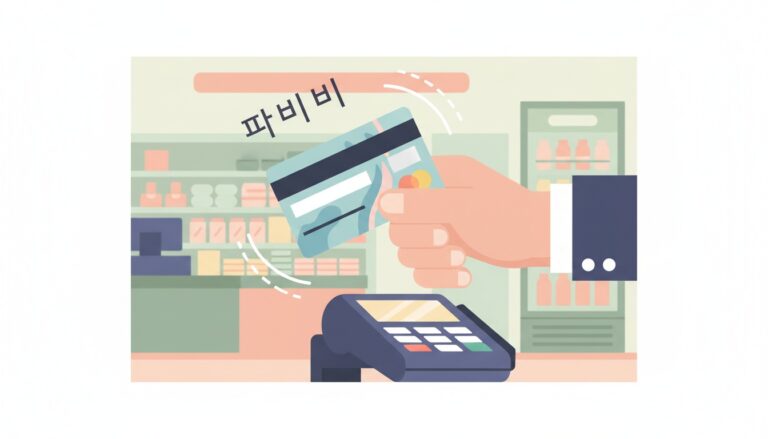
Don’t Freeze at the Register! The Art of the “Pbali-Pbali” Checkout 💳
Phase 1: The Immersive Hook
Hello, Daily Hangul family! It’s your local editor here.
Picture this: It’s lunch hour in Gangnam. You enter a packed convenience store (pyeoneui-jeom) to grab a banana milk. The line is moving at the speed of light. The part-timer (alba) is scanning barcodes like a DJ scratching records. Beep-beep-beep!
Suddenly, it’s your turn. The clerk looks at you. The person behind you shifts their weight. You start fumbling for your wallet… digging… digging…
Freeze. ❄️
Do you feel that invisible laser beam on your back? That, my friends, is the pressure of “Pbali-Pbali” (Hurry-Hurry) culture. In K-Dramas, you might see a CEO slam a ‘Black Card’ on the counter without looking. In reality, being prepared is not just cool—it’s basic manners here.
Today, we aren’t just learning how to pay; we’re learning the choreography of a Korean checkout. Let’s make you look like a Seoul local who never holds up the line.
Phase 2: Deep Dive into Key Expressions
Here are the phrases that will make your transaction smooth as silk.
1. 영수증은 버려 주세요 (Please throw away the receipt)
- Pronunciation: [Yeong-su-jeung-eun beo-ryeo ju-se-yo]
(Think: “Young-Sue-Jung” is a name, “Burrow” like a rabbit, “Ju-se-yo” like juice)- Meaning:
- Literal: Please throw the receipt away for me.
- Real Nuance: “I don’t need the receipt, and let’s save the 2 seconds it takes for you to hand it to me.”
- K-Culture Moment: You’ll hear this in almost every busy cafe scene in dramas. It’s the ultimate signal that says, “I value efficiency.”
- Editor’s Insight: Most Koreans don’t take receipts for small purchases. Saying this before they print it makes you look like a pro.
- Situation Spectrum:
[🚫 Formal Boss] ———— [✅ Semi-formal/Casual]
(Perfect for clerks, taxi drivers, and servers)- 🤔 Think About It: In some cultures, checking the receipt is crucial for trust. Why do you think Koreans are so comfortable telling the cashier to trash it immediately?
2. 카드로 계산할게요 (I’ll pay by card)
- Pronunciation: [Ka-deu-ro gye-san-hal-ge-yo]
- Meaning: I will calculate/pay with a card.
- K-Culture Moment: Think of K-Pop idols on reality shows splitting the bill. One usually yells this to treat the others.
- Editor’s Insight: While holding out your card makes it obvious, saying this clearly helps the clerk select the payment method on their screen faster. It’s about verbalizing your move.
- Situation Spectrum:
[⚠️ Casual] ———— [✅ Standard Polite]
(Safe to use with anyone)- 🤔 Think About It: Korea is becoming a cashless society. Many places are now “Card Only.” How does this compare to your home country’s cash usage?
3. 잠시만요 (Just a moment / Excuse me)
- Pronunciation: [Jam-si-man-yo]
- Meaning: Wait a moment / Excuse me (passing by).
- K-Culture Moment: The magic shield word! If you are fumbling for your wallet, say this immediately. It breaks the tension.
- Editor’s Insight: Don’t just stay silent while searching for your card. Silence creates awkwardness. “Jam-si-man-yo” tells them, “I’m trying my best, please bear with me!”
Phase 3: Textbook vs. Real Life
Let’s be real. Textbooks are polite, but the streets are efficient.
| Situation | 📖 Textbook Korean | 🗣️ Real Korean | 💡 Why the difference? |
|---|---|---|---|
| Rejecting a receipt | 영수증을 안 주셔도 됩니다. (Please, you do not need to give me the receipt.) | 영수증(은) 됐어요. (Receipt, done/okay.) | “됐어요” implies “It’s fine/no need” and saves 5 syllables. Time is money! |
| Asking to pay | 계산해 주시겠습니까? (Would you please calculate this?) | 계산이요~ (Calculation, please~) | Adding “~yo” to a noun is the quickest way to be polite but fast. |
| Splitting the bill | 각자 계산할 수 있을까요? (Could we calculate each person?) | 따로따로 할게요. (We’ll do it separately.) | “Ttaro-Ttaro” is easier to say and instantly understood. |
💡 Editor’s Note: “됐어요” (Dwae-sseo-yo) depends heavily on your tone. Say it with a smile and a soft voice. If you say it bluntly, it sounds like “I’m done with you!” (Rude!).
Phase 4: Cultural Deep Dive — The Art of “Nunchi” at the Counter
4-1. The “Ready Stance” (Non-verbal)
Have you noticed? In Korea, before the cashier even says the total, the customer often has their credit card inserted in the reader or held out in their hand.
– The Rule: Don’t wait for the total amount. Have your card in your hand while standing in line.
– The Two-Handed Pass: Even if you are rushing, when you hand over the card (if not inserting it yourself), use two hands (or support your right elbow with your left hand). It’s the perfect mix of Pbali-Pbali efficiency and Confucian respect.
4-2. K-Food Connection: The “N-Bang” (Dutch Pay) Culture
In K-Dramas, you often see a sunbae (senior) buying lunch. But among friends or coworkers of the same level, we often split the bill.
– However, doing complex math at the register kills the “Pbali-Pbali” vibe.
– Pro Tip: Usually, one person pays the full amount to save time at the register, and everyone wires them money via KakaoPay immediately. It keeps the line moving!
Phase 5: Immersive Roleplay
Setting: A frantic coffee shop in Hongdae during the lunch rush (12:30 PM). Techno music is playing. The line is out the door.
Characters:
– YOU: A hungry student who needs caffeine ASAP.
– Alba (Part-timer): Wearing a headset, moving incredibly fast.
Dialogue:
Alba: (Without looking up) 주문 도와드릴까요? 드시고 가세요?
(Ju-mun do-wa-deu-ril-kka-yo? Deu-si-go ga-se-yo?)
(English) Can I take your order? Are you eating here?
YOU: 아뇨, 가져갈게요. 아이스 아메리카노 한 잔이요.
(Anyo, ga-jyeo-gal-ge-yo. A-i-se-u A-me-ri-ka-no han jan-i-yo.)
(English) No, to go. One Iced Americano, please.
Alba: (Typing furiously) 4,500원입니다. 할인 적립 카드 있으세요?
(Sa-cheon-o-baek-won-im-ni-da. Hal-in jeok-rip ka-deu i-sseu-se-yo?)
(English) That’s 4,500 won. Do you have a discount or point card?
🔀 YOUR TURN! You don’t have one and you want to leave fast. What do you say?
- A) “아니요, 할인은 괜찮습니다. 하지만 영수증은 주시겠어요?” (Polite, but long)
- B) “없어요. 영수증은 버려 주세요.” (Fast, standard, efficient)
- C) “빨리 계산해주세요!” (Rude demand for speed)
✅ Best Choice: B — “Eop-seo-yo. Yeong-su-jeung-eun beo-ryeo ju-se-yo.” This is music to the part-timer’s ears. You answer the question and pre-emptively handle the receipt step.
⚠️ Choice A: Grammatically perfect, but in a loud, busy cafe, shorter sentences are better to avoid mishearing.
Alba: 네, 결제됐습니다. 진동벨로 알려드릴게요!
(Ne, gyeol-je-dwaet-seum-ni-da. Jin-dong-bel-lo al-lyeo-deu-ril-ge-yo!)
(English) Payment complete. I’ll let you know via the buzzer!
YOU: (Taking the buzzer with two hands) 감사합니다! 수고하세요!
(Gam-sa-ham-ni-da! Su-go-ha-se-yo!)
(English) Thank you! Keep up the good work!
Phase 6: 10-Second Shadowing Drill
Let’s practice the rhythm. Don’t be flat—sound like a local!
1. The Efficient Exit (Polite but Fast)
😊 없어요 / 영수증은 / 버려 주세요!
(Eop-seo-yo / yeong-su-jeung-eun / beo-ryeo ju-se-yo!)
Translation: I don’t have (points/discounts). Please throw away the receipt!
2. The Panic Breaker (Apologetic)
🥺 아! / 잠시만요 / 카드가… / 여기 있어요!
(Ah! / Jam-si-man-yo / ka-deu-ga… / yeo-gi i-sseo-yo!)
Translation: Ah! Just a moment. My card is… Here it is!
Phase 7: K-Culture Mini Glossary
| Korean | Romanization | Meaning | Context |
|---|---|---|---|
| 눈치 | Nunchi | Social sensing | Reading the line length and preparing your card is high ‘Nunchi’. |
| 알바 | Alba | Part-timer | Short for “Arbeit” (German). The busy staff at cafes/stores. |
| 진동벨 | Jindong-bell | Vibration buzzer | Given at cafes. It saves calling out names in noisy places. |
| 삼성페이 | Samsung Pay | Samsung Pay | The king of payments in Korea. Almost everyone uses their phone to pay. |
| 일시불 | Il-si-bul | Lump sum | Paying all at once (vs. monthly installments). |
Phase 8: Traveler’s Survival Kit (Checkout Edition)
Don’t panic at the counter. Keep these 3 cards in your mental wallet.
🆘 Survival Phrase #1
– 🇰🇷 “봉투 필요하세요?” (Bong-tu pir-yo-ha-se-yo?) -> “네 / 아니요”
– 🗣️ Context: The clerk asks this 99% of the time. It means “Do you need a bag?”
– 💡 Pro Tip: Plastic bags cost extra (usually 20-100 won). If you have your own, show it and say “Gwaen-chan-a-yo” (It’s okay).🆘 Survival Phrase #2
– 🇰🇷 “이거 데워 주세요.” (I-geo de-wo ju-se-yo)
– 🗣️ Meaning: Please heat this up.
– 📍 Using it: Convenience stores. If you buy a bento box or burger, ask this!📌 Editor’s Travel Note
– Cash vs. Card: 90% of places prefer cards. Even taxis! But keep some cash for street food (Bungeoppang) or charging your T-Money card (transport card).
– No Tips: Do not leave a tip on the counter. The staff might run after you thinking you forgot your change!
Phase 9: Think Deeper — Silence vs. Small Talk
In many Western cultures, asking the cashier “How is your day?” is considered polite. In Korea, especially during busy hours, speed is the highest form of politeness.
Why? Because Korean culture often prioritizes the collective experience (the people waiting behind you) over the individual interaction (you and the clerk). By being fast, you are showing respect to everyone in the room. The clerk isn’t being cold by not chatting; they are being professional and efficient for the group.
💬 Your Turn: Does your culture value “Small Talk” or “Speed” at the register? Let me know in the comments!
Phase 10: FAQ & Troubleshooting
Q: Can I hand my card to the cashier with one hand?
A: It’s not a crime, but it can look rude, especially if you are younger than the cashier. Just lightly touching your forearm with your other hand is enough to show respect, even while moving fast!
Q: The cashier mumbled something ending in “…yo?” and I didn’t understand!
A: It was probably “Point card?” (Jeok-rip?) or “Receipt?” (Yeong-su-jeung?). If you aren’t sure, just smile and say “Gwaen-chan-a-yo” (It’s okay/No thanks). It works for rejecting almost anything.
❌ Common Mistake: staring at the menu after getting to the front of the line.
✅ Fix: Decide your order while waiting in line. That’s the Korean way!
Phase 11: Wrap-up & Missions
One-Liner: Being “Pbali-Pbali” at the checkout isn’t about rushing; it’s about being considerate of everyone’s time.
🔥 Action Missions:
– 🥉 Bronze: Say “Yeong-su-jeung-eun beo-ryeo ju-se-yo” 3 times fast while pretending to hand over a card.
– 🥈 Silver: Next time you buy something (even in your country), try to have your payment method ready before the cashier finishes scanning. Feel the efficiency!
– 🥇 Gold: Go to a Korean mart or cafe, order, and use the phrase “Yeong-su-jeung-eun beo-ryeo ju-se-yo” naturally.
📺 K-Culture Mission: Watch a scene in a K-Drama where someone buys something at a convenience store. Do they take the receipt? Do they chat? Observe the speed!
Phase 12: Interactive Quiz
- Situation: The line is long. The cashier asks if you have a point card. You don’t. What is the fastest polite response?
- A) “죄송하지만 포인트 카드는 제가 가지고 있지 않습니다.”
- B) “없어요.”
- C) “잠시만요…” (and start looking for one you don’t have)
- True or False: In Korea, it is considered rude to not ask the cashier “How are you doing today?”
-
Fill in the Blank: To look like a local, you should tell the cashier to throw away the ______ (yeong-su-jeung).
Answers:
1. B (A is too long/formal like a textbook. B is perfect for speed.)
2. False (Speed and efficiency are preferred over small talk.)
3. Receipt (영수증)
Frequently Asked Questions (FAQ)
Q: What does "영수증은 버려 주세요 (Please throw away the receipt)" mean in Korean and how do you pronounce it?
A: In Korean, "영수증은 버려 주세요 (Please throw away the receipt)" is pronounced [Yeong-su-jeung-eun beo-ryeo ju-se-yo] and means: Literal: Please throw the receipt away for me.
Q: What does "카드로 계산할게요 (I'll pay by card)" mean in Korean and how do you pronounce it?
A: In Korean, "카드로 계산할게요 (I'll pay by card)" is pronounced [Ka-deu-ro gye-san-hal-ge-yo] and means: I will calculate/pay with a card.
Q: What does "잠시만요 (Just a moment / Excuse me)" mean in Korean and how do you pronounce it?
A: In Korean, "잠시만요 (Just a moment / Excuse me)" is pronounced [Jam-si-man-yo] and means: Wait a moment / Excuse me (passing by).







