

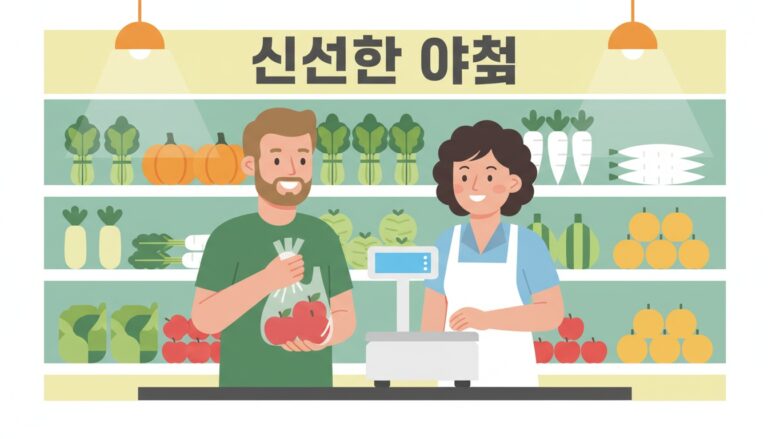
Don’t Freeze at the Checkout! 🍎 How to Weigh Veggies in Korea Like a Local
Phase 1: The “Walk of Shame” Prevention 🛑
Greeting: 안녕하세요! It’s your Daily Hangul editor here.
Imagine this: You are at a bustling Korean supermarket (Mart). You’ve picked out the perfect, shiny red apples and some fresh spinach for tonight’s dinner. You wait in a long line at the checkout. Finally, it’s your turn! You proudly place your items on the belt.
The cashier picks up your bag of apples, pauses, and looks at you with that look. She holds up the bag and asks, “가격표는요?” (Where is the price tag?).
Panic sets in. You look behind you; three people are waiting. You have to run back to the vegetable section to weigh them while everyone watches. 😱
This is the classic “Mart Walk of Shame.”
Unlike many Western supermarkets where produce is weighed at the register, in Korea (especially at traditional markets or older marts like E-Mart Everyday or Lotte Super), you often need to find the “Scale Station” first. Today, I’ll teach you how to get that sticker so you can breeze through the checkout like a K-Drama lead!
Phase 2: Deep Dive into Key Expressions 🧠
1. 가격표 붙여 주세요 (Gagyeok-pyo buchyeo juseyo)
- Pronunciation: [Ga-gyeok-pyo] + [bu-chyeo] + [ju-se-yo]
- Tip: ‘Pyo’ sounds like the start of “Pure.” ‘Buchyeo’ sounds like “Butcher” but softer.
- Meaning: “Please attach the price tag.”
- Literal: Price (Gagyeok) + Ticket/Tag (Pyo) + Attach/Stick (buchyeo) + Please (juseyo).
- K-Culture Moment: You’ll see this in family dramas when a mom sends her son to the market. It’s the magic phrase that turns a bag of raw veggies into a purchasable product.
- Editor’s Insight: This is the most standard, polite, and clear way to ask. Even if the staff is busy, this sentence gets the job done instantly.
- Situation Spectrum:
[🚫 To Boss] ———— [✅ Standard] ———— [✅ Friendly]
(Safe to use with any staff member at the mart!) - 🤔 Think About It: Why do we say “attach” (붙이다)? Because in Korea, the result of weighing isn’t just a number on a screen; it’s a physical sticker that proves the value.
2. 저울 어디에 있어요? (Jeoul eodie isseoyo?)
- Pronunciation: [Jeo-ul] + [eo-di-e] + [i-sseo-yo?]
- Tip: ‘Jeoul’ rhymes with “Soul” but with a ‘J’.
- Meaning: “Where is the scale?”
- Editor’s Insight: Sometimes the scale is hidden behind a pillar or looks just like a regular counter. Use this when you are wandering around with a bag of onions looking lost.
3. 이거 찍어 주세요 (Igeo jjigeo juseyo)
- Pronunciation: [I-geo] + [jji-geo] + [ju-se-yo]
- Tip: ‘Jjik’ sounds like the sound a camera makes (click!).
- Meaning: “Please scan/weigh this.”
- Nuance: Literally “Please take a picture of this” or “stamp this.” In a mart context, it means “shoot the barcode” or “print the label.”
- Situation Spectrum:
[🚫 Formal] ———— [✅ Casual/Daily] ———— [✅ Very Common]
(Very commonly used by locals!)
Phase 3: Textbook vs. Real Life 🗣️
| Situation | 📖 Textbook Korean | 🗣️ Real Korean (Street/Mart) | 💡 Why the difference? |
|---|---|---|---|
| Asking to weigh | 무게를 달아 주시겠습니까? (Could you weigh this?) | (Just handing the bag) “이거요!” (This!) or “여기요~” | Koreans value speed (Palli-palli). The action speaks for itself! |
| Finding the scale | 저울은 어디에 위치해 있습니까? (Where is the scale located?) | 저울 어디예요? (Where is scale?) | Grammatical particles are often dropped for efficiency. |
Bottom Note: As an A2 learner, stick to “이거요 (This please)” while handing the bag over. It’s universally understood and polite enough with a smile! 😊
Phase 4: Cultural Deep Dive — The “Nunchi” of the Scale ⚖️
4-1. Nunchi (Eye-measure)
In a busy Korean mart, the staff member at the scale (often an older lady called ‘Imo-nim’ or auntie) is a master multitasker. She is weighing spinach, wrapping tofu, and shouting daily specials all at once.
- Nunchi Tip: Do not just stand there waiting for eye contact. Gently extend your arm with the bag into her workspace (but don’t touch the scale yourself unless it’s self-service!). Say “Gagyeok-pyo juseyo” effectively to get her attention.
4-2. K-Food Connection: The “Service” (덤/Service)
If you go to a traditional market (Sijang) instead of a supermarket and buy a lot of vegetables, you might experience the beautiful culture of “Deom” (덤) or “Service.” The seller might throw in a handful of chili peppers or an extra onion for free after weighing your main items. It’s a sign of Jeong (affection/connection)!
Phase 5: Immersive Roleplay 🎬
Setting: A local supermarket (Lotte Super or Homeplus Express) at 6 PM. It’s the evening rush. You have a bag of loose potatoes.
Characters:
* YOU: A hungry student craving potato soup.
* Staff (Imo-nim): Busy weighing bean sprouts for another customer.
(Dialogue)
Imo-nim: (Shouting) 자, 콩나물 세일해요! 오세요!
(Ja, kongnamul seil-haeyo! Oseyo!)
(English: Hey, bean sprouts are on sale! Come on over!)
YOU: (Approaching the counter) 저기요…
(Jeogiyo…)
(English: Excuse me…)
Imo-nim: (Looks at you quickly) 네, 뭐 드릴까요?
(Ne, mwo deurilkkayo?)
(English: Yes, what can I give you?)
🔀 YOUR TURN! How do you respond?
- A) (Silent stare and put potatoes on the scale)
- B) “감자 가격표 붙여 주세요.” (Gamja gagyeok-pyo buchyeo juseyo.)
- C) “이거 얼마예요?” (Igeo eolmayeyo? – How much is this?)
✅ Best Choice: B — Clear and direct. She knows exactly what you need (the sticker).
⚠️ Choice C Analysis: Asking the price is fine, but her main job right now is to weigh it. If you ask for the price tag, you get the price and the sticker to buy it.
(Continuation)
YOU: 감자 가격표 붙여 주세요.
Imo-nim: (Weighs it quickly, slap! Sticks the barcode on your bag) 네, 여기 있어요. 맛있게 드세요~
(Ne, yeogi isseoyo. Masitge deuseyo~)
(English: Here you go. Enjoy your meal~)
Phase 6: 10-Second Shadowing Drill 🎤
Listen to the rhythm. Korean sentences often have a “wave” intonation.
- Polite & Clear 😊
사장님 / 이거 / 가격표 / 붙여 주세요!
(Sa-jang-nim / i-geo / ga-gyeok-pyo / bu-chyeo ju-se-yo!) -
Confused but Cute 🥺
저기요 / 저울이 / 어디 / 있어요?
(Jeo-gi-yo / jeo-uri / eo-di / i-sseo-yo?)
Phase 7: K-Culture Mini Glossary 📚
| Korean | Romanization | Meaning | Context |
|---|---|---|---|
| 이모님 | Imo-nim | Auntie | Friendly title for female staff in marts/restaurants (middle-aged). |
| 원플원 | Won-peul-won | 1+1 | Buy one, get one free. The holy grail of Korean shopping! |
| 셀프 | Sel-peu | Self | Short for “Self-Service.” If you see this on a scale, YOU weigh it! |
| 봉투 | Bong-tu | Plastic Bag | You usually have to pay (20-100 won) for this. |
Phase 8: Traveler’s Survival Kit 🧳
Buying fruit for a hotel snack? Don’t get stuck!
🆘 Survival Expression #1
* 🇰🇷 “이거 어디서 찍어요?” (Igeo eodiseo jjigeoyo?)
* 🗣️ Meaning: “Where do I scan/weigh this?”
* 📍 Use when: You have a bag of fruit but don’t see a scale or a staff member nearby.
* 💡 Pro Tip: Look up! In big marts (E-mart, Lotte Mart), there are often hanging number signs (like #4) indicating the weighing station.📌 Editor’s Note
* Pre-packaged vs. Loose: If vegetables are already wrapped in plastic with a barcode, go straight to the checkout. If it’s in a thin clear bag with no sticker, find the scale!
Phase 9: Think Deeper — Efficiency vs. Connection 🧠
Topic: The Human Touch in a High-Tech City
Korea is known for high-tech kiosks and robots, yet the “Weighing Station” remains manually operated in many places. Why? It’s partly about Trust and Quality Control. The staff member checks the freshness of your apples while weighing them, ensuring no “bad apples” ruin the batch. It’s a small moment of human interaction in a fast-paced city.
💬 Your Turn: In your country, do you weigh your own veggies, or does the cashier do it? Which do you prefer? Tell us in the comments!
Phase 10: FAQ & Troubleshooting 🛠️
- Q: Can I weigh it myself if I see a scale?
- A: Look for the word “셀프 (Self)”. If you see it, yes! If not, and there’s a staff member nearby, wait for them. If you touch their scale, they might scold you (lightly) because there are complex codes for each item.
- Q: Can I eat a grape before buying to taste it?
- A: Absolute NO! 🚫 Unless it is a specific “Sample Tasting” (시식 – Sisik) stand with a lady offering it to you on a toothpick. Eating unpaid produce is considered theft and very rude in Korea.
❌ Common Mistake: taking loose veggies to the main checkout line.
✅ Fix: Always check for a white barcode sticker. No sticker? Look for the scale!
Phase 11: Wrap-up & Mission 🚀
Summary: Today we learned that loose veggies need a “passport” (barcode) before leaving the store! Use “가격표 붙여 주세요” to get it.
🌟 Action Mission:
* 🥉 Bronze: Practice saying “Gagyeok-pyo buchyeo juseyo” 3 times fast.
* 🥈 Silver: Go to a Korean mart (or a photo online) and spot the “Weighing Counter.”
* 🥇 Gold: Go to a Korean market, buy an apple, and successfully ask the Imo-nim to weigh it for you!
K-Culture Mission: Watch a scene in a K-Drama where they are grocery shopping (e.g., Crash Course in Romance). Do they weigh the items? Spot the barcode!
Phase 12: Interactive Quiz 🧩
1. You see a sign that says “1+1”. What does it mean?
* A) It costs 11,000 won.
* B) You buy one, you get one free.
* C) It is for one person only.
2. Which phrase is best when you hand your veggies to the staff?
* A) 사랑해요 (Saranghaeyo – I love you)
* B) 가격표 붙여 주세요 (Gagyeok-pyo buchyeo juseyo)
* C) 안녕히 계세요 (Annyeonghi gyeseyo – Goodbye)
Answers: 1 (B), 2 (B) — Don’t say “I love you” to the staff unless you really mean it! 😉
Frequently Asked Questions (FAQ)
Q: What does "가격표 붙여 주세요 (Gagyeok-pyo buchyeo juseyo)" mean in Korean and how do you pronounce it?
A: In Korean, "가격표 붙여 주세요 (Gagyeok-pyo buchyeo juseyo)" is pronounced [Ga-gyeok-pyo] and means: a key conversational Korean expression covered in this lesson.
Q: What does "저울 어디에 있어요? (Jeoul eodie isseoyo?)" mean in Korean and how do you pronounce it?
A: In Korean, "저울 어디에 있어요? (Jeoul eodie isseoyo?)" is pronounced [Jeo-ul] and means: a key conversational Korean expression covered in this lesson.
Q: What does "이거 찍어 주세요 (Igeo jjigeo juseyo)" mean in Korean and how do you pronounce it?
A: In Korean, "이거 찍어 주세요 (Igeo jjigeo juseyo)" is pronounced [I-geo] and means: a key conversational Korean expression covered in this lesson.







