

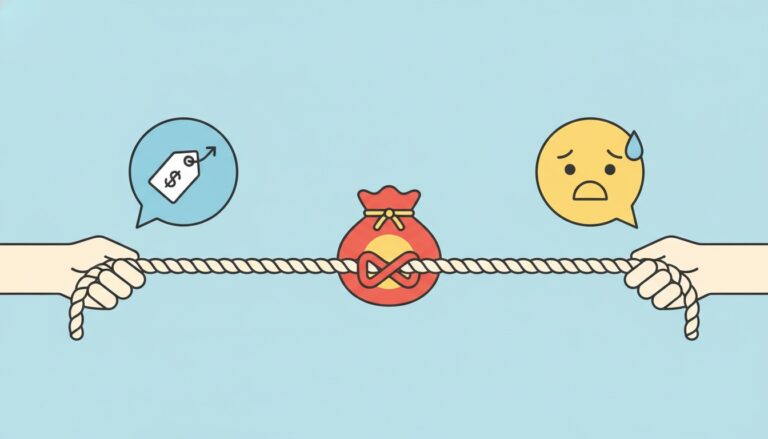
Phase 1: Immersive Hook
Hello, Daily Hangul family! Your editor here.
Let’s talk about a scene you’ve definitely seen in a K-Drama. The protagonist sits across from a stern-faced potential father-in-law or a corporate rival. The air is thick enough to slice with a chopstick. The rival slides a check across the table. “Take this and leave.”
The amount? Ridiculously high. Or maybe, ridiculously low.
Here’s the thing: In Korea, the first number thrown onto the table—whether it’s the price of a vintage jacket at Gwangjang Market or a salary expectation in Gangnam—is rarely the real number. It’s an emotional anchor. It’s a test of your Nunchi (eye-measure/intuition).
If you take that first offer at face value, you’ve already lost the game. Today, we’re dealing with the advanced art of Anchoring—setting a high (or bold) baseline to steer the negotiation exactly where you want it. This isn’t just about money; it’s about controlling the flow of Kibun (mood/feeling).
Ready to learn how to make a “ridiculous” offer sound sophisticated? Let’s get into it.
Phase 2: Deep Dive (Key Expressions)
These aren’t your beginner “Please give me a discount” phrases. We are operating at C2 level, where nuance is your weapon.
1. 일단 질러보다 (Ildan jilleoboda)
- Pronunciation: [Il-dan jil-leo-bo-da] (Think of ‘jil’ like ‘chill’ but with a J, and ‘leo’ like ‘love’ without the ve.)
- Meaning: Literally “To shout it out first.” Real nuance: “To make a bold, high-ball offer just to test the waters.”
- K-Culture Moment: You see this in variety shows like Running Man or Knowing Bros, where a cast member makes an absurd demand to the producer. They know they won’t get it, but they’ve shifted the baseline.
- Editor’s Insight: This is a verb of action and guts. It implies you are taking a risk. You wouldn’t say this to the person you are negotiating with; you’d use it to describe your strategy to a friend. “Just ask for a 20% raise. Just jilleobwa (throw it out there)!”
- Situation Spectrum:
[🚫 Formal Reports] ———— [⚠️ Semi-formal Strategy Talk] ———— [✅ Casual Planning]- 🤔 Think About It: Why does Korean use a verb related to “shouting” or “screaming” (jireuda) for negotiation? It suggests that boldness involves breaking silence and social harmony.
2. ~는 좀 곤란한데요 (…neun jom gollanhandeyo)
- Pronunciation: […neun jom gol-lan-han-de-yo]
- Meaning: “That is a bit difficult.” (The C2 way to say “Absolutely not, are you crazy?”)
- K-Culture Moment: Every office drama ever. When a boss asks for a report by tomorrow morning, the smart assistant doesn’t say “No.” They say, “Ah, by tomorrow is a bit gollanhandeyo…”
- Editor’s Insight: If someone anchors you with a ridiculous price/request, you never say “No” (An-dwae-yo) directly in a formal setting. It breaks the Chemyon (face). You say the situation is “difficult” (gollan). It shifts the blame from you to the abstract situation.
- Situation Spectrum:
[🚫 Close Friends (Too stiff)] ———— [⚠️ Colleagues] ———— [✅ Business/Elders]- 🤔 Think About It: By blaming the “situation” rather than your own will, how does this protect the relationship between the two speakers?
3. 무리한 부탁인 건 알지만… (Murihan butagin geon aljiman…)
- Pronunciation: [Mu-ri-han bu-ta-gin geon al-ji-man]
- Meaning: “I know this is an unreasonable request, but…”
- K-Culture Moment: This is the preamble to the Anchor. Before you drop the bomb (the high proposal), you must acknowledge that you are crossing a line. This softens the blow.
- Editor’s Insight: This phrase is your shield. It gives you permission to say something audacious. If you say this, and then ask for a huge favor, the listener is less likely to be offended because you’ve already humbled yourself.
- Situation Spectrum:
[🚫 Casual Chat] ———— [⚠️ Requests to Seniors] ———— [✅ High-stakes Negotiation]
Phase 3: Textbook vs. Real Life
Let’s see how a textbook robot negotiates versus a Seoulite with 10 years of survival experience.
| Situation | 📖 Textbook Korean | 🗣️ Real Korean (C2 Nuance) | 💡 Why the difference? |
|---|---|---|---|
| Rejecting a high price | 비싸요. 깎아 주세요. (It’s expensive. Discount please.) | 에이, 사장님~ 이 가격은 좀 센데요? (Ey, Boss~ This price is a bit strong, isn’t it?) | “Strong” (seda) is a sensory word. It sounds less like a complaint and more like a critique of the situation. |
| Proposing a high salary | 저는 5천만 원을 원합니다. (I want 50 million won.) | 희망 연봉은 일단 5천으로 생각하고 있습니다만… (As for my hopeful salary, I’m thinking 50 for now, but…) | Adding “hopeful” and trailing off with “but…” leaves the door open for the counter-offer without losing dignity. |
| Asking a huge favor | 제 부탁을 들어주세요. (Please listen to my request.) | 염치 불구하고 부탁 하나만 드려도 될까요? (Even though I have no shame, may I ask one favor?) | Koreans value humility. Acknowledging your “shamelessness” (yeomchi) actually restores your honor. |
Bottom Note: In the Real Korean column, notice how nothing is final? It’s all “thinking about it,” “a bit strong,” or “hoping.” This ambiguity is where the negotiation happens.
Phase 4: Cultural Deep Dive — The Art of ‘Mil-dang’
Negotiation in Korea is basically dating. We call it Mil-dang (Push and Pull).
1. The Performance of Shock (Non-verbal)
When you hear an anchor (a high price or demand), you must perform. Do not just stand there.
* The ‘Seueup’ (스읍): Inhale sharply through your teeth. It signals, “Oh, this is going to be difficult/painful.”
* The Head Scratch: Even if your head doesn’t itch. It visually displays your internal conflict.
2. K-Drama Context: The “Call High” Trope
You know how the lead actor grabs the girl’s wrist (don’t do that in real life, please) and says, “Don’t go”?
In business, the “Wrist Grab” is the counter-offer. You set an anchor so high that when you lower it slightly, the other person feels relieved, like they’ve “won” something. You create a crisis (the high price) just to solve it for them.
3. Critical View: Why so indirect?
Western negotiation often values clarity: “Here is my bottom line.” Korean negotiation values the relationship. If I reject you bluntly, I hurt your feelings (Kibun). If I anchor high and let you negotiate me down, I am “giving” you a win. We are building a relationship through the concession.
Phase 5: Immersive Roleplay
Scenario: You are a freelance graphic designer meeting a new client, Department Head Kim, in a sleek cafe in Pangyo (Korea’s Silicon Valley). You want 5 million won for the project. You are going to anchor at 7 million.
Characters:
* YOU: A confident expert, respectful but firm.
* Kim: A sharp businessman, tries to save budget but values quality.
(Dialogue Start)
Kim: (Sipping Iced Americano) 그래서, 이번 프로젝트 견적은 어떻게 생각하세요?
(So, what are you thinking for the estimate on this project?)
YOU: 네, 부장님. 작업 범위가 꽤 넓더라고요. 솔직히 말씀드리면, 일단 700만 원 정도는 생각해야 퀄리티가 나올 것 같습니다.
(Yes, sir. The scope is quite wide. To be honest, I think we need to look at around 7 million won to ensure quality.)
Kim: (Inhales sharply through teeth – Seueup) 700이요? 아… 예산이 생각보다 좀 센데요. 저희는 400 정도 예상했거든요.
(7 million? Ah… that’s a bit stronger than expected. We were anticipating around 4 million.)
🔀 Decision Point! How do you react to his low-ball?
A) “400은 절대 안 됩니다. 600 주세요.” (Too direct. You kill the vibe.)
B) “아, 400은 좀 곤란합니다. 그 가격엔 못 맞춰 드려요.” (Polite refusal, but a dead end.)
C) “400이라… (Scratch head) 그 예산으로는 원하시는 퀄리티를 맞추기가 현실적으로 좀 어렵습니다. 600까지는 맞춰 주셔야…” (The Pivot: Blame reality, not him, and offer a concession.)
✅ Best Choice: C. You acknowledge his anchor (400), validate it (
Frequently Asked Questions (FAQ)
Q: What does "일단 질러보다 (Ildan jilleoboda)" mean in Korean and how do you pronounce it?
A: In Korean, "일단 질러보다 (Ildan jilleoboda)" is pronounced [Il-dan jil-leo-bo-da] and means: Literally "To shout it out first." Real nuance: "To make a bold, high-ball offer just to test the waters."
Q: What does "~는 좀 곤란한데요 (…neun jom gollanhandeyo)" mean in Korean and how do you pronounce it?
A: In Korean, "~는 좀 곤란한데요 (…neun jom gollanhandeyo)" is pronounced […neun jom gol-lan-han-de-yo] and means: "That is a bit difficult." (The C2 way to say "Absolutely not, are you crazy?")
Q: What does "무리한 부탁인 건 알지만... (Murihan butagin geon aljiman...)" mean in Korean and how do you pronounce it?
A: In Korean, "무리한 부탁인 건 알지만... (Murihan butagin geon aljiman...)" is pronounced [Mu-ri-han bu-ta-gin geon al-ji-man] and means: "I know this is an unreasonable request, but..."







