

Surviving the Queue: The Korean Art of Waiting in Line
Phase 1: The “Are We There Yet?” Hook
Hello! This is your Daily Hangul Editor.
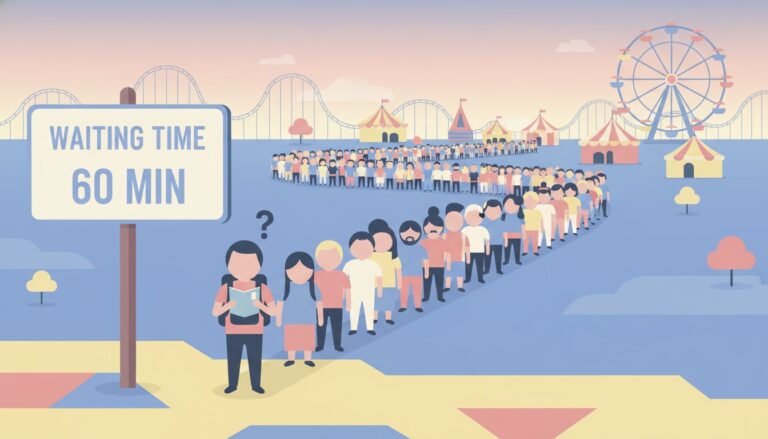
Picture this: You are at Lotte World or Everland, two of Korea’s biggest amusement parks. The air smells like churros, you hear screams from the roller coasters, and you see… people. Lots of people.
You see a massive group standing in a row. Are they waiting for the Viking Ship ride? Are they waiting for the bathroom? Or is it just a random crowd for a K-Pop event?
In K-Dramas, the main characters always seem to find a magical empty spot to talk. In reality? You wait. And wait. But the scariest part isn’t the waiting—it’s accidentally cutting in line because you didn’t know where it started, or standing in the wrong line for 20 minutes.
Don’t worry. Today, I’m going to teach you the magic words that will turn you from a confused tourist into a confident “local” in the queue.
Phase 2: Deep Dive into Core Expressions
Here are the only three phrases you really need to survive a Korean crowd.
1. 여기 줄이에요? (Yeogi jul-i-e-yo?)
- Pronunciation: [Yeo-gi] + [Jul] (sounds like Jewel) + [i-e-yo]
- Meaning: “Is this the line?”
- K-Culture Moment: You’ll hear this everywhere—from the T-Express roller coaster at Everland to the famous bagel shop in Gangnam that requires a 2-hour wait.
- Editor’s Insight: This is the polite way to verify. Never assume! If you just stand behind someone, they might just be looking at their phone, not waiting.
- Situation Spectrum:
[🚫 Formal Boss] ———— [✅ Stranger/Staff] ———— [✅ Friend]- 🤔 Think About It: Why do you think Koreans ask this even when it looks obvious? It’s about respecting the collective order. Making a mistake disrupts everyone else.
2. 끝이 어디예요? (Kkeuti eodi-yeyo?)
- Pronunciation: [Kkeut] (sounds like Cut) + [i] + [eo-di-ye-yo]
- Meaning: “Where is the end?” (Literal: Where is the end?)
- K-Culture Moment: Imagine a K-Pop popup store. The line wraps around the building three times. You need to find the tail to join.
- Editor’s Insight: Often, the line is broken to let cars or people pass. The “end” might be far away from where you think it is.
- Situation Spectrum:
[⚠️ Formal Boss] ———— [✅ Stranger/Staff] ———— [✅ Friend]3. 잠시만요 (Jamsimanyo)
- Pronunciation: [Jam-si-man-yo]
- Meaning: “Excuse me” / “Just a moment”
- K-Culture Moment: Essential when moving through a crowded concert pit or getting off a packed subway to get to Lotte World. It works like Moses parting the Red Sea.
- Editor’s Insight: It literally means “wait a moment,” but it is used as “I’m coming through, please make space.”
- Situation Spectrum:
[✅ Everyone]
Phase 3: Textbook vs. Real Life
| Situation | 📖 Textbook Korean | 🗣️ Real Korean | 💡 Why different? |
|---|---|---|---|
| Asking if it’s a line | 줄을 서 계십니까? (Are you standing in line?) | 여기 줄이에요? (Is this the line?) | The textbook version is too robotic. No one speaks like a news anchor at a theme park. |
| Moving through a crowd | 실례합니다 (Excuse me) | 잠시만요 / 지나갈게요 (Passing through) | “Sil-lye-ham-ni-da” is very formal. “Jamsimanyo” is the practical “coming through!” alert. |
Bottom Note: If you use the textbook version, people will understand you, but they might think you learned Korean from a 1990s book!
Phase 4: Cultural Context — The “Nunchi” of Lines
4-1. Nunchi (Eye-measure)
In Korea, waiting in line is a silent team sport. You need Nunchi (the art of sensing the atmosphere).
– The Gap: Don’t leave a huge gap between you and the person in front. In the intense lines for popular rides like the “Atlantis Adventure,” a large gap invites confusion (or assertive aunties trying to squeeze in).
– The Bag: If you are at a cafe, a bag on a chair means “Taken.” But in a standing line? Your body is the only placeholder. You cannot leave your bag and go to the bathroom expecting your spot to be saved unless you have a friend there.
4-2. K-Drama Connection
Have you seen scenes where a couple waits in line for hours for a famous restaurant? That’s real. Koreans are willing to wait for quality (or trends). Waiting is often part of the date course!
Phase 5: Interactive Roleplay
Setting: It’s Saturday afternoon at Everland. You want to ride the famous wooden roller coaster. There are people everywhere.
Characters:
– YOU: Excited tourist wearing animal headband.
– Student: A Korean high school student wearing a matching school uniform costume.
Dialogue:
YOU: (Approaching a group of students standing near the entrance)
“Excuse me… Yeogi jul-i-e-yo?”
(Excuse me… is this the line?)
Student: 네, 맞아요. (Ne, majayo.)
(Yes, that’s right.)
YOU: (Looking confused because the line goes around a corner)
“Ah… Kkeuti eodi-yeyo?”
(Ah… where is the end?)
Student: (Pointing far away) 저기 뒤에 있어요.
(It’s over there in the back.)
🔀 Decision Point! You need to get to the back, but it’s crowded.
A) Push silently.
B) Shout “Hey! Move!”
C) Say “Jamsimanyo” while walking.
✅ Best Choice: C) “Jamsimanyo” is polite but firm. It signals you aren’t being rude; you just need to pass.
⚠️ Choice A Analysis: Pushing without words is considered very rude in Korea.
Phase 6: 10-Second Shadowing Drill
Repeat after me. Focus on the intonation!
- 😊 Asking politely:
여기 / 줄이에요?
(Yeo-gi / jul-i-e-yo?) -
😲 Surprised at the length:
끝이 / 어디예요?
(Kkeut-i / eo-di-ye-yo?) -
🏃 Moving quickly:
잠시만요! / 잠시만요!
(Jam-si-man-yo! / Jam-si-man-yo!)
Phase 7: K-Culture Mini Glossary
| Korean | Romanization | Meaning | Context |
|---|---|---|---|
| 눈치 | Nunchi | Social Sense | Reading the room. Essential in crowded lines. |
| 새치기 | Saechigi | Cutting in line | The ultimate sin in Korean queuing culture. Never do this! |
| 대기 | Daegi | Waiting | You’ll see this word on screens: “대기 시간 60분” (Waiting time 60 min). |
Phase 8: Traveler’s Survival Kit
🆘 Survival Phrases for Queues
1. “Is this the line for the bathroom?”
🇰🇷 화장실 줄이에요? (Hwajangsil jul-i-e-yo?)
2. “Are you in line?”
🇰🇷 줄 서신 거예요? (Jul seosin geoyeyo?) [Slightly more formal]
📌 Editor’s Travel Note
– App Tip: Use the Lotte World or Everland apps to check “Magic Pass” or “Smart Queue” options. You can book a time slot and skip the physical line! It’s the digital version of Saechigi (but legal).
Phase 9: Think Deeper — “Ppalli Ppalli” vs. Order
🧠 Korean Speed Culture:
Korea is famous for Ppalli Ppalli (Hurry Hurry) culture. You might wonder: “If everyone is in a rush, why are the lines so orderly?”
Interestingly, the order exists because of the desire for speed. If everyone cut in line, it would be chaos, and everything would be slower. The strict queuing culture is a collective agreement: “If we all follow the rules, we all get there faster.”
💬 Your Turn: In your country, do people respect lines strictly, or is it more of a chaotic crowd? Tell me in the comments!
Phase 10: FAQ & Troubleshooting
Q: Can I save a spot for my 5 friends who are buying food?
A: NO. This is a huge taboo. One person joining a friend is sometimes tolerated (with dirty looks), but bringing a whole group? You will get scolded. In Korea, if you want to ride together, you wait together.
Q: I accidentally cut in line. Someone is yelling at me. What do I do?
A: Say “Joesong-ham-nida” (I’m sorry) immediately and move to the back. Don’t argue. Mistakes happen, but a quick apology fixes everything.
❌ Common Mistake: asking “Who is last?” (Nuga majimak-ieyo?). While grammatically correct, “Kkeuti eodiyeyo?” (Where is the end?) is much more natural for finding your spot.
Phase 11: Wrap-up & Mission
One-Liner: To survive a Korean line, just remember: Ask “Yeogi jul-i-e-yo?” and use your Nunchi!
🔥 Action Mission:
– 🥉 Bronze: Say “Yeogi jul-i-e-yo?” out loud three times right now.
– 🥈 Silver: Watch a YouTube vlog of “Everland T-Express” and imagine yourself asking where the line ends.
– 🥇 Gold: Next time you are at a cafe or bus stop (even in your country), whisper “Jamsimanyo” as you walk past someone.
Phase 12: Quiz — Do You Have Nunchi?
Scenario: You see a gap in the line at the ticket booth. A person is standing slightly to the side looking at their phone.
What should you do?
1. Just walk into the gap. Finders keepers!
2. Ask that person: “Yeogi jul-i-e-yo?”
3. Stare at them until they move.
⬇️ Click for Answer
Check Answer
Correct Answer: 2
Never assume! They might be in line but distracted. Asking “Yeogi jul-i-e-yo?” saves you from an embarrassing fight.
Frequently Asked Questions (FAQ)
Q: What does "여기 줄이에요? (Yeogi jul-i-e-yo?)" mean in Korean and how do you pronounce it?
A: In Korean, "여기 줄이에요? (Yeogi jul-i-e-yo?)" is pronounced [Yeo-gi] and means: "Is this the line?"
Q: What does "끝이 어디예요? (Kkeuti eodi-yeyo?)" mean in Korean and how do you pronounce it?
A: In Korean, "끝이 어디예요? (Kkeuti eodi-yeyo?)" is pronounced [Kkeut] and means: "Where is the end?" (Literal: Where is the end?)
Q: What does "잠시만요 (Jamsimanyo)" mean in Korean and how do you pronounce it?
A: In Korean, "잠시만요 (Jamsimanyo)" is pronounced [Jam-si-man-yo] and means: "Excuse me" / "Just a moment"






