

Phase 1: The “Don’t Buy That Sticker Yet” Moment
Hello! I’m your editor at Daily Hangul.
Let me take you back to my second year in Seoul. I was moving out of my officetel in Mapo-gu and had an old, broken rice cooker and a heavy vacuum cleaner to discard. Being a “good foreigner,” I walked to the local district office, bought expensive waste disposal stickers (steek-uh), and slapped them on the appliances. I felt proud.
Later that evening, my Korean friend Min-ji came over to help me pack. She looked at the stickers, looked at me, and sighed. “Why did you pay for these? The government picks them up for free.”
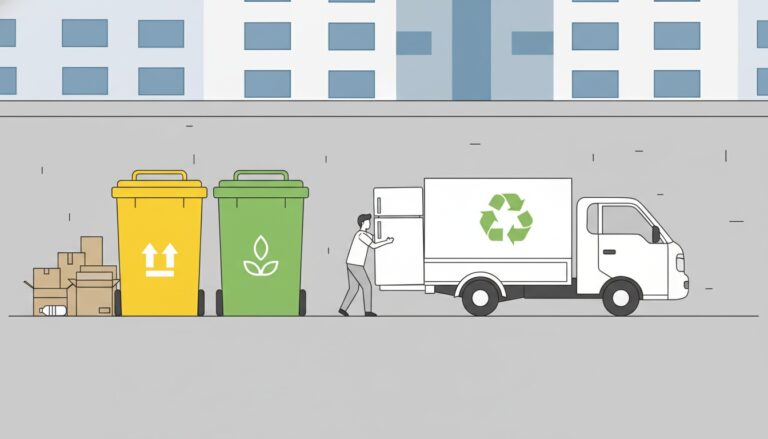
I was stunned. In Korea, throwing away trash is a science, but throwing away appliances is a hidden strategy game. If you don’t know the rules, you lose money. If you do, you get the VIP treatment: “Free Collection” (무상 수거).
Today, we aren’t just learning how to throw things away. We are learning how to navigate the Korean administrative system like a local pro. This is the difference between a tourist and a resident.
Phase 2: Deep Dive into Admin Korean
At the C1 level, we move past survival Korean into “Administrative Korean.” These words carry weight.
1. 무상 수거 [musang sugeo]
- Pronunciation: [mu-sang su-geo] (Sounds like ‘Moo’ as in cow + ‘Sang’ like sung)
- Meaning: Free collection / Complimentary pickup
- Nuance: You know the word gongjja (공짜) for free, right? Never use gongjja in official documents or requests. Musang implies a system-provided benefit, whereas gongjja feels cheap or lucky. Use this when searching on Naver or talking to officials.
- Situation Spectrum:
[Friends] ———— [⚠️ Service Center] ———— [✅ Government/Admin]- 🤔 Think About It: Why does Korean distinguish so sharply between “free stuff” (gongjja) and “free service” (musang)? It reflects the formality and contractual nature of the transaction.
2. 배출하다 [baechulhada]
- Pronunciation: [bae-chul-ha-da]
- Meaning: To discharge / To put out (waste)
- Nuance: If you say “beorida” (버리다 – to throw away), it sounds like you are tossing something in a bin. Baechulhada is the official act of placing an item in a designated area for collection. It implies you followed the rules.
- K-Culture Moment: You’ll see signs in apartment complexes: “일요일은 재활용 배출일입니다” (Sunday is recycling discharge day). It sounds rigid because it is.
- Situation Spectrum:
[Casual Chat] ———— [✅ Apartment Announcements] ———— [✅ City Hall]3. 폐가전 [pye-gajeon]
- Pronunciation: [pye-ga-jeon]
- Meaning: Waste home appliances / E-waste
- Editor’s Insight: The prefix Pye- (폐) means discarded or waste (like pye-yuju for waste oil). Adding this prefix instantly makes your Korean sound C1. Don’t say “bad computer”; say “pye-computer.”
Phase 3: Textbook vs. Real Life
When scheduling a pickup, precision saves time.
| Situation | 📖 Textbook Korean | 🗣️ Real “Admin” Korean | 💡 Why the difference? |
|---|---|---|---|
| asking to throw away | 이거 버리고 싶어요. (I want to throw this away.) | 폐가전 무상 수거 신청하려고 하는데요. (I’d like to apply for free e-waste collection.) | The second one uses the exact terminology the call center agent needs to categorize your request. |
| asking for cost | 얼마예요? (How much is it?) | 수수료가 있나요? (Is there a handling fee?) | Susuryo (commission/fee) is the specific term for administrative costs. |
| asking where to put it | 어디에 둬요? (Where do I put it?) | 배출 장소가 어디인가요? (Where is the discharge location?) | Jangso is more formal than eodi, and fits the administrative context. |
Phase 4: Cultural Context — The “Recycling Police”
1. The “Gyeongbi-ajeossi” (Security Guard) Factor
If you live in an apartment complex (Apart-eu), the security guard is the gatekeeper of the recycling bin. In K-Dramas, they are often depicted as grumpy grandpas, but in reality, they are strictly managing the complex’s waste budget. If you try to sneak a rice cooker into the general trash, they will find you via CCTV. It’s not about being mean; it’s about avoiding fines for the building.
2. The “1599-0903” Phenomenon
Korea has a unified, government-run service called E-Circulation Governance (soonhwan-ge). You don’t call the local district office anymore; you book through this nationwide system. It’s a prime example of Korea’s “Digital Government” efficiency. Understanding this system proves you aren’t just a visitor—you’re a resident who contributes to the eco-system.
Phase 5: Immersive Roleplay
Setting: It’s Monday morning. You are on the phone with the “E-Circulation Governance” call center. You have a broken microwave and an old fan to get rid of.
Characters:
– YOU: A foreign resident who refuses to pay unnecessary sticker fees.
– Agent: Professional, fast-talking call center employee.
Dialogue:
Agent: 한국전자제품 자원순환공제조합입니다. 무엇을 도와드릴까요?
(Hanguk jeonja-jepum jawon-sunhwan gongje-johap-imnida. Mueoseul dowadeurilkkayo?)
(This is the Korea E-waste Mutual Aid Association. How may I help you?)
YOU: 네, 안녕하세요. 폐가전 무상 수거를 예약하고 싶어서 연락드렸어요.
(Ne, annyeonghaseyo. Pyegajeon musang sugeoreul yeyakhago sipeoseo yeollak-deuryeosseoyo.)
(Hello. I contacted you because I want to reserve a free e-waste collection.)
Agent: 네, 고객님. 배출하실 품목이 어떻게 되시나요?
(Ne, gogaeknim. Baechul-hasil pummogi eotteoke doesinayo?)
(Okay. What items will you be discharging?)
YOU: 전자레인지 하나랑 선풍기 한 대예요.
(Jeonja-reinji hanarang seonpunggi han daeyeyo.)
(It’s one microwave and one fan.)
Agent: 아, 소형 가전은 5개 이상이어야 수거가 가능합니다. 단품은 수거가 어렵습니다.
(Ah, sohyeong gajeoneun daseot-gae isangi-eoya sugeoga ganeunghamnida. Danpumeun sugeoga eoryeopseumnida.)
(Ah, small appliances must be 5 or more for collection. Single items are difficult to collect.)
🔀 DECISION POINT: The agent says you don’t have enough items! What do you do?
- Option A: “아, 그렇군요. 알겠습니다.” (Hang up and go buy a sticker.)
- Option B: “혹시 냉장고 버리는 게 있는데, 같이 내놓으면 되나요?” (Add a large item to qualify.)
- Option C: “그럼 그냥 스티커 붙여서 버려야 하나요?” (Ask for advice.)
✅ Best Choice: Option B. Here is the loophole: If you have one large appliance (fridge, washing machine, TV), you can bundle small items (fans, toasters) with it, even if you don’t have 5 small items. If you truly only have small items, unfortunately, you must use the paid sticker system or find a designated collection bin at your community center (Dong-office).
Phase 6: 10-Second Shadowing Drill
Let’s practice the rhythm of a polite inquiry. This isn’t just asking; it’s checking feasibility.
- Sentence: 혹시 / 이 날짜에 / 수거 예약이 / 가능한지 / 확인해 주시겠어요?
- Romanization: Hoksi / i naljja-e / sugeo yeyagi / ganeunghanji / hwaginhae jusigesseoyo?
- Emotion: 🧐 Polite but precise (Customer Service Tone)
- Meaning: By any chance, could you check if a collection reservation is possible on this date?
Phase 7: K-Culture Mini Glossary
| Korean | Romanization | English | Context |
|---|---|---|---|
| 대형 폐기물 스티커 | Daehyeong pyegimul sticker | Large waste sticker | The paid stickers you buy at convenience stores or district offices for furniture/items not covered by free collection. |
| 경비실 | Gyeongbi-sil | Security Office | The hub of all apartment logistics. Be nice to them. |
| 주민센터 (동사무소) | Jumin-center | Community Center | Where you go if you need in-person help with waste bags or stickers. |
| 나눔 | Nanum | Sharing/Giving away | Before throwing it away, try “Danggeun Market” (Karrot). “Free sharing” (Muryo Nanum) is huge in Korea. |
Phase 8: Traveler’s Survival Kit
Wait, you’re a traveler. You don’t have a fridge to throw away. But you might have a broken suitcase.
🆘 Survival Scenario: The Broken Suitcase
You cannot just leave a broken suitcase in the hotel lobby or on the street. It is considered “Large Waste.”
- Do this: Ask the hotel front desk. “가방을 버리고 싶은데, 폐기물 수수료를 낼까요?” (I want to throw this bag away; shall I pay the disposal fee?)
- Don’t do this: Leave it by a street trash can. You are on camera.
- Pro Tip: If you are at an Airbnb, you must buy a sticker at the nearest convenience store (CU, GS25). Ask for “Pye-gimul sticker” (Waste sticker).
Phase 9: Critical Thinking — “Why so complicated?”
Think Deeper:
Korea is a small peninsula with high population density and very limited landfill space. The complexity of the recycling system isn’t just bureaucracy; it’s a survival strategy for the land. The strict separation implies a collective social contract: “We all suffer a little inconvenience to keep the country livable.”
💬 Your Turn: Does your country view waste disposal as a personal convenience or a civic duty? How would people react if they had to buy stickers to throw away a toaster?
Phase 10: FAQ & Troubleshooting
Q: Do I need to tip the collection workers?
A: No. Absolutely not. They are government-contracted workers. A cold bottle of water or canned coffee in summer is appreciated, but money is awkward and unnecessary.
Q: I booked a pickup, but I won’t be home.
A: That’s fine! This is Korea. We have “Untact” (non-contact) culture. Just leave the items by your front door or the designated recycling area and text them the exact location. They will take it and leave.
❌ Common Mistake:
Thinking “Recycling” means you can just put it in the plastic/recycling bin.
Correction: Electronics are not standard recycling. Putting a toaster in the “Can/Metal” bin causes huge headaches for the sorting center. Always use the separate E-waste system.
Phase 11: Wrap-up
One-Liner: Don’t pay for what the government does for free—use “Musang Sugeo” for electronics, but buy stickers for furniture.
Action Missions:
– 🥉 Bronze: Look at your toaster or hairdryer. Say “이것은 폐가전입니다” (This is e-waste) out loud.
– 🥈 Silver: Go to the website 15990903.or.kr (it has an English button!) and just click through to see how the interface works.
– 🥇 Gold: If you live in Korea, check your storage. Do you have 5 old phones/cables/broken gadgets? actually book a pickup!
Phase 12: Quiz — The “Waste Master” Challenge
- Situational Judgment: You have one broken hairdryer. You call the free collection center. Will they come?
- A) Yes, Korean service is great.
- B) No, you need at least 5 small items.
- C) Yes, if you pay them extra.
- True or False: You should put your broken laptop in the standard “Plastic” recycling bin because the case is plastic.
- (True / False)
- Fill in the blank: To sound like a pro, instead of saying “throw away” (beorida), you should use the word “______”.
(Scroll down for answers)
.
.
.
Answers:
1. B (Unless you bundle it with a fridge/TV!)
2. False (Never! It’s E-waste.)
3. 배출하다 (Baechulhada)
Frequently Asked Questions (FAQ)
Q: What does "무상 수거 [musang sugeo]" mean in Korean and how do you pronounce it?
A: In Korean, "무상 수거 [musang sugeo]" is pronounced [mu-sang su-geo] and means: Free collection / Complimentary pickup
Q: What does "배출하다 [baechulhada]" mean in Korean and how do you pronounce it?
A: In Korean, "배출하다 [baechulhada]" is pronounced [bae-chul-ha-da] and means: To discharge / To put out (waste)
Q: What does "폐가전 [pye-gajeon]" mean in Korean and how do you pronounce it?
A: In Korean, "폐가전 [pye-gajeon]" is pronounced [pye-ga-jeon] and means: Waste home appliances / E-waste







