

Phase 1: The Invisible Crowd (Immersive Hook)
Hello there, Daily Hangul editor here.
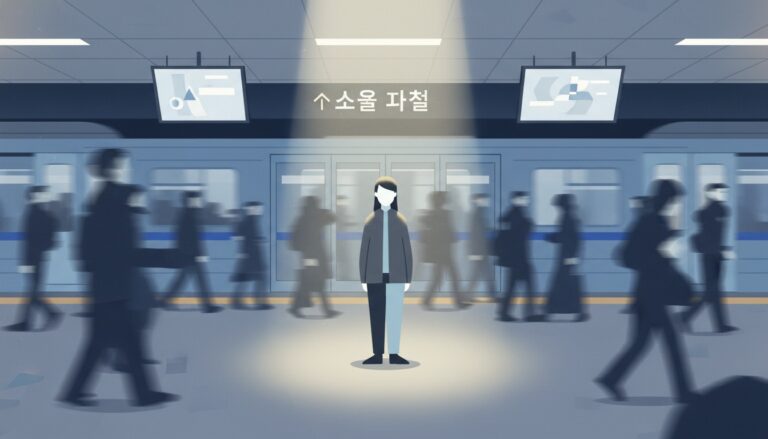
Picture this: It’s 6:30 PM on Seoul Subway Line 2. The train is packed so tight your feet barely touch the floor. Everyone is glued to their smartphones, scrolling through an endless feed of other people’s “perfect” lives. You are physically surrounded by hundreds of people, yet the silence is deafening. In K-Dramas, this is usually the scene where the protagonist stares blankly out the dark window, questioning their entire existence while a melancholic ballad plays.
That specific feeling—being alone in a crowd, the sudden realization of life’s absurdity, or the desire to just disconnect—is a huge part of modern Korean sentiment. If you only learn “I’m happy” or “I’m sad,” you’ll never truly connect with a Korean friend over a bottle of Soju when they open up about their real struggles.
Today, we are going deep. We’re skipping the tourist phrases and diving into the vocabulary of the soul: Human Alienation and Existentialism.
Phase 2: Deep Dive into the Void
1. 현타 온다 (Hyeonta onda)
- Pronunciation: [Hyeonta onda] (Sounds like: Hyeon-ta on-da)
- Meaning:
- Literal: “Reality hit time comes.”
- Real Nuance: A sudden wave of disillusionment, emptiness, or realization of reality after a period of delusion, excitement, or meaningless effort. It’s the Gen Z version of an existential crisis.
- K-Culture Moment: You just spent 500,000 KRW on fan merchandise. You look at your bank account balance. “Ah, hyeonta onda…” Or, you worked overtime for a week, only to get scolded by your boss. “Real hyeonta moment.”
- Editor’s Insight: This comes from the slang “현자타임” (Sage Time)—a state of extreme clarity (and emptiness) often associated with post-desire clarity. Now, it’s the go-to phrase for burnout or feeling like a cog in the machine.
- Situation Spectrum:
[🚫 Formal Presentation] ———— [⚠️ Colleagues] ———— [✅ Friends] - 🤔 Think About It: Why do Koreans view “reality” (hyeon-sil) as something that “hits” or attacks you? Is reality seen as the enemy of happiness?
2. 군중 속의 고독 (Gunjung sogui godok)
- Pronunciation: [Gunjung sogui godok]
- Meaning: Loneliness in a crowd.
- K-Culture Moment: Think of the intro scene in almost every slice-of-life drama (like My Liberation Notes). The protagonist is walking in a busy crossing in Gangnam, but the camera focus blurs everyone else out.
- Editor’s Insight: This isn’t slang; it’s a somewhat literary, poetic expression. You’d use this when writing a diary entry, a sentimental Instagram caption, or having a deep late-night talk (Dae-hwa).
- Situation Spectrum:
[✅ Writing/Deep Talk] ———— [⚠️ Casual Chat] ———— [🚫 Ordering Food] - 🤔 Think About It: In a collectivist society like Korea, is being physically alone scarier, or is feeling disconnected while being with a group scarier?
3. 자발적 아웃사이더 (Jabaljeok Outsider)
- Pronunciation: [Jabaljeok A-ut-sa-i-deo] (Shortened: Assa)
- Meaning: Voluntary Outsider.
- K-Culture Moment: University lunch time. While everyone rushes to eat in groups to avoid looking like a “loner,” someone coolly puts on noise-canceling headphones and eats alone in a corner. They aren’t outcast; they chose solitude.
- Editor’s Insight: In the past, eating alone meant you had no friends. Now, it’s becoming a movement to reclaim one’s sanity from the pressure of Nunchi (reading social cues).
- Situation Spectrum:
[✅ Casual/Self-description] ———— [⚠️ Job Interview] ———— [✅ Social Media]
Phase 3: Textbook vs. Real Life
| Situation | 📖 Textbook Korean | 🗣️ Real Korean | 💡 Why different? |
|---|---|---|---|
| Expressing burnout | 저는 너무 피곤해서 의욕이 없어요. (I am too tired and have no will.) | 아, 다 부질없다. (Ah, it’s all meaningless/futile.) | Textbook focuses on physical state; Real life focuses on the existential pointlessness of the struggle. |
| Asking for space | 혼자 있고 싶어요. (I want to be alone.) | 저 잠수 좀 탈게요. (I’m going to “submerge”/ghost for a bit.) | “Submarining” (Jamsu) implies disappearing from social radar to recharge, a common digital detox method. |
| Feeling disconnected | 저는 소외감을 느껴요. (I feel a sense of alienation.) | 나만 딴 세상 사는 기분이야. (Feels like only I am living in a different world.) | “Alienation” is too academic. “Living in a different world” captures the emotional distance better. |
Bottom Note: At C1 level, don’t just say you are “sad.” Explain why the structure of society makes you feel isolated. That’s the key.
Phase 4: Cultural Context — The Nunchi Paradox
4-1. The Exhaustion of Connection
Korea is hyper-connected. You are expected to reply to KakaoTalk messages instantly. You are expected to read the room (Nunchi) constantly. This constant demand for connection paradoxically creates human alienation. You are so busy being a “member of society” that you lose the sense of “who am I?”
4-2. K-Drama Connection: The “Worship” Concept
Remember the drama where the female lead asks the male lead to “Worship me” (Chuang-ha-ra) instead of just loving her? This resonated explosively in Korea. Why? because people felt empty. Standard “love” or “dating” felt like another job or social obligation. They wanted something existential—to be seen as a complete being, filled up from the inside. When you watch these scenes, notice how silence is used. The most profound connections often happen when characters stop trying to be polite.
Phase 5: Immersive Roleplay
Setting: A quiet Izakaya (Japanese style pub) in Hongdae, 11 PM. Rain is tapping on the window. You are with Min-ji (29, Office Worker), who looks exhausted.
Min-ji: 하… 오늘 부장님한테 또 깨졌어. 진짜 열심히 했는데… 다 무슨 소용인가 싶다. 🍺
(Ha… oneul bujangnim-hante tto kkaejyeosseo. Jinjja yeolsimhi haenneunde… da museun soyonginga sipda.)
(Sigh… I got crushed by the manager again today. I really worked hard… I wonder what the use of it all is.)
YOU:
(Listen carefully. She isn’t just complaining about work; she’s questioning the meaning of her labor.)
🔀 Your Turn! How do you respond?
A) “힘내! 내일은 더 좋을 거야.” (Cheer up! Tomorrow will be better.)
B) “너 진짜 고생 많았어. 가끔은 현타 오지?” (You really suffered. Sometimes reality hits hard, right?)
C) “그 회사 그만두면 되잖아?” (Why don’t you just quit that company?)
✅ Best Choice: B
Reason: Option A is toxic positivity which can feel alienating. Option C is practical but ignores her feelings. Option B validates her existential exhaustion using the “Hyeonta” concept. It says, “I see your pain.”
Min-ji: (Nods slowly) 어, 맞아. 진짜 현타 와. 기계 부품이 된 기분이야. 너는 안 그래?
(Eo, maja. Jinjja hyeonta wa. Gigye bupumi doen gibuniya. Neoneun an geurae?)
(Yeah, exactly. Reality hits hard. I feel like a machine part. Don’t you feel that?)
YOU: (Shadow this)
나도 그래. 그래서 가끔은 아무 생각 없이 멍 때리고 싶을 때가 있어.
(Nado geurae. Geuraeseo gakkeumeun amu saenggak eopsi meong ddaerigo sipeul ttaega isseo.)
(Me too. That’s why sometimes I just want to space out without thinking anything.)
Phase 6: 10-Second Shadowing Drill
Emotion: 😟 Melancholic but accepting (Bitter-sweet).
군중 속에서도 / 가끔은 / 철저히 혼자인 기분이 들어요.
(Gunjung sogeseodo / gakkeumeun / cheoljeohi honjain gibuni deureoyo.)
Even in a crowd / sometimes / I feel thoroughly alone.
Phase 7: K-Culture Mini Glossary
| Korean | Romanization | Meaning | Context |
|---|---|---|---|
| 멍 때리다 | Meong ddaerida | Spacing out | A state of “doing nothing” to recover from mental overload. There is even a “Space Out Competition” in Seoul! |
| 소확행 | Sohwakhaeng | Small but certain happiness | Finding existential meaning in small things (a coffee, a sunset) rather than grand success. |
| 혼코노 | Honkono | Solo Coin Karaoke | A sanctuary for screaming out stress alone. |
| 인간관계 회의감 | Ingangwangye hoeigam | Skepticism about relationships | Thinking “Are these friends real?” |
Phase 8: Traveler’s Survival Kit (The Solo Edition)
Korea is changing. Eating alone (Honbap) is no longer taboo, but you need to know where to go.
🆘 Survival Expression #1
– 🇰🇷 “1인분 되나요?” (I-rin-bun doenayo?)
– 🗣️ Meaning: “Is a serving for one person available?”
– 📍 Where: BBQ restaurants, stew places.
– 💡 Pro Tip: Many traditional places require 2 orders minimum. If you are alone and hungry, offer to pay for two (“2인분 시킬게요”) or look for places with a bar table (Datchi).📌 Editor’s Travel Note: The Han River
If you feel overwhelmed by the city, go to the Han River parks. You will see hundreds of people sitting on mats, yet leaving each other alone. It is the perfect place to practice “together but separate.”
Phase 9: Think Deeper — “Hell-Joseon” & The Search for Meaning
Global Era of Burnout:
We often hear the term “Hell-Joseon” (a satirical term comparing modern Korea to the rigid Joseon dynasty). It reflects the despair of the younger generation regarding employment and social mobility. But interestingly, this despair has birthed a rich culture of introspection. Bookstores are filled with essays like “I Want to Die but I Want to Eat Tteokbokki.” This isn’t just about depression; it’s about the existential struggle to find individuality in a collective society.
🧠 Think Deeper:
In your culture, is admitting loneliness seen as a weakness or a normal part of life? Does your language have a specific word for “loneliness in a crowd”?
Phase 10: FAQ & Troubleshooting
- Q: Can I use “Hyeonta” with my boss?
- A: No! It’s slang. With a boss, say “슬럼프가 온 것 같습니다” (I think I’ve hit a slump) or “번아웃이 온 것 같아요” (I think I have burnout – ‘Burnout’ is widely used).
- Q: Is eating alone sad in Korea?
- A: It used to be. Now, it’s a “lifestyle.” If you walk in confidently with headphones, you are cool. If you look around nervously, you look lonely. Confidence is key!
- ❌ Common Mistake:
- Confusing 외로움 (Oeroum – Loneliness) with 고독 (Godok – Solitude).
- Oeroum is emotional pain (I need people). Godok can be neutral or even positive/stylish (I am a solitary philosopher).
Phase 11: Wrap-up & Mission
One-Liner: Alienation is painful, but acknowledging it with words like “Hyeonta” connects you to the modern Korean soul.
Action Mission:
– 🥉 Bronze: Look in the mirror and say “Oneul jinjja hyeonta onda” with a sigh.
– 🥈 Silver: Go to a cafe, sit alone without your phone for 10 minutes (Meong ddaerigi).
– 🥇 Gold: Visit a Coin Karaoke alone (Honkono) and sing a sad ballad. Feel the “Godok.”
💬 Your Turn: Have you ever felt “Hyeonta” while studying Korean? Tell us your moment in the comments!
Frequently Asked Questions (FAQ)
Q: What does "현타 온다 (Hyeonta onda)" mean in Korean and how do you pronounce it?
A: In Korean, "현타 온다 (Hyeonta onda)" is pronounced [Hyeonta onda] and means: Literal: "Reality hit time comes."
Q: What does "군중 속의 고독 (Gunjung sogui godok)" mean in Korean and how do you pronounce it?
A: In Korean, "군중 속의 고독 (Gunjung sogui godok)" is pronounced [Gunjung sogui godok] and means: Loneliness in a crowd.
Q: What does "자발적 아웃사이더 (Jabaljeok Outsider)" mean in Korean and how do you pronounce it?
A: In Korean, "자발적 아웃사이더 (Jabaljeok Outsider)" is pronounced [Jabaljeok A-ut-sa-i-deo] and means: Voluntary Outsider.






